


The Complete Guide to Applying for an Income Certificate Online in India (2026)
Income Certificate Apply Online India In a nation as socio-economically diverse as India, official documents that verify an individual’s or family’s financial standing are crucial. Among these, the Income Certificate stands as a pivotal document, serving as a gateway to numerous government schemes, scholarships, reservations, and financial aids. Traditionally, obtaining this certificate was synonymous with long queues, multiple visits to government offices, and bureaucratic delays. However, the Digital India initiative has revolutionized this process, making it possible to apply from the comfort of your home.
This comprehensive guide will walk you through everything you need to know about applying for an Income Certificate online in India—its purpose, the step-by-step process, required documents, and how to navigate the state-specific portals.
Part 1: Understanding the Income Certificate
What is an Income Certificate?
An Income Certificate is an official document issued by a state government authority (typically the Tahsildar or Revenue Department) that certifies the annual income of an individual or a family from all sources. It is a testament to your financial status and is a key document for availing benefits meant for economically weaker sections (EWS), other backward classes (OBC), and sometimes even for general category candidates in certain contexts.
Key Purposes and Uses:
- Educational Scholarships: Essential for applying for state and central government scholarships (like Post-Matric, Pre-Matric, National Merit Scholarship) for SC, ST, OBC, and EWS categories.
- Admissions under Reserved Categories: Many educational institutions require an Income Certificate for admission under fee-waiver or reserved quotas.
- Government Welfare Schemes: Availing benefits under schemes like LPG subsidy (Ujjwala), housing schemes (PMAY), pension schemes, and other social security programs.
- Loan Applications: Often required for applying for educational loans, agricultural loans, or other subsidized loans from government banks.
- Legal and Court Proceedings: May be required in matters of alimony, child support, or other legal disputes where income is a factor.
- Tax Exemptions and Benefits: To claim certain tax benefits or exemptions under specific clauses.
Part 2: Prerequisites for Online Application
Before you begin the online application, ensure you have the following ready:
- Digital Documents (Scanned Copies):
- Passport-sized Photograph: Recent, white background preferred.
- Identity Proof: Aadhaar Card (most crucial), Voter ID, PAN Card, or Driving License.
- Address Proof: Aadhaar Card, Ration Card, Electricity Bill, or Water Bill.
- Income Proof: Salary slips (for employed), Form 16, Income affidavit on stamp paper, Bank statements (6 months to 1 year), Agriculturist Income Declaration (for farmers), Pension documents, etc.
- Caste Certificate (if applicable): For category-based certificates.
- Ration Card: Often used as family income proof.
- Bank Account Details: For verification and direct benefit transfers.
- Personal & Family Information:
- Full name(s) as per Aadhaar.
- Date of Birth.
- Residential address (Permanent and Current).
- Details of family members and their incomes.
- Mobile number (linked to Aadhaar for OTP verification).
- Email address.
- Technical Readiness:
- A stable internet connection.
- A working computer or smartphone.
- A scanner or a smartphone camera with a document scanning app (like Adobe Scan, CamScanner) to create clear PDFs/JPEGs.
Part 3: The Pan-India Process: A Step-by-Step Guide
While each state has its own portal, the core application process is largely similar. The National Government Services Portal (https://services.india.gov.in) acts as a central directory, but applications are processed through state portals.
Step 1: Identify Your State’s Official Portal
The first and most critical step is to find the official website of your state’s Revenue Department or the dedicated e-District portal.
- Examples:
- Maharashtra:
aaplesarkar.mahaonline.gov.in - Karnataka:
www.rajeevika.karnataka.gov.inorsevasindhu.karnataka.gov.in - Tamil Nadu:
www.tnesevai.tn.gov.in - Uttar Pradesh:
edistrict.up.gov.in - Delhi:
edistrict.delhigovt.nic.in - West Bengal:
www.banglarabhikar.in - Kerala:
www.erala.inoredistrict.kerala.gov.in
- Maharashtra:
Step 2: Registration on the Portal
- Visit the portal and look for the “Citizen Login” or “Register” option.
- If you are a new user, you will need to create an account using your mobile number (linked to Aadhaar) and email ID. You will receive an OTP for verification.
- Some portals allow direct login with Aadhaar-based One-Time Password (OTP).
Step 3: Locate the Income Certificate Service
- Search for “Income Certificate” or look under categories like “Revenue Services,” “Certificates,” or “Social Welfare.”
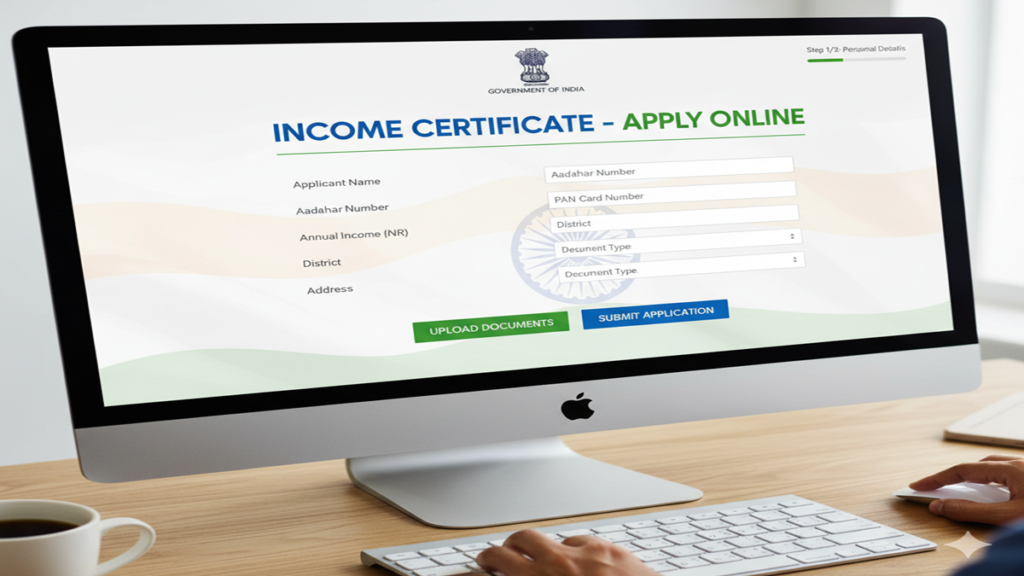
Step 4: Fill the Online Application Form
This is the most detailed part. You will be required to fill in:
- Applicant Details: Your personal information (Name, DOB, Gender, etc.).
- Family Details: Names, ages, relationship, and income details of all family members. The definition of “family” (parents, spouse, dependent children) is usually specified.
- Income Details: A break-up of income from all sources—salary, agriculture, business, rent, etc. Be precise and truthful.
- Address Details: Permanent and correspondence address.
- Document Upload: You will be prompted to upload the scanned copies of the documents listed in the prerequisites. Ensure files are within the specified size and format (PDF/JPEG, usually under 1 MB or 2 MB).
Step 5: Review, Submit & Pay Fees
- Review: Carefully check all entered data for errors. An incorrect digit in income can lead to rejection.
- Submit: Once satisfied, submit the form. You will receive an Application Reference Number (ARN) or Acknowledgement Number. Note this down meticulously for future tracking.
- Fees: In most states, applying for an Income Certificate is free of cost. However, some states may levy a minimal processing fee (e.g., ₹20-₹30), payable online via debit/credit card, net banking, or UPI.
Step 6: Track Application Status
- Use the “Track Application” feature on the portal by entering your ARN.
- Statuses typically progress through: Submitted → Under Verification → Approved/Rejected → Ready for Download/Dispatch.
Step 7: Receiving the Certificate
- Digital Download: Upon approval, the digitally signed certificate can be downloaded directly from the portal in PDF format. This is the most common outcome.
- Physical Dispatch: In some cases, it may be sent via post to your registered address.
- Office Collection: Rarely, you might be asked to collect it in person from the Tehsil or SDM office, especially if physical verification was required.
Part 4: State-Specific Nuances & Challenges
- Verification Process: Some states mandate a field verification by a Revenue Officer (Patwari or Inspector). You or your neighbours might be contacted.
- Affidavit Requirement: Many portals require you to upload a self-declared income affidavit on non-judicial stamp paper as a supporting document.
- Caste Linkage: For OBC/SC/ST income certificates, the application might be integrated with your existing caste certificate data.
- Common Challenges:
- Portal Downtime: Government sites may be slow or under maintenance. Try during non-peak hours.
- Document Rejection: Blurry scans, incorrect file format, or incomplete documents are common reasons for rejection. Double-check before uploading.
- Verification Delays: The human verification step can take time. Patience is key.
Part 5: Tips for a Smooth Application
- Truthful Declaration: Providing false information is a punishable offence under the Indian Penal Code.
- Aadhaar is Key: Ensure your mobile number is linked to Aadhaar for seamless OTP authentication across portals.
- Clarity of Documents: Scan documents clearly. Illegible uploads are the primary cause of application rejection.
- Follow-up: If the application is pending beyond the stated timeline (often 15-30 days), use the grievance redressal mechanism on the portal or contact the local Tehsil office with your ARN.
- Bookmark Your State Portal: Save the link to your browser for easy access during tracking.
Frequently Asked Questions (FAQ)
Q1: Is the online Income Certificate valid everywhere in India?
A: The Income Certificate is issued by a state government authority and is primarily valid within that state. However, it is accepted by central government ministries and institutions (like national banks, central universities) for scholarships and schemes across India. If you move to another state, you would typically need to apply for a fresh certificate from your new state of domicile.
Q2: What is the difference between an Income Certificate and a BPL (Below Poverty Line) Card?
A: An Income Certificate simply states your total annual income from all sources. A BPL Card/Ration Card (AAY or PHH), issued by the Food & Civil Supplies Department, identifies households living below the poverty line based on specific deprivations and entitles them to highly subsidized food grains. While both are used for economic classification, the BPL card involves a more complex survey and has a different application process.
Q3: My application was rejected. What are the common reasons and what should I do next?
A: Common reasons for rejection include:
- Discrepancy in information (name/address mismatch with Aadhaar).
- Unclear or insufficient income proof.
- Failure in field verification (if officer couldn’t contact you).
- Incorrect family income calculation.
- Next Steps: The portal usually mentions the reason for rejection. Correct the errors and reapply. You can also visit the concerned Tehsil office for clarification.
Q4: How long is an Income Certificate valid for?
A: The validity period varies by state but is typically one to three years from the date of issue. This is because an individual’s or family’s financial situation can change. Always check the expiry date on the certificate itself. For long-duration courses, some authorities may accept a certificate valid for the entire course period if mentioned at the time of application.
Q5: Can I apply for an Income Certificate online if I am an NRI or my family resides in a different state?
A: The process can be challenging. The certificate is based on the family’s residential address. If you are an NRI but your family resides in India, a family member can apply on behalf of the household from the home state portal. If the entire family is abroad, you may need to contact the Indian Embassy or your local Tehsil office directly, as physical verification might be difficult. Provisions exist but require direct liaison with the authorities.
Conclusion
The transition to online application for Income Certificates is a significant stride toward transparent and citizen-centric governance in India. While the process may seem daunting at first glance, being prepared with the right documents and following the step-by-step guide for your specific state can make it remarkably smooth. This digital empowerment not only saves time and reduces corruption but also ensures that welfare benefits reach the intended beneficiaries efficiently. Remember, the key lies in accurate information, clear documentation, and using the power of the ARN to track your application to its successful completion.