


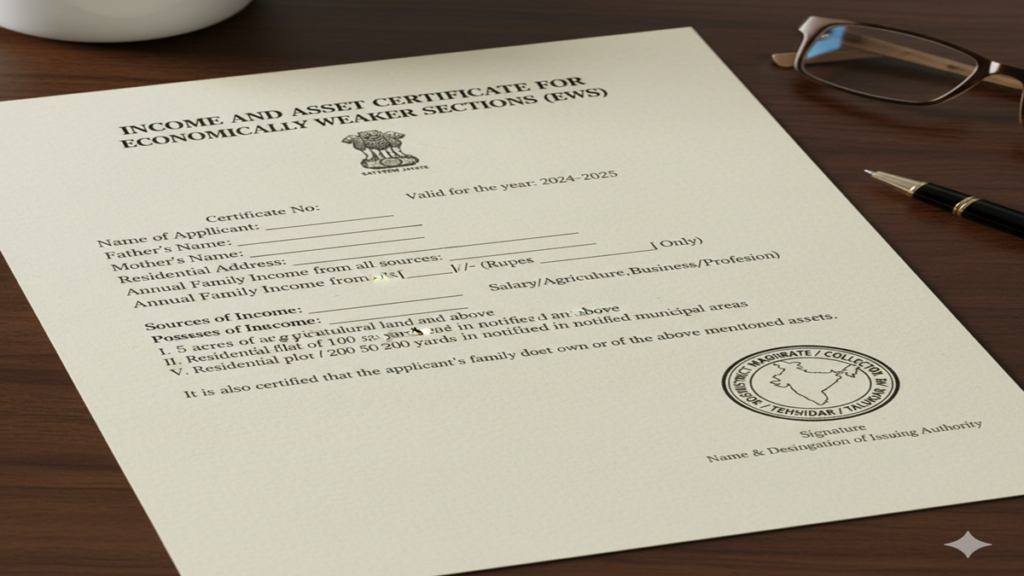
Comprehensive Guide to Income Certificates for EWS Status: Application, Benefits, and Common Questions
Understanding the EWS Certificate: A Gateway to Educational and Economic Empowerment
Income Certificate For Ews Certificate In recent years, India has introduced several progressive policies aimed at fostering greater social and economic equity. Among these, the Economically Weaker Sections (EWS) certificate has emerged as a crucial document for individuals from economically disadvantaged backgrounds who don’t belong to Scheduled Castes (SC), Scheduled Tribes (ST), or Other Backward Classes (OBC). This certificate serves as official recognition of economic status, enabling access to reservations in educational institutions and government jobs.
An income certificate for EWS purposes is more than just a piece of paper—it’s a key that unlocks opportunities for upward mobility. As the government continues to implement the 10% reservation for EWS categories in educational institutions and public employment, understanding the intricacies of obtaining and using this certificate becomes increasingly important for eligible citizens.
This comprehensive guide will walk you through every aspect of EWS income certificates, from eligibility criteria to application procedures, common pitfalls, and their impact on beneficiaries’ lives.
What is an EWS Certificate?
The Economically Weaker Sections (EWS) certificate is an official document issued by competent authorities to certify that an individual or family belongs to the economically weaker section of society. This certificate is specifically designed for individuals from the general category who do not fall under any existing reservation categories but whose economic circumstances warrant support through affirmative action policies.
not covered by existing reservations for SC, ST, and OBC categories.
Eligibility Criteria for EWS Certificate
Income Threshold
The primary eligibility criterion for obtaining an EWS certificate is the family’s annual income. According to government guidelines:
- The family’s gross annual income must be below ₹8 lakh (₹800,000)
- Income includes all sources: salary, agriculture, business, profession, etc.
- The income limit applies to the financial year preceding the application
Family Definition
For EWS purposes, “family” includes:
- The applicant
- Parents
- Siblings below 18 years
- Spouse and children below 18 years
Asset Ownership Restrictions
In addition to income limits, applicants must not possess certain assets:
- Agricultural land of 5 acres or more
- Residential flat of 1,000 sq. ft. or more
- Residential plot of 100 sq. yards or more in notified municipalities
- Residential plot of 200 sq. yards or more in non-notified municipalities
Exclusion Categories
Applicants who belong to SC, ST, or OBC categories are not eligible for EWS certificates as they already have separate reservation provisions.
Documents Required for EWS Certificate Application
The documentation process is crucial for successful application. Required documents typically include:
- Identity Proof: Aadhaar card, voter ID, passport, or driver’s license
- Address Proof: Ration card, utility bills, or property tax receipt
- Income Proof:
- Salary slips (for employed individuals)
- Income certificate from employer
- Income affidavit
- Agriculture income details
- Business income statements
- Bank statements for the previous year
- Asset Details:
- Property documents
- Land ownership records
- Photographs: Recent passport-sized photographs
- Caste Certificate: To confirm the applicant doesn’t belong to SC, ST, or OBC categories
- Family Details: Ration card or family declaration document
- Application Form: Duly filled with accurate information
Step-by-Step Application Process
Online Application Process
Many states have implemented online portals for EWS certificate applications:
- Visit the Official Portal: Access your state’s revenue department or e-district portal
- Registration: Create an account using your mobile number and email
- Form Filling: Complete the application form with accurate details
- Fee Payment: Pay the nominal application fee online
- Submission: Submit the application and note the reference number
- Tracking: Use the reference number to track application status
- Certificate Download: Once approved, download the digitally signed certificate
Offline Application Process
For those without digital access:
- Obtain Application Form: Collect from Tahsildar office, revenue department, or e-Seva centers
- Document Preparation: Make photocopies of all required documents
- Form Completion: Fill the form carefully, preferably in block letters
- Submission: Submit to the appropriate authority along with documents
- Acknowledgement: Collect acknowledgement receipt with application number
- Verification Process: Revenue officials may conduct field verification
- Collection: Collect the certificate from the issuing office once approved
Processing Time and Validity
- Processing time typically ranges from 7 to 21 days
- EWS certificates are generally valid for one year from the date of issue
- Renewal requires a fresh application with updated income documents
Benefits of EWS Certificate
Educational Opportunities
- Admission Reservations: 10% reservation in government educational institutions
- Fee Concessions: Reduced tuition fees in many institutions
- Scholarships: Access to various government scholarship programs
- Coaching Assistance: Support for competitive exam preparation
Employment Advantages
- Government Jobs: 10% reservation in central and state government positions
- Promotional Benefits: Consideration in promotions within government services
- Skill Development: Access to specialized training programs
Other Benefits
- Housing Schemes: Eligibility for various affordable housing programs
- Subsidies: Access to certain government subsidies and benefits
- Loan Facilities: Preferential treatment in some government loan schemes
Common Challenges and Solutions in Obtaining EWS Certificates
Documentation Issues
Challenge: Incomplete or incorrect documentation is the most common reason for rejection.
Solution:
- Create a checklist of required documents before applying
- Verify document requirements on the official portal
- Ensure all documents are recent and valid
Income Calculation Complexity
Challenge: Many applicants struggle with accurate income calculation.
Solution:
- Include all income sources: salary, business, agriculture, rent, etc.
- Consult with a knowledgeable person if unsure
- Maintain proper financial records throughout the year
Bureaucratic Hurdles
Challenge: Delays and procedural complexities in government offices.
Solution:
- Apply well in advance of when the certificate is needed
- Follow up regularly on application status
- Maintain polite but persistent communication with officials
Digital Literacy Barriers
Challenge: Difficulty navigating online portals for applicants with limited digital skills.
Solution:
- Seek assistance from Common Service Centers (CSCs)
- Visit e-Seva centers for guided application support
- Ask family members or friends with digital literacy to help
State-Wise Variations in EWS Certificate Procedures
While the central government provides overarching guidelines, implementation varies across states:
Maharashtra
- Online application through “Aaple Sarkar” portal
- Requires income affidavit on ₹100 stamp paper
- Tahsildar is the issuing authority
Delhi
- Application via Revenue Department website
- Certificate issued by SDM (Sub-Divisional Magistrate)
- Special provisions for homeless applicants
Uttar Pradesh
- “E-District” portal for online applications
- Tehsildar issues the certificate
- Specific document requirements for agricultural income
Karnataka
- “E-Sahamathi” portal for certificate applications
- Village Administrative Officer (VAO) initiates verification
- Integration with various government databases
Tamil Nadu
- Application through e-Seva centers
- Requires community certificate proving non-SC/ST/OBC status
- Special provisions for fishermen and traditional artisans
Applicants should always check their specific state guidelines before beginning the application process.
Impact and Success Stories
Educational Empowerment
The EWS quota has significantly increased access to quality education. For instance, in Delhi University, the implementation of EWS reservations has allowed thousands of economically disadvantaged students to pursue higher education in prestigious colleges that were previously financially out of reach.
Employment Transformation
Government data indicates that since the implementation of EWS reservations, approximately 1.5 lakh positions in central government services have been filled through this quota, substantially altering the economic prospects of beneficiary families.
Case Study: Rohan’s Journey
Rohan, a student from a lower-middle-class family in Bihar with an annual income of ₹3.5 lakh, secured admission to a prestigious engineering college through the EWS quota. “Without the EWS certificate, I could only dream of such education. The fee concession allowed my family to afford my studies,” he shares. Rohan is now preparing for civil services examinations, again benefiting from EWS reservations in the selection process.
Future Prospects and Policy Considerations
As the EWS reservation system evolves, several developments are anticipated:
- Digital Integration: Increased integration with national databases like Aadhaar for seamless verification
- Income Assessment Refinements: More sophisticated methods for income evaluation
- Periodic Review: Potential adjustments to income thresholds based on economic indicators
- Expanded Benefits: Possible extension of benefits to additional sectors
Legal Framework and Recent Judgments
The constitutional validity of the EWS reservation was upheld by the Supreme Court in November 2022, with a 3:2 majority.
Important legal considerations include:
- The exclusion of SC, ST, OBC from EWS quota is constitutionally valid
- States have flexibility in implementation within central guidelines
- Income and asset criteria can be modified based on economic conditions
Frequently Asked Questions (FAQs)
Q1: Can I apply for an EWS certificate if I already have an OBC certificate?
No, individuals belonging to Scheduled Castes (SC), Scheduled Tribes (ST), and Other Backward Classes (OBC) are not eligible for EWS certificates. The EWS category is specifically designed for individuals from the general category who are economically disadvantaged. If you already possess an OBC certificate, you should utilize the benefits available under that category rather than applying for EWS status.
Q2: How is family income calculated for EWS certificate eligibility?
Family income includes income from all sources (salary, business, agriculture, rent, etc.) of all family members over the previous financial year. “Family” for this purpose includes yourself, your parents, siblings below 18 years, your spouse, and children below 18 years. You must provide documentary proof for all income sources, and the total should not exceed ₹8 lakh annually.
Q3: What happens if my income exceeds the limit after obtaining the certificate?
EWS certificates are typically valid for one year. If your income exceeds the ₹8 lakh threshold during the validity period, you are technically no longer eligible for benefits. However, the certificate remains valid until its expiration date. For renewal, you must provide updated income documents, and if your income now exceeds the limit, you will not be eligible for a renewed certificate.
Q4: Is the EWS certificate valid across all states in India?
While the EWS certificate issued by one state should technically be valid across India, some states and institutions may have specific requirements or may prefer certificates issued within their jurisdiction. For central government institutions and jobs, EWS certificates from any state are generally accepted. However, for state-specific benefits, you may need to obtain a certificate from that particular state’s authorities.
Yes, you can still apply if your family owns agricultural land, but only if it is less than 5 acres. The EWS eligibility criteria specify that applicants should not possess agricultural land of 5 acres or more. If your family owns less than 5 acres of agricultural land, you may still be eligible provided your annual family income is below ₹8 lakh and you meet other asset criteria.
Conclusion
The EWS certificate represents a significant step toward creating a more equitable society by extending reservation benefits to economically disadvantaged individuals from the general category. While the application process requires careful attention to documentation and eligibility criteria, the benefits—ranging from educational opportunities to employment reservations—can be life-changing for eligible candidates.
As with any government certification process, accuracy, patience, and proper documentation are key to successful application. Eligible individuals should not hesitate to pursue this certificate, as it opens doors to opportunities that can break cycles of economic disadvantage and create pathways to prosperity.
The continued refinement of the EWS system, coupled with digital governance initiatives, promises to make this important social welfare instrument increasingly accessible to those who need it most, contributing to the broader vision of an inclusive and progressive India where economic status does not determine one’s educational and professional horizons.