


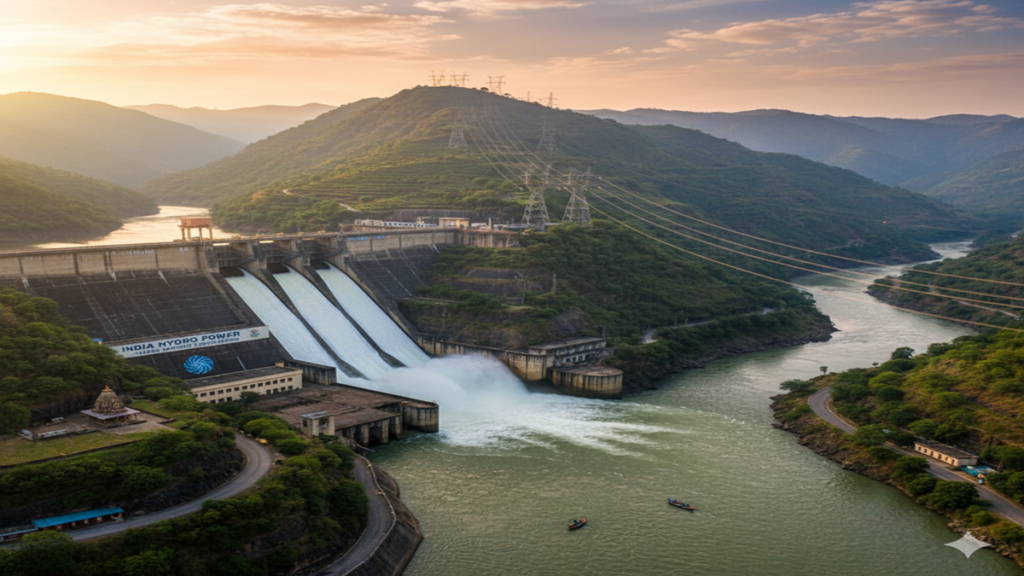
Hydropower Renewable Energy India: भारत में जलविद्युत ऊर्जा का महत्व, प्रमुख प्रोजेक्ट्स और भविष्य की चुनौतियाँ!
Hydropower Renewable Energy India: Introduction: जलवायु परिवर्तन (Climate Change) के इस दौर में दुनिया तेजी से जीवाश्म ईंधन (Fossil Fuels) को छोड़कर अक्षय ऊर्जा की ओर बढ़ रही है। भारत, जो दुनिया की सबसे तेजी से बढ़ती अर्थव्यवस्थाओं में से एक है, अपनी ऊर्जा जरूरतों के लिए जलविद्युत (Hydropower) पर बहुत अधिक निर्भर है। सौर और पवन ऊर्जा की तुलना में, जलविद्युत एक ऐसा स्रोत है जो ‘बेस लोड’ (Base Load) बिजली प्रदान करने में सक्षम है।
अगर हम “Hydropower Renewable Energy India” की बात करें, तो भारत अपनी भौगोलिक स्थिति के कारण जलविद्युत उत्पादन में दुनिया के अग्रणी देशों में शामिल है। इस लेख में हम भारत में जलविद्युत की वर्तमान स्थिति, इसके लाभ और प्रमुख बांधों के बारे में विस्तार से जानेंगे।
1. जलविद्युत ऊर्जा क्या है? (What is Hydropower?)
Hydropower Renewable Energy India: जलविद्युत ऊर्जा वह प्रक्रिया है जिसमें बहते हुए पानी (नदियों या झरनों) की गतिज ऊर्जा (Kinetic Energy) का उपयोग करके बिजली पैदा की जाती है। जब पानी ऊंचाई से टरबाइन पर गिरता है, तो वह टरबाइन को घुमाता है, जिससे जनरेटर बिजली उत्पन्न करता है। इसे ‘अक्षय ऊर्जा’ (Renewable Energy) इसलिए कहा जाता है क्योंकि जल चक्र (Water Cycle) के माध्यम से पानी की उपलब्धता निरंतर बनी रहती है।
2. भारत में जलविद्युत की वर्तमान स्थिति (Status in India)
Hydropower Renewable Energy India: भारत जलविद्युत उत्पादन के मामले में विश्व स्तर पर पांचवें स्थान पर है। भारत सरकार के नवीन और नवीकरणीय ऊर्जा मंत्रालय (MNRE) के अनुसार:
- भारत की कुल स्थापित जलविद्युत क्षमता लगभग 47,000 मेगावाट (MW) से अधिक है।
- भारत ने 2030 तक गैर-जीवाश्म स्रोतों से 500 GW बिजली उत्पादन का लक्ष्य रखा है, जिसमें जलविद्युत की भूमिका महत्वपूर्ण होगी।
- हिमालयी क्षेत्र और उत्तर-पूर्वी राज्य (जैसे अरुणाचल प्रदेश) भारत के ‘पावर हाउस’ कहे जाते हैं क्योंकि यहाँ जलविद्युत की अपार संभावनाएं हैं।
3. भारत के प्रमुख जलविद्युत प्रोजेक्ट्स (Major Projects)
Hydropower Renewable Energy India: भारत में कई विशाल जलविद्युत संयंत्र हैं जो देश की बिजली की जरूरतों को पूरा करते हैं:
- टिहरी बांध (Tehri Dam), उत्तराखंड: यह भारत का सबसे ऊंचा बांध है जिसकी क्षमता 2400 मेगावाट है।
- भाखड़ा नांगल बांध (Bhakra Nangal), हिमाचल/पंजाब: सतलुज नदी पर बना यह बांध भारत के सबसे पुराने और महत्वपूर्ण प्रोजेक्ट्स में से एक है।
- कोयना जलविद्युत परियोजना (Koyna), महाराष्ट्र: यह भारत के सबसे बड़े पूर्ण जलविद्युत संयंत्रों में से एक है।
- श्रीशैलम बांध, आंध्र प्रदेश/तेलंगाना: कृष्णा नदी पर स्थित यह प्रोजेक्ट दक्षिण भारत के लिए ऊर्जा का मुख्य स्रोत है।
[Image map of major hydroelectric power plants in India]
4. जलविद्युत के लाभ (Advantages of Hydropower)
- स्वच्छ ऊर्जा: इसमें किसी भी प्रकार का धुआं या ग्रीनहाउस गैसों का उत्सर्जन नहीं होता।
- लागत प्रभावी: शुरुआत में निर्माण खर्च अधिक होता है, लेकिन एक बार चालू होने पर इसके संचालन और रखरखाव की लागत बहुत कम होती है।
- बहुउद्देश्यीय: बांधों का उपयोग न केवल बिजली बनाने के लिए, बल्कि सिंचाई, बाढ़ नियंत्रण और मछली पालन के लिए भी किया जाता है।
- त्वरित प्रतिक्रिया: सौर ऊर्जा की तरह यह बादलों या रात पर निर्भर नहीं है; जरूरत पड़ने पर इसे तुरंत शुरू और बंद किया जा सकता है।
5. चुनौतियाँ और भविष्य (Challenges & Future)
Hydropower Renewable Energy India: अपार संभावनाओं के बावजूद, भारत में बड़े जलविद्युत प्रोजेक्ट्स के सामने कुछ चुनौतियाँ भी हैं:
- पर्यावरणीय प्रभाव: बड़े बांध बनाने से स्थानीय पारिस्थितिकी तंत्र और जंगलों को नुकसान पहुँच सकता है।
- विस्थापन: बांध के डूब क्षेत्र में आने वाले गांवों के लोगों का पुनर्वास एक बड़ी सामाजिक चुनौती है।
- भूकंपीय संवेदनशीलता: हिमालयी क्षेत्र भूकंप के प्रति संवेदनशील है, जिससे वहां बड़े बांध बनाना जोखिम भरा हो सकता है।
भविष्य की राह: सरकार अब ‘लघु जलविद्युत परियोजनाओं’ (Small Hydro Projects) और ‘पम्प्ड स्टोरेज’ (Pumped Storage) तकनीक पर ध्यान केंद्रित कर रही है ताकि पर्यावरण को कम से कम नुकसान पहुँचाकर बिजली बनाई जा सके।
4. अक्सर पूछे जाने वाले प्रश्न (FAQs)
Q1: क्या जलविद्युत ऊर्जा पूरी तरह से प्रदूषण मुक्त है?
Ans: हाँ, उत्पादन के दौरान यह कोई प्रदूषण नहीं फैलाती, हालांकि बांध निर्माण के समय पर्यावरण में कुछ बदलाव जरूर होते हैं।
Q2: भारत का सबसे बड़ा जलविद्युत संयंत्र कौन सा है?
Ans: क्षमता के मामले में टिहरी जलविद्युत परिसर (Tehri Hydroelectric Complex) भारत का सबसे बड़ा प्रोजेक्ट है।
Q3: छोटे जलविद्युत प्रोजेक्ट (Small Hydro) क्या होते हैं?
Ans: वे प्रोजेक्ट जिनकी क्षमता 25 मेगावाट से कम होती है, उन्हें स्मॉल हाइड्रो प्रोजेक्ट कहा जाता है। ये पर्यावरण के लिए अधिक अनुकूल माने जाते हैं।
Conclusion: सतत विकास के लिए जलविद्युत
Hydropower Renewable Energy India के सपनों को साकार करने के लिए एक मजबूत स्तंभ है। जैसे-जैसे भारत अपनी ऊर्जा सुरक्षा की ओर बढ़ रहा है, जलविद्युत का महत्व और बढ़ता जाएगा। सौर और पवन ऊर्जा के साथ मिलकर जलविद्युत भारत को एक ‘ऊर्जा आत्मनिर्भर’ राष्ट्र बनाने में मदद करेगा।
Harnessing the Flow: Hydropower as the Bedrock of Renewable Energy
Hydropower Renewable Energy India In the global quest for a sustainable energy future, where the clarion call is to decarbonize our economies and mitigate the existential threat of climate change, renewable energy sources have moved from the periphery to the very center of policy and technological discourse. Solar panels glitter on rooftops, wind turbines spin in majestic arrays, and green hydrogen promises a new dawn. Yet, amidst these ascendant technologies, one renewable giant stands as the original, the most reliable, and still the largest contributor to clean electricity worldwide: hydropower.
Hydropower Renewable Energy India: For over a century, hydropower has been the silent workhorse of the electricity grid, transforming the kinetic energy of flowing water into a steady stream of electrons. It is a technology as simple as a waterwheel and as complex as a continent-spanning system of dams, reservoirs, and turbines. As we navigate the turbulent waters of the 21st-century energy transition, understanding hydropower—its immense potential, its evolving challenges, and its critical role in a renewables-dominated future—is more important than ever.
The Engine of Flowing Water: How Hydropower Works
Hydropower Renewable Energy India: At its core, hydropower is an elegant application of fundamental physics. It harnesses the gravitational potential energy of water, collected at a height, converting it first into kinetic energy as it falls, and then into mechanical energy via a turbine, which finally spins a generator to produce electricity.
Hydropower Renewable Energy India: The most common and recognizable form is impoundment hydropower, which utilizes a dam to create a large reservoir. This reservoir acts as a massive, natural battery, storing water (and therefore energy) that can be released on demand through penstocks to drive turbines. This controllability is hydropower’s superpower, allowing it to respond to grid fluctuations within minutes.
Run-of-river systems, on the other hand, do not feature large storage reservoirs. They channel a portion of a river’s flow through a canal or penstock to a turbine, returning it to the river downstream. Their environmental footprint is often smaller, but their generation is more subject to natural river flow variations.
Hydropower Renewable Energy India: A third, increasingly vital category is pumped storage hydropower (PSH). This is the world’s preeminent grid-scale energy storage technology. It uses two reservoirs at different elevations. During times of low electricity demand and high renewable output (e.g., sunny, windy days), cheap or excess power is used to pump water from the lower to the upper reservoir. When demand peaks or renewable generation falters, the water is released back down to generate high-value electricity. PSH is not a source of new energy but a crucial enabler for other, more intermittent renewables.
The Unrivaled Strengths: Why Hydropower Remains Indispensable
Hydropower Renewable Energy India: In the mosaic of renewable energy, hydropower provides several unique and critical pieces:
- Hydropower Renewable Energy India: Baseload and Peak Power Paragon: Unlike solar and wind, which are variable and dependent on weather, large reservoir hydropower can generate electricity consistently, 24/7, providing baseload power. More importantly, its rapid dispatchability makes it the ideal resource for meeting sudden spikes in demand (peak shaving) and providing essential grid stability services.
- Hydropower Renewable Energy India: The Ultimate Grid Stabilizer: Modern grids require constant balance between supply and demand. Hydropower plants provide inertia (resistance to changes in grid frequency) and frequency regulation naturally, through the spinning mass of their heavy turbines. They are also uniquely capable of black start operations—restoring a grid from a complete power outage without relying on an external power source. These services are the bedrock of a reliable electricity system.
- Hydropower Renewable Energy India: Multi-Purpose Water Management: Many hydropower projects are integrated with other critical water needs. Reservoirs provide water for irrigation, supporting agriculture and food security. They supply drinking water to municipalities and help in flood control by capturing and managing surge flows during heavy rains. This multi-purpose nature can enhance a project’s overall socio-economic value.
- Longevity and Cost-Effectiveness: A well-maintained hydropower plant has an operational lifespan of 80-100 years, far exceeding that of solar or wind farms. While upfront capital costs are high and construction timelines long, the ongoing fuel (water) is free. This results in a very low levelized cost of electricity (LCOE) over the project’s lifetime, making it highly economical in the long run.
Navigating the Currents: Environmental and Social Challenges
Hydropower Renewable Energy India: The legacy of hydropower is not without profound shadows. The construction of large dams, particularly in the 20th century, has led to significant controversies that continue to shape the industry today.
- Ecosystem Fragmentation: Dams are major barriers to river connectivity. They disrupt sediment transport (leading to downstream erosion and reservoir siltation), block fish migration routes (impacting species like salmon), and alter natural flow regimes, temperature, and chemistry of rivers, affecting entire aquatic and riparian ecosystems.
- Community Displacement: Large reservoirs can inundate vast areas of land, leading to the displacement and resettlement of communities, often with profound cultural and socio-economic consequences. The loss of ancestral lands, livelihoods, and cultural heritage sites remains a deep and unresolved issue for many projects.
- Hydropower Renewable Energy India: Greenhouse Gas Emissions: The climate-friendly image of hydropower is nuanced. While operational emissions are near-zero, the flooding of vegetation and soils in tropical regions can lead to significant decomposition, releasing methane—a potent greenhouse gas—from reservoirs. The net emissions profile varies dramatically by site and must be carefully assessed.
The Future Flow: Modernization and Sustainable Innovation
Hydropower Renewable Energy India: The hydropower industry is not static. It is evolving to address its historical flaws and adapt to the new energy landscape:
- Modernization and Digitalization: Retrofitting and upgrading existing “fleet” with advanced, more efficient turbines, improved environmental sensors, and AI-driven predictive maintenance can boost output, extend plant life, and enhance environmental performance. The potential for powering non-powered dams is also vast.
- Sustainable Design and Operation: New projects increasingly adopt “environmental flows“—managing Hydropower Renewable Energy India: water releases to mimic natural river patterns and support downstream ecosystems. Improved fish passage technologies (like advanced fish ladders and even fish elevators) and sediment management strategies are becoming standard.
- Pumped Storage 2.0: Innovations in PSH are thriving. Closed-loop systems, which use two off-stream reservoirs not connected to a continuous river, minimize ecological impact. New technologies, including ternary pump-turbines that offer even faster response times, are enhancing flexibility.
- Hydropower Renewable Energy India: Marine and Hydrokinetic Energy: Beyond traditional dams, the frontier of hydropower includes capturing energy from tides, ocean currents, and riverine currents without dams. While still nascent, these technologies promise to extract energy from water with minimal environmental disruption.
Hydropower in the 21st-Century Energy Mix
Hydropower Renewable Energy India: As grids worldwide integrate higher shares of variable renewables, the value of hydropower’s flexibility and storage grows exponentially. It is the perfect complement to solar and wind, filling generation gaps when the sun doesn’t shine and the wind doesn’t blow. In regions like Scandinavia, the Alps, and the Pacific Northwest, hydropower is already the backbone that enables massive wind and solar penetration.
Hydropower Renewable Energy India: For developing economies with significant untapped hydropower potential, it represents a pathway to energy independence, industrialization, and development—but one that must be trodden with rigorous environmental and social safeguards, learning from the mistakes of the past.
Conclusion: An Enduring Pillar in a Renewable World
Hydropower Renewable Energy India: Hydropower is at a crossroads. It is simultaneously a mature, foundational technology and a dynamic field of innovation. Its challenges are significant and demand continued vigilance, better science, and inclusive governance. Yet, its strengths are irreplaceable. In the complex equation of decarbonization—which must balance clean energy, grid reliability, water security, and ecological integrity—hydropower, particularly in its modernized and sustainably managed forms, offers a powerful and essential solution.
Hydropower Renewable Energy India: It is not the sole answer to our energy needs, but it is a critical enabler of a future powered by renewables. By harnessing the timeless flow of water with 21st-century wisdom and technology, hydropower will continue to be a cornerstone of our clean energy edifice for generations to come.
5-FAQ on Hydropower Renewable Energy
1. Is hydropower truly a “green” and carbon-free source of energy?
Hydropower Renewable Energy India: While hydropower generates electricity without burning fossil fuels, its carbon footprint is not always zero. The operation phase is very low-carbon. However, the construction of large dams and reservoirs involves significant emissions from cement production and machinery. More notably, in certain tropical and boreal regions, the flooding of large areas of vegetation and soil can lead to anaerobic decomposition, releasing methane (CH4), a greenhouse gas about The net emissions vary greatly by location; a deep, cold reservoir in Norway will have minimal emissions, while a shallow, warm reservoir in the Amazon may have a significant footprint. Lifecycle assessments are crucial to determine a project’s true climate impact.
2. What are the main environmental impacts of large dams, and can they be mitigated?
Hydropower Renewable Energy India: The primary impacts include:
- Ecosystem Fragmentation: Dams block river connectivity, affecting fish migration (e.g., salmon, eels) and disrupting sediment flow, which can lead to downstream erosion and reservoir siltation.
- Altered Flow Regimes: Natural seasonal floods and flows are replaced by artificial schedules, impacting riparian habitats, wetlands, and delta regions.
- Community Displacement: Large reservoirs can flood towns, farmland, and cultural sites, forcing communities to relocate.
Mitigation strategies are continually improving and include:
- Environmental Flow Releases: Managing water discharges to mimic natural flow patterns.
- Advanced Fish Passage: Installing state-of-the-art fish ladders, lifts, or even constructing specialized “fishways” to aid migration.
- Sediment Management: Using techniques like sluicing, dredging, or sediment bypass tunnels.
- Careful Site Selection: Prioritizing locations with lower ecological and social impact, and favoring run-of-river or pumped storage designs over large reservoir projects where possible.
3. How does hydropower compare to solar and wind energy in terms of reliability and grid support?
Hydropower is fundamentally different and highly complementary:
- Hydropower, especially with a reservoir, is dispatchable. It can generate power on demand, 24/7, making it a reliable source of both baseload and peak power.
- Grid Services: Hydropower is exceptional at providing critical grid stability services. The heavy spinning turbines provide inertia, which helps maintain grid frequency during sudden changes. Plants can also provide voltage support, frequency regulation, and black-start capability (restarting a dead grid). Solar and wind, being inverter-based, traditionally do not provide these services inherently, though new technologies are emerging to help.
4. What is pumped storage hydropower, and why is it becoming so important?
Pumped storage hydropower (PSH) is the world’s largest-capacity form of grid-scale energy storage. It works like a giant water battery:
- It uses two reservoirs at different elevations.
- During periods of low electricity demand/high renewable output (e.g., a windy night), excess electricity is used to pump water from the lower to the upper reservoir, storing energy.
- When electricity demand is high (e.g., weekday evening), water is released back down through turbines to generate power.
Its importance is skyrocketing because it is the most proven and scalable solution to store excess energy from intermittent solar and wind farms and release it when needed, thereby enabling higher penetration of these renewables on the grid.
5. Does hydropower have a future, given its environmental issues and the rise of cheaper solar/wind?
Absolutely, but its role is evolving. The era of mega-dams in pristine ecosystems is largely over in many parts of the world due to social and environmental opposition. However, the future lies in:
- Modernizing the Existing Fleet: Upgrading old plants with more efficient, fish-friendly turbines and digital systems can significantly increase output and environmental performance.
- Building Sustainable New Projects: Focusing on low-impact designs, better locations, and incorporating strict environmental mitigations from the outset.
- Expanding Pumped Storage: Developing new closed-loop and advanced PSH projects is critical for grid storage and stability.
- Supporting Variable Renewables: Hydropower’s flexibility makes it the perfect partner for solar and wind, balancing the grid and providing backup. It is not in competition with them but is a key enabler for a reliable, 100% renewable grid.