


Renewable Energy Examples for Students: अक्षय ऊर्जा क्या है? छात्रों के लिए सरल उदाहरण और भविष्य की ऊर्जा की पूरी जानकारी!
Renewable Energy Examples for Students: Introduction: क्या आपने कभी सोचा है कि जब हम लाइट जलाते हैं या पंखा चलाते हैं, तो वह बिजली कहाँ से आती है? वर्तमान में, अधिकांश बिजली कोयले या तेल को जलाकर बनाई जाती है, जो एक दिन खत्म हो जाएंगे और पर्यावरण को नुकसान भी पहुँचाते हैं। यहीं पर पुनर्नवीकरणीय ऊर्जा (Renewable Energy) की भूमिका आती है।
छात्रों के लिए यह समझना बहुत जरूरी है कि अक्षय ऊर्जा (Renewable Energy) वह ऊर्जा है जो प्राकृतिक स्रोतों से प्राप्त होती है और कभी खत्म नहीं होती। इसे ‘स्वच्छ ऊर्जा’ (Clean Energy) भी कहा जाता है। इस लेख में हम “Renewable Energy Examples for Students” के बारे में विस्तार से चर्चा करेंगे ताकि आप अपने स्कूल प्रोजेक्ट और भविष्य की पढ़ाई के लिए इसे बेहतर ढंग से समझ सकें।
1. पुनर्नवीकरणीय ऊर्जा क्या है? (Definition)
Renewable Energy Examples For Students: अक्षय ऊर्जा वह ऊर्जा है जो सूर्य, वायु, जल और पृथ्वी की गर्मी जैसे प्राकृतिक स्रोतों से लगातार बनती रहती है। कोयले या पेट्रोल के विपरीत, ये स्रोत कभी समाप्त नहीं होते, इसलिए इन्हें ‘नवीकरणीय’ कहा जाता है।
2. छात्रों के लिए अक्षय ऊर्जा के प्रमुख उदाहरण (Top Examples)
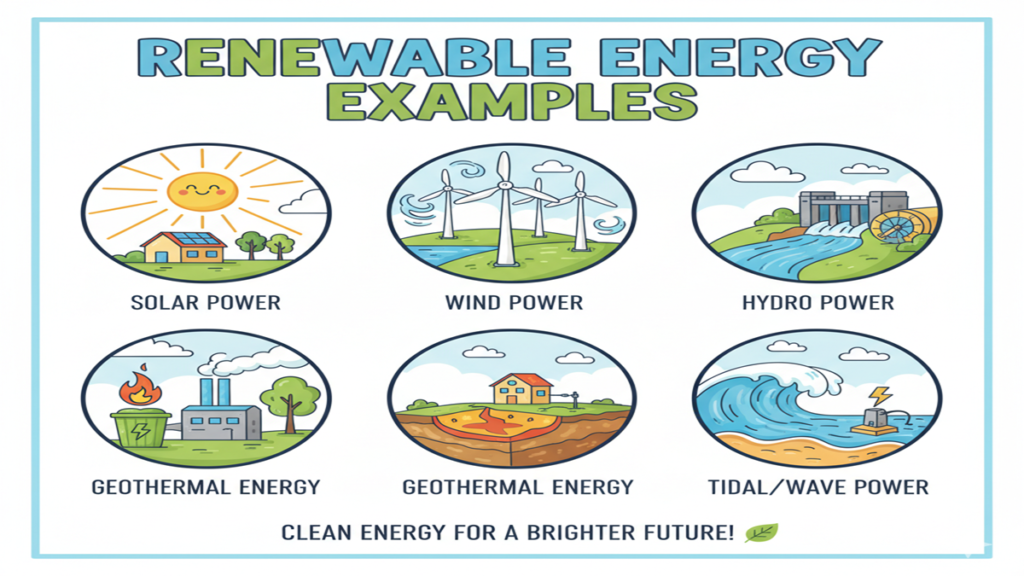
Renewable Energy Examples For Students: A. सौर ऊर्जा (Solar Energy): सूर्य ऊर्जा का सबसे बड़ा और मुफ्त स्रोत है। सोलर पैनल सूर्य की रोशनी को सीधे बिजली में बदल देते हैं।
- उदाहरण: आपके स्कूल की छतों पर लगे सोलर पैनल, सोलर कैलकुलेटर, और सड़कों पर लगी सोलर लाइट।
- छात्रों के लिए तथ्य: सूर्य की केवल एक घंटे की ऊर्जा पूरी दुनिया की एक साल की बिजली की जरूरत को पूरा कर सकती है!
B. पवन ऊर्जा (Wind Energy): बहती हवा की गतिज ऊर्जा (Kinetic Energy) का उपयोग करके बिजली बनाई जाती है। इसके लिए ऊंचे स्थानों पर बड़ी पवन चक्कियां (Wind Turbines) लगाई जाती हैं।
- उदाहरण: तमिलनाडु और गुजरात के तटीय क्षेत्रों में स्थित विशाल विंड फार्म।
- छात्रों के लिए तथ्य: एक अकेली बड़ी पवन चक्की लगभग 1,500 घरों को बिजली दे सकती है।
Renewable Energy Examples For Students: C. जल विद्युत ऊर्जा (Hydroelectric Energy): बहते पानी या बांधों में जमा पानी की ताकत से टर्बाइन चलाकर बिजली पैदा की जाती है। भारत में बिजली का एक बड़ा हिस्सा इसी माध्यम से आता है।
- उदाहरण: भाखड़ा नांगल बांध और टेहरी बांध जैसे बड़े प्रोजेक्ट।
- छात्रों के लिए तथ्य: यह दुनिया में बिजली बनाने का सबसे पुराना और सबसे विश्वसनीय नवीकरणीय तरीका है।
D. बायोमास ऊर्जा (Biomass Energy): पेड़-पौधों, कचरे और जानवरों के गोबर जैसे कार्बनिक पदार्थों से प्राप्त ऊर्जा को बायोमास कहते हैं।
- उदाहरण: गांवों में इस्तेमाल होने वाले गोबर गैस प्लांट (Biogas) और पराली से बनाई जाने वाली बिजली।
- छात्रों के लिए तथ्य: बायोमास कचरे को कम करने और ऊर्जा बनाने का एक बेहतरीन ‘रीसाइक्लिंग’ तरीका है।
Renewable Energy Examples For Students: E. भूतापीय ऊर्जा (Geothermal Energy): पृथ्वी के अंदर मौजूद गर्मी (भाप या गर्म पानी) का उपयोग करके बिजली बनाई जाती है।
- उदाहरण: गर्म पानी के झरने और ज्वालामुखी क्षेत्रों के पास स्थित बिजली संयंत्र।
- छात्रों के लिए तथ्य: पृथ्वी का केंद्र सूर्य की सतह जितना गर्म है, जो ऊर्जा का अटूट भंडार है।
3. नवीकरणीय ऊर्जा क्यों महत्वपूर्ण है? (Importance)
- Renewable Energy Examples For Students: पर्यावरण सुरक्षा: यह प्रदूषण नहीं फैलाती और ग्लोबल वार्मिंग को कम करने में मदद करती है।
- असीमित आपूर्ति: सूर्य और हवा कभी खत्म नहीं होंगे, जबकि कोयला अगले 50-100 सालों में खत्म हो सकता है।
- स्वास्थ्य लाभ: स्वच्छ हवा और पानी से बीमारियां कम होती हैं।
- रोजगार के अवसर: 2026 में सोलर और विंड एनर्जी के क्षेत्र में लाखों नई नौकरियां पैदा हो रही हैं।
4. छात्र अक्षय ऊर्जा में अपना योगदान कैसे दे सकते हैं?
- Renewable Energy Examples For Students: जागरूकता फैलाएं: अपने दोस्तों और परिवार को सोलर एनर्जी के फायदों के बारे में बताएं।
- ऊर्जा बचाएं: कमरे से बाहर निकलते समय लाइट और पंखे बंद करना भी ऊर्जा संरक्षण का एक हिस्सा है।
- प्रोजेक्ट्स: स्कूल साइंस फेयर में सोलर कुकर या मिनी विंड टर्बाइन जैसे मॉडल बनाएं।
4. अक्सर पूछे जाने वाले प्रश्न (FAQs)
Q1: सबसे सस्ता ऊर्जा का स्रोत कौन सा है?
Ans: वर्तमान में तकनीकी विकास के कारण सौर ऊर्जा (Solar Energy) को सबसे सस्ता और सुलभ स्रोत माना जाता है।
Q2: क्या बिजली के बिना भी अक्षय ऊर्जा का उपयोग किया जा सकता है?
Ans: हाँ, जैसे सोलर कुकर में बिना बिजली के खाना बनाना या कपड़ों को धूप में सुखाना।
Q3: क्या भारत अक्षय ऊर्जा का उपयोग कर रहा है?
Ans: हाँ, भारत दुनिया के उन टॉप देशों में शामिल है जो सौर और पवन ऊर्जा का सबसे अधिक उपयोग कर रहे हैं।
Conclusion: भविष्य हमारा है!
Renewable Energy Examples for Students को समझना केवल परीक्षा के लिए नहीं, बल्कि पृथ्वी को बचाने के लिए भी जरूरी है। जैसे-जैसे हम 2026 और उससे आगे बढ़ रहे हैं, अक्षय ऊर्जा हमारे जीवन का हिस्सा बन जाएगी। एक छात्र के रूप में, इस तकनीक को अपनाना और इसे बढ़ावा देना आपकी सबसे बड़ी जिम्मेदारी है।
The Power of Tomorrow: Renewable Energy Explained Through Real-World Examples
Renewable Energy Examples For Students In the face of climate change and a growing global demand for power, a profound energy transformation is underway. Moving from finite, polluting fossil fuels to clean, inexhaustible sources is no longer a niche ideal but a global imperative. For students shaping the future, understanding renewable energy isn’t just a chapter in a science textbook; it’s a roadmap to the world they will inherit and build. This article explores the dynamic landscape of renewable energy, breaking down complex technologies through tangible, real-world examples that illuminate their potential and challenges.
The Core Quartet: Sun, Wind, Water, and Earth
Renewable Energy Examples For Students: Renewable energy harnesses the planet’s natural, self-replenishing flows. While sources like green hydrogen and tidal power are emerging, four core pillars currently form the backbone of the transition.
1. Solar Power: Capturing the Abundance of the Sun
he technologies to capture it are diverse:
- Renewable Energy Examples For Students: Photovoltaic (PV) Panels: These are the familiar glassy panels that convert sunlight directly into electricity via the photovoltaic effect. Example: The Bhadla Solar Park in Rajasthan, India, one of the world’s largest solar parks, spans over 14,000 acres—an area larger than Manhattan. It operates in a region once considered barren and too hot, now generating over 2.2 gigawatts (GW) of electricity, enough to power millions of homes. This example shows how “wastelands” can become powerhouses and how scale drives down costs, making solar among the cheapest sources of new electricity globally.
- Renewable Energy Examples For Students: Concentrated Solar Power (CSP): This method uses mirrors (heliostats) to concentrate sunlight onto a receiver, heating a fluid to drive a traditional turbine and generate electricity. Its key advantage is thermal storage. Example: The Noor Ouarzazate Complex in Morocco uses molten salt storage, allowing it to generate electricity for up to seven hours after the sun sets. This addresses the critical challenge of intermittency—providing power when demand is high in the evening, thus dispelling the myth that solar only works in daylight hours.
2. Wind Power: Harvesting the Air in Motion
Renewable Energy Examples For Students: Wind turbines, the modern-day windmills, convert kinetic energy from wind into mechanical power, which a generator then turns into electricity.
- Onshore Wind: Turbines installed on land. Example: The Gansu Wind Farm in China (targeting 20 GW) highlights both the potential and the grid integration challenges of massive scale. It demonstrates how wind can transform regional economies but also requires sophisticated transmission lines to send power to distant cities.
- Offshore Wind: Turbines erected in bodies of water, where winds are stronger and more consistent. Example: The Hornsea Project series in UK waters is a game-changer. Hornsea 2 alone, with its 165 turbines, can power over 1.4 million homes. Offshore projects like this minimize land-use concerns and can be built at vast scale, but they face harsher engineering conditions and higher initial costs. The rapid innovation here, including floating turbines for deep water, exemplifies technological adaptation.
3. Hydropower: The Established Giant
Renewable Energy Examples For Students: Using the energy of flowing or falling water, hydropower is the largest source of renewable electricity globally.
- Large-Scale Dams: Example: The Three Gorges Dam in China (22.5 GW) showcases immense generation capacity and flood control benefits, but also the significant social and environmental trade-offs: displacement of communities, sediment disruption, and ecosystem damage.
- Small-Scale and Run-of-the-River: These systems divert a portion of a river’s flow without creating a large reservoir, minimizing ecological impact. Example: Projects in countries like Switzerland and Canada provide reliable, low-impact local power, illustrating that “smaller” can sometimes be more sustainable and community-focused.
4. Geothermal Energy: Tapping the Earth’s Inner Heat
Renewable Energy Examples For Students: This resource uses heat from deep within the Earth, available 24/7, for both electricity generation and direct heating.
- Volcanic Regions: Example: Iceland is the poster child, where geothermal meets over 90% of heating needs and about 25% of electricity. The Hellisheiði Power Station, one of the world’s largest, provides baseload power (constant, reliable supply) and even captures carbon dioxide for mineralization—a process called carbon capture and storage (CCS).
- Enhanced Geothermal Systems (EGS): This emerging technology creates reservoirs in hot dry rock, potentially unlocking geothermal power anywhere. Example: Pilot projects like The FORGE initiative in Utah, USA, are pioneering EGS techniques, showing how innovation can expand a renewable resource’s geographic reach beyond tectonic plate boundaries.
Beyond Electricity: Heat, Transport, and Integration
Renewable Energy Examples For Students: The energy transition extends beyond the power grid.
- Biomass & Biofuels: Example: In Brazil, sugarcane-based ethanol powers a vast portion of the vehicle fleet, demonstrating a renewable path for transportation. However, it also sparks the “food vs. fuel” debate, highlighting the need for sustainable sourcing and advanced biofuels from algae or waste.
- The Holy Grail: Energy Storage & Green Hydrogen Intermittency is renewables’ biggest hurdle. Example: The Hornsdale Power Reserve in South Australia—the “Tesla Big Battery”—proved the value of grid-scale storage. It uses lithium-ion batteries to store excess wind and solar, stabilizing the grid and preventing blackouts, saving consumers millions. Looking ahead, green hydrogen (made via electrolysis using renewable electricity) is being piloted for heavy industry and long-haul transport. Projects in Northern Germany are using offshore wind to create hydrogen, aiming to decarbonize steelmaking and shipping.
Why This Matters for Students: Challenges as Opportunities
Renewable Energy Examples For Students: The examples reveal a clear narrative: the technology works, and its scale is breathtaking. But they also unveil the complex challenges that define the frontier of this field—challenges that represent career-defining opportunities for students.
- Engineering & Tech: Improving battery density, turbine efficiency, solar cell materials, and green hydrogen production.
- Environmental Science: Conducting thorough lifecycle analyses, mitigating ecological impacts of large projects, and advancing sustainable bioenergy.
- Social Sciences & Planning: Engaging communities in siting decisions (addressing “NIMBY” – Not In My Backyard) and managing resource use conflicts.
Conclusion: A Dynamic Canvas for the Future
Renewable Energy Examples For Students: Renewable energy is not a singular solution but a diverse, interconnected toolkit being deployed across the planet. From the solar farms in Indian deserts to the wind turbines in the North Sea, from Iceland’s geothermal wells to the battery banks stabilizing Australian grids, the real-world examples are proving that a clean energy future is viable, economical, and imperative.
For students, this is more than an academic subject. It is a living, breathing sector ripe with innovation. Understanding these examples—their triumphs and their complexities—provides the context to contribute meaningfully. Whether through STEM, policy, economics, or advocacy, the energy transition needs a multifaceted workforce. The journey from 2000 to 3000 words can only scratch the surface of this revolution, but it hopefully illuminates a path: the power to reshape our world is, quite literally, all around us—in the sun, the wind, the water, and the heat beneath our feet. The task ahead is to harness it wisely, equitably, and with relentless innovation.
5 FAQs on Renewable Energy for Students
1. If renewable energy is so great, why can’t we just switch off fossil fuels tomorrow?
This is a crucial question about practicality vs. potential. While the sources are free and abundant, the infrastructure is not. Our entire global economy—from power grids to transportation systems—was built around the concentrated, on-demand energy of fossil fuels. Transitioning requires:
- Massive Infrastructure Investment: Building enough solar farms, wind parks, and transmission lines takes time, materials, and capital.
- Grid Modernization: The grid must evolve from a one-way system to a smart, flexible network that can handle variable inputs from millions of sources (like rooftop solar) and include massive storage.
- Energy Storage at Scale: We need cheaper, larger-scale storage (beyond lithium-ion) to cover days with low sun/wind.
- Just Transition: Millions of jobs depend on the fossil fuel industry. A responsible shift requires retraining programs and economic diversification for affected communities. The switch is a massive engineering and socio-economic project, not a simple flip of a switch.
2. What’s the difference between “renewable” and “clean” or “green” energy?
These terms are often used interchangeably, but there are nuances:
- Renewable strictly refers to sources that are naturally replenished on a human timescale (sun, wind, geothermal heat). It says nothing about environmental impact during manufacturing or operation.
- Clean or Green typically implies low or zero greenhouse gas emissions and minimal overall environmental harm during the entire lifecycle (manufacturing, operation, decommissioning).
Most renewables are also clean, but not always. For example, a large hydroelectric dam is renewable (water cycles back), but its construction can cause significant ecological disruption and methane emissions from flooded vegetation, potentially challenging its “clean” label. Conversely, nuclear power is low-carbon (clean in terms of emissions) but is not renewable, as it relies on finite uranium.
3. Aren’t the manufacturing processes for solar panels and batteries themselves polluting?
This is an excellent point about lifecycle analysis. Yes, manufacturing PV panels involves mining (e.g., quartz for silicon), chemical processes, and energy use. Batteries require lithium, cobalt, and nickel. The key points are:
- Payback Time: A solar panel typically “pays back” the energy used to create it within 1-4 years of operation. Given a lifespan of 25-30 years, it produces decades of clean energy.
- Concentrated vs. Distributed Pollution: The pollution from manufacturing, while serious, is localized and can be regulated at factories. Burning fossil fuels, in contrast, distributes pollution and carbon emissions globally and continuously.
- Rapid Innovation: The industry is constantly working to reduce the environmental footprint: using less silicon, developing efficient recycling programs (like for old panels and batteries), and researching new battery chemistries with abundant materials (e.g., sodium-ion).
4. What can I actually do as a student to support renewable energy?
Individual actions, combined, drive systemic change:
- Educate & Advocate: Be informed. Discuss these topics. Support science-based climate and energy policies in your community and campus. Student voices have power.
- Consumer Choice: If you have agency over your home’s electricity, opt for a green power plan from your utility (if available). This directly increases demand for renewables.
- Career Path: Consider how your chosen field—be it engineering, law, business, communications, or political science—can contribute to the energy transition. It needs all skillsets.
- Campus Action: Push your school or university to commit to 100% renewable energy, invest responsibly, and integrate sustainability into the curriculum.
- Daily Habits: Reduce your overall energy consumption (e.g., LED lights, unplug devices). Efficiency makes the transition easier and cheaper.
5. Which renewable energy source has the most potential for the future?
There’s no single “winner.” The future is a diversified portfolio tailored to local geography:
- Solar & Wind will likely be the dominant workhorses due to plummeting costs and scalability.
- Geothermal could provide vital, constant baseload power if EGS technology becomes commercially viable.
- Green Hydrogen may become the key to decarbonizing “hard-to-abate” sectors like heavy industry, aviation, and shipping.
The real hero won’t be one source, but the intelligent system that integrates them all—using AI and smart grids to balance solar from the southwest, wind from the plains, hydropower from rivers, and stored energy in batteries and hydrogen, all while ensuring a reliable, resilient, and affordable power supply for everyone.