


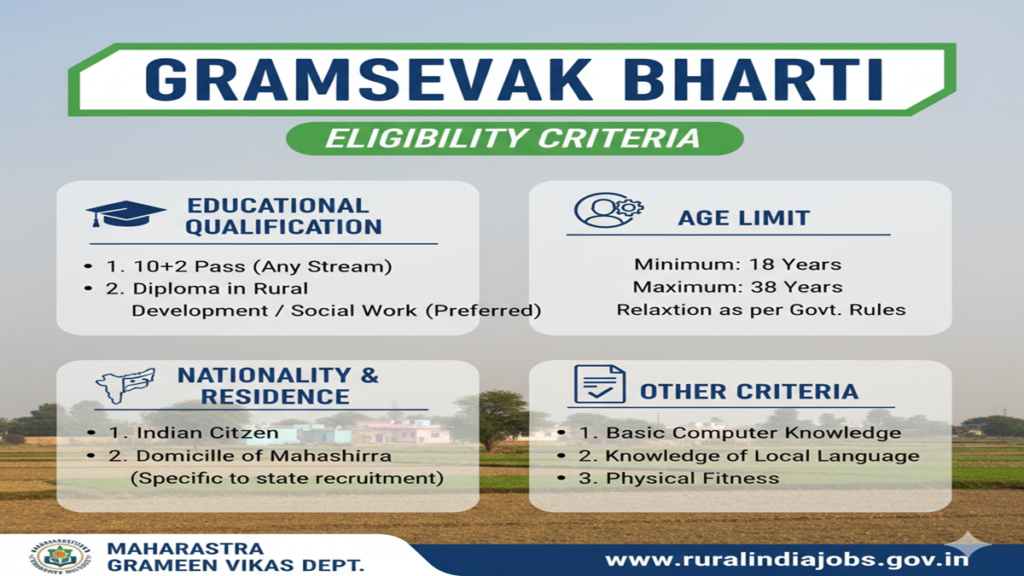
Gramsevak Bharti Eligibility Criteria 2026: ग्रामसेवक बनना है? जानें योग्यता, आयु सीमा और आवश्यक दस्तावेजों की पूरी जानकारी!
Gramsevak Bharti Eligibility Criteria 2026: Introduction: महाराष्ट्र जिला परिषद (Zilla Parishad) के अंतर्गत ‘ग्रामसेवक’ का पद ग्रामीण विकास में एक महत्वपूर्ण भूमिका निभाता है। हर साल लाखों छात्र इस प्रतिष्ठित सरकारी नौकरी का सपना देखते हैं। लेकिन, सफलता की पहली सीढ़ी है “Gramsevak Bharti Eligibility Criteria” को सही ढंग से समझना। 2026 की आगामी भर्ती में पात्रता नियमों और चयन प्रक्रिया में कुछ महत्वपूर्ण अपडेट्स की संभावना है।
यदि आप भी ग्रामीण स्तर पर सरकारी सेवा में शामिल होना चाहते हैं, तो यह लेख आपके लिए एक विस्तृत गाइड है। यहाँ हम शैक्षणिक योग्यता से लेकर आयु सीमा तक के हर पहलू पर चर्चा करेंगे।
1. शैक्षणिक योग्यता (Educational Qualification)
Gramsevak Bharti Eligibility Criteria 2026: ग्रामसेवक पद के लिए आवेदन करने के लिए उम्मीदवारों को निम्नलिखित में से किसी एक शर्त को पूरा करना अनिवार्य है:
- 12वीं पास (Higher Secondary): कम से कम 60% अंकों के साथ 12वीं (HSC) उत्तीर्ण होना आवश्यक है।
- डिप्लोमा/डिग्री: यदि आपके पास कृषि (Agriculture) में डिप्लोमा या डिग्री है, तो आपको वरीयता दी जाती है। इंजीनियरिंग या अन्य तकनीकी विषयों के डिग्री धारक भी आवेदन के पात्र होते हैं।
- कंप्यूटर ज्ञान: आवेदन के समय या नियुक्ति के बाद एक निश्चित समय सीमा के भीतर MS-CIT या उसके समकक्ष कंप्यूटर प्रमाणपत्र होना अनिवार्य है।
2. आयु सीमा (Age Limit 2026)
Gramsevak Bharti Eligibility Criteria 2026: ग्रामसेवक भर्ती के लिए आयु सीमा सरकारी नियमों के अनुसार तय की जाती है:
- सामान्य वर्ग (Open Category): 18 से 38 वर्ष।
- आरक्षित वर्ग (OBC/SC/ST/VJNT): 18 से 43 वर्ष (5 वर्ष की छूट)।
- दिव्यांग और खिलाड़ी: सरकारी नियमानुसार अतिरिक्त आयु सीमा में छूट का प्रावधान है।
3. ग्रामसेवक भर्ती चयन प्रक्रिया (Selection Process)
Gramsevak Bharti Eligibility Criteria 2026: पात्रता मानदंडों को पूरा करने के बाद, उम्मीदवारों को एक कड़ी चयन प्रक्रिया से गुजरना पड़ता है:
- ऑनलाइन परीक्षा (IBPS/TCS पैटर्न): इसमें मराठी, अंग्रेजी, सामान्य ज्ञान, तर्कशक्ति (Reasoning) और तकनीकी (Technical – Agriculture संबंधित) विषयों पर आधारित 200 अंकों का पेपर होता है।
- दस्तावेज सत्यापन (Document Verification): मेरिट लिस्ट में आने वाले उम्मीदवारों के मूल दस्तावेजों की जांच की जाती है।
- अंतिम चयन: परीक्षा के अंकों के आधार पर अंतिम मेरिट लिस्ट जारी की जाती है।
[Image showing Gramsevak Exam Pattern and Subjects]
4. आवश्यक दस्तावेज (Important Documents Checklist)
Gramsevak Bharti Eligibility Criteria 2026:
- स्नातक/डिप्लोमा (कृषि) प्रमाण पत्र।
- अधिवास प्रमाणपत्र (Domicile Certificate – महाराष्ट्र निवासी होना अनिवार्य)।
- आधार कार्ड और पासपोर्ट साइज फोटो।
- MS-CIT सर्टिफिकेट।
5. तकनीकी विषय का महत्व (Technical Subject)
Gramsevak Bharti Eligibility Criteria 2026: ग्रामसेवक भर्ती में ‘तकनीकी’ (Technical) सेक्शन बहुत महत्वपूर्ण होता है। इसमें मुख्य रूप से कृषि, ग्रामीण विकास योजनाएं (जैसे मनरेगा), और पंचायती राज से संबंधित प्रश्न पूछे जाते हैं। यदि आपकी शैक्षणिक पृष्ठभूमि कृषि से है, तो आपको इस खंड में बढ़त मिल सकती है।
4. अक्सर पूछे जाने वाले प्रश्न (FAQs)
Q1: क्या आर्ट्स या कॉमर्स के छात्र ग्रामसेवक बन सकते हैं?
Ans: हाँ, यदि आपने 12वीं कक्षा कम से कम 60% अंकों के साथ उत्तीर्ण की है, तो आप आवेदन कर सकते हैं। हालांकि, कृषि स्नातकों को कुछ मामलों में प्राथमिकता दी जाती है।
Q2: ग्रामसेवक का वेतन (Salary) कितना होता है?
Ans: शुरुआत में ग्रामसेवक को ‘अनुबंधित’ (Contractual) आधार पर नियुक्त किया जाता है, जहाँ एक निश्चित मानदेय मिलता है। 3 साल की सफल सेवा के बाद, उन्हें नियमित वेतनमान (Pay Scale) में शामिल किया जाता है।
Q3: क्या MS-CIT आवेदन के समय ही चाहिए?
Ans: प्राथमिकता यही दी जाती है कि आपके पास सर्टिफिकेट हो, लेकिन कुछ परिस्थितियों में सरकार नियुक्ति के बाद इसे जमा करने का समय प्रदान करती है।
Conclusion: तैयारी अभी से शुरू करें!
Gramsevak Bharti Eligibility Criteria को समझना आपकी तैयारी का आधा हिस्सा है। 2026 में प्रतियोगिता कड़ी होने वाली है, इसलिए अपनी शैक्षणिक योग्यता सुनिश्चित करने के बाद तुरंत सिलेबस के अनुसार पढ़ाई शुरू कर दें। ग्रामीण विकास में योगदान देने का यह एक सुनहरा अवसर है।
Navigating the Path to Village Development: A Complete Guide to Gram Sevak Bharti Eligibility Criteria
Gramsevak Bharti Eligibility Criteria The role of a Gram Sevak, often synonymous with Village Development Officer (VDO), is the cornerstone of rural administration in India. Acting as the executive arm of the Gram Panchayat, the Gram Sevak is the vital link between government schemes and their on-ground implementation. From overseeing development projects and maintaining land records to facilitating citizen services and revenue collection, the position is one of immense responsibility and respect. Consequently, recruitment for Gram Sevak positions, conducted by state-level recruitment boards or rural development departments, is a highly competitive process.
The first and most crucial step for any aspirant is to thoroughly understand and meet the Gram Sevak Bharti Eligibility Criteria. This guide provides a detailed, exhaustive breakdown of all typical eligibility parameters, helping you determine if you are qualified to apply and how to prepare your application.
Understanding the Recruitment Context
Gramsevak Bharti Eligibility Criteria 2026: Before delving into the criteria, it’s essential to note that Gram Sevak recruitment is a state-specific process. While the core responsibilities of the post are similar across India, the eligibility rules—age limit, educational qualifications, residency requirements—are formulated by individual state governments. Therefore, the information presented here is a standardized framework. Aspirants must refer to the official notification released by the recruiting body of their respective state (e.g., Maharashtra Revenue Department, Rajasthan Subordinate and Ministerial Services Selection Board, etc.) for the definitive and final criteria.
The general eligibility structure can be broken down into four pillars:
- Nationality & Domicile
- Age Limit and Relaxations
- Educational and Technical Qualifications
- Other Essential Criteria
Pillar 1: Nationality and Domicile/Residency Requirements
Gramsevak Bharti Eligibility Criteria 2026: This is the most fundamental criterion.
- Nationality: The candidate must be a citizen of India. Proof of citizenship, such as a birth certificate, passport, or a domicile certificate, is mandatory during document verification.
- Domicile/Residency Requirement: This is where state-specific rules come heavily into play. Almost all states require the candidate to be a domicile/permanent resident of the state for which the recruitment is being held.
- Proof: This is typically established through a Domicile Certificate (often called a Permanent Resident Certificate – PRC) or a Local Candidate Certificate issued by a competent state authority.
- Rationale: This provision ensures that individuals familiar with the local language, culture, and administrative nuances are responsible for village development, leading to more effective governance.
Pillar 2: Age Limit and Category-Based Relaxations
Gramsevak Bharti Eligibility Criteria 2026: The age limit is strictly defined, with relaxations provided for candidates from reserved and special categories as per government norms.
- Standard Age Limit: Typically, the candidate must be between 18 years (minimum) and 40 years (maximum) on the cutoff date specified in the notification. The cutoff date is usually the last date for application submission or a date mentioned explicitly by the board.
- Upper Age Limit Relaxations: These relaxations vary by state but generally follow the central government pattern:
- Persons with Benchmark Disabilities (PwBD): 10 years relaxation.
- Ex-Servicemen: Varies (often up to 45 years or service period + 3 years).
- Women/Widows/Divorcees: Many states provide 3-5 years of relaxation.
- State Government Employees: Some states offer relaxation for in-service employees with a certain number of years of service.
Gramsevak Bharti Eligibility Criteria 2026: Crucial Note: Age relaxations are not cumulative. If a candidate belongs to more than one category (e.g., SC and PwBD), they will usually receive the single largest relaxation applicable, not a sum of both.
Pillar 3: Educational and Technical Qualifications
Gramsevak Bharti Eligibility Criteria 2026: This is the most detailed and critical pillar. A Gram Sevak is expected to have a blend of administrative knowledge and technical prowess.
A. Minimum Educational Qualification:
- Mandatory: Passing the 12th Standard (HSC) or its equivalent from a recognized board is the absolute baseline requirement for almost all states.
B. Essential Technical/Professional Qualification:
Gramsevak Bharti Eligibility Criteria 2026: This is the key differentiator. In addition to the 12th pass, candidates must possess one of the following diplomas/certificates. The specific requirement will be stated in the notification:
- Diploma in Agriculture (DAgri): This is one of the most common and preferred qualifications. The course covers basic agriculture, soil science, horticulture, and animal husbandry, which are directly relevant to village economy.
- Certificate in Social Work (CSW) / Rural Development: This diploma equips candidates with the knowledge of community mobilization, development theories, and government scheme structures.
- Diploma in Rural Development (DRD): A specialized course focusing on panchayati raj systems, rural engineering, cooperatives, and development planning.
- Computer Proficiency Certificate: In today’s digital era, many states mandate a government-recognized computer certificate (e.g., MS-CIT, CCC from NIELIT, RS-CIT, or equivalent). This proves competency in basic computer operations, word processing, spreadsheets, and internet usage, as all records are now digitized.
- State-Specific Certificates: Some states have their own mandated certificates. For example, in the past, Maharashtra has required a “Government Recognized Registration Certificate” under the respective state’s society’s act for certain courses.
C. Language Proficiency:
- Gramsevak Bharti Eligibility Criteria 2026: State Official Language: Proficiency in reading, writing, and speaking the official language of the state is compulsory. The written exam is often conducted in this language.
- Local/District Language: Knowledge of the local dialect or the specific language of the district may be an added advantage or sometimes a requirement.
Pillar 4: Other Essential Criteria
- Gramsevak Bharti Eligibility Criteria 2026: Character: The candidate must possess a sound moral character. A police verification and/or certificates from respectable members of the community may be required.
- Physical Fitness: While not excessively stringent, candidates must be medically fit to perform the duties, which may involve traveling across the village. A medical certificate from a government-approved doctor is standard during the appointment process.
- No Criminal Record: Candidates should not have been convicted of a criminal offense or involved in any moral turpitude.
- Employment Status: Some notifications bar candidates who are already in regular government service from applying unless they resign or obtain a proper No Objection Certificate (NOC).