


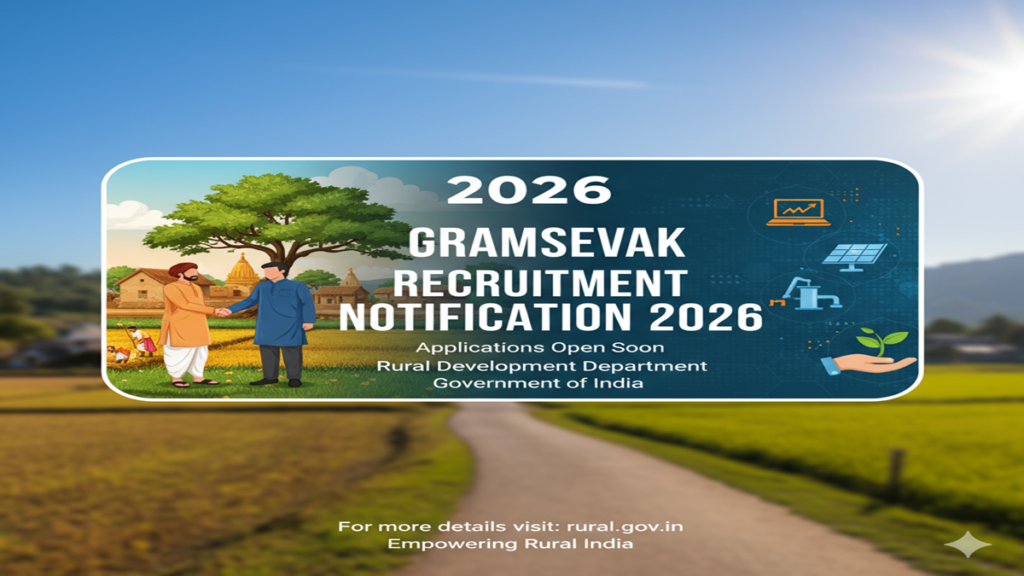
Gramsevak Recruitment 2026: ग्रामसेवक भरती का नया नोटिफिकेशन जारी!
Gramsevak Recruitment Notification 2026: Introduction: सरकारी नौकरी की तलाश कर रहे युवाओं के लिए ‘ग्रामसेवक’ (Gramsevak) का पद हमेशा से एक आकर्षण का केंद्र रहा है। ग्रामीण विकास में अपना योगदान देने के साथ-साथ एक स्थिर सरकारी करियर बनाने का यह सुनहरा मौका है। साल 2026 में विभिन्न राज्यों की जिला परिषदों (Zilla Parishad) ने ग्रामसेवक के हजारों रिक्त पदों को भरने के लिए प्रक्रिया शुरू कर दी है। यदि आप भी ग्रामीण भारत की उन्नति में भागीदार बनना चाहते हैं, तो यह लेख आपके लिए है।
1. ग्रामसेवक क्या होता है? (Role of Gramsevak)
Gramsevak Recruitment Notification 2026: ग्रामसेवक पंचायत का सबसे महत्वपूर्ण कर्मचारी होता है। वह गांव के विकास कार्यों को लागू करने, सरकारी योजनाओं को आम जनता तक पहुँचाने और पंचायत के प्रशासनिक कामकाज को संभालने का काम करता है।
2. शैक्षणिक योग्यता (Eligibility Criteria)
ग्रामसेवक बनने के लिए आमतौर पर निम्नलिखित योग्यताएं आवश्यक होती हैं:
- शैक्षणिक योग्यता: मान्यता प्राप्त संस्थान से 12वीं पास (10+2) या कृषि में डिप्लोमा/डिग्री। कुछ राज्यों में स्नातक (Graduate) होना अनिवार्य है।
- कंप्यूटर ज्ञान: ‘MS-CIT’ या कंप्यूटर का बुनियादी ज्ञान (CCC सर्टिफिकेट) होना अनिवार्य है।
- आयु सीमा: सामान्य वर्ग के लिए 18 से 38 वर्ष (राज्य के अनुसार आयु में छूट का प्रावधान अलग हो सकता है)।
3. चयन प्रक्रिया (Selection Process)
Gramsevak Recruitment Notification 2026: ग्रामसेवक की भर्ती मुख्य रूप से लिखित परीक्षा (Written Exam) के आधार पर होती है। इसमें निम्नलिखित चरणों का पालन किया जाता है:
- लिखित परीक्षा (Objective Type): इसमें सामान्य ज्ञान, अंकगणित, मराठी/हिंदी भाषा, और ग्रामीण विकास से जुड़े प्रश्न पूछे जाते हैं।
- दस्तावेज़ सत्यापन (Document Verification): लिखित परीक्षा में उत्तीर्ण होने वाले उम्मीदवारों को अपने मूल प्रमाण पत्र दिखाने होते हैं।
- मेरिट सूची (Merit List): अंत में लिखित परीक्षा के अंकों के आधार पर अंतिम चयन होता है।
4. आवेदन प्रक्रिया (How to Apply Online)
Gramsevak Recruitment Notification 2026: ग्रामसेवक भर्ती के लिए आवेदन पूरी तरह से ऑनलाइन होते हैं। आप नीचे दिए गए स्टेप्स का पालन करें:
- संबंधित जिला परिषद या भर्ती बोर्ड की आधिकारिक वेबसाइट पर जाएं।
- ‘Recruitment’ या ‘Career’ सेक्शन में ‘Gramsevak Bharti 2026’ पर क्लिक करें।
- ‘New Registration’ पर जाकर अपनी जानकारी भरें।
- फोटो और सिग्नेचर अपलोड करें।
- आवेदन शुल्क का भुगतान ऑनलाइन करें।
- अंत में ‘Submit’ बटन दबाकर आवेदन की हार्ड कॉपी (Printout) निकाल लें।
5. परीक्षा का पाठ्यक्रम (Gramsevak Syllabus 2026)
Gramsevak Recruitment Notification 2026: तैयारी शुरू करने के लिए इन विषयों पर ध्यान दें:
- सामान्य ज्ञान (General Knowledge): इतिहास, भूगोल, वर्तमान घटनाएं (Current Affairs), और राजनीति।
- बौद्धिक क्षमता (Reasoning): तर्कशक्ति, एनालॉजी, और कोडिंग-डिकोडिंग।
- अंकगणित (Mathematics): प्रतिशत, लाभ-हानि, और सांख्यिकी।
- ग्राम प्रशासन (Village Administration): पंचायत राज प्रणाली और ग्रामीण विकास योजनाएं।
6. महत्वपूर्ण सुझाव (Pro-Tips for Success)
- पिछला पेपर (Previous Year Papers): पिछले साल के प्रश्नपत्र हल करने से आपको परीक्षा के स्तर का अंदाजा होगा।
- टाइम मैनेजमेंट: परीक्षा में प्रश्नों को कम समय में हल करने के लिए मॉक टेस्ट (Mock Test) जरूर दें।
- Current Affairs: पिछले 6-12 महीनों की सरकारी योजनाओं (जैसे मनरेगा, पीएम आवास योजना) को विस्तार से पढ़ें।
4. अक्सर पूछे जाने वाले प्रश्न (FAQs)
Q1: ग्रामसेवक का वेतन (Salary) कितना होता है?
Gramsevak Recruitment Notification 2026: Ans: सातवें वेतन आयोग के अनुसार, ग्रामसेवक का वेतन शुरुआती समय में ₹25,000 से ₹35,000 प्रति माह (भत्तों के साथ) होता है।
Q2: क्या कृषि डिप्लोमा होना जरूरी है?
Gramsevak Recruitment Notification 2026: Ans: कुछ राज्यों में केवल 12वीं पास उम्मीदवार भी आवेदन कर सकते हैं, लेकिन कृषि डिप्लोमा रखने वाले उम्मीदवारों को प्राथमिकता दी जाती है।
Q3: क्या ग्रामसेवक पद स्थायी (Permanent) है?
Gramsevak Recruitment Notification 2026: Ans: हाँ, यह एक स्थायी सरकारी पद है जो जिला परिषद के अंतर्गत आता है।
Conclusion: अपना भविष्य संवारें!
Gramsevak Recruitment 2026 उन सभी युवाओं के लिए एक सुनहरा अवसर है जो सरकारी सिस्टम का हिस्सा बनकर गांव के विकास में अपना योगदान देना चाहते हैं। सही दिशा में की गई मेहनत और योजनाबद्ध अध्ययन ही आपको इस परीक्षा में सफलता दिला सकता है। अभी से तैयारी शुरू करें और अपने लक्ष्य की ओर आगे बढ़ें।
The 2026 Gramsevak Recruitment: Your Gateway to Rural Development and a Stable Career
2026 Gramsevak Recruitment Notification: Comprehensive Guide to Eligibility, Application, and Exam Strategy
Gramsevak Recruitment Notification 2026: Meta Description: The much-anticipated 2026 Gramsevak (Village Development Officer) Recruitment Notification is expected soon. Get a complete overview of expected dates, eligibility, syllabus, application process, and preparation tips in this detailed guide.
Introduction
Gramsevak Recruitment Notification 2026: The position of a Gramsevak, also known as a Village Development Officer (VDO), is the cornerstone of rural administration in India. Serving as the executive arm of the Panchayati Raj system, a Gramsevak is directly responsible for implementing government schemes, fostering rural development, and acting as a bridge between the village community and the district administration. The 2026 Gramsevak Recruitment drive, expected to be announced by various state governments (like Maharashtra, Uttar Pradesh, Madhya Pradesh, Gujarat, etc.), is projected to open thousands of vacancies, offering a unique opportunity for a career that combines job security, social impact, and a deep connection to India’s grassroots.
Gramsevak Recruitment Notification 2026: This article provides an exhaustive, forward-looking analysis of the expected 2026 Gramsevak Recruitment Notification, based on previous patterns and official trends. Aspirants are advised to treat this as a strategic blueprint and always cross-check with the official state-specific recruitment board websites once the notification is live.
Part 1: Anticipated Overview of the 2026 Recruitment Drive
Gramsevak Recruitment Notification 2026: While the exact dates are state-dependent, recruitment for such posts typically follows a cyclical pattern after the finalization of budgets and administrative calendars.
- Expected Notification Release: August – October 2026
- Conducting Authorities: State-wise bodies like:
- Maharashtra: Maharashtra Revenue Department / Maharashtra Zilla Parishad
- Madhya Pradesh: Madhya Pradesh Employee Selection Board (MPESB)
- Gujarat: Gujarat Panchayat Seva Selection Board
- Expected Vacancies: 2000 to 3000 positions across participating states. Maharashtra and Uttar Pradesh are likely to be major recruiters.
Part 2: Detailed Expected Eligibility Criteria (2026)
A. Nationality & Domicile
- Must be a citizen of India.
- Must possess a permanent domicile certificate of the respective state for which the application is being made. This is a crucial and non-negotiable criterion.
B. Educational Qualifications (Expected)
- Gramsevak Recruitment Notification 2026: Essential: A Bachelor’s Degree in any discipline (Arts, Science, Commerce) from a recognized university.
- Preferred/Additional: Diplomas or certificates in Rural Development, Agriculture, Cooperation, Social Work, or Computer Applications may be advantageous or required in some states.
- Mandatory: Computer Literacy with a certificate (MS-CIT, CCC, ‘O’ Level or equivalent) is expected to be compulsory, given the digital governance push.
C. Age Limit (As on 1st July 2026)
- Gramsevak Recruitment Notification 2026: Minimum Age: 18 years
- Maximum Age: 38 years (for General/Open Category)
- Age Relaxations: As per state government norms.
- OBC: 3-5 years relaxation
- SC/ST: 5 years relaxation
- Ex-Servicemen: As per rules
- PwD: Additional relaxation
D. Language Proficiency
- Gramsevak Recruitment Notification 2026: Proficiency in the state’s official language and the local dialect of the district will be essential. A language test may be part of the process or a prerequisite for document verification.
Part 3: Projected Application Process & Fees
- Gramsevak Recruitment Notification 2026: Registration: Visit the official recruitment website and register with a valid email ID and mobile number.
- Form Filling: Carefully enter personal, educational, and domicile details. Upload scanned copies of:
- Photograph & Signature
- Domicile Certificate
- Educational Marksheets & Degree
- Caste/Category Certificate (if applicable)
- Computer Course Certificate
- Application Fee:
- General / Open Category: ₹500 – ₹600 (Expected)
- Reserved Categories (OBC/SC/ST): ₹300 – ₹400 (Expected)
- Payment Mode: Net Banking, Credit/Debit Card, UPI.
- Gramsevak Recruitment Notification 2026: Final Submission: Review and submit. Keep a printout of the confirmation page.
Part 4: Expected Exam Pattern & Syllabus
The exam will likely be a single-tier objective-type Computer Based Test (CBT).
A. Exam Pattern (Projected)
| Section | Subject | Expected Questions | Marks | Duration |
|---|---|---|---|---|
| I | General Knowledge & Current Affairs | 30 | 30 | |
| II | General Mathematics & Mental Ability | 30 | 30 | |
| III | Rural Development & Panchayati Raj | 30 | 30 | 120 Minutes |
| IV | Agriculture & Basic Science | 30 | 30 | |
| V | Computer Knowledge | 20 | 20 | |
| VI | Language Proficiency (State Official) | 20 | 20 | |
| Total | 160 | 160 |
B. Detailed Syllabus Breakdown
- Gramsevak Recruitment Notification 2026: General Knowledge & Current Affairs: Indian History, Geography, Polity, Economy, General Science, Major events of state, national & international importance (2024-2026), Sports, Awards, Schemes related to rural India (e.g., PM Awas Yojana, Jal Jeevan Mission).
- General Mathematics & Mental Ability: Number System, Simplification, Percentage, Average, Ratio & Proportion, Profit & Loss, Simple & Compound Interest, Time & Work, Speed & Distance, Basic Geometry, Data Interpretation, Logical & Analytical Reasoning.
- Rural Development & Panchayati Raj: History of Panchayati Raj, 73rd Constitutional Amendment, Functions of Gram Panchayat, Gram Sabha, Role of Gramsevak, Major Rural Development Schemes (MGNREGS, NSAP), Community Development, Local Governance Issues.
- Agriculture & Basic Science: Basic Agronomy, Major crops of the state, Soil types, Irrigation methods, Animal Husbandry basics, Organic Farming, Weather & Climate, Elementary Biology, Chemistry, and Physics.
- Language Proficiency: Grammar, Vocabulary, Comprehension, Essay Writing (short), Translation.
Part 5: Strategic Preparation Tips for 2026 Aspirants
- Gramsevak Recruitment Notification 2026: Start with the Basics & Official Sources: Acquire the syllabus from the 2023/24 notification of your target state as a reference. Once the 2026 notification is out, align your preparation precisely.
- Master the State Context: Focus 40% of your GK on your state-specific history, geography, economy, and current schemes. Follow the state’s rural development department news.
- Conceptual Clarity Over Rote Learning: For Panchayati Raj and Rural Development, understand the why and how of schemes and structures. This aids in answering application-based questions.
- Practice is Key: Solve previous years’ question papers and take regular mock tests. This is vital for the Mathematics and Mental Ability sections to improve speed and accuracy.
- Gramsevak Recruitment Notification 2026: Develop a Study Schedule: Allocate time daily to each section, with more weightage to weaker areas and high-mark sections.
As a Gramsevak, you will be at the forefront of:
- Implementing state and central government welfare schemes.
- Maintaining land and revenue records.
- Coordinating with various departments (Agriculture, Health, Education) at the village level.
- Disaster management and relief work.
- Promoting local self-governance through the Gram Panchayat.
The role offers a respectable pay scale (typically in the Pay Matrix Level 5 or 6, with a starting in-hand salary of approximately ₹35,000 – ₹45,000 per month), job security, and opportunities for promotion to higher revenue and administrative posts.
Frequently Asked Questions (FAQs)
1. When will the exact 2026 Gramsevak Recruitment Notification be released?
While we anticipate notifications between August and October 2026, the exact date will be set by individual state recruitment boards. Candidates should regularly check the official websites of their state’s conducting authority (e.g., MPESB, UPSSSC) from mid-2026 onwards.
2. I will complete my graduation in May 2027. Can I apply for the 2026 recruitment?
No. The eligibility criteria for educational qualification typically require you to possess the required degree on or before the last date of application mentioned in the official notification. If the notification is released in 2026, you will likely need the degree in hand by that time.
3. Is the Gramsevak exam conducted in online or offline mode?
The exam is now almost universally conducted in Online (Computer-Based Test or CBT) mode. The 2026 recruitment will almost certainly follow this pattern.
4. What is the most important document for eligibility?
The Domicile/Certificate of Permanent Residence of the respective state is arguably the most critical document. Without it, your application will be rejected regardless of other qualifications. Ensure you have this ready well in advance.
5. How should I balance preparation between general subjects and state-specific topics?
Follow a 60-40 rule. Dedicate 60% of your General Studies preparation to state-specific topics—history, geography, current schemes, and Panchayati Raj structure of your state. The remaining 40% should cover national and international affairs, general science, and other common sections. The language section will also be state-specific.
Conclusion
The 2026 Gramsevak Recruitment presents a golden opportunity for dedicated individuals to build a meaningful career while contributing to the nation’s rural backbone. With an estimated 2000 to 3000 vacancies, the competition will be intense, making early and systematic preparation the key to success. Use the information in this guide as your strategic roadmap. Begin your preparatory studies now, stay updated on current affairs—especially those related to rural development—and keep a vigilant eye on the official portals for the precise notification. Your journey to becoming an agent of change at the grassroots level starts today.
Disclaimer: This article is a predictive guide based on analysis of previous recruitment cycles. All details regarding dates, vacancies, fees, and patterns are speculative. Candidates must wait for the official notification from their respective state governments in 2026 and refer only to that for final and authoritative information.