


Picture this. You’re on a road trip from LA to Vegas. Your EV battery dips low halfway through the desert. Do you stop for a quick fast charge and keep moving? Or wait hours at a normal charger, risking the sunset? This tug between speed and battery care hits many EV owners hard. Range anxiety makes every mile count.
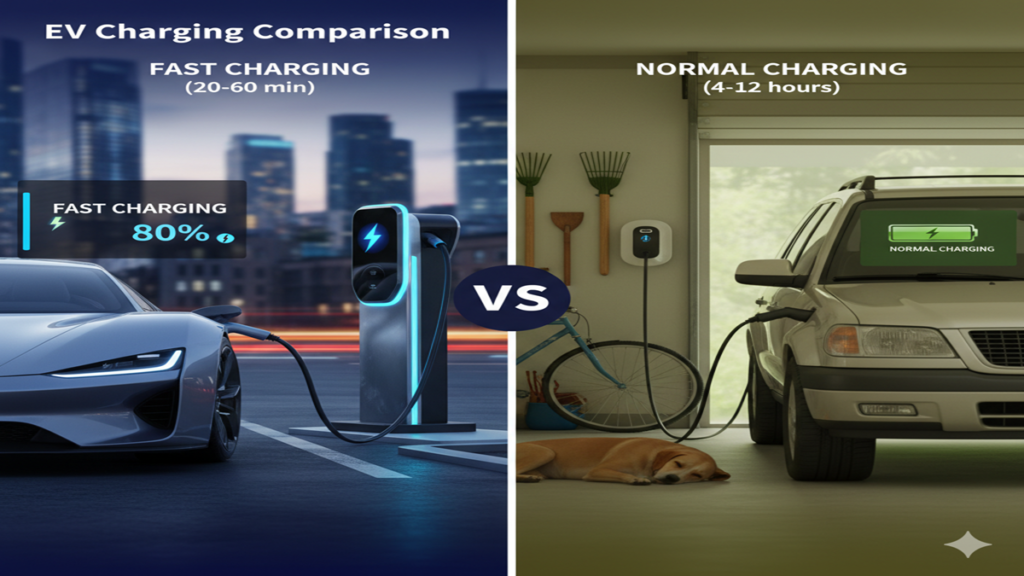
Fast charging and normal charging both power your electric vehicle. But they differ in speed, cost, and impact on your battery. Normal charging includes Level 1 and Level 2 setups. These use AC power from outlets or stations. Fast charging means DC fast charging, or DCFC. It pumps direct current straight to the battery for quick boosts. We’ll compare them here to help you pick the best for your drives.
Understanding Charging Levels: The Power Spectrum
EV charging comes in levels based on power and speed. Each fits different needs, like home use or highway stops. Let’s break them down.
Level 1 Charging (The Trickle Charge)
Level 1 charging runs on standard 120V AC outlets. It delivers about 1.4 kW of power. This adds just 3 to 5 miles of range per hour. It’s slow, like a drip feed.
You plug into any wall socket for this. No special setup needed. It’s great for overnight charges when you sleep eight hours. That might fill your car from empty to full. But for daily needs, it’s too basic. Use it for top-offs or if you’re stuck without options.
Many EVs come with a Level 1 cord. It’s portable and cheap. Yet, it takes 20 hours or more for a full charge on bigger batteries.
Level 2 Charging (The Standard Solution)
Level 2 uses 240V AC power. It handles 3.3 kW to 19.2 kW, based on amps from 16 to 80. This adds 20 to 60 miles per hour. A full charge often takes 4 to 10 hours.
Install it at home with a dedicated unit. You might need an electrician for wiring. Public spots, like malls or offices, offer Level 2 too. They use the same J1772 plug as home ones.
This level suits most routines. Charge while you work or eat dinner. It’s faster than Level 1 but gentle on batteries. Costs stay low with home electricity rates.
DC Fast Charging (DCFC) – Speed Redefined
DCFC skips the onboard AC converter. It sends DC power direct from the station. Power ranges from 50 kW to 350 kW or more. This can add 100 to 200 miles in 30 minutes.
Stations use CCS or CHAdeMO plugs. They’re common on highways. But they work best below 80% battery. Speed drops after that to protect cells.
Save DCFC for trips, not every day. It heats batteries fast. Modern EVs have cooling to handle it. Still, frequent use wears things down quicker.
Performance Metrics: Speed, Distance, and Time Comparison
Compare charging by how much range you gain. Speed matters most on long hauls. Normal options build range steady. Fast ones spike it quick.
The ‘Miles Added Per Hour’ Metric
Level 1 adds 3-5 miles per hour. A Tesla Model 3 gains about 4 miles hourly. Level 2 jumps to 25-30 miles per hour on the same car. In 30 minutes, you get 12-15 miles.
DCFC shines here. That Model 3 adds 150 miles in 30 minutes at 150 kW. A Chevy Bolt might hit 100 miles fast. But rates vary by model and station.
Real gains depend on battery size and weather. Cold days slow all levels. Check your EV’s app for exact figures.
The Charging Curve Phenomenon
Charging isn’t linear. It starts fast and slows near full. The battery management system caps power after 50-80% state of charge. This prevents overheating.
For DCFC, peak speed hits early. Then it tapers. A Nissan Leaf might charge at 50 kW to 80%, then drop to 20 kW. Normal charging curves less. Level 2 stays steady till the end.
Understand this to plan stops. Aim for 20-80% sessions. Full charges waste time on fast setups.
Real-World Road Trip Example
Say you drive 300 miles from Seattle to Portland. With Level 2 only, plan two 4-hour stops. Total charge time: 8 hours. Your trip stretches to 12 hours with driving.
Switch to DCFC. Make three 20-minute stops. Add time for finding stations: 1 hour total. The whole journey takes 6 hours. You save half the wait.
This shows fast charging’s edge for travel. But mix in Level 2 at hotels. Pure fast use drains your wallet and battery.
Battery Health and Longevity: The Wear and Tear Factor
Charging affects battery life. Fast methods stress cells more. Normal ones let them rest easy. Balance use to keep your pack strong.
Thermal Management and Heat Generation
High power means more heat in DCFC. Batteries hit 40-50°C during sessions. This speeds chemical reactions that age cells.
Most EVs use liquid cooling now. It pulls heat away fast. Older models rely on air, which lags. Heat cycles cut range over years.
Normal charging stays cool, under 30°C. Less stress means longer life. Track temps in your dash to spot issues.
The Impact of Frequent DCFC Use on Battery Degradation
Studies show DCFC cuts battery life by 10-20% if used daily. A DOE report notes 1-2% capacity loss per year extra. Consumer Reports found similar in tests.
One year of mostly fast charging equals two years of normal. Cells degrade from lithium plating. Keep it under 20% of charges for best results.
Real data from fleets backs this. Taxis with heavy DCFC lose 15% range in three years.
Optimal Charging Habits for Battery Preservation
Charge to 80% max daily. Let it drop to 20% before top-ups. This avoids full cycles that wear edges.
Use Level 2 for 90% of needs. Save DCFC for roads. precondition batteries before fast stops. Warm cells charge better and safer.
Follow maker guidelines. Apps remind you of habits. These steps add thousands of miles to your battery.
Cost Implications: Energy Rates and Infrastructure Fees
Money adds up with charging. Home normal options beat public fast costs. But fees hide in fast networks.
Comparing Electricity Rates (Home vs. Public Charging)
Home Level 1 or 2 costs $0.10-0.20 per kWh. A full charge runs $5-15. Public Level 2 matches this at many spots.
DCFC charges $0.30-0.50 per kWh. Some bill per minute, up to $0.40. A quick stop costs $10-20. Fast adds up on trips.
Time-of-use rates help. Charge home at night for half price. Public peaks cost more midday.
Hidden Fees and Idle Charges
Networks like Electrify America add idle fees. If you linger after full, pay $0.40 per minute. This pushes turnover at busy spots.
Blocking fees hit if you unplug wrong. Some charge $1 per minute. Always move your car quick.
Check apps for rules. These extras make fast charging pricier than it seems.
Government Incentives and Rebates for Home Installation
The feds offer up to $500 for Level 2 installs via the IRA. States add more, like California’s $1,000 rebate. Check energy.gov for locals.
These cut upfront costs by half. A $600 unit drops to $300. Worth it for daily savings.
Incentives change, so apply soon. They make normal charging even cheaper long-term.
Infrastructure Availability and User Experience
Access shapes your EV life. Home setups beat hunting public ones. But networks grow fast.
Home Charging Accessibility and Installation Hurdles
Level 1 works anywhere with outlets. No install needed. Level 2 requires a 240V line. Electricians charge $500-1,500.
Apartments face issues. Shared garages limit spots. But many buildings add them now.
Once set, home charging beats all. No lines, low cost. It’s the EV dream.
Public Fast Charging Network Reliability and Density
DCFC covers highways well. But rural gaps persist. Tesla Superchargers hit 99% uptime. Others lag at 80-90%.
Broken stalls frustrate. Waits hit 30 minutes in cities. Apps show real-time status.
Density improves yearly. By 2025, expect 100,000 US stalls. Still, plan routes ahead.
Navigating Payment and App Ecosystems
Most networks need apps. ChargePoint, EVgo—each has one. Some take cards, but apps save time.
RFID cards work too. But carrying multiples annoys. Unified apps like PlugShare help track all.
Friction slows trips. Updates simplify, but test before long drives.
Conclusion: Choosing the Right Charge for the Right Time
Fast charging speeds up life but costs more in health and cash. Normal charging builds steady for routines. Pick based on your drives.
| Aspect | Normal Charging (Level 1/2) | Fast Charging (DCFC) |
|---|---|---|
| Speed | 3-60 miles/hour; 4-10 hours full | 100-200 miles/30 min; 30-60 min to 80% |
| Battery Impact | Low wear; ideal for daily | Higher heat/degradation; limit to trips |
| Cost | $0.10-0.20/kWh; cheap home | $0.30-0.50/kWh + fees; pricier public |
| Best For | Home/work, overnight | Highways, emergencies |
Go balanced. Rely on Level 2 for 90% of charges. Use DCFC smart for travel. This keeps your EV happy and wallet full. Track your habits with apps. Start planning your next trip today—your battery will thank you.