


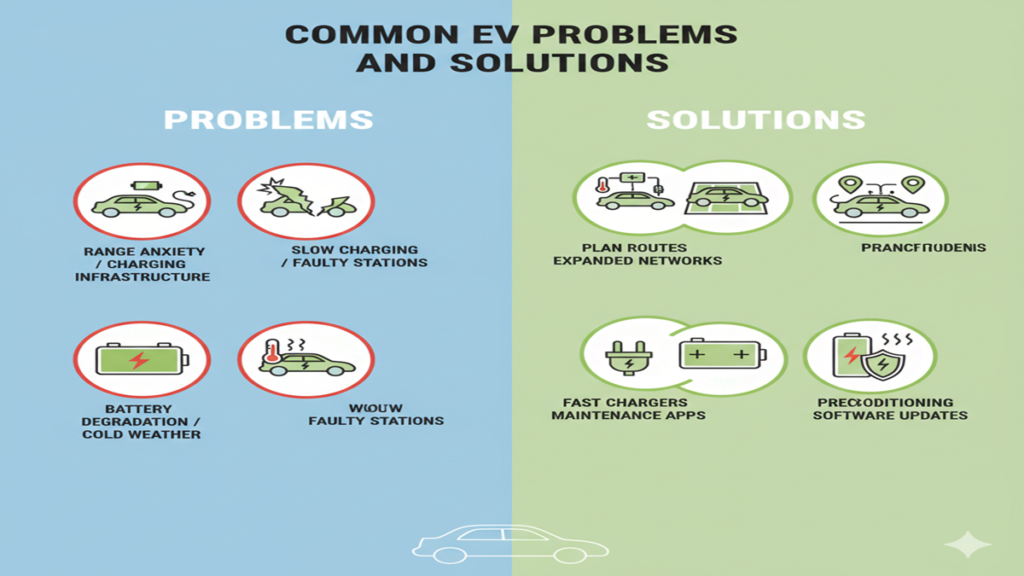
The Electric Roadblock: Navigating Common EV Problems and Practical Solutions
Global EV sales surpassed 10 million in 2022, and projections show exponential growth. Yet, for many prospective and current owners, the transition from internal combustion engine (ICE) vehicles to electric brings a new set of questions, concerns, and sometimes, frustrations. While EVs offer immense benefits—lower operating costs, reduced emissions, and thrilling instant torque—they also introduce unique challenges rooted in their fundamentally different technology.
This comprehensive guide delves into the most common problems faced by EV owners, separating justified concerns from outdated myths, and provides actionable solutions and strategic advice to ensure your electric journey is smooth, efficient, and enjoyable.
1. The Prime Anxiety: Range and Charging Infrastructure
The Problem: Range anxiety remains the flagship concern. It’s the fear that the battery will deplete before reaching a destination or a charger. Compounding this is “charger anxiety”—the worry about finding a working, compatible, and available charging point. Real-world range can be significantly less than EPA estimates due to weather, driving style, and climate control use. Furthermore, public charging networks, while growing rapidly, can be plagued by broken units, confusing payment systems, and long wait times.
The Solutions:
- Know Your True Range: Use your vehicle’s trip planner and efficiency data. Understand that highway speeds (over 70 mph), extreme cold, and heavy use of heat can cut range by 20-40%. Pre-condition your car while plugged in to warm the cabin and battery in winter, saving battery for driving.
- Master the Art of Trip Planning: For long journeys, always plan ahead. Use reliable apps like PlugShare, A Better Routeplanner (ABRP), and your car’s native navigation. ABRP is exceptional for factoring in elevation, weather, and your specific vehicle’s efficiency to create accurate charging stops.
- Leverage Home Charging: This is the ultimate solution for daily anxiety. Over 80% of charging happens at home. Install a Level 2 charger (240V). This allows you to start every day with a “full tank,” making range a non-issue for daily commutes.
- Utilize DC Fast Charging Strategically: Use DC fast chargers for road trips, not daily top-ups. Familiarize yourself with networks (Electrify America, EVgo, Tesla Supercharger network opening to more brands). Consider memberships for lower rates. Have a backup charger in mind for each stop.
- Technology is Your Ally: Modern EVs have increasingly accurate range predictors that learn from your driving. Trust them, but add a buffer.
2. The Time Factor: Charging Speed and Battery Degradation
The Problem: “Refueling” takes minutes for ICE vehicles; charging an EV can take 20 minutes to 12 hours. While daily charging at home is passive, long trips require stops that are longer than a gas station break. Linked to this is battery degradation—the gradual loss of a battery’s maximum capacity over time and charge cycles, which subtly reduces range each year.
The Solutions:
- Emphasize Home Charging: Overnight Level 2 charging transforms waiting time into inactive time. You sleep, the car charges. This makes the time issue virtually irrelevant for 95% of driving.
- Understand Charging Curves: Fast charging isn’t linear. EVs charge fastest (often up to 80%) then slow to protect the battery. Plan road trip stops to charge from ~10% to 60-80%, not to 100%, to minimize stop time.
- Adopt Battery-Longevity Habits:
- Avoid Constant 100% Charges: For daily use, set your charge limit to 80-90%. Reserve 100% for trips.
- Minimize Deep Discharges: Try not to regularly drop below 10-20% state of charge.
- Limit Consistent Fast Charging: While modern batteries are robust, rely on it only when necessary. DC fast charging generates more heat, a key contributor to degradation.
- Park Smart: In extreme heat, park in shade or a garage when possible.
3. The Upfront Cost and Depreciation Concerns
The Problem: The sticker price of most new EVs is higher than comparable ICE vehicles, primarily due to battery cost. Additionally, early models suffered from steep, unpredictable depreciation, worrying buyers about long-term value.
The Solutions:
- Calculate Total Cost of Ownership (TCO): Factor in massive fuel savings (electricity is cheaper than gas), drastically reduced maintenance (no oil changes, fewer brake jobs), and potential tax credits/rebates. Over 3-5 years, the TCO often favors EVs.
- Explore Incentives: Research federal, state, and local incentives. The US federal tax credit (up to $7,500) and point-of-sale rebates in 2024 can significantly lower the effective price.
- Consider the Growing Used EV Market: This is a fantastic value proposition. A 3-5 year old EV with a certified battery health check can offer tremendous savings. Battery warranties (often 8 years/100,000+ miles) typically transfer.
- Understand Evolving Depreciation: As technology stabilizes and demand grows, depreciation curves are normalizing. Popular models from mainstream brands are holding value better. Do your research on specific models.
4. The Inconvenience: Public Charging Hurdles
The Problem: The public charging experience can be a minefield: broken chargers (noted as “out of order” on apps), incompatible plugs (CHAdeMO vs. CCS vs. NACS/Tesla), confusing payment methods (requiring specific network apps/RFID cards), and “ICE-ing” (gas cars blocking spots).
The Solutions:
- Do Your Reconnaissance: Use PlugShare not just for location, but to read recent check-ins. Users report real-time status, reliability, and amenities. Don’t rely solely on the network’s app.
- Prepare Your “Charging Toolkit”: Have multiple network apps downloaded and accounts set up (Electrify America, EVgo, ChargePoint). Consider carrying a universal RFID card. For non-Tesla drivers, check for Supercharger accessibility.
- Carry Adapters: A J1772 adapter allows you to use Level 2 Tesla Destination Chargers. As the industry standardizes to the North American Charging Standard (NACS), adapters will be key during the transition.
- Plan for Contingencies: Always have a backup charging location within remaining range. For destination charging, call hotels or venues ahead to confirm charger availability and functionality.
- Advocate and Report: Report broken chargers through the app and to the property manager. Politely ask management to address ICE-ing.
5. The Environmental and Practical Dilemma: Battery Lifecycle & Cold Weather
The Problem: Two persistent concerns are the environmental impact of battery manufacturing/disposal and significant cold-weather performance loss. Batteries can lose 30-40% of their range in sub-freezing temperatures as energy is diverted to heat the cabin and battery pack itself.
The Solutions:
- On Batteries & Environment:
- Look for manufacturers committing to renewable energy in their supply chains.
- Support the growing battery recycling industry. Companies like Redwood Materials are creating a circular economy, recovering over 95% of key battery minerals like lithium, cobalt, and nickel.
- Remember: Even accounting for manufacturing, an EV has a lower lifetime carbon footprint than an ICE car, and this improves as the grid gets greener.
- On Cold Weather:
- Pre-conditioning is King: Use your app to warm the car and battery while it’s still plugged in. This uses grid power, not battery.
- Use the Heated Steering Wheel and Seats: These use far less energy than heating the entire cabin air.
- Garage Your Vehicle: Simply keeping the battery above freezing preserves range.
- Adjust Expectations: Plan for reduced range in winter and increase your charging buffer.
6. The Ownership Nuances: Maintenance Myths and Repair Networks
The Problem: While EVs have lower maintenance, they are not zero-maintenance. Tire wear can be higher due to instant torque and weight. Additionally, not all mechanics are equipped to service high-voltage systems, potentially leading to longer repair times or limited service options.
The Solutions:
- Follow the Schedule: Adhere to the manufacturer’s maintenance schedule for tire rotations, brake fluid checks, cabin air filter changes, and cooling system service.
- Invest in Tires: Buy quality, EV-specific tires designed to handle the weight and torque; they often have lower rolling resistance for better efficiency.
- Research Service Options: Before buying, understand the dealer and independent repair network for your chosen brand. Some newer EV companies have limited service centers, which can be a hurdle in some regions. Consider the availability of mobile service.
Strategic Mindset Shifts for EV Ownership
Beyond specific problems and fixes, successfully adopting an EV requires a subtle shift in perspective:
- From “Refueling” to “Opportunity Charging”: Think like a smartphone user. Top up when parked—at the grocery store, gym, or cinema. You don’t wait for 1%; you plug in when it’s convenient.
- From “Maximum Range” to “Sufficient Range”: Do you need 300 miles daily, or just 50? A 250-mile EV is more than sufficient for most, when home charging is available.
- From “Instant Fill-up” to “Strategic Planning”: View charging stops on road trips as mandatory breaks. Plan them around meals or walks. It can lead to a safer, less fatiguing driving experience.
The Road Ahead: A Rapidly Improving Landscape
It’s crucial to recognize that the EV ecosystem is evolving at breakneck speed. Charging networks are expanding and reliability is improving. Battery technology is advancing, offering longer ranges, faster charging, and more resilient chemistries like LFP (Lithium Iron Phosphate) that are cheaper, longer-lasting, and avoid critical minerals. Industry standardization around the NACS plug will massively simplify the charging experience for most new EVs by 2025.
Conclusion: An Informed Journey is a Smooth One
Owning an electric vehicle today requires slightly more planning and a different mindset than a century of gasoline car ownership has ingrained in us. The common problems—range, charging, cost, weather—are real but increasingly manageable and often surmountable with knowledge and preparation.
The solutions hinge on one central principle: make home charging your foundation. This single act eliminates the majority of daily hassles. For the remaining challenges, a combination of modern technology, strategic habits, and a growing, improving infrastructure provides a clear path forward.
The EV journey isn’t just about adopting a new technology; it’s about participating in a cleaner, quieter, and more efficient future of transportation. By understanding the pitfalls and equipping yourself with solutions, you can confidently navigate the electric roadblock and enjoy the remarkable benefits that lie on the other side.