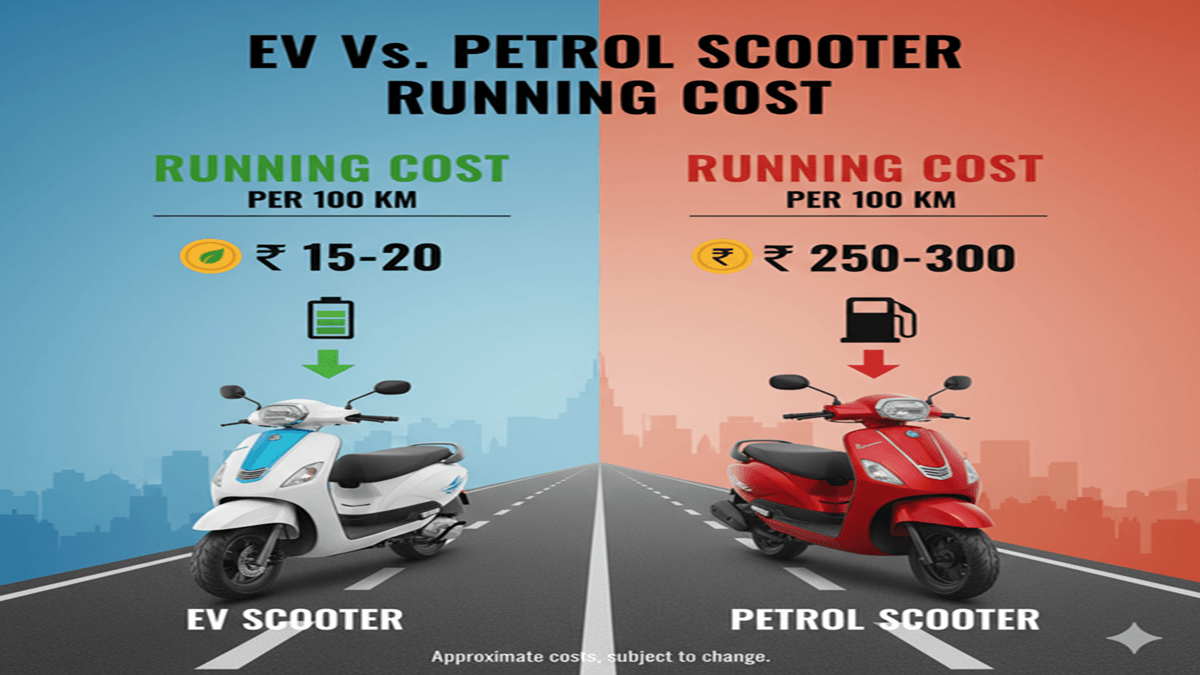
Buying a scooter is easy, living with it every day is where the money story shows up. When people talk about EV vs petrol scooter running cost, they usually mean what you spend to keep it moving and healthy, not the purchase price.
Running cost has two parts. First is energy, electricity for an EV scooter, petrol for a petrol scooter. Second is routine upkeep, things like service visits, consumables, and wear items (tires, brake pads, cables). Repairs matter too, but they’re harder to predict, so it helps to start with the repeatable costs.
In this guide, you’ll compare cost per km, typical maintenance, and practical factors like charging at home versus paid public charging. Prices change by city, slab, traffic, and riding style, but the math stays simple, and you can plug in your own numbers.
EV vs petrol scooter cost per mile, the simple math anyone can do
If you want a clean comparison, ignore brand names for a moment and measure just one thing: cost per km (or cost per mile). This is the part of running cost you feel every week.
The quick formulas
EV scooter energy cost per km
Energy used per km (kWh/km) × electricity price (₹/kWh) = ₹/km
Petrol scooter fuel cost per km
Fuel price (₹/L) ÷ mileage (km/L) = ₹/km
In India in 2025, many owner comparisons land in these broad ranges:
- EV scooters: about ₹0.25 to ₹0.50 per km (home charging, normal city speeds)
- Petrol scooters: about ₹2 to ₹3 per km (typical mileage, typical city petrol prices)
Those ranges won’t match every rider, but they’re a good “sanity check.” If your result is far outside them, re-check the inputs.
Worked example, EV scooter (December 2025 context)
Most electric scooters in real traffic often use about 30 to 50 Wh per km. That’s 0.03 to 0.05 kWh per km, or 3.0 to 5.0 kWh per 100 km.
Now pick realistic electricity pricing. In December 2025, home electricity in many Indian cities often averages roughly ₹4 to ₹7 per kWh for common household slabs, but it can be higher if you fall into expensive slabs (Mumbai can climb much more depending on usage).
Example:
- Consumption: 3.0 kWh per 100 km
- Home tariff: ₹10 per kWh (using a higher, easy-to-follow number)
Cost = 3.0 × 10 = ₹30 per 100 km, which is ₹0.30 per km.
Add charging losses. Energy is lost as heat in the charger and battery, often around 10 to 15%.
₹0.30 per km becomes roughly ₹0.33 to ₹0.35 per km.
This is why home charging usually wins. Public chargers can price electricity higher than your home slab, and the convenience fee can shrink your savings fast.
If you want a quick way to test your numbers, a brand calculator can help you sanity-check assumptions like electricity rate and monthly km (for example, the Chetak EV savings calculator).
Worked example, petrol scooter (December 2025 context)
Petrol scooters live or die on two things: your real mileage and your local petrol price. In many cities, riders see something like 40 to 60 km/L depending on traffic, speed, tire pressure, and load.
Example:
- Mileage: 45 km/L
- Petrol price: ₹110 per liter
Cost per km = 110 ÷ 45 = ₹2.44 per km.
Or per 100 km:
- Fuel used = 100 ÷ 45 = 2.22 L
- Cost = 2.22 × 110 = ₹244 per 100 km
That lines up with the common 2025 estimate of ₹2 to ₹3 per km.
The same method works anywhere. In the US or Europe, you just swap in local units (miles per gallon, €/L, $/kWh), then convert to cost per mile if that’s how you track spending.
For a broader 2025 comparison view (including real-world ownership angles), this breakdown is a useful reference point: Electric vs Petrol Scooter 2025: Cost & Mileage Compared.
Hidden running costs that change the real total: maintenance, repairs, and battery life
Energy cost is the loud part of the story. Maintenance is the quiet part that shows up as small bills, often when you’re busy and least interested in visiting a service center.
Routine maintenance differences, what you pay for each year
A petrol scooter has more parts that constantly heat up, spin, and wear. That means more periodic service items.
An EV scooter has fewer moving parts in the drivetrain, so routine service is often simpler.
Here’s a practical snapshot many owners use in India (ranges vary by scooter, city, and service habits):
Cost area (typical)EV scooterPetrol scooterRoutine upkeep per year₹2,000 to ₹4,000Often higher due to oil and engine serviceCommon repeat itemsTires, brake pads, suspension checksEngine oil, filters, spark plug, CVT belt and clutch work, plus tires and brakes
EVs don’t eliminate maintenance. You’ll still buy tires, brake pads, and you’ll still want periodic checks. The difference is frequency and the number of consumables.
For another 2025-focused view that talks through cost and maintenance categories, see: Electric vs Petrol Scooters in 2025: Cost & Maintenance.
Battery replacement and warranty, when it matters and how to budget for it
The big long-term EV question is battery aging. Over time, the battery holds less energy, so range drops. Heat, fast charging, and regularly draining to near zero can speed that up.
Battery replacement cost depends heavily on battery size and chemistry. In Indian ownership discussions, you’ll often see replacement numbers around ₹20,000 to ₹35,000 for some scooters, while larger packs can cost more.
Most buyers don’t need to panic-plan for a battery on day one. Many scooters also come with battery warranties commonly advertised around 5 to 7 years (check the fine print for capacity retention terms).
A simple budgeting trick: If you think you’ll keep the scooter 6 years and you want to be safe, set aside a “battery fund.”
Example: ₹30,000 ÷ 72 months = about ₹417 per month.
If you never use it, great. If you need it, it won’t hurt as much.
Which scooter is cheaper for you, quick scenarios and a break even checklist
The cheapest scooter on running cost depends less on debates and more on your routine. Your monthly km, your charging access, and your local rates do most of the deciding.
Many city riders who cover high monthly distance and can charge at home often see payback in about 2 to 3 years in running costs alone, but only if public charging isn’t their main source.
3 real life rider profiles
Daily commuter (high monthly km, home charging): EV scooters usually win on running cost because electricity per km is far lower than petrol, and routine service tends to be lighter.
Weekend rider (low monthly km): Petrol scooters can feel “good enough” because the fuel savings from EV may take longer to matter. If you ride 200 km a month, even a big per km gap won’t look huge on your wallet.
Apartment dweller (no home charging, paid public charging): Savings can shrink or disappear if you pay high public charging rates or spend time hunting for plugs. In this case, petrol can be simpler day to day, even if the fuel cost per km is higher.
Conclusion
The headline result is hard to ignore: on pure energy spend, EV scooters usually cost far less per km than petrol scooters. Petrol scooters can still make sense when charging is difficult, or when you ride so little that savings stay small.
For EVs, the long-term cost to respect is the battery. Plan for it, understand the warranty, and your risk drops a lot.
Do this next: calculate your own cost per km using your electricity rate, petrol price, and monthly distance. Pick the scooter that fits your routine, not the noise.