


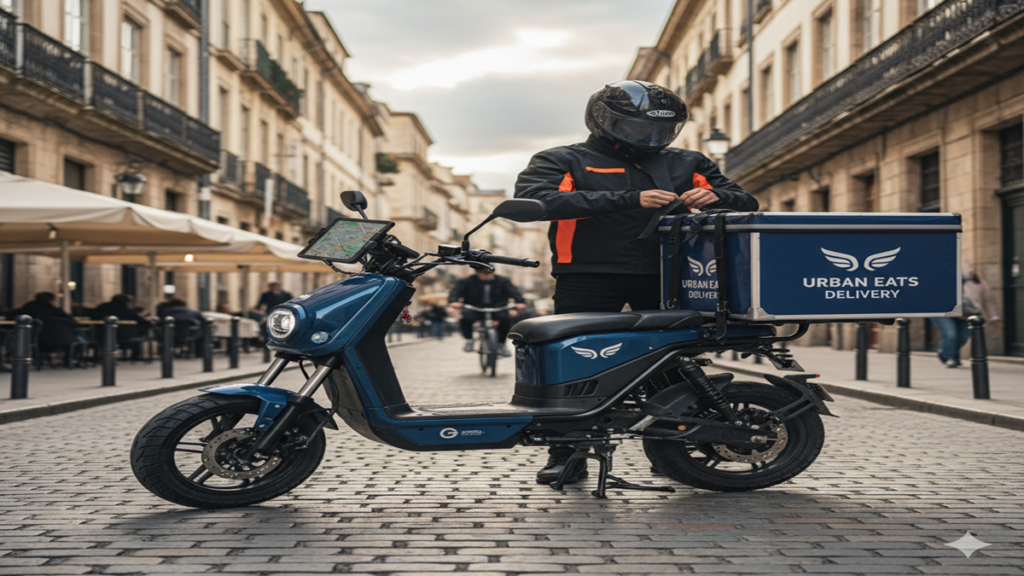
Electric Scooter For Delivery Business: डिलीवरी बिजनेस को बनाएं सुपर फास्ट और किफायती; जानें बेस्ट स्कूटर्स और सरकारी लाभ!
Introduction:
Electric Scooter For Delivery Business: आजकल सड़कों पर हमें फूड डिलीवरी, कूरियर और ग्रोसरी डिलीवरी करने वाले हजारों वाहन दिखते हैं। पहले ये डिलीवरी मुख्य रूप से पेट्रोल बाइक्स पर होती थी, लेकिन बढ़ती पेट्रोल की कीमतों ने डिलीवरी पार्टनर्स और लॉजिस्टिक्स कंपनियों का मुनाफा कम कर दिया है। यही कारण है कि “Electric Scooter For Delivery Business” आज के समय की सबसे बड़ी जरूरत बन गया है।
इलेक्ट्रिक स्कूटर न केवल पर्यावरण के अनुकूल हैं, बल्कि इनका प्रति किलोमीटर खर्च पेट्रोल के मुकाबले 90% तक कम है। यदि आप भी डिलीवरी का बिजनेस शुरू करना चाहते हैं या अपनी फ्लीट (Fleet) को अपग्रेड करना चाहते हैं, तो यह लेख आपके लिए एक कंप्लीट गाइड है।
1. डिलीवरी बिजनेस के लिए इलेक्ट्रिक स्कूटर ही क्यों? (Benefits)
- कम परिचालन लागत (Low Operating Cost): पेट्रोल बाइक का खर्च ₹2.5 – ₹3 प्रति किमी आता है, जबकि इलेक्ट्रिक स्कूटर मात्र 15 से 20 पैसे प्रति किमी में चलता है।
- न्यूनतम मेंटेनेंस (Low Maintenance): इलेक्ट्रिक स्कूटर्स में इंजन, गियरबॉक्स या क्लच नहीं होता, जिससे सर्विसिंग का खर्चा नाममात्र रह जाता है।
- भारी पेलोड क्षमता (High Payload): कमर्शियल इलेक्ट्रिक स्कूटर्स को में राहत देती है।
2. डिलीवरी के लिए बेस्ट इलेक्ट्रिक स्कूटर्स (Top Models 2026)
क. Hero Electric Nyx:
Electric Scooter For Delivery Business: डिवरी बिजनेस के लिए यह सबसे लोकप्रिय मॉडल है। इसकी लंबी सीट और बड़ा फुटबोर्ड सामान रखने के लिए पर्याप्त जगह देता है। इसकी रेंज लगभग 100-120 किमी है।
ख. Okinawa Dual:
Electric Scooter For Delivery Business: इसे विशेष रूप से लॉजिस्टिक्स के लिए बनाया गया है। इसमें पीछे की तरफ बड़ी बास्केट या डिलीवरी बॉक्स लगाने की सुविधा मिलती है। इसकी पेलोड क्षमता 150-200 किलो तक है।
ग. Yulu Wynn:
Electric Scooter For Delivery Business: छोटे दायरे (Last Mile Delivery) के लिए यह एक सस्ता और अच्छा विकल्प है। इसमें लाइसेंस की जरूरत नहीं पड़ती, जो इसे नए डिलीवरी बॉयज के लिए आसान बनाता है।
घ. Bounce Infinity E1 (Swappable Battery):
Electric Scooter For Delivery Business: डिलीवरी बिजनेस के लिए ‘बैटरी स्वैपिंग’ सबसे बड़ी क्रांति है। जब बैटरी खत्म हो, तो स्टेशन पर जाकर मात्र 1 मिनट में फुल चार्ज बैटरी से बदल लें।
3. डिलीवरी स्कूटर चुनते समय किन बातों का ध्यान रखें? (Buying Guide)
- रेंज (Range): डिलीवरी के लिए कम से कम 80-100 किमी की रियल वर्ल्ड रेंज वाला स्कूटर चुनें।
- चार्जिंग समय (Charging Time): फास्ट चार्जिंग सपोर्ट वाला स्कूटर बेहतर होता है। बैटरी स्वैपिंग का विकल्प हो तो सबसे अच्छा।
- बैटरी लाइफ: LFP (Lithium Ferro Phosphate) बैटरी वाली गाड़ियाँ चुनें क्योंकि इनकी लाइफ लंबी होती है।
- बनावट (Durability): चूंकि डिलीवरी के लिए खराब रास्तों पर चलना पड़ता है, इसलिए स्कूटर की बॉडी और सस्पेंशन मजबूत होना चाहिए।
4. कमाई का गणित: पेट्रोल बनाम इलेक्ट्रिक (Cost Comparison)
| विवरण | पेट्रोल बाइक (100km/दिन) | इलेक्ट्रिक स्कूटर (100km/दिन) |
| ईंधन खर्च | ₹250 – ₹300 | ₹15 – ₹25 |
| महीने का खर्च | ₹7,500 – ₹9,000 | ₹450 – ₹750 |
| सालाना बचत | – | ₹80,000 – ₹1,00,000 |
4. अक्सर पूछे जाने वाले प्रश्न (FAQs)
Q1: क्या डिलीवरी बिजनेस के लिए ईवी लोन पर सब्सिडी मिलती है?
Ans: हाँ, पीएसयू बैंकों और एनबीएफसी (NBFC) से कमर्शियल ईवी के लिए लोन लेने पर ब्याज दरों में छूट और राज्य सरकारों द्वारा कैश सब्सिडी दी जाती है।
Q2: बैटरी स्वैपिंग क्या है?
Ans: यह एक ऐसी तकनीक है जिसमें आप अपनी डिस्चार्ज बैटरी को चार्जिंग स्टेशन पर जमा करके तुरंत चार्ज की हुई बैटरी ले सकते हैं। यह डिलीवरी पार्टनर्स का समय बचाता है।
Q3: क्या डिलीवरी स्कूटर्स के लिए ड्राइविंग लाइसेंस जरूरी है?
Ans: यदि स्कूटर की टॉप स्पीड 25 किमी/घंटा से कम है, तो लाइसेंस की जरूरत नहीं है। लेकिन कमर्शियल उपयोग के लिए हाई-स्पीड स्कूटर्स (45+ किमी/घंटा) और लाइसेंस बेहतर होते हैं।
Conclusion: स्मार्ट बिजनेस, ज्यादा मुनाफा!
Electric Scooter For Delivery Business अपनाना न केवल पर्यावरण के लिए अच्छा है, बल्कि यह आपके बिजनेस को आर्थिक रूप से मजबूत बनाता है। 2026 तक भारत के अधिकांश डिलीवरी फ्लीट इलेक्ट्रिक होने की ओर बढ़ रहे हैं। यदि आप आज निवेश करते हैं, तो आप लंबे समय में लाखों रुपये की बचत करेंगे।
Electric Scooters in India: Powering the Last Mile and Revolutionizing the Delivery Business
Electric Scooter For Delivery Business It’s not the incessant honking of diesel trucks or the sputter of ageing two-stroke engines, but the near-silent, efficient hum of electric scooters. This quiet revolution is most visible in the hands of delivery executives, weaving through traffic with boxes of food, parcels, and groceries strapped to their backs. For India’s booming delivery sector—a lifeline for e-commerce giants like Amazon and Flipkart, food aggregators like Swiggy and Zomato, and countless hyper-local services—the electric scooter is rapidly transitioning from a novelty to a necessity. This article explores the powerful synergy between India’s delivery business and electric scooters, examining the drivers, economic models, challenges, and future roadmap of this transformative shift.
The Perfect Storm: Convergence of Megatrends
Electric Scooter For Delivery Business: The rise of the electric scooter (e-scooter) as the preferred vehicle for delivery is no accident. It is the result of a unique convergence of economic, environmental, and technological trends shaping modern India.
- Electric Scooter For Delivery Business: The Explosion of the Delivery Economy: India’s delivery sector is on a stratospheric rise. Driven by deep smartphone penetration, affordable data, and changing consumer habits, the market is projected to reach $8-10 billion by 2025. From meals to medicines, electronics to eyewear, the promise of quick, door-step delivery has created an insatiable demand. This has spawned a massive fleet of delivery riders, estimated in the millions, who collectively cover billions of kilometers annually.
- The Crushing Weight of Fuel Costs: For a delivery executive, fuel is the single largest operational expense. With petrol prices consistently above ₹100 per litre in major cities, the economics of petrol-powered scooters (delivering 40-50 km/litre) become punishing. A significant portion of their daily earnings—often 30-40%—is siphoned off by fuel stations. This directly impacts their take-home income and the profitability of delivery platforms.
- Electric Scooter For Delivery Business: The Imperative for Sustainable Urban Mobility: Indian cities dominate global lists of the most polluted. The contribution of vehicular emissions, especially from two-wheelers which constitute over 75% of the vehicle fleet, is substantial. Governments at the national and state level are under immense pressure to clean the air. Electrifying the high-utilization delivery fleet presents a low-hanging fruit with an immediate and measurable impact on urban emissions and noise pollution.
- Electric Scooter For Delivery Business: Policy Push: FAME and Beyond: The Indian government’s Faster Adoption and Manufacturing of Electric Vehicles (FAME) II scheme has been a catalyst. While initially focused on incentives for buyers, its emphasis has evolved. Subsidies for commercial vehicles, especially two-wheelers, have been strengthened. Many states offer additional subsidies, road tax exemptions, and registration fee waivers for EVs, making the upfront cost more palatable. Furthermore, the government’s production-linked incentive (PLI) scheme for Advanced Chemistry Cell (ACC) battery manufacturing aims to bring down the cost of the most expensive component—the battery.
The Economic Calculus: Why E-Scooters Make Business Sense
Electric Scooter For Delivery Business: For the key stakeholders—the delivery executive, the fleet owner, and the aggregator platform—the shift to electric is fundamentally a compelling financial decision.
For the Delivery Executive (The Rider):
- Electric Scooter For Delivery Business: Drastic Reduction in Running Cost: This is the most significant advantage. The cost of electricity to charge an e-scooter is a fraction of petrol. Running cost plummets from ₹2-2.5 per km on petrol to about ₹0.40-0.50 per km on electricity. For a rider covering 80-100 km a day, this translates to daily savings of ₹120-₹200, directly boosting net earnings by ₹3,000-₹6,000 per month.
- Lower Maintenance: E-scooters have far fewer moving parts—no engine oil, spark plugs, clutch, or complex gearbox. This means negligible maintenance costs, fewer breakdowns, and less downtime. Regular servicing is often limited to brake pads, tires, and occasional software updates.
- Easier to Ride: With no gears and instant torque, e-scooters are less physically taxing in stop-start traffic, reducing rider fatigue over long shifts.
For Fleet Operators and Aggregator Platforms (Swiggy, Zomato, etc.):
- Electric Scooter For Delivery Business: Predictable Operating Expenses: Electricity prices are stable compared to volatile petrol prices, allowing for better financial planning and standardized payout models.
- Brand Image and ESG Goals: Deploying a green fleet strengthens brand identity as an environmentally responsible company, appealing to conscious consumers and investors. It directly contributes to ESG (Environmental, Social, and Governance) targets.
- Potential for Fleet Management: IoT-enabled e-scooters allow platforms to monitor vehicle health, battery status, and rider behavior in real-time, optimizing fleet utilization and safety.
- Electric Scooter For Delivery Business: Attracting and Retaining Riders: By offering riders e-scooters through leasing partnerships or facilitating easier ownership, platforms can reduce rider attrition—a major pain point in the industry—by improving their earning potential.
The Emerging Models of Adoption
Electric Scooter For Delivery Business: The ecosystem has innovated to overcome the high initial purchase price of e-scooters (typically ₹1-1.5 lakh, even after subsidies).
- Direct Ownership (Rider-Owned): Ambitious and stable riders are increasingly taking loans or using savings to buy their own e-scooters, attracted by the long-term savings. OEMs and NBFCs are creating tailored loan products for this segment.
- Fleet Leasing/Rental Models: This is becoming the dominant model for large-scale adoption. Companies like Yulu, Bounce, and Zypp Electric (formerly known as Mobycy) own and maintain large fleets of e-scooters (often purpose-built for delivery) and lease them to delivery executives on a daily, weekly, or monthly subscription basis. This model removes the upfront cost barrier for the rider and bundles in charging/battery swapping, insurance, and maintenance.
- Battery Swapping: Pioneered by Sun Mobility and adopted by OEMs like Hero Electric and Bounce, this model addresses the twin challenges of long charging time and range anxiety. Riders can exchange a depleted battery for a fully charged one at a swapping station in under two minutes, mimicking the petrol refill experience. This is particularly effective for delivery riders who cannot afford 3-4 hour charging breaks during peak delivery hours.
- Electric Scooter For Delivery Business: Platform-Aggregator Partnerships: Delivery giants are forming deep partnerships with EV fleet operators and OEMs. For instance, Zomato has committed to 100% EV adoption by 2030 and partners with multiple fleet operators. Swiggy has similar partnerships and its own pilot programs. These partnerships often include preferential pricing and integrated app experiences for riders.
Navigating the Roadblocks: The Challenges Ahead
Electric Scooter For Delivery Business: Despite the clear momentum, the journey to full electrification is fraught with challenges.
- High Upfront Capital Cost: Even with subsidies, the purchase price of a reliable, long-range e-scooter is nearly double that of a conventional ICE scooter. This remains the primary barrier to widespread direct ownership.
- Charging Infrastructure Paradox: While home charging is sufficient for personal use, delivery riders need public charging points to top up during shifts. India’s public charging infrastructure, especially for two-wheelers, is still in its infancy, concentrated in metros. Riders without secure parking also fear battery theft.
- Range Anxiety and Performance Concerns: Although daily delivery ranges (80-120 km) are within the capability of most modern e-scooters (claimed range 100-150 km), real-world range can drop with load, terrain, and aggressive riding. The fear of being stranded with a dead battery during a shift is real.
- Vehicle Durability & Suitability: Delivery scooters endure extreme punishment—carrying heavy loads, operating for 12+ hours daily, and traversing poor roads. The market needs vehicles specifically engineered for this rugged duty cycle, with robust frames, enhanced suspension, and powerful brakes. Not all consumer-grade e-scooters are up to the task.
- Financing Hurdles: Many traditional banks are still wary of financing EVs due to concerns about resale value, battery life, and the evolving technology. While improving, access to easy credit for riders remains a constraint.
- Electric Scooter For Delivery Business: The Battery Question: Battery degradation over time (typically 3-5 years before significant capacity loss) poses a future cost. Establishing a streamlined and efficient recycling ecosystem for end-of-life lithium-ion batteries is critical to the sustainability story.
The Road Ahead: Electrifying the Future of Deliveries
Electric Scooter For Delivery Business: The trajectory is unmistakably positive. Several developments will accelerate this transition:
- Next-Generation Product Innovation: OEMs are now designing “Purpose-Built Delivery Vehicles.” These feature larger wheelbases, integrated lockable cargo boxes, modular and hot-swappable batteries, ultra-low maintenance drivetrains, and durable construction. Companies like Omega Seiki Mobility, Euler Motors, and even established players like TVS and Bajaj are launching products specifically for this segment.
- Electric Scooter For Delivery Business: Infrastructure Build-out: The government’s focus on charging infrastructure, coupled with private investment from energy companies (like Tata Power and Reliance) and dedicated startups (like Charzer and Statiq), will densify the charging network. Battery swapping will play a complementary, crucial role in commercial applications.
- Evolution of Business Models: We will see more integrated “Vehicle-as-a-Service” (VaaS) models, where the rider pays a single fee covering the scooter, battery, charging/swapping, insurance, and maintenance. This transfers all operational complexity to the provider.
- Data & Technology Integration: IoT data from fleets will be used to optimize delivery routes based on real-time battery status, locate the nearest swapping station, and predict maintenance needs, creating a smarter, more efficient ecosystem.
- Electric Scooter For Delivery Business: Green Warehouses & Hubs: The electrification will extend beyond last-mile. Micro-fulfillment centers and dark stores in cities will increasingly use rooftop solar to charge their delivery fleets, creating a truly green supply chain loop.
Conclusion: A Silent Transformation with a Loud Impact
Electric Scooter For Delivery Business: The adoption of electric scooters in India’s delivery business is more than just a vehicle replacement strategy. It is a holistic transformation that touches economics, environment, and employment. It puts more money in the pockets of millions of delivery executives, reduces the toxic haze over India’s cities, and positions the country as a pragmatic leader in sustainable logistics.
While challenges around cost, infrastructure, and vehicle design persist, the collective push from policymakers, innovative OEMs, agile fleet operators, and determined aggregator platforms is creating an irreversible momentum. The sight of a silent, zero-emission electric scooter darting through a crowded street, delivering not just a package but also a promise of a cleaner, more efficient future, is becoming the defining image of urban India’s progress. The revolution is not coming; it is already here, one delivery at a time.