


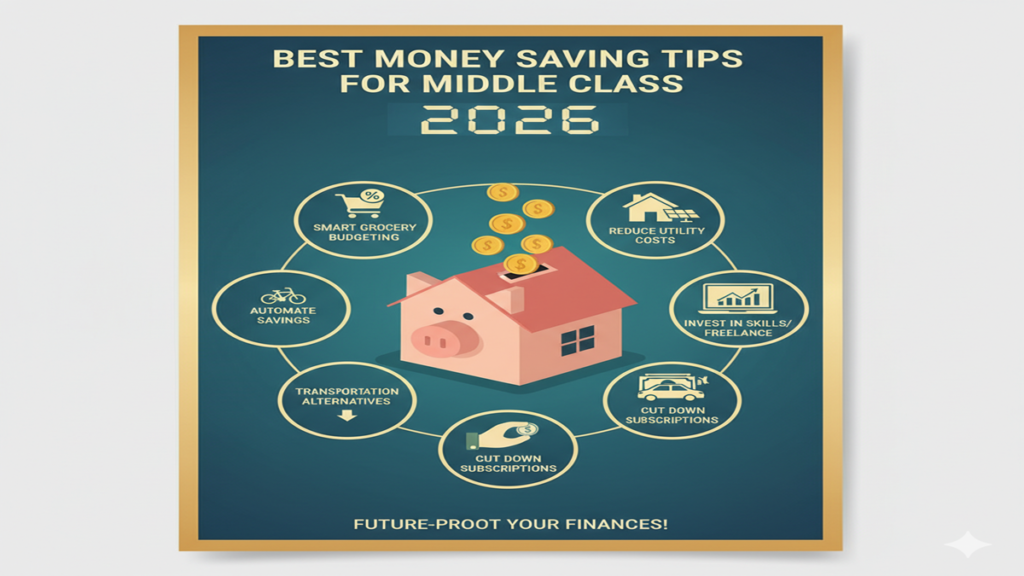
Future-Proof Your Finances: The Ultimate Money-Saving Guide for the Middle Class in 2026
Best Money Saving Tips For Middle Class 2026 The middle class has always been the engine of the economy, but navigating personal finances feels increasingly like a high-wire act. In 2026, the landscape is defined by a potent mix of lingering inflation, ubiquitous AI integration, climate-driven costs, and a gig economy that offers both flexibility and instability. The old playbook of “cut out your daily latte” is woefully inadequate. True financial resilience now requires a strategic, tech-savvy, and forward-looking approach.
This guide is not about deprivation; it’s about intelligent optimization. It’s designed to help you harness new tools, anticipate emerging trends, and build a savings buffer that can withstand the unique pressures of this era. Let’s dive into the best money-saving strategies tailored for 2026.
Part 1: The 2026 Mindset: From Reactive to Proactive Saving
Before specific tips, you must adopt the core mindset:
- Data is Your Most Valuable Asset: Your spending data, energy usage, subscription audits—these are the keys to unlocking savings.
- Automation is Non-Negotiable: In a world of digital noise, “set and forget” systems protect your savings from your willpower’s bad days.
- Sustainability Equals Savings: The green choice is increasingly the financially savvy choice, thanks to incentives and long-term cost reductions.
- Your Skills Are a Savings Account: Continuous, lean learning is the best hedge against economic uncertainty.
Part 2: The Core Savings Strategies for 2026
1. Master the AI-Powered Financial Dashboard
Forget simple budgeting apps. 2026 is about integrated dashboards.
- Tool Up: Use platforms like Copilot, Rocket Money, or the next generation of AI-native banking apps that do more than categorize—they predict. They’ll analyze cash flow to suggest the optimal day to pay a credit card, identify subscription price creep you missed, and forecast next month’s spending based on your calendar.
- Action: Sync all accounts (checking, credit, investments, even loyalty programs) to one primary dashboard. Spend 10 minutes weekly reviewing its AI-generated insights. Let it automatically cancel unused subscriptions and negotiate bills.
2. The “Climate-Proof” Your Home & Transport Audit
Energy and insurance costs are volatile. Proactive management yields major savings.
- The Home Audit: Use a smart home system or a dedicated energy monitor (like Sense or Emporia) to pinpoint vampire energy drains. In 2026, explore:
- Demand-Response Programs: Get paid by your utility company to let them slightly modulate your smart thermostat or EV charger during peak grid stress.
- Incentive Aggregation: Use services that scan for all applicable federal, state, and local rebates for insulation, heat pumps, and solar panels. The upfront cost is dropping, and the long-term lock-in on energy rates is invaluable.
- The Transport Triage: With hybrid work models solidified, reassess the two-car household. For the secondary vehicle, consider switching to a subscription-based car service (like Audi on Demand or Care by Volvo) for months you need it, rather than owning a depreciating asset. For daily use, leverage apps that find the cheapest fuel (including electric charging) on your route and optimize insurance through telematics (pay-as-you-drive).
3. The Precision Grocery & Food System
Inflation hits hardest at the grocery store. Fight back with data.
- Leverage Price-Tracking Apps: Use Flipp, Basket, or supermarket apps to build digital carts across stores. In 2026, AI will do this automatically, creating a weekly “optimal buy list” split between retailers.
- Embrace Strategic Meal Kits: For busy weeks, a meal kit can save money by eliminating food waste and impulse takeout. The key is strategic: use them for 2-3 meals during your most hectic weeknights, not for every meal. Pause or cancel easily.
- Optimize Loyalty Programs Rigorously: Don’t just scan your card; use the retailer’s app to “clip” digital coupons and load personalized offers directly to your loyalty account. The savings are now almost entirely app-based.
4. Implement “Stealth” Savings & Debt Destruction
Make saving and debt repayment frictionless and intelligent.
- Round-Up 2.0: Use round-up apps that invest the spare change into a micro-investment portfolio (like Acorns), but take it further. Set up “boosters” like rounding up to the nearest $5 on weekends or doubling round-ups on days you don’t commute.
- The “Debt Avalanche” on Autopilot: Use a free tool like Undebt.it to chart your payoff plan. Then, set up automatic, bi-weekly (not monthly) extra payments toward your highest-interest debt. Bi-weekly payments result in one extra full payment per year, shaving months off your timeline.
- High-Yield Everything: In 2026, letting cash sit in a traditional savings account is a loss. Your emergency fund and short-term savings must be in a high-yield savings account (HYSA) or money market fund (MMF) from a reputable online bank. Automatically sweep any excess cash over your checking buffer into these accounts weekly.
5. Invest in “Micro-Upskilling” & Side Hustle Optimization
Your earning potential is your greatest wealth-building tool.
- Lean Learning: Instead of expensive degrees, use LinkedIn Learning, Coursera, or industry-specific platforms for 1-2 hour weekly skill boosts. Focus on “adjacent skills” for your field (e.g., a marketer learning basic data analytics; a teacher learning curriculum design software). This makes you indispensable and opens internal promotion paths.
- The “Gig Stack”: If you have a side hustle, optimize it. Use HARPA AI or similar tools to automate client communication and scheduling. Dedicate a separate, no-fee business checking account (from Novo or Lili) for it to track income and expenses effortlessly. Pre-pay estimated quarterly taxes into a separate HYSA to avoid surprises.
6. The Annual “Subscription & Service” Re-Negotiation Ritual
Schedule one day each January for this.
- Beyond Streaming: Call your internet, mobile, and insurance providers. Use competitor quotes (easily found online) as leverage. In 2026, threaten to switch to a mobile virtual network operator (MVNO) like Mint Mobile or Google Fi for drastic cell savings.
- Insurance Re-Shop: Don’t just renew. Get quotes from competitors and ask your current provider to match. Increase deductibles on older vehicles if you have a solid emergency fund.
- The “Family Plan” Maximization: Formally share streaming, cloud storage, and even certain software subscriptions with trusted family or friends. Use Venmo to split costs annually.
7. Redefine “Frugal” Fun: The Experience Economy on a Budget
Social connection is vital, but doesn’t require lavish spending.
- The “Potluck & Game Night” Renaissance: Host themed potlucks or board game nights. The cost is minimal, and the engagement is high-quality.
- Master Your City’s “Off-Peak” Culture: Museums, theaters, and galleries often have “pay-what-you-wish” evenings, discounted matinees, or free community days. Sign up for their newsletters to be first in the know.
- The “Skill Swap” Party: Trade skills with friends—you teach basic photo editing, they teach you how to change your car’s air filter or bake sourdough. This builds community and saves on professional services.
Part 3: Looking Ahead: Preparing for 2027 and Beyond
The strategies for 2026 are about adapting to the present while eyeing the future. By becoming data-driven, automating your financial defenses, and investing in your human capital, you’re not just saving money—you’re building a robust, adaptable financial system that can thrive amid constant change. Start with one or two strategies that resonate most, systematize them, and then build from there. Your future self will thank you.
FAQ: Best Money Saving Tips for the Middle Class in 2026
Q1: I’m overwhelmed by all the apps and tech. Do I really need to use AI to save money?
A: You don’t need AI, but it provides a massive efficiency advantage. Think of it as a full-time, free financial assistant. If it feels overwhelming, start with just one tool: use Rocket Money to track subscriptions and negotiate one bill. The goal isn’t to master every platform, but to let one key tool do the tedious work for you, freeing up your mental energy.
Q2: With high interest rates, should I prioritize paying off debt or building savings?
A: This is a critical 2026 balancing act. The rule of thumb is: Build a “mini-emergency fund” of $1,000-$2,000 first (to avoid new debt from a small crisis). Then, aggressively attack high-interest debt (anything over 7-8% interest). However, simultaneously, try to contribute enough to your 401(k) to get any employer match—it’s an instant 100% return. Once high-interest debt is gone, fully fund your emergency savings (3-6 months of expenses) in a HYSA before focusing on other investments.
Q3: Are smart home devices and electric vehicles really money-savers, given their high upfront cost?
A: They are strategic, long-term investments, not instant saves. The calculation has improved dramatically by 2026. For EVs, you must factor in federal/state tax credits, significantly lower “fueling” costs (especially with home solar), and reduced maintenance. For smart thermostats/energy monitors, their savings come from behavioral insights and participation in utility savings programs. Always run the numbers for your specific home, driving habits, and local incentives—the payoff period is shorter than ever.
Q4: How can I save on groceries without spending hours couponing?
A: The game has changed. It’s less about paper coupons and more about strategic app use. Spend 5 minutes before your shop: open your main grocery store’s app, “clip” all digital coupons (they often apply automatically), and check the weekly digital ad. Then, use a price comparison app like Flipp for one big-ticket item (like meat or diapers) to see if it’s cheaper elsewhere.
Q5: I’m worried about job stability. What’s the best way to “save” for potential income loss?
A: The best savings is earning potential diversification. Alongside your 3-6 month emergency fund in a HYSA, invest in “side skill” development. Dedicate a small monthly amount (even $20) to a learning platform. Use free resources to build a basic, actionable skill (e.g., SEO writing, basic video editing, Notion automation) that could be monetized on a platform like Upwork or Fiverr within 3-6 months. This turns a potential crisis from “I have no income” to “I need to activate my side-income plan,” which is a far less precarious position.