Your Gateway to Digital Healthcare: A Complete Guide to ABHA (Ayushman Bharat Health Account) – Eligibility, Documents, and Benefits
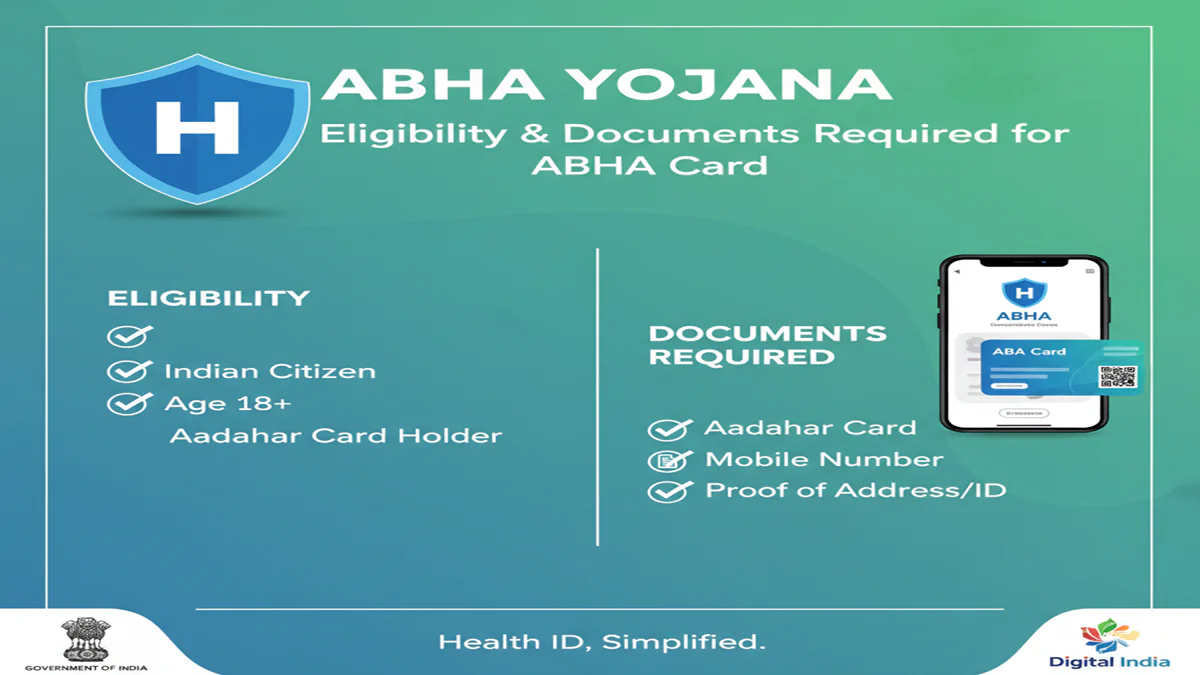
Abha Yojana Eligibility & Documents Required for ABHA Card In an era where technology is seamlessly integrating into every facet of our lives, India’s healthcare sector is undergoing a quiet yet revolutionary transformation. At the heart of this change is theAyushman Bharat Digital Mission (ABDM), a flagship initiative by the Government of India aimed at creating a national digital health ecosystem. The cornerstone of this ambitious mission is theABHA (Ayushman Bharat Health Account) Number, formerly known as the Health ID. This 14-digit unique identifier is designed to bridge the gap between patients, healthcare providers, and digital health services.
If you’ve heard about the “Abha Yojana” or “Abha Card” and are wondering how to be a part of this digital health revolution, this comprehensive guide is for you. We will demystify the ABHA, delve deep into its eligibility criteria, list out all required documents, and walk you through the simple creation process.
Understanding ABHA: More Than Just a Number
Before we jump into the “how,” it’s crucial to understand the “why.” The ABHA number is not just another card to carry in your wallet; it is a key that unlocks a future of streamlined, accessible, and personalized healthcare.
What is an ABHA Number?
An ABHA number is a randomly generated 14-digit number that uniquely identifies you as a participant in India’s digital healthcare ecosystem. It allows you to:
- Consolidate Health Records: Securely link and access your medical records from different hospitals, labs, and clinics in one place (with your explicit consent).
- Enable Paperless Healthcare: Share your health history with doctors digitally, eliminating the need to carry physical files and reports.
- Access Telemedicine: Easily sign up for and use various digital health platforms and teleconsultation services.
- Build a Longitudinal Health History: Create a continuous, lifelong record of your health, which can lead to better diagnosis and treatment.
- Control Your Data: You have complete ownership of your health data. You decide who can access your records and for how long.
The ABHA is the foundation upon which a unified health infrastructure is being built, aiming to make healthcare delivery more efficient, transparent, and patient-centric.
Part 1: ABHA Yojana Eligibility – Who Can Apply?
One of the most empowering aspects of the Abha Yojana is its universal and inclusive eligibility. The Government of India has designed it to be accessible to every resident of India.
Here is the complete eligibility criteria for creating an ABHA number:
1. Citizenship/Residency:
- Primary Eligibility: You must be a resident of India. This is the fundamental criterion.
- Important Clarification: It is not mandatory to be an Indian citizen. The ABDM guidelines explicitly state that the ABHA number is for “residents.” This includes Non-Resident Indians (NRIs) who reside in India for the purpose of receiving healthcare, and potentially other foreign nationals residing in India.
2. Age Criteria:
- No Minimum or Maximum Age Limit: An ABHA number can be created for any individual, from a newborn to a senior citizen. This is a truly lifelong identifier.
3. Pre-existing Health Conditions:
- No Restrictions: Whether you are perfectly healthy or managing a chronic condition, you are eligible. The ABHA is designed to be your health companion throughout your life’s journey.
4. Socio-Economic Status:
- No Barriers: The scheme is independent of income, caste, religion, or gender. It is free of cost and aims to bridge the digital divide in healthcare access.
5. Aadhaar Card Holder Status:
- Preferred but Not Mandatory: While having an Aadhaar number simplifies the registration and verification process significantly, it is not an absolute requirement. The ABDM provides multiple pathways to create an ABHA number, including using a mobile number without Aadhaar.
6. For Minors and Dependents:
- Creation by Parents/Guardians: An ABHA number for a child or a dependent can be created by a parent or guardian. The process requires the guardian’s Aadhaar or mobile number for verification and linking.
7. For Individuals without Aadhaar or Mobile Number:
- Assisted Creation: Healthcare providers (like hospitals) enrolled with ABDM can help create an ABHA number using alternative demographic details (like name, year of birth, gender) for individuals who may not have Aadhaar or a personal mobile number. This ensures inclusivity for all sections of society.
In essence, if you are living in India and wish to be part of an organized digital health system, you are eligible for an ABHA number. The government has intentionally kept barriers to entry non-existent to achieve widespread adoption.
Part 2: Documents Required for ABHA Card Creation
The documentation process for ABHA is minimal and digital-friendly. You do not need to submit physical copies of any document. The process involves verification using one or more of the following accepted identity proofs.
Mandatory & Primary Document (Choose one of the following):
- Aadhaar Card: This is the fastest and most recommended method. The ABHA creation process uses Aadhaar-based authentication (via OTP or biometrics) to auto-populate your demographic details (name, date of birth, gender, address), making the process instant and seamless.
If you do not have an Aadhaar Card, you can use the following combination:
- Mobile Number: A mobile number registered in your name is essential for OTP verification. This is the primary mode of authentication for non-Aadhaar based creation.
- Alternate Government ID (for demographic details): While creating an ABHA without Aadhaar, you will need to manually enter details. While not “uploaded,” having one of the following can ensure accuracy:
- Driving License
- PAN Card
- Passport
For Creating ABHA for a Child/Dependent:
- Guardian’s Aadhaar/Mobile Number: The parent or guardian will use their own Aadhaar or mobile number for verification.
- Child’s Details: You will need to input the child’s name, gender, and date of birth/year of birth. For newborns, the birth certificate details can be used.
What You Do NOT Need:
- No physical photograph upload is required.
- No income certificate, caste certificate, or ration card is needed.
- No medical records or prescriptions are required at the time of creation.
Summary Table: Documents at a Glance
| Scenario | Primary Document | Supporting for Verification | Method |
|---|---|---|---|
| For Individuals with Aadhaar | Aadhaar Number | Mobile Number linked to Aadhaar | Aadhaar-based OTP/Biometric Auth |
| For Individuals without Aadhaar | Mobile Number (Self) | Driving License/PAN/Passport (for accurate details) | Mobile OTP + Manual Entry |
| For Minors (with Guardian Aadhaar) | Guardian’s Aadhaar | Guardian’s Mobile Number | Aadhaar-based Auth for Guardian |
| For Minors (without Aadhaar) | Guardian’s Mobile Number | Child’s Birth Certificate (for details) | Mobile OTP + Manual Entry |
| Assisted Creation (at Hospital) | Basic Demographics (Name, DoB, Gender) | — | Created by ABDM-enabled Healthcare Provider |
Part 3: Step-by-Step Guide to Creating Your ABHA Number
Creating your ABHA is free and can be done in a few minutes from the comfort of your home using your smartphone. Here are the primary methods:
Method 1: Using the Official ABHA App (Health Records App)
- Select “Create Your ABHA“.
- Choose “Using Aadhaar” (recommended) or “Without Aadhaar“.
- If using Aadhaar: Enter your Aadhaar number, authenticate via OTP sent to your Aadhaar-linked mobile. Review auto-filled details, set a password, and your ABHA number is generated instantly.
- If without Aadhaar: Enter your mobile number, verify via OTP. Manually enter your name, year of birth, gender, etc. Submit to get your ABHA number.
Method 2: Via the ABDM Website
- Visit the official portal:
https://abha.abdm.gov.in/ - Click on “Create ABHA Number“.
- Follow the same steps as in the app, choosing between Aadhaar or non-Aadhaar methods.
Method 3: Through a Participating Healthcare Facility
- Visit any ABDM-integrated hospital, clinic, or lab.
- Request the frontline staff or the Ayushman Bharat Health Account counter to help you create an ABHA.
- They will use their system to generate it for you, often via Aadhaar authentication or demographic details.
Method 4: Using your Bank Account (NPCI Partnership)
- Some banks (like SBI) have integrated ABHA creation within their internet banking or ATM services.
- Log in to your net banking portal and look for the “Create ABHA” or “Link Health ID” option.
What Happens After Creation?
Once created, you will receive your:
- 14-digit ABHA Number (e.g., 14-8144-5106-1896)
- A publicly shareable ABHA Address (e.g.,
yourname@abdm), which you can choose to create—it acts like an email ID for your health records.
You can immediately start using this number to register on other ABDM-compliant health apps (like Aarogya Setu, Eka Care, etc.) and begin linking your health records.
Part 4: Beyond Creation: Using, Benefits, and Addressing Concerns
Linking Health Records (PHR – Personal Health Record):
The real power of ABHA is realized when you start building your digital health ledger. You can use ABHA-compatible PHR (Personal Health Record) apps to:
- Scan and Upload: Use the app to scan QR codes on your physical lab reports or prescription papers from ABDM-enabled facilities. The records get digitally linked to your ABHA.
- Consent Manager: You will have a dashboard to see which healthcare providers have accessed your records and revoke access anytime.
Key Benefits and the Bigger Picture:
- For You (The Patient): No more worrying about lost reports. Facilitates smooth second opinions and continuity of care. Empowers you with data ownership.
- For Doctors: Provides a comprehensive health history at a glance, leading to accurate diagnosis and reducing repetitive tests.
- For the Nation: Enables data-driven policymaking, efficient public health management, and fosters innovation in health-tech.
Addressing Common Concerns:
- Privacy & Security: ABDM follows a federated architecture. Your health data is not stored in a central government database. It remains with the healthcare providers where you were treated. The ABHA acts only as a secure index or pointer to these records. Access is strictly based on your dynamic, purpose-specific, and time-bound consent.
- Is it Mandatory? No, ABHA creation is entirely voluntary. You can choose to avail healthcare services without it.
- Linking with Ayushman Bharat PM-JAY: While both are under the Ayushman Bharat umbrella, they are different. ABHA is a digital health ID for all residents. PM-JAY is a health insurance scheme for eligible economically vulnerable families. However, having an ABHA can streamline the claim process under PM-JAY.
Conclusion: Embracing a Healthier, Digital Future
The Abha Yojana is a visionary step towards democratizing healthcare in India. By removing complex eligibility hurdles and keeping the document requirements simple, the government has ensured that this powerful tool is within everyone’s reach. Your ABHA number is more than a digital card; it is your lifelong health companion, giving you control, convenience, and continuity in your healthcare journey.
Taking five minutes today to create your ABHA is an investment in a hassle-free healthcare experience for you and your family for years to come. It is a small step for you, but a giant leap for India’s digital health ecosystem.
Ready to create your ABHA? Start now at: https://abha.abdm.gov.in/
Disclaimer: This article is for informational purposes only. For the most current and official information, please always refer to the official Ayushman Bharat Digital Mission (ABDM) website and guidelines.