


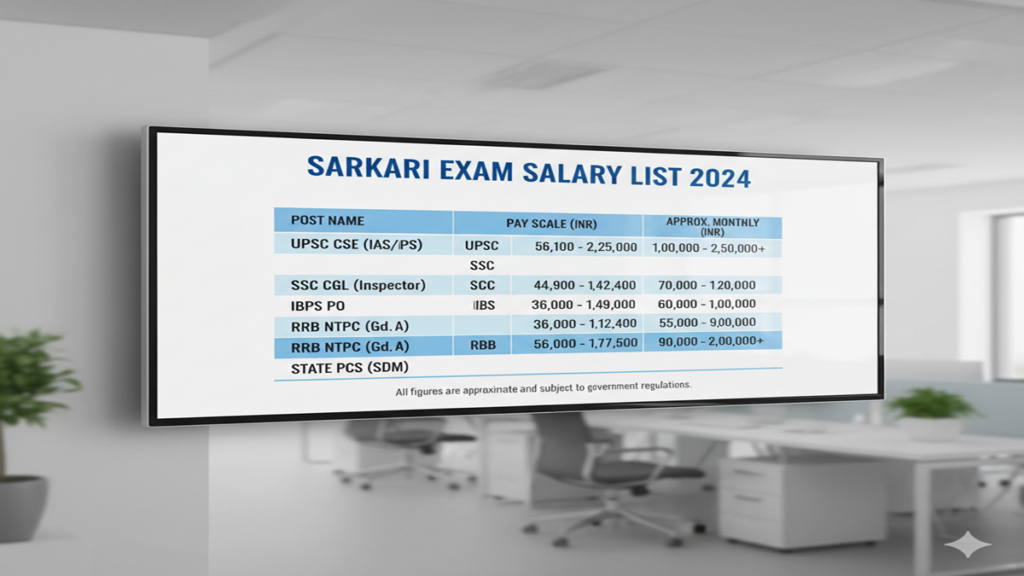
Sarkari Exam Salary List 2026: भारत में सबसे ज्यादा पगार वाली सरकारी नौकरियां; जानें ग्रेड-पे, भत्ते और इन-हैंड सैलरी की पूरी जानकारी!
Introduction:
Sarkari Exam Salary List 2026: क्या आप जानते हैं कि एक सरकारी अधिकारी को केवल वेतन ही नहीं, बल्कि मान-सम्मान, सुरक्षा और ढेरों भत्ते भी मिलते हैं? भारत में सरकारी नौकरी (Sarkari Naukri) की लोकप्रियता का एक बड़ा कारण इसका शानदार सैलरी पैकेज है। साल 2026 में, “Sarkari Exam Salary List” को लेकर उम्मीदवारों में काफी उत्सुकता है, क्योंकि नए भत्तों और वेतन वृद्धि के कारण अब सरकारी विभागों में निजी कंपनियों के मुकाबले बेहतर पैकेज मिल रहा है।
चाहे वह यूपीएससी (UPSC) हो, एसएससी (SSC) या बैंकिंग क्षेत्र, हर विभाग का अपना एक पे-मेट्रिक्स (Pay Matrix) होता है। इस लेख में हम भारत की प्रमुख सरकारी परीक्षाओं और उनके पदों के अनुसार मिलने वाली सैलरी का विस्तृत विश्लेषण करेंगे।
1. टॉप सरकारी परीक्षाओं की सैलरी लिस्ट 2026 (Job-Wise Salary)
Sarkari Exam Salary List 2026: नीचे दी गई तालिका में प्रमुख परीक्षाओं और उनके शुरुआती मासिक वेतन (Gross Salary) की जानकारी दी गई है:
| परीक्षा का नाम | पद (Post) | अनुमानित मासिक वेतन (2026) |
| UPSC CSE | IAS/IPS/IFS (Entry Level) | ₹90,000 – ₹1,20,000 |
| RBI Grade B | Officer | ₹1,05,000 – ₹1,25,000 |
| SSC CGL | Income Tax Inspector / ASO | ₹75,000 – ₹90,000 |
| SBI PO | Probationary Officer | ₹70,000 – ₹85,000 |
| RRB NTPC | Station Master (Level 6) | ₹60,000 – ₹75,000 |
| IBPS Clerk | Office Assistant | ₹35,000 – ₹45,000 |
2. 7वें वेतन आयोग का पे-मेट्रिक्स (7th Pay Commission Structure)
Sarkari Exam Salary List 2026: सरकारी पगार को मुख्य रूप से तीन भागों में बांटा जाता है:
- Basic Pay (मूल वेतन): यह आपके पद के अनुसार निर्धारित न्यूनतम वेतन है। (जैसे लेवल 10 के लिए ₹56,100)।
- Allowances (भत्ते): * DA (Dearness Allowance): महंगाई भत्ता, जो हर 6 महीने में बढ़ता है।
- HRA (House Rent Allowance): मकान किराया भत्ता (शहर के अनुसार 10%, 20% या 30%)।
- TA (Transport Allowance): आने-जाने का खर्च।
- Deductions (कटौती): इसमें NPS (पेंशन), इनकम टैक्स और बीमा का पैसा कटता है।
3. विभाग के अनुसार वेतन विश्लेषण (Deep Dive)
A. UPSC Civil Services (The Apex Pay):
Sarkari Exam Salary List 2026: एक आईएएस (IAS) अधिकारी की शुरुआती बेसिक सैलरी ₹56,100 होती है, लेकिन सभी भत्तों को जोड़कर यह ₹1 लाख के करीब पहुंच जाती है। कैबिनेट सचिव के पद तक पहुँचते-पहुँचते यह ₹2,50,000 प्रति माह हो जाती है।
B. Banking Sector (High Perks):
बैंकिंग क्षेत्र, विशेषकर RBI Grade B और SBI PO, अपने कर्मचारियों को लीज्ड आवास (Leased Accommodation) और पेट्रोल भत्ते जैसी सुविधाएं देते हैं, जिससे उनका कुल पैकेज ₹15 लाख सालाना (CTC) से ऊपर चला जाता है।
C. SSC CGL (Group B & C):
Sarkari Exam Salary List 2026: एसएससी के जरिए इंस्पेक्टर बनने पर आपको लेवल 7 (पे-ग्रेड 4600) मिलता है। दिल्ली या मुंबई जैसे शहरों में पोस्टिंग होने पर इन-हैंड सैलरी ₹80,000 से अधिक होती है।
4. पगार के अलावा मिलने वाली अन्य सुविधाएं (Perks)
- आवास: सरकारी बंगला या क्वार्टर की सुविधा।
- मेडिकल: परिवार के लिए मुफ्त या रियायती इलाज (CGHS)।
- एलटीसी (LTC): साल में एक बार परिवार के साथ घूमने के लिए टिकट का पैसा।
- रिटायरमेंट: ग्रेच्युटी और पेंशन (NPS) की सुरक्षा।
4. अक्सर पूछे जाने वाले प्रश्न (FAQs)
Q1: इन-हैंड सैलरी और ग्रॉस सैलरी में क्या अंतर है?
Ans: ग्रॉस सैलरी (Gross) वह कुल राशि है जो भत्तों को जोड़कर बनती है, जबकि इन-हैंड (In-hand) वह राशि है जो टैक्स और पीएफ कटने के बाद आपके खाते में आती है।
Q2: 2026 में सबसे ज्यादा सैलरी वाली सरकारी नौकरी कौन सी है?
Ans: वर्तमान में RBI Grade B Officer और IAS अधिकारी का पद सबसे अधिक वेतन और सुविधाओं वाला माना जाता है।
Q3: क्या शहर बदलने पर पगार बदलती है?
Ans: हाँ, HRA (मकान किराया भत्ता) शहर के अनुसार (X, Y, Z कैटेगरी) अलग-अलग होता है, जिससे कुल पगार में ₹5,000 से ₹15,000 का अंतर आ सकता है
Conclusion: पगार ही नहीं, करियर का आधार!
Sarkari Exam Salary List केवल आंकड़े नहीं, बल्कि आपकी मेहनत का फल है। २०२६ में सरकारी क्षेत्र में करियर बनाना न केवल आर्थिक रूप से सुरक्षित है, बल्कि समाज में एक प्रतिष्ठित स्थान भी दिलाता है। यदि आप भी इन शानदार सैलरी पैकेज का हिस्सा बनना चाहते हैं, तो आज ही अपनी तैयारी को नई दिशा दें।
Demystifying the Sarkari Exam Salary List: Your Guide to Pay Scales, Perks, and Career Growth
Sarkari Exam Salary List The allure of a “Sarkari Naukri” (government job) in India is multifaceted, blending job security, social prestige, and a structured, rewarding career path. For lakhs of aspirants navigating the labyrinth of UPSC, SSC, State PSCs, and banking exams, one of the most compelling yet confusing aspects is the salary. The term “Sarkari Exam Salary List” often leads to fragmented and outdated information. This comprehensive guide aims to demystify the salary structure for all major government exams, explaining the pay scales, allowances, and the hidden financial benefits that make these positions so coveted.
Understanding the Foundation: The 7th Central Pay Commission (7th CPC)
Sarkari Exam Salary List 2026: Before delving into specific exams, understanding the 7th CPC, implemented in 2016, is crucial. It replaced the complex “Pay Band + Grade Pay” system with a streamlined “Level” system. Salaries are now defined by:
- Pay Matrix Level: Ranging from Level 1 (lowest) to Level 18 (highest e.g., Cabinet Secretary). Each level corresponds to a set of basic pay increments.
- Basic Pay: The core component of the salary, upon which all allowances are calculated.
- Dearness Allowance (DA): A cost-of-living adjustment, revised quarterly as a percentage of the basic pay. Currently, it stands at 50% of basic pay for central employees, significantly inflating the total salary.
- House Rent Allowance (HRA): Varies based on city classification (X, Y, Z).
- Travel Allowance (TA), Medical Benefits, etc.: Other significant additions.
Net Salary = Basic Pay + DA (currently 50%) + HRA (8%-27%) + Other Allowances – Deductions (NPS, Insurance, etc.)
Sarkari Exam Salary List: A Tier-Wise Breakdown
Sarkari Exam Salary List 2026: Here is a detailed, tier-wise breakdown of salaries for jobs acquired through major Sarkari exams, updated with current figures including 50% DA.
Tier 1: All India Services & Group A (Central Civil Services)
Sarkari Exam Salary List 2026: Exams: UPSC Civil Services Exam (IAS, IPS, IFS, IRS, etc.), UPSC Engineering Services Exam (IES), UPSC Combined Defence Services (CDS).
- Designations: IAS, IPS, IFS, IRS Officer, IES Officer, Defence Officer.
- Entry Level: Typically, Level 10 or Level 8 of the Pay Matrix.
- Basic Pay (Entry): ₹56,100/- (Level 10) for most. For example, an IAS officer starts at ₹56,100.
- In-Hand Salary (Approx., at entry):
- Basic Pay: ₹56,100
- DA (50%): ₹28,050
- HRA (27% for X city): ₹15,147
- TA & Other Allowances: ₹5,000 – ₹10,000
- Gross: ~₹1,05,000 – ₹1,10,000
- Deductions (NPS, CGHS, etc.): ₹15,000
- Approx. In-Hand Salary: ₹90,000 to ₹1,00,000 per month.
- Growth: At the apex scale (Cabinet Secretary, Level 18), the basic pay reaches ₹2,50,000, with a total monthly package exceeding ₹3,00,000.
Tier 2: Central Group B & State Group A Services
Sarkari Exam Salary List 2026: Exams: UPSC CAPF (Assistant Commandant), State PSC Civil Services (SDM, DSP, BDO), SSC CGL (for Group B Gazetted posts).
- Designations: CAPF Assistant Commandant, State Police Service Officer (DSP), State Civil Service Officer (SDM/BDO), SSC CGL posts like Assistant Audit Officer, Income Tax Inspector.
- Entry Level: Levels 7, 8, or 9 of the Pay Matrix.
- Basic Pay (Entry): Ranges from ₹44,900/- (Level 7) to ₹56,100/- (Level 8).
- In-Hand Salary (Approx.):
- Basic Pay: ₹44,900 – ₹56,100
- DA (50%): ₹22,450 – ₹28,050
- HRA: ₹8,982 – ₹15,147
- Approx. In-Hand Salary: ₹65,000 to ₹90,000 per month, depending on city and posting.
Tier 3: Non-Gazetted Officers (Central & State)
Sarkari Exam Salary List 2026: Exams: SSC CGL (Non-Gazetted), SSC CHSL, Railway Recruitment Boards (RRB NTPC), IBPS PO/CLERK, State PSC Clerk/Police Exams.
- Designations: Tax Assistant, Auditor, Divisional Accountant (SSC CGL), Lower Division Clerk (SSC CHSL), Station Master (RRB), Probationary Officer (IBPS), Police Sub-Inspector (State).
- Entry Level: Levels 4, 5, 6, or 7 of the Pay Matrix.
- Basic Pay (Entry): Ranges from ₹25,500/- (Level 4) to ₹44,900/- (Level 7).
- In-Hand Salary (Approx.):
- SSC CGL (Auditor/Tax Assistant): ₹45,000 – ₹60,000/month.
- IBPS Probationary Officer: ₹52,000 – ₹55,000/month (initial months), rising quickly with increments.
- Railway NTPC (Station Master/Commercial Clerk): ₹35,000 – ₹50,000/month.
- State Police SI: ₹40,000 – ₹55,000/month (varies by state).
Tier 4: Clerical & Support Staff
Sarkari Exam Salary List 2026: Exams: SSC CHSL, SSC MTS, RRB Group D, State Govt. Clerk Exams.
- Designations: Postal Assistant, Data Entry Operator (DEO), Multi-Tasking Staff (MTS), Railway Track Maintainer, Office Clerk.
- Entry Level: Levels 1, 2, or 3 of the Pay Matrix.
- Basic Pay (Entry): ₹18,000/- to ₹21,700/-.
- In-Hand Salary (Approx.): ₹22,000 to ₹35,000 per month. While the starting figure seems modest, job security, defined working hours, and a full pension (for those under the old scheme) add immense value.
Specialized & Technical Departments
- Sarkari Exam Salary List 2026: Teaching & Research: UGC NET Assistant Professor (Entry Basic Pay: ₹57,700 as per Level 10), ISRO Scientist (₹56,100 at entry), DRDO Scientist.
- Public Sector Undertakings (PSUs): Through GATE, BARC OCES, etc. Salaries often exceed traditional government scales. An MT in a Maharatna PSU like ONGC or NTPC can start with a CTC of ₹16-20 Lakhs per annum.
- Defence Forces: Through NDA, CDS, AFCAT. A Lieutenant in the Army starts with a package of approx. ₹80,000-90,000/month (including all military-specific allowances).
Beyond the Basic Pay: The “Real” Salary of a Sarkari Job
Sarkari Exam Salary List 2026: The in-hand cash is just the tip of the iceberg. The true value lies in the comprehensive benefits package:
- Job Security & Regular Increments: Assured career progression with annual increments and periodic promotions. No fear of arbitrary layoffs.
- Pension & Retirement Benefits: For employees under the Old Pension Scheme (OPS), it’s a lifelong financial haven. The National Pension System (NPS) for post-2004 appointees is also a robust, contributory scheme.
- Allowances (The Game Changer):
- Dearness Allowance (DA): Inflation-proofs your salary. Currently at 50% and likely to rise.
- House Rent Allowance (HRA): Up to 27% of basic for metros.
- Travel Allowance (TA): For official and sometimes personal travel.
- City Compensatory Allowance (CCA): For high-cost cities.
- Special Duty Allowance (SDA): For postings in difficult areas like the North-East (can be substantial).
- Field Area Allowances: For defence and CAPF personnel.
- Healthcare: Subsidized, high-quality medical treatment for self and family through CGHS/REHS.
- Work-Life Balance: Fixed working hours, ample leave (casual, earned, medical), and national holidays.
- Subsidized Facilities: Government accommodation in many posts, loans at concessional rates, and access to clubs and recreational facilities.
- Social Status & Impact: The respect and ability to influence public policy and implementation is an intangible yet significant reward.
Choosing the Right Exam: Aligning Aspiration with Compensation
Sarkari Exam Salary List 2026: Your career choice should not be based on starting salary alone. Consider:
- Long-Term Growth: An IAS officer may start at ~₹90,000 but in 20 years can head departments with immense power and compensation. A PSU job may start higher but have a different growth curve.
- Nature of Work: Do you want field work (IPS, CAPF), policy-making (IAS, IFS), technical challenges (IES, ISRO), or financial regulation (IRS, RBI)?
- Exam Difficulty vs. Reward: The UPSC CSE is arguably the toughest, offering the highest career trajectory. Exams like SSC CGL or IBPS PO offer a great balance of respectable pay, good work profile, and relatively lower competition.
State Government vs. Central Government Salaries: Key Differences
- Sarkari Exam Salary List 2026: Pay Commissions: States generally adopt the central pay commission recommendations but with a time lag and sometimes modifications.
- DA Rates: DA for state employees can differ and is often lower than central rates, impacting total salary.
- Allowances: HRA, TA, and special allowances vary significantly from state to state based on their finances. Prosperous states like Maharashtra, Gujarat, or Karnataka often offer better packages than some others.
- Rule of Thumb: Central government jobs usually offer slightly higher and more uniform pay, while state government jobs offer deeper connection to one’s home region and culture.
Future Outlook: Pay Revisions and Trends
Sarkari Exam Salary List 2026: Salaries are not static. The DA is revised every six months. A major revision will come with the 8th Central Pay Commission, expected around 2026, which will provide the next significant hike. Furthermore, as the government competes with the private sector for talent, especially in technical roles, we are seeing more attractive, performance-linked packages in sectors like Railways, PSUs, and financial institutions.
Conclusion: More Than Just a Number
Sarkari Exam Salary List 2026: The “Sarkari Exam Salary List” reveals a structure designed for dignity, security, and gradual prosperity. While the initial in-hand figure might sometimes be lower than elite private sector packages, the holistic view—factoring in allowances, benefits, work-life balance, pension, and unmatched job security—often makes the government job a superior lifetime financial decision. For an aspirant, the key is to look beyond the starting salary, understand the pay matrix of the target post, and choose an exam that aligns with both your financial goals and your passion for service. Your preparation is an investment in a career that guarantees not just a salary, but a stable and respected life.
Frequently Asked Questions (FAQs)
1. Which Sarkari exam gives the highest starting salary?
Sarkari Exam Salary List 2026: While top-level civil services (IAS/IPS) offer excellent packages, entrance exams for top Public Sector Undertakings (PSUs) like ONGC, NTPC, BHEL through GATE or specific MT exams often offer the highest starting Cost-to-Company (CTC), sometimes ranging from ₹16-25 lakhs per annum. In traditional government, the IAS, IFS, and IRS (Indian Revenue Service) have among the best growth-oriented compensation packages.
2. Is the salary the same across all states for the same post (e.g., Police SI)?
Sarkari Exam Salary List 2026: No, salaries for the same post differ across states. They are determined by the respective State Pay Commissions. While the basic pay might be similar as per central matrix adoption, the Dearness Allowance (DA) and other local allowances vary greatly depending on the state’s finances. An SI in Maharashtra or Tamil Nadu may earn significantly more than an SI in a state with weaker finances.
3. What is the major deduction from a government employee’s salary?
Sarkari Exam Salary List 2026: The single largest deduction for employees recruited after January 1, 2004, is the contribution to the National Pension System (NPS), which is 10% of (Basic Pay + DA). Other common deductions include Central Government Health Service (CGHS) contributions, income tax (as per slab), and sometimes group insurance.
4. How much does the Dearness Allowance (DA) impact the total salary?
DA has a massive impact. At the current rate of 50%, it directly adds half of your basic pay to your salary. For example, if your basic pay is ₹50,000, DA adds ₹25,000 immediately. It is revised every six months to offset inflation, making the salary inflation-proof. A future hike to 52% or 54% will further increase the total.
5. Do government officers get a salary during their training period?
Yes, most government officers receive a stipend or salary during training. For example, an IAS officer at the Lal Bahadur Shastri National Academy of Administration receives a stipend (currently around ₹45,000-₹50,000 per month). Similarly, officers in the Armed Forces, RBI, and banking sectors receive a fixed stipend or a reduced initial salary during their probationary training period. This is considered part of the service tenure.