


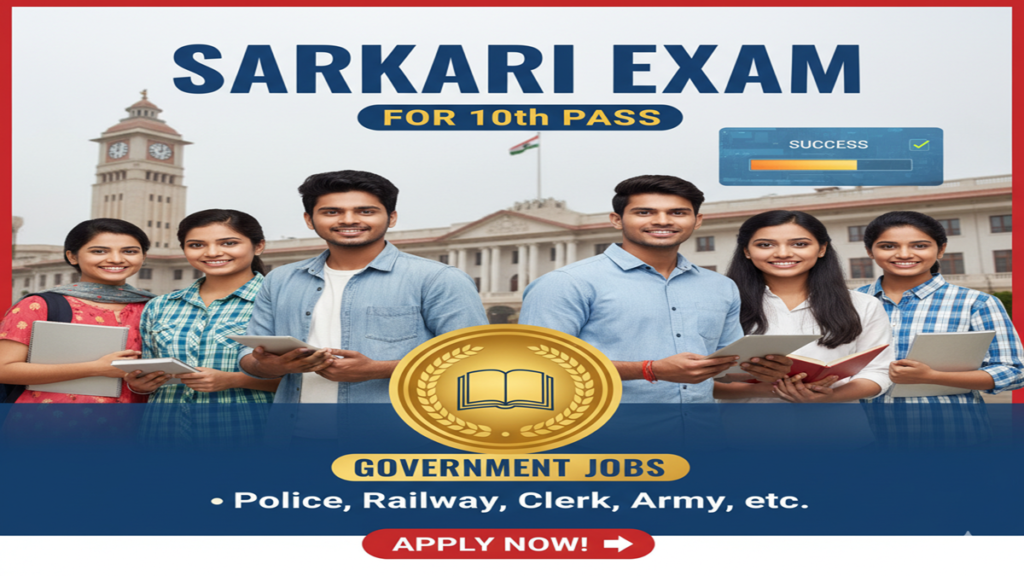
The Complete Guide to Sarkari Exams for 10th Pass Candidates: Launching Your Government Career Early
Introduction
Sarkari Exam For 10th Pass In India, a “Sarkari Naukri” (government job) is synonymous with stability, security, respect, and a host of benefits like dearness allowance, pensions, and medical facilities. While many believe that high-level government posts require advanced degrees, there exists a vast and often underappreciated universe of prestigious and rewarding opportunities for candidates who have just passed their 10th standard (Secondary School Examination).
Choosing to pursue a Sarkari exam right after the 10th grade is a strategic and practical decision. It allows you to enter the workforce early, gain valuable experience, earn financial independence, and often provides a clear pathway for further promotions and career growth through departmental exams. This comprehensive guide aims to demystify the landscape of government jobs for 10th pass candidates, providing a roadmap to navigate eligibility, preparation, and success.
Why Aim for a Sarkari Exam After 10th?
- Early Financial Independence: Start earning a regular salary with perks at a young age, reducing the financial burden on your family and allowing you to plan for the future.
- Job Security: In an unpredictable economic climate, government jobs offer unparalleled job security, a benefit highly valued across generations.
- Skill-Based Opportunities: These jobs are not just about clerical work. They span fields like railways, defense, policing, postal services, and more, offering roles that involve technical skills, physical fitness, and fieldwork.
- Foundation for Growth: Most positions have well-defined promotion ladders. With experience and by clearing departmental exams, a 10th-pass appointee can rise to higher pay grades and positions of responsibility.
- Work-Life Balance and Benefits: Government jobs typically offer reasonable working hours, generous leave policies, housing allowances (HRA), travel allowances (TA), and robust pension schemes under the National Pension System (NPS).
Major Recruiting Bodies and Popular Job Categories
Several central and state government departments regularly recruit 10th pass candidates. Here are the key players:
A. Central Government Recruitment
- Indian Railways: The largest employer in the country offers numerous opportunities.
- Recruiting Body: Railway Recruitment Boards (RRBs) and Railway Recruitment Cells (RRCs).
- Defense Sector:
- Indian Army: Soldier General Duty (GD), Soldier Technical, Tradesman Mate.
- Indian Navy: Sailor (Direct Entry), Artificer Apprentice (AA), Senior Secondary Recruit (SSR).
- Indian Air Force: Agniveer Vayu (for Airmen roles in various trades).
- *Note: While some technical roles in Navy/Air Force require 10+2, many soldier/entry-level posts are open for 10th pass with specific physical standards.*
- Staff Selection Commission (SSC): A premier recruiting body for various ministries and departments.
- Posts: Multi-Tasking Staff (MTS), Lower Division Clerk (LDC) (though LDC often requires 12th pass), Constable in Central Armed Police Forces (CAPFs) like BSF, CRPF, CISF, SSB.
- Posts Department:
- Recruiting Body: The Department of Posts conducts its own exams and also recruits through SSC.
- State Government Recruitment: Opportunities are abundant at the state level.
- Police Departments: Constable (Male/Female), Home Guard.
- Transport Departments: Bus Conductor, Driver, Clerk.
- Other Departments: Village Administrative Officer (VAO – Tamil Nadu), Patwari (Land Record Keeper in many states), Forest Guard, Excise Constable.
Detailed Look at Key Exam Patterns and Syllabus
While patterns vary, most exams for 10th pass candidates follow a similar two or three-tier structure:
1. Written Examination (Objective Type):
This is the first and most common hurdle. The question paper usually tests:
- General Intelligence & Reasoning: Analogies, Classification, Series, Coding-Decoding, Spatial Visualization, Problem Solving.
- Numerical Ability (Quantitative Aptitude): Number Systems, Fundamental Arithmetical Operations (Percentages, Ratio & Proportion, Average, Profit & Loss, Simple Interest), Mensuration, Time & Work, Time & Distance.
- General English: Basic Grammar, Vocabulary (Synonyms, Antonyms), Spelling, Comprehension.
- General Awareness (General Knowledge): Current Affairs (last 6-12 months), Indian History, Geography, Polity, Economy, General Science (Physics, Chemistry, Biology at 10th level), Environmental Studies, Sports, Important Days, Books & Authors.
- Crucial for Defense, Police, and Paramilitary Jobs. This stage tests physical fitness through running (1.6 km, 800m), long jump, high jump, shot put, etc. Physical measurements like height, chest (for males), and weight are also strictly checked.
3. Skill Tests/Trade Tests:
- For technical posts like Assistant Loco Pilot (ALP) or certain railway apprentices, a basic trade test related to electrical, mechanical, or fitter work may be conducted.
4. Document Verification and Medical Examination:
- Final step to verify the authenticity of certificates (10th marksheet, Domicile, Caste/Category certificate) and ensure the candidate is medically fit for the role.
Step-by-Step Preparation Strategy
Success in these competitive exams requires a disciplined and strategic approach.
Phase 1: Foundation Building (Months 1-3)
- Know Your Exam: Choose 2-3 target exams (e.g., RRB Group D, SSC MTS, Police Constable). Download their official notifications and previous year’s papers. Analyze the syllabus, weightage, and pattern.
- Gather Resources: Invest in good books tailored for 10th-level competitive exams from authors like Arihant, Kiran Publication, or R.S. Aggarwal. Use a single, trusted source for current affairs (monthly magazine/Yojana/Kurukshetra).
- Create a Realistic Timetable: Allocate fixed hours daily, dedicating time to each subject (Math, Reasoning, GK, English). Include weekly revision slots.
Phase 2: Intensive Study and Practice (Months 4-6)
- Subject-wise Focus:
- Maths & Reasoning: Don’t just read formulas. Solve a minimum of 20-30 problems daily. Focus on accuracy and speed. Learn shortcut tricks.
- General Knowledge: Make notes of current affairs. Revise static GK (History, Geography, Polity) from your 10th-grade NCERT textbooks—they are an excellent resource.
- English: Read a newspaper daily (The Hindu, Indian Express). Improve vocabulary by learning 5-10 new words each day. Practice grammar exercises.
- Mock Tests are Key: Start taking full-length mock tests every weekend. Simulate exam conditions (time yourself, no distractions).
Phase 3: Revision and Final Touches (Last 2 Months)
- Revise Notes: Systematically revise your short notes, formulas, and GK facts.
- Analyze Mock Tests: Don’t just look at the score. Analyze every wrong and right answer. Identify weak areas and work on them.
- Focus on Speed and Accuracy: In the exam, both matter. Practice eliminating wrong options quickly.
- Physical Preparation (if applicable): If your target exam has PET, start training at least 4-5 months in advance. Follow a regular running and exercise regimen.
Important Documents and Eligibility Criteria
Before applying, ensure you meet all criteria:
- Educational Qualification: Minimum 10th pass from a recognized board. Some posts may require specific subjects (e.g., Science for technical apprentices).
- Age Limit: Typically between 18 to 25 years. Relaxation is provided as per government norms for SC/ST (5 years), OBC (3 years), PwD, and Ex-Servicemen.
- Nationality: Must be a citizen of India.
- Domicile Requirements: State-level jobs often require a domicile certificate of that particular state.
- Category Certificate: SC/ST/OBC/EWS certificates must be in the prescribed format issued by competent authorities.
- Physical Standards: As specified for police/defense roles (height, chest, weight, eyesight).
Overcoming Common Challenges
- High Competition: Accept it as a reality. Focus on self-improvement. Your competition is not with lakhs of others, but with your own preparation level.
- Balancing School/Coaching: If you are still in school or have just passed out, create a strict schedule. Prioritize your time.
- Staying Motivated: Set small, weekly goals. Join a study group (online or offline) for peer support. Remember your goal and the long-term benefits.
- Information Overload: Stick to 1-2 reliable sources for news and study material. Avoid jumping between too many books or YouTube channels.
The Agniveer Scheme: A New Avenue
Introduced in 2022, the Agnipath Scheme is a new model for recruiting soldiers in the Indian Armed Forces. Recruits, called Agniveers, serve for a period of four years. After this, up to 25% may be retained in the regular cadre, while others will be released with a handsome “Seva Nidhi” financial package and priority in various state and central government jobs. For a 10th pass candidate with the right physical and medical fitness, this is a compelling new route to serve the nation and build a strong career foundation.
Conclusion
Starting your quest for a Sarkari Naukri right after the 10th grade is not a compromise; it is a smart and ambitious career choice. It opens doors to a world of responsibility, learning, and growth. The journey demands discipline, perseverance, and smart work. By understanding the exam landscape, crafting a solid preparation plan, and staying consistent, you can successfully crack these exams. Remember, every senior officer in a government department today started somewhere—your journey can begin with that first step of clearing a 10th-pass level Sarkari exam. Start today, stay focused, and build a secure future for yourself and your family.
FAQs: Sarkari Exams for 10th Pass Candidates
Q1: I have just passed my 10th class. Which is the easiest government exam for me?
However, exams like Railway Group D (now Level-1 posts), SSC Multi-Tasking Staff (MTS), and state-level Police Constable exams are popular entry points for 10th pass candidates. Their syllabus is clearly defined and based on 10th-level academics. Your focus should be on the exam that aligns with your interests (e.g., physical fitness for police, technical bent for railways).
Q2: What is the approximate salary for a 10th pass government job?
The salary is as per the 7th Central Pay Commission levels. For most entry-level posts (like Group D, MTS, Constable), the starting basic pay is at Level-1 or Level-2, which ranges from ₹18,000 to ₹21,000 per month. After adding allowances like Dearness Allowance (DA), House Rent Allowance (HRA), and Travel Allowance (TA), the in-hand salary typically falls between ₹20,000 to ₹25,000 per month initially, increasing with pay revisions and promotions.
Q3: Can I apply for these exams if I am appearing for my 10th class exams?
Yes, but with a condition. Most exam notifications state that you must have passed the 10th standard examination from a recognized board on or before the last date of application. If your results are not declared by that date, you are generally not eligible for that particular cycle. You should wait for the next recruitment cycle after you have your final marksheet in hand.
Q4: Is physical fitness very important for all 10th pass government jobs?
No, it is crucial only for specific job categories. Physical Efficiency Tests (PET) are mandatory for roles in the Defense forces (Army, Navy, Air Force), Central Armed Police Forces (BSF, CRPF, CISF), State Police, and Forest Guard. For clerical, postal, or multitasking staff roles in offices (like SSC MTS, Railway Clerk, Postal Assistant), there is usually no PET. However, a basic medical examination to ensure general fitness is common for all.
Q5: After getting a 10th pass government job, can I study further for promotions?
Absolutely, and it is highly encouraged. Government departments have excellent provisions for higher education and promotion. You can:
- Clear Departmental Exams: Most departments conduct in-house promotion exams (like LDCE – Limited Departmental Competitive Exams) to move to higher posts (e.g., from Constable to Sub-Inspector, from Clerk to Officer).
- Study Through Distance/Online Mode: You can pursue a 12th standard, graduation (BA, B.Com, B.Sc), or even post-graduation through IGNOU or other open universities while working. These qualifications will make you eligible for higher-level exams within and outside your department.
- Many departments also offer study leave for higher education.