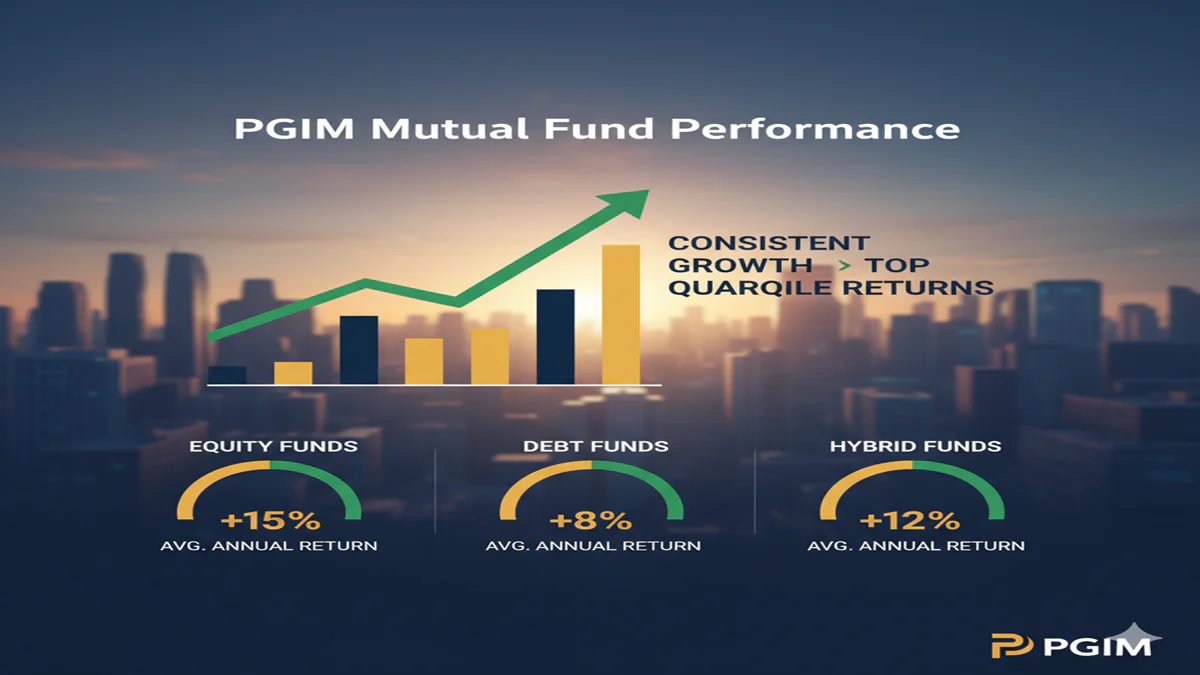
Navigating the Landscape: A Deep Dive into PGIM Mutual Fund Performance
In the vast and often noisy world of investment management, where short-term trends frequently overshadow long-term strategy, finding a firm built on a foundation of rigorous research, disciplined risk management, and global perspective is paramount. PGIM, the global investment management businesses of Prudential Financial, Inc., stands as one such entity. As one of the world’s largest asset managers, with over $1.4 trillion in assets under management, PGIM’s scale is undeniable. But for the individual investor considering PGIM mutual funds, the critical question is:How do they perform, and what truly drives that performance?
This article moves beyond simple star ratings and quarterly returns to provide a nuanced analysis of PGIM mutual fund performance. We will explore the philosophical underpinnings of their approach, dissect the performance across key categories, identify the structural advantages and potential considerations, and offer a framework for evaluating if these funds align with your financial objectives.
The PGIM Ethos: A Multi-Manager, Active Approach
To understand PGIM’s performance, one must first understand its unique structure. Unlike many firms with a single, homogenized investment style, PGIM operates as a“multi-manager”model. This means it houses multiple autonomous investment boutiques—each with deep specialization—under one corporate umbrella.
Key boutiques include:
- Jennison Associates:Known for growth equity investing, driven by fundamental, bottom-up research.
- PGIM Fixed Income:A global leader in bond management, with extensive capabilities in credit research.
- Quantitative Solutions:Employs systematic, factor-based strategies.
- PGIM Real Estate:Focuses on real estate debt and equity.
- PGIM Private Capital:Specializes in private credit and equity.
This structure is fundamental to its performance profile. Each boutique is empowered to pursue its best ideas within its mandate, leveraging PGIM’s shared resources in risk management, technology, and operations. The philosophy is rooted in active management—the belief that skilled managers, through deep research and disciplined processes, can identify mispriced securities and deliver alpha (excess return over a benchmark) over the long term.
Decoding Performance: Strengths and Nuances Across Asset Classes
PGIM mutual fund performance is not monolithic; it varies significantly by boutique, strategy, and market cycle. However, clear patterns and strengths emerge.
1. Equity Funds: The Growth Power of Jennison
PGIM’s flagship equity offerings, particularly from Jennison, have a pronounced orientation toward growth investing. Funds like the PGIM Jennison Growth Fund (PJFAX) and the PGIM Jennison Mid-Cap Growth Fund (PEEAX) are designed to capitalize on companies with above-average earnings potential.
- Performance Driver:Jennison’s performance is heavily reliant on its concentrated, high-conviction stock selection. Portfolio managers and analysts conduct proprietary, fundamental research, often building detailed financial models to project long-term growth. This approach can lead to significant outperformance during bull markets or when growth stocks are in favor.
- Historical Context:Over long periods (5-10 years), many of Jennison’s growth funds have historically ranked in thetop half or better of their Morningstar categories. Their success often hinges on identifying and holding onto transformative companies for the long term.
- Consideration:This same focus makes them vulnerable during market rotations into value or defensive sectors. Volatility can be higher than the broader market, and performance may experience periods of significant relative underperformance.
2. Fixed Income Funds: A Core Strength in Credit
PGIM Fixed Income is a behemoth, managing hundreds of billions in fixed income assets. Their mutual funds, such as the PGIM Total Return Bond Fund (PDBAX), benefit from one of the largest and most respected credit research platforms in the world.
- Performance Driver:The key to performance here isbottom-up credit analysis. With over 200 credit analysts globally, the team digs deep into corporate and structured debt to find attractive risk-adjusted yields. This allows them to navigate different interest rate and credit cycles, potentially avoiding pitfalls and seizing opportunities that others miss.
- Historical Context:PGIM’s core bond funds have often been praised for theirresilience and consistent income generation. Their focus on credit selection over interest rate speculation has, in many periods, provided a smoother journey than funds taking larger interest rate bets.
- Consideration:In environments where government Treasuries dramatically outperform corporate credit, a more credit-focused strategy may lag. Investors should understand the specific credit risk profile of each fund.
3. Thematic and Sector Funds: Focused Conviction
PGIM offers several funds targeting specific long-term themes, such as the PGIM Global Real Estate Fund (PURAX) or technology-focused equity funds.
- Performance Driver:These funds live and die by the viability of their theme and the manager’s execution. They offer pure-play exposure to a specific investment thesis, which can lead to explosive growth if the theme materializes.
- Consideration:Volatility and concentration risk are high.Performance can be cyclical and disconnected from the broad market. These are typically suitable as satellite holdings, not core portfolio positions.
The Pillars of Potential Outperformance: PGIM’s Structural Advantages
Several factors inherent to PGIM’s model contribute positively to its performance potential:
- Depth of Research:The sheer scale of analytical resources, particularly in equities and fixed income, allows for insights that many competitors cannot match.
- Autonomy with Accountability:Boutique autonomy fosters entrepreneurialism and focus, while the overarching PGIM framework provides rigorous risk oversight.
- Long-Term Horizon:Many of PGIM’s boutiques emphasize long-term business trends over short-term market noise, encouraging patient capital.
Important Considerations and Potential Drawbacks
No investment firm is without its trade-offs. Informed investors must weigh these considerations:
- Fee Structure:As an active manager, PGIM’s expense ratios are generallyhigher than passive index funds or ETFs. The investor must judge whether the potential for alpha justifies the cost. While competitive within the active universe, fees are a constant drag on net returns.
- Performance Variability:The multi-manager model means performance is uneven. A top-performing boutique can be offset by one in a slump. Investors must evaluate each fund on its own merits.
- Style-Specific Risk:A heavy weighting toward growth-oriented strategies means a PGIM-heavy portfolio may lack style diversification. In a prolonged value cycle, overall results could disappoint.
- The Active Management Debate:In an era where low-cost index funds consistently outperform a majority of active managers over the very long term, the core premise of PGIM’s model is under constant pressure. While some PGIM funds have succeeded, others have struggled to consistently beat their benchmarks after fees.
How to Evaluate a PGIM Fund for Your Portfolio: A Practical Framework
- Look Beyond Short-Term Returns:Examine performance across full market cycles (e.g., 2008-2009, 2020, 2022). How did the fund perform in both up and down markets? Is the long-term (5-10 year) risk-adjusted return (as measured by Sharpe or Sortino ratios) attractive?
- Benchmark and Peer Comparison:Don’t just look at absolute returns. Consistent top-quartile performance is a positive signal.
- Assess the Manager and Process:Who is the portfolio manager, and what is their tenure? Is the investment process clear, disciplined, and repeatable? PGIM provides substantial resources on manager philosophy and process—use them.
- Analyze the Cost:Calculate the total cost of ownership (expense ratio + any sales loads). Use tools like Morningstar’s “Hypothetical Growth of $10,000” chart to visualize the impact of fees over time.
- Determine Portfolio Fit:Does the fund’s style, risk profile, and sector exposure fill a gap or meet a specific need in your otherwise diversified portfolio? Avoid over-concentration in a single style.
Conclusion: A Contender for the Active Allocation
PGIM mutual funds represent a sophisticated, research-intensive approach to active management. Their performance story is one of specialized expertise, deep fundamental research, and a commitment to long-term growth and income generation. The Jennison growth funds and the Fixed Income complex, in particular, have established strong track records within their respective domains.
For investors who believe in the potential of active management to add value over time, and who are willing to pay higher fees for that potential, PGIM offers a compelling suite of options. The key is selectivity. The multi-manager model demands that investors pick the right boutique and the right strategy for the market environment and their personal goals.
Ultimately, PGIM mutual funds are not a passive, set-it-and-forget-it solution. They require due diligence and monitoring. However, for the investor building a strategically diversified portfolio and seeking to allocate a portion to skilled active managers with substantial resources, PGIM’s offerings warrant a close and serious look. Their performance is a testament to the power of focused expertise, but it is an expertise that must be harnessed with a clear understanding of its costs, risks, and cyclical nature.
Frequently Asked Questions (FAQ)
1. Has the PGIM Jennison Growth Fund consistently beaten the S&P 500?
Performance versus the S&P 500 varies over time. As a dedicated growth fund, it is designed to outperform in strong growth markets but may significantly trail the S&P 500 during periods when value or other sectors lead. Historically, it has experienced periods of both notable outperformance and underperformance relative to the broader market.
2. What is the minimum investment for PGIM mutual funds?
Minimum investments vary by share class and whether you are investing through a taxable account or a retirement account (like an IRA). For Class A shares (often the front-load share class), the standard minimum initial investment is typically $1,000 for IRAs and $2,500 for taxable accounts. However, these minimums may be waived or reduced through certain brokerage platforms or for automated investing plans. Always check the fund’s current prospectus or PGIM’s website for exact details.
3. Are PGIM mutual funds considered high-risk?
Risk is specific to each fund. PGIM offers a spectrum of risk profiles:
- PGIM Jennison Growth/Technology Funds:These are generally consideredhigh to very high riskdue to their concentration in growth stocks and sector focus.
- PGIM Core Fixed Income Funds:These are typicallymoderate risk, though risk levels depend on the fund’s duration and credit quality.
- PGIM High Yield Bond Funds:These arehigh riskdue to their focus on lower-credit-quality debt.
Always review a fund’sMorningstar Risk Ratingand its standard deviation and maximum drawdown statistics to gauge its historical volatility.
4. Where can I buy PGIM mutual funds?
PGIM funds are widely available through:
- Financial Advisors:Most commonly purchased through commissioned or fee-based advisors.
- You can usually buy no-load share classes (like Class R6 or Z-shares) if available, often with lower expense ratios, though these may have higher investment minimums.
- Retirement Plans:Many 401(k) and other employer-sponsored plans include PGIM funds as investment options.
- Directly from PGIM:Through their website, though this may limit you to specific share classes.
5. How does PGIM’s multi-manager model benefit me as an investor?
The model is designed to provide two key benefits:
- Focused Expertise:You get access to specialized portfolio teams (like Jennison for growth or PGIM Fixed Income for bonds) that operate with the intensity of a boutique, dedicating themselves to one style or asset class.
- Institutional Oversight:These boutiques are supported by PGIM’s global risk management, compliance, and operational infrastructure, which aims to provide stability and mitigate operational risks that a standalone boutique might face.
In theory, this combines the best of both worlds: entrepreneurial investment talent within a robust, risk-aware framework.