


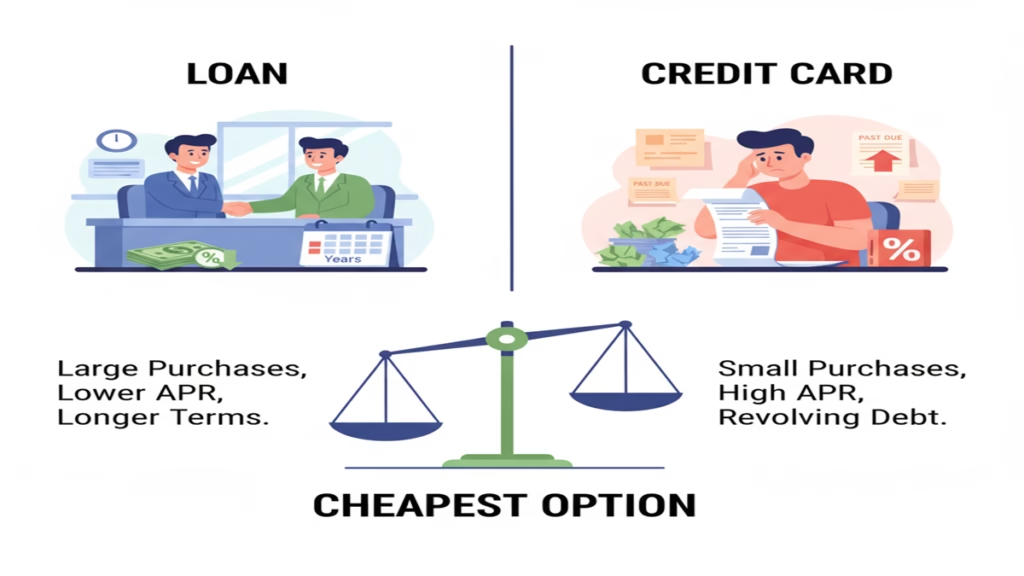
Loan vs. Credit Card: Unmasking the True “Cheapest” Option for Your Wallet
Loan Vs Credit Card Cheapest Option In the complex landscape of personal finance, few questions are as pressing or as common as: “Should I use a loan or a credit card to finance this need, and which one is truly cheaper?” Whether it’s for a home renovation, a medical emergency, consolidating debt, or a major purchase, the choice between these two forms of credit carries significant long-term implications for your financial health. The answer is rarely a simple either/or. The “cheapest” option is not a universal truth but a personal calculation that depends on the amount, purpose, timeframe, your financial discipline, and most critically, the Total Cost of Borrowing (TCB).
This deep-dive analysis will move beyond surface-level comparisons to dissect the mechanics, psychology, and hidden costs of loans and credit cards, providing you with a definitive framework to make the most cost-effective decision.
Part 1: The Fundamental Architectures of Debt
To compare, we must first understand the inherent design of each product.
The Installment Loan: Predictable & Purpose-Built
A loan is a lump sum of money borrowed for a specific purpose, with a fixed or variable interest rate, repaid in equal monthly installments over a predetermined period (term). Its DNA is structured and linear.
- Structure: Closed-end credit. You receive the principal upfront and the debt balance decreases with each payment.
- Interest Model: Typically expressed as an Annual Percentage Rate (APR), encompassing interest and fees. Interest is usually calculated on the declining balance.
- Cost Drivers: Principal amount, interest rate (APR), loan term (length), and any origination/administration fees.
- Best For: Large, one-time expenses with a clear price tag (e.g., car, roof replacement, debt consolidation of a fixed amount).
The Revolving Credit Card: Flexible & Tempting
A credit card is a line of open-ended credit you can draw from, repay, and draw from again, up to a set limit. Its nature is flexible and cyclical, which is both its strength and its peril.
- Structure: Revolving credit.
- Interest Model: Purchases have a grace period (usually 21-25 days) where no interest accrues if you pay the full statement balance by the due date. If you carry a balance, interest is charged daily at a high APR, typically on the average daily balance.
- Cost Drivers: The APR (often 18-28% for purchases), the amount of balance carried, and the time you take to repay it. Minimal payments are a trap, designed to extend debt for years.
- Best For: Smaller, everyday purchases you can pay off monthly, managing cash flow, and leveraging rewards programs without carrying a balance.
Part 2: The Grand Cost Showdown – A Scenario-Based Analysis
Let’s move from theory to hard numbers. The “cheapest” option is revealed through specific use cases.
Scenario 1: The $5,000 Home Appliance Upgrade
- Personal Loan Option: A 3-year (36-month) personal loan at a 10% APR with a 2% origination fee ($100). Monthly payment: $161.34. Total repaid: $5,808.24. Total interest + fee: $808.24.
- Credit Card Option: Charged to a card with an 18% APR. You make only the minimum payment (2% of balance, or $25 min). Result? A repayment period stretching over ~16 years, with total interest exceeding $4,700—almost as much as the original purchase! Even if you commit to a fixed $200/month, you’d pay ~$600 in interest over 2+ years.
Verdict: The loan is decisively cheaper. Its lower APR and forced structure guarantee a finite, lower-cost debt lifecycle. The credit card’s flexibility becomes a curse without immediate, aggressive repayment.
Scenario 2: The $1,200 Emergency Vet Bill
- Credit Card Option (with a twist): You use a card offering a 0% Introductory APR on purchases for 18 months. You divide $1,200 by 18 and pay $66.67/month. Total cost: $1,200. Interest: $0.
Verdict: The 0% APR credit card is cheaper—if and only if you pay the balance in full before the promotional period ends. This requires strict budgeting. If you fail, retroactive interest (deferred interest) may apply on some cards, nullifying the benefit.
Scenario 3: Consolidating $15,000 of High-Interest Credit Card Debt
This is the most telling battleground.
- Debt Consolidation Loan: You take a loan at 12% APR for 5 years to pay off cards charging 24% APR. Monthly payment: $333.67. Total repaid: $20,020.20. Total interest: $5,020.20. You’ve saved a fortune compared to minimum payments on the cards and have a clear end date.
- To pay it off in time, you pay $714.29/month ($15,450 / 21). Total cost: $15,450. Interest: $0 (beyond the fee).
Verdict: The balance transfer card is mathematically cheaper ($450 vs. $5,020 in interest) but behaviorally risky. It demands a high, disciplined monthly payment. The loan is a more expensive but safer path, automating the payoff with a lower payment and eliminating the risk of another costly revolving balance later.
Part 3: The Hidden Costs & Psychological Factors
The cheapest option isn’t just about APR. It’s about total financial impact.
1. The Flexibility Tax: Credit cards tempt you to pay the minimum and re-spend freed-up credit, potentially digging a deeper hole. Loans force amortization, which is a protective constraint for many.
2. The Impact on Credit Scores:
- Loans: Initially cause a small score dip due to the hard inquiry and new account. Over time, consistent on-time payments build a positive “installment loan” mix, and the decreasing balance helps your credit utilization ratio.
- Credit Cards: High balances (>30% of your limit) devastate your credit utilization score, a key factor. Consistently paying in full boosts your score. Maxing out a card can cause an immediate, severe drop.
3. Fee Structures:
- Loans: Upfront fees (origination, administration) are baked into the APR. Prepayment penalties are now rare on most personal loans.
- Credit Cards: Beyond APR, landmines await: cash advance fees (with immediate interest), late fees, annual fees (on some cards), and balance transfer fees.
They offer robust fraud liability protection, extended warranties, and purchase dispute mechanisms under the Fair Credit Billing Act. Loans offer no such protection for the purchased item.
Part 4: The Decision Matrix – Your Cheapest Path Revealed
Use this flowchart as your guide:
- → Lean Loan. Is it a variable, ongoing, or smaller (<$5,000) expense? → Lean Credit Card (if paid monthly).
- Assess Your Discipline: Are you a “set it and forget it” payer who needs structure, or a hyper-vigilant budgeter who pays bills in full? For the former, a loan’s automation is cheaper. For the latter, a card’s grace period or 0% offer is cheaper.
- Calculate the Total Cost of Borrowing (TCB): For any scenario, run the numbers!
- For a loan: Use an online calculator. Include all fees.
- For a card: Assume you will not just pay the minimum. Decide on a fixed, aggressive monthly payment and use a “credit card payoff calculator” to see the true interest cost.
- Consider the Time Horizon: Debt needed for >2 years? A loan’s fixed rate is safer and likely cheaper. Debt you can erase in under 2 years? A 0% promotional card could be cheapest.
- Check Your Credit: Excellent credit unlocks low-interest personal loans and premium 0% credit card offers. Poor credit may leave you with high-rate loans and subprime cards, narrowing the “cheapest” gap.
The Ultimate Rule: If you cannot pay a credit card balance in full within its standard grace period (or a promotional period), a loan will almost always be the cheaper option. The card’s high ongoing APR is a wealth-destroying machine.
Part 5: Strategic Hybrid Approaches
The savvy finance manager sometimes uses both tools in concert.
- Use a loan to consolidate high-interest credit card debt into a lower, fixed payment.
- Use a rewards credit card for all daily spending that you pay off in full every month, earning cash back or travel points at a net cost of $0.
- Finance a large purchase with a 0% APR card, but simultaneously set up a dedicated sinking fund with automatic monthly transfers to ensure the balance is paid before the deadline.
Conclusion: It’s About Cost Control, Not Just Cost
The pursuit of the “cheapest” option is really the pursuit of predictability and control over your total debt cost. Loans provide external control through a mandatory payoff schedule. Credit cards place the burden of control entirely on your shoulders—offering potentially lower costs (even $0) for the disciplined, and catastrophic costs for the less vigilant.
Before you decide, ask yourself the core question: “What is the Total Cost of Borrowing, and what behavior does this financial product encourage in me?” Your honest answer will lead you to the option that is cheapest not just on paper, but for your life and your financial future. In the vast majority of cases involving carried debt, the installment loan emerges as the safer, more predictably economical choice. The credit card’s true “cheapness” is reserved for those who use its grace period as a sharp financial tool, never as a crutch.
Frequently Asked Questions (FAQ)
1. I have excellent credit and need $8,000 for a kitchen update. I’m confident I can pay it off in 18 months. What’s my best move?
Your best move is to hunt aggressively for a credit card with a 0% introductory APR on purchases for 18 months or more. If you secure one, you can finance the project at zero interest, provided you calculate a monthly payment ($8,000 / 18 = ~$445) and stick to it religiously. This is the cheapest possible path. Have a backup plan (e.g., a personal loan pre-approval) in case you can’t get a sufficient credit limit. Never opt for this if you cannot guarantee paying it off before the promo period ends.
2. I’m drowning in high-interest credit card debt. Should I get a consolidation loan or try a balance transfer card?
This depends on your discipline and income stability.
- Choose a Debt Consolidation Loan if: You need the psychological win of a fixed end date, you want one automated payment, and you’re worried you might run up the old credit cards again. It provides a structured path out.
- Choose a Balance Transfer Card if: You have excellent credit to qualify for a long 0% term, you can commit to a high monthly payment, and you are confident you will not use the old or new cards for new spending. This is mathematically cheaper but requires ironclad discipline. For most people, the loan is the safer, more effective solution.
Aren’t they the same?
No, they function differently. The loan’s 10% APR is applied to a steadily decreasing principal over a fixed term. The credit card’s 10% APR (which is very rare—cards are much higher) is a revolving rate. If you only make minimum payments on the card, you’ll stretch the debt out over many years, paying interest on interest for far longer. Even at the same APR, the loan’s structure forces faster principal repayment, leading to a lower total interest cost.
4. How do loans and credit cards affect my credit score differently?
- Loans: Help your “credit mix” (having different types of credit is positive). They initially lower the average age of your accounts. Most importantly, as you pay down the loan, it shows as a decreasing installment balance, which can help your score over time.
- Credit Cards: Have a massive impact on your credit utilization ratio (balances/limits). Keeping your reported balance below 30% of your limit is crucial for a high score. High utilization can tank your score quickly, while paying in full can boost it. They also affect the average age of your accounts.
5. I need to borrow $2,000 for a car repair and my credit is poor. What are my realistic “cheapest” options?
With poor credit, your options are limited and expensive, but you must still compare:
- Secured Personal Loan: From a credit union, possibly using an asset as collateral. Likely the lowest rate you’ll find with bad credit.
- Credit-Builder Loan: Designed to help you build credit. The money is held by the lender while you make payments. It’s not immediate cash but forces savings and builds history.
- Avoid: Payday loans, auto title loans, and high-fee “subprime” installment loans with APRs in the triple digits. These are never the cheapest option and create debt traps.
Realistic Cheapest Path: Explore a small loan from a community bank or credit union, and simultaneously work on improving your credit to access better rates in the future. The “cheapest” option now may be borrowing from a family member with a clear, written repayment plan.