


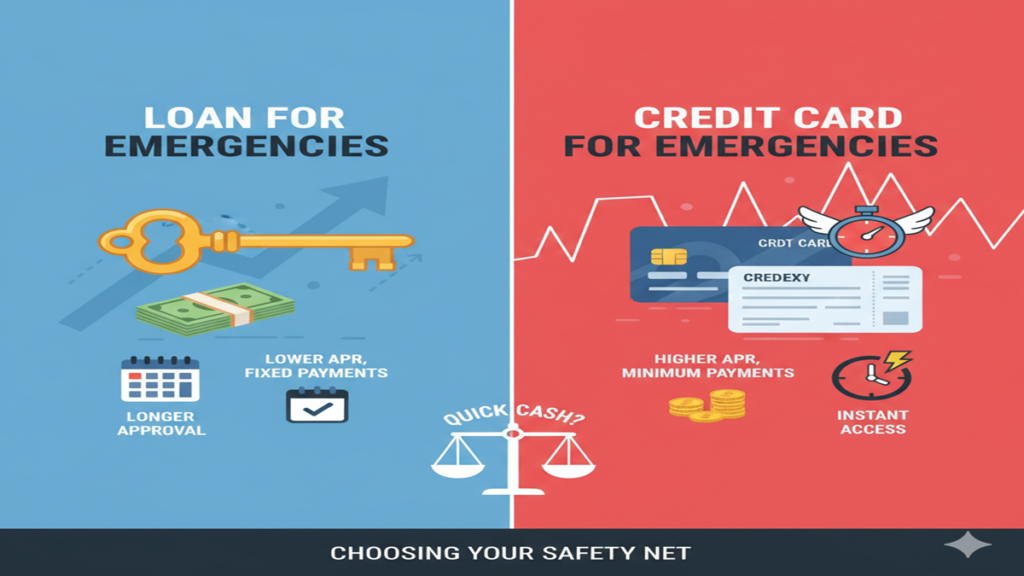
Loan vs. Credit Card for Emergencies: A Strategic Guide to Smart Borrowing in a Crisis
Introduction: When the Unexpected Strikes
Loan Vs Credit Card For Emergency Life is beautifully unpredictable, but its surprises aren’t always welcome. A sudden medical procedure, an urgent car repair, a leaking roof, or an unexpected job loss—financial emergencies descend without warning, demanding immediate action and accessible cash. In these moments of stress, the primary question isn’t just how to cover the cost, but which tool will minimize the long-term financial damage. For most individuals, the choice narrows down to two common instruments: a personal loan or a credit card.
While both provide a lifeline, they are fundamentally different financial products with distinct costs, structures, and implications. Choosing incorrectly can transform a short-term crisis into a lingering debt burden. This comprehensive guide delves into the intricacies of personal loans and credit cards for emergency use, providing a detailed framework to help you make an informed, strategic decision that aligns with your crisis and your financial health.
Part 1: The Contenders – Understanding the Tools
The Structured Workhorse: Personal Loans
You borrow a fixed sum of money from a bank, credit union, or online lender and repay it, plus interest, in equal monthly installments over a predetermined period (typically 12 to 84 months).
Key Characteristics:
- Fixed Amount & Term: The loan amount and repayment schedule are set at the outset.
- Fixed Interest Rate (Usually): Most personal loans have a fixed Annual Percentage Rate (APR), meaning your payment stays consistent.
- Disbursement: Funds are provided as a lump sum, often deposited directly into your checking account.
- Credit Check: Requires a hard credit inquiry. Approval and your offered interest rate are heavily dependent on your credit score and income.
- Secured vs. Unsecured: Most emergency personal loans are unsecured (no collateral required), though secured options (using an asset like a car) may offer lower rates.
The Flexible Revolving Line: Credit Cards
You are granted a credit limit—a maximum amount you can borrow—and you can use as much or as little as needed, up to that limit. You can repay the full balance each month or carry a balance, making minimum payments, though interest accrues on any unpaid amount.
Key Characteristics for Emergencies:
- Revolving Limit: A pool of funds you can tap into repeatedly.
- Variable Interest Rate: Credit cards typically have high, variable APRs for purchases and cash advances.
- Immediate Access: The card itself is the access tool, usable for most expenses instantly.
- Minimum Payments: You are required to pay only a small percentage of the balance each month, though this is the most expensive way to manage debt.
- Potential for 0% APR: Some cards offer introductory 0% APR periods on purchases or balance transfers, which can be a critical feature.
Part 2: The Head-to-Head Comparison
To choose wisely, you must compare across the dimensions that matter most in an emergency: cost, speed, flexibility, and impact.
1. Cost of Borrowing: The Interest Rate Battle
This is often the most decisive factor.
- Personal Loan: Generally the winner for larger, longer-term debt. For borrowers with good to excellent credit (FICO 670+), unsecured personal loan APRs can range from 6% to 24%. The rate is fixed, providing predictability. You pay interest only on the principal initially borrowed.
- Credit Card: Typically more expensive. The average credit card APR hovers around 22-24%, and can exceed 30% for those with lower credit scores. This rate is variable and applies to any carried balance. Cash advances are even costlier, often incurring a higher APR plus an immediate fee (e.g., 5% of the advance). A card’s saving grace is a promotional 0% APR offer, which can make it effectively interest-free for a period (12-21 months).
Verdict: For predictable, lower-cost debt, a personal loan wins.
2. Speed & Accessibility: When Minutes Matter
- Personal Loan: The process has accelerated with online lenders. Many offer instant approval decisions and funding within 24 to 72 hours of approval. Some promise same-day funding. However, it still requires an application and underwriting process.
- Credit Card: The undisputed speed champion. If you already have a card with available credit, the funds are accessible immediately for purchases. For cash needs, an ATM cash advance is instantaneous, though costly.
Verdict: For true, immediate needs (like a tow truck or emergency vet), the credit card in your wallet is the only practical choice.
3. Flexibility & Reusability
- Personal Loan: Inflexible. You receive the lump sum once. If you borrow $10,000 but the emergency only costs $8,000, you’re still paying interest on the full $10,000. You cannot re-borrow repaid amounts without a new application.
- Credit Card: Highly flexible. Your credit line is reusable. If you have a $10,000 limit, spend $3,000, and pay it back, you have the full $10,000 available again. This is invaluable for ongoing or uncertain emergency costs (e.g., multiple doctor visits).
Verdict: For uncertain or evolving emergencies, a credit card’s revolving line offers superior flexibility.
4. Repayment Structure & Discipline
- Personal Loan: Forces discipline. The fixed monthly payment and set payoff date create a mandatory debt exit plan. This prevents the “debt treadmill” and ensures the debt will be cleared by a specific date.
- Credit Card: Requires self-discipline. Making only the minimum payment (often 1-3% of the balance) can extend repayment for decades and multiply the total interest paid. It’s easy for emergency debt to become permanent, high-cost debt.
Verdict: For those who need structure to stay on track, a personal loan is safer. For disciplined individuals with a clear payoff plan, a card can work.
5. Impact on Credit Score
- Personal Loan: Initially causes a slight dip due to the hard inquiry and new account. Over time, consistent on-time payments significantly boost your credit mix and payment history, a major positive. As you pay it down, your installment loan debt decreases, which is good for your score.
- Credit Card: High utilization (the ratio of your balance to your credit limit) is a key scoring factor. Maxing out a card during an emergency can severely hurt your score. Carrying a high balance over time continues to report as high utilization.
Verdict: A personal loan, managed well, is often more constructive for credit building. A maxed-out credit card is more immediately damaging.
Part 3: Strategic Scenarios – Which Tool When?
The “best” choice is contextual. Here’s a breakdown by common emergency types:
Scenario A: The Major, Defined Emergency ($5,000+)
(e.g., New home HVAC system, significant dental work, funeral expenses)
- Recommended: Personal Loan.
- Why: The amount is large and known. A fixed-rate loan provides a lower, predictable cost and a forced repayment schedule, preventing this one-time event from haunting your finances for years.
Scenario B: The “Bridge the Gap” Emergency
(e.g., Covering 3 months of rent after job loss)
- Recommended: 0% APR Introductory Credit Card.
- Why: If you can qualify, this allows you to cover expenses interest-free for the promotional period. You MUST have a rigorous plan to pay off the balance before the standard high APR kicks in. A personal loan is a close second here.
Scenario C: The Immediate, Unavoidable Expense
(e.g., Emergency car repair on a road trip, after-hours plumbing disaster)
- Recommended: Existing Credit Card.
- Why: Speed and universal acceptance are paramount. You can deal with the crisis now and strategize repayment later, potentially by transferring the balance to a 0% card or taking out a personal loan to consolidate it.
Scenario D: The Uncertain, Evolving Situation
(e.g., A pet’s illness with unknown treatment costs, home repairs with potential for discovered issues)
- Recommended: Credit Card (with a high limit).
- Why: The flexible, reusable credit line is ideal when you don’t know the final cost. You can draw exactly what you need, as you need it.
Part 4: The Hybrid Strategy & Critical Warnings
The most sophisticated approach may involve using both tools sequentially:
- Use a credit card to handle the immediate emergency expense.
- Apply for a personal loan at a lower APR to consolidate the credit card debt.
- Pay off the card balance in full with the loan proceeds.
- Repay the personal loan on its structured, lower-interest schedule.
This captures the credit card’s speed but escapes its crippling APR.
Warnings:
- Avoid Payday Loans & Title Loans: These are not legitimate alternatives. They feature predatory APRs (often 400%+) and trap borrowers in cycles of debt.
- Have an Emergency Fund: This entire discussion underscores the critical need for a cash emergency fund (3-6 months of expenses). It is the cheapest, least stressful “borrowing” tool from your future self.
- Read the Fine Print: Understand all fees—loan origination fees, credit card late fees, cash advance fees, and balance transfer fees (typically 3-5%).
Conclusion: Empowering Your Emergency Decision
There is no universal “best” option between a personal loan and a credit card for an emergency. The optimal choice is a function of your specific crisis, your credit profile, and your financial discipline.
Choose a Personal Loan if: Your emergency cost is known, sizable, and one-time. You value lower, fixed interest rates and need the structured discipline of an installment plan to get out of debt. You have good enough credit to qualify for a favorable rate.
Choose a Credit Card if: You need immediate, universal access or face uncertain costs. The expense is relatively smaller or shorter-term.
In the storm of an emergency, the goal is to solve the immediate problem without creating a larger, longer-term financial disaster. By understanding the mechanics, costs, and strategic applications of these two common tools, you can navigate the crisis with clarity, choose your financial instrument with purpose, and emerge on the other side with your stability not just intact, but strengthened.
Frequently Asked Questions (FAQ)
1. I have bad credit. Which option is easier to get?
Typically, a credit card may be more accessible, but with severe caveats. You might only qualify for a secured credit card (requiring a cash deposit) or a card with a very high APR and low limit. A personal loan for those with poor credit often comes from subprime lenders with very high rates (up to 36%) or require a co-signer. In both cases, the cost will be extreme. Exploring alternatives like borrowing from a credit union, negotiating payment plans directly with the service provider, or seeking community assistance should be prioritized.
2. Can I use a credit card to get a cash advance for an emergency? Should I?
You can, but you generally should not unless it’s an absolute last resort. Cash advances come with immediate fees (often 5% of the amount), a higher APR than regular purchases, and no grace period—interest starts accruing from the moment you get the cash. The effective cost is prohibitively high.
3. What’s a balance transfer card, and how could it help in an emergency?
A balance transfer card often comes with a 0% introductory APR for transfers (e.g., 0% for 18 months). In an emergency, you could:
- Put new emergency expenses on an existing card.
- Open a balance transfer card.
- Transfer that balance to the new card.
- Pay it down during the 0% period.
Crucially: There is usually a balance transfer fee (3-5%), and you must pay off the entire balance before the promotional period ends to avoid retroactive interest.
4. How does my credit score specifically affect the rates I’m offered?
Your credit score is the primary determinant of your offered APR.
- For Personal Loans: Borrowers with excellent credit (720+) can see APRs as low as 6-10%. Those with good credit (670-719) may see 10-18%. With fair/poor credit (below 670), APRs jump to 18-36%.
- For Credit Cards: The same tiered system applies, with average offered APRs rising sharply as scores drop.
5. Are there any emergencies where I should avoid both and consider something else entirely?
Yes. For true, catastrophic expenses (like massive medical bills), always explore non-borrowing options first:
- Negotiate: Hospitals and providers often offer payment plans with little or no interest.
- Seek Assistance: Many communities and non-profits have grants or interest-free loans for specific crises (medical, utility shut-off).
- Liquidate Assets: Selling unused items may cover part of the cost without creating debt.
- Family Loans: If possible, a formal, low-interest loan from family can be a better solution, but put terms in writing to avoid relationship strain.
The goal is to reserve borrowing for when all other avenues are exhausted.