


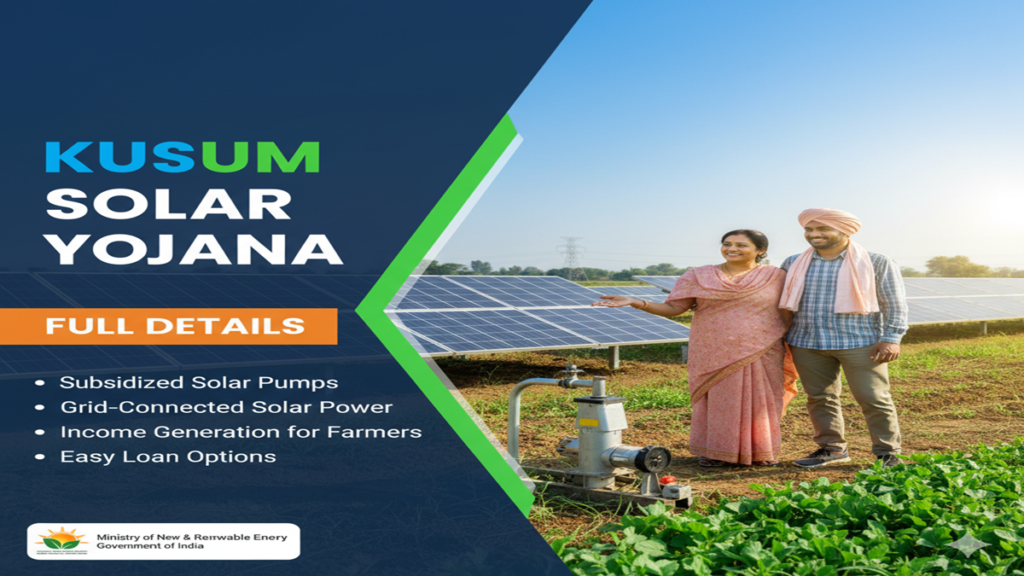
Kusum Solar Yojana Full Details 2026: पीएम कुसुम योजना क्या है? सब्सिडी, पात्रता और ऑनलाइन आवेदन की पूरी जानकारी हिंदी में!
Kusum Solar Yojana Full Details 2026: Introduction: भारत एक कृषि प्रधान देश है, लेकिन आज भी कई क्षेत्रों में सिंचाई के लिए बिजली या डीजल पंपों पर निर्भरता एक बड़ी चुनौती है। किसानों की इसी समस्या को दूर करने के लिए केंद्र सरकार ने “Kusum Solar Yojana” (Pradhan Mantri Kisan Urja Suraksha evam Utthaan Mahabhiyan) की शुरुआत की है। 2026 में इस योजना को और भी सरल और सुलभ बनाया गया है ताकि अधिक से अधिक किसान सोलर पंप अपनाकर अपनी खेती की लागत कम कर सकें।
इस लेख में हम Kusum Solar Yojana Full Details के बारे में विस्तार से जानेंगे, जिसमें सब्सिडी की मात्रा, आवेदन के चरण और आवश्यक दस्तावेजों की चेकलिस्ट शामिल है।
1. कुसुम योजना के तीन मुख्य भाग (Components of the Scheme)
Kusum Solar Yojana Full Details 2026: इस योजना को तीन अलग-अलग श्रेणियों में बांटा गया है ताकि हर प्रकार के किसान इसका लाभ उठा सकें:
- कंपोनेंट-A: इसमें किसान अपनी बंजर या खाली जमीन पर छोटे सोलर पावर प्लांट (500 किलोवाट से 2 मेगावाट तक) लगा सकते हैं और उत्पादित बिजली सरकार को बेचकर कमाई कर सकते हैं।
- कंपोनेंट-B: व्यक्तिगत किसानों को स्टैंडअलोन सोलर पंप (Off-grid) लगाने के लिए सब्सिडी दी जाती है, जहाँ बिजली का कनेक्शन नहीं है।
- कंपोनेंट-C: जिन किसानों के पास पहले से बिजली वाले पंप हैं, उन्हें सोलर से जोड़ने (Solarization) के लिए मदद दी जाती है ताकि वे अतिरिक्त बिजली ग्रिड को बेच सकें।
2. सब्सिडी का गणित (Subsidy Structure)
Kusum Solar Yojana Full Details 2026: कुसुम सोलर योजना की सबसे बड़ी खासियत इसकी भारी सब्सिडी है। केंद्र और राज्य सरकार मिलकर इसका खर्च उठाती हैं:
- केंद्र सरकार की हिस्सेदारी: प्रोजेक्ट लागत का 30%।
- राज्य सरकार की हिस्सेदारी: प्रोजेक्ट लागत का 30%।
- बैंक लोन सुविधा: प्रोजेक्ट लागत का 30%।
- किसान का योगदान: केवल 10%।
उदाहरण के लिए, यदि सोलर पंप की कीमत ₹1,00,000 है, तो किसान को केवल ₹10,000 देने होंगे।
3. पात्रता और आवश्यक दस्तावेज (Eligibility & Documents)
पात्रता:
- आवेदक भारत का स्थायी निवासी और किसान होना चाहिए।
- किसान के पास स्वयं की कृषि भूमि होनी चाहिए।
- Kusum Solar Yojana Full Details 2026: पात्रता, आवेदन प्रक्रिया और आवश्यक दस्तावेजों की पूरी जानकारी यहाँ पढ़ें।
आवश्यक दस्तावेज:
- आधार कार्ड।
- जमीन के दस्तावेज (7/12 उतारा, खसरा-खतौनी)।
- बैंक पासबुक की फोटोकॉपी।
- मोबाइल नंबर (ओटीपी के लिए)।
- पासपोर्ट साइज फोटो।
4. ऑनलाइन आवेदन कैसे करें? (Step-by-Step Guide)
Kusum Solar Yojana Full Details 2026: स्टेप 1: आधिकारिक वेबसाइट पर जाएं सबसे पहले अपने राज्य की सौर ऊर्जा विकास एजेंसी (जैसे महाराष्ट्र के लिए MEDA) या पीएम-कुसुम के केंद्रीय पोर्टल पर जाएं।
स्टेप 2: पंजीकरण (Registration) पोर्टल पर ‘New Registration’ या ‘Apply for Solar Pump’ पर क्लिक करें और अपनी व्यक्तिगत जानकारी दर्ज करें।
स्टेप 3: आवेदन फॉर्म भरें अपनी जमीन का विवरण, पंप की क्षमता (3HP, 5HP या 7.5HP) और बैंक विवरण ध्यानपूर्वक भरें।
स्टेप 4: दस्तावेज अपलोड करें
स्टेप 5: शुल्क का भुगतान आवेदन शुल्क (यदि कोई हो) ऑनलाइन जमा करें। इसके बाद विभाग द्वारा आपके खेत का सर्वे किया जाएगा और पात्रता पाए जाने पर सोलर पंप स्थापित कर दिया जाएगा।
4. अक्सर पूछे जाने वाले प्रश्न (FAQs)
Q1: कुसुम योजना में कितने HP का पंप मिलता है?
Ans: किसान अपनी जरूरत के अनुसार 3 HP, 5 HP और 7.5 HP के सोलर पंप के लिए आवेदन कर सकते हैं।
Q2: क्या किराए की जमीन पर सोलर प्लांट लगाया जा सकता है?
Ans: हाँ, यदि आपके पास लंबी अवधि का लीज एग्रीमेंट है, तो आप कंपोनेंट-A के तहत आवेदन कर सकते हैं।
Q3: सोलर पंप की वारंटी कितनी होती है?
Ans: आमतौर पर सोलर पैनल्स पर 25 साल की परफॉरमेंस वारंटी और पंप सेट पर 5 साल की वारंटी मिलती है।
Conclusion: किसानों के लिए सुनहरे भविष्य की शुरुआत!
Kusum Solar Yojana Full Details से स्पष्ट है कि यह योजना न केवल पर्यावरण के अनुकूल है, बल्कि किसानों के आर्थिक सशक्तिकरण का सबसे बड़ा माध्यम है। डीजल के बढ़ते दामों और बिजली की कटौती से मुक्ति पाने के लिए यह सबसे बेहतरीन निवेश है। यदि आप एक किसान हैं, तो देर न करें और आज ही इस योजना के लिए आवेदन कर अपनी खेती को आधुनिक बनाएं।
Harnessing the Sun: A Complete Guide to the KUSUM Solar Yojana for Farmers and Agri-Entrepreneurs
Kusum Solar Yojana Full Details In the heartland of India, where the sun beats down with relentless energy, a revolutionary scheme is quietly transforming the agricultural landscape. The Pradhan Mantri Kisan Urja Suraksha evam Utthaan Mahabhiyan (PM-KUSUM), commonly known as the Kusum Solar Yojana, is not just a subsidy program; it is a visionary attempt to address India’s triple challenge of farmer distress, water security, and the transition to clean energy. Launched in 2019 by the Ministry of New and Renewable Energy (MNRE), KUSUM aims to empower farmers, reduce the dependence on erratic grid power and expensive diesel, and contribute to India’s ambitious climate goals.
This in-depth guide unravels every layer of the KUSUM scheme—its objectives, components, eligibility, application process, benefits, and the challenges it faces—to serve as a definitive resource for farmers, entrepreneurs, and stakeholders.
1. The Genesis and Vision of KUSUM
Kusum Solar Yojana Full Details 2026: Indian agriculture is heavily dependent on monsoon rains and irrigation, for which electricity is a critical input. However, the farm power sector grapples with issues of unreliable grid supply, high subsidies for Discoms (Distribution Companies), and the carbon-intensive nature of diesel pumps. The KUSUM scheme was conceived as a holistic solution with a multi-pronged vision:
- Energy Security for Farmers: To provide farmers with a reliable, day-time solar power source for irrigation, freeing them from the constraints of fixed power schedules.
- Financial Empowerment: To enable farmers to become “prosumers” (producers + consumers) by selling surplus solar power to the grid, creating a new, steady stream of income.
- Decarbonization: To replace diesel pumps with solar pumps, reducing carbon emissions and local pollution.
- Grid Relief: To reduce the massive subsidy burden on Discoms for agricultural power by decentralizing energy generation.
- Water Conservation: To promote efficient water use through solar-powered micro-irrigation systems.
2. The Three-Pillared Structure: Components of KUSUM
Kusum Solar Yojana Full Details 2026: The strength of KUSUM lies in its structured approach, divided into three distinct components that cater to different needs.
Component A: Decentralized Ground-Mounted Solar Power Plants
- Aim: To set up 10,000 MW of decentralized solar power plants (500 KW to 2 MW) on barren/fallow land.
- Model: Farmers, cooperatives, or panchayats can lease land to developers or install the plant themselves. The power generated is purchased by the local Discom at a pre-fixed tariff.
- Subsidy: The central government provides a 30% CFA (Central Financial Assistance). The state government gives a 30% subsidy. The remaining 40% is arranged by the farmer/developer through loans. Many states offer additional support to reduce the loan burden.
Component B: Installation of Standalone Solar Agriculture Pumps
- Aim: To replace 20 lakh existing grid-connected diesel and electric pumps with standalone solar pumps.
- Model: Individual farmers get solar pumps (typically up to 7.5 HP) that operate independently of the grid, perfect for areas with poor grid connectivity.
- Subsidy: Similar structure—30% CFA from Centre, 30% from State, and 40% farmer contribution (often via loan). For states like the North-Eastern ones, the central subsidy can be up to 50%.
Component C: Solarisation of Grid-Connected Agriculture Pumps
- Aim: To solarise 15 lakh existing grid-connected agriculture pumps.
- Model: This is the most innovative component. A solar PV system is installed to power the existing grid-connected pump. When solar power is insufficient (e.g., at night or cloudy days), the pump draws power from the grid. Crucially, when the pump is not in use, the surplus solar power can be fed into the grid and sold to the Discom, generating income for the farmer.
- Subsidy: Same subsidy pattern as Component A & B (30%+30%+40%).
3. Eligibility Criteria: Who Can Apply?
Kusum Solar Yojana Full Details 2026: The scheme is designed to be inclusive, with broad eligibility:
- Individual Farmers: Any farmer owning cultivable land can apply for a solar pump (Component B & C).
- Groups of Farmers/Cooperatives: Farmer Producer Organizations (FPOs), Water User Associations, and cooperatives can come together for collective projects, especially under Component A.
- Panchayats/Rural Local Bodies: They can utilize common village land for setting up solar plants under Component A.
- Land Requirement: For Component A, barren, fallow, or cultivable land can be used. It cannot be forest land or agricultural land with standing crops.
4. Step-by-Step Application Process
Kusum Solar Yojana Full Details 2026: The implementation is state-driven. While the exact portal and process vary by state, the general workflow is:
- Awareness and Registration: Farmers must register through their state’s designated portal (often run by the State Nodal Agency – SNA like MEDA in Maharashtra, KREDL in Karnataka, etc.). This usually involves submitting land records (7/12 or Khatian), identity proof, and bank details.
- Technical Feasibility Study: The SNA or Discom officials conduct a site inspection to assess suitability, load requirement, and grid connectivity (for Component C).
- Empanelment of Vendors: States empanel solar pump and PV module manufacturers through a bidding process. Farmers must choose from this approved list to avail subsidies.
- Application Submission and Approval: After selecting a vendor, a detailed application is submitted. Upon verification and approval, a sanction letter is issued.
- Installation and Commissioning: The empanelled vendor installs the system. A joint inspection by SNA/Discom officials is done before commissioning.
- Subsidy Disbursement: The subsidy amount is directly transferred to the beneficiary’s bank account post-commissioning, or it is adjusted by the vendor in the invoice.
5. The Transformative Benefits: Why KUSUM is a Game-Changer
- Kusum Solar Yojana Full Details 2026: For Farmers:
- Reduced Cost of Cultivation: Near-zero cost of irrigation power after the initial investment.
- Diesel Savings: Freedom from volatile diesel prices (saving ₹ 50,000 – ₹ 1,00,000 per year per pump).
- Kusum Solar Yojana Full Details 2026: Additional Income: Under Component C, farmers can earn ₹ 30,000-₹ 50,000 annually by selling surplus power.
- Irrigation Reliability: Solar power is available during peak daytime hours, enabling precise irrigation.
- For the Nation:
- Renewable Energy Capacity: Aims to add over 30 GW of solar capacity.
- Grid Stability: Reduces peak load on Discoms and cuts transmission losses due to decentralized generation.
- Climate Action: Will cut millions of tonnes of CO2 emissions by displacing diesel and coal-based power.
- Kusum Solar Yojana Full Details 2026: Rural Development: Spurs green jobs in rural areas—installation, maintenance, and operation of solar systems.
6. Navigating the Challenges and Road Ahead
Kusum Solar Yojana Full Details 2026: Despite its potential, KUSUM’s rollout has faced hurdles:
- Awareness Gaps: Many farmers, especially in remote areas, are unaware of the scheme’s nuances, particularly the income-generating Component C.
- Bureaucratic Delays: Land record verification, subsidy disbursement, and vendor empanelment can be slow.
- Kusum Solar Yojana Full Details 2026: High Initial Contribution: The 40% farmer share (even via loan) can be a barrier for small and marginal farmers.
- Grid Infrastructure: For Component C, weak rural grid infrastructure sometimes hinders the ability to inject surplus power.
- Water Usage Paradox: There’s a concern that cheap solar power might lead to over-extraction of groundwater unless coupled with mandatory micro-irrigation.
Kusum Solar Yojana Full Details 2026: The government is actively working on course corrections: Aggregating farmers through FPOs to ease implementation, promoting blended finance to reduce farmer contribution, and integrating micro-irrigation mandates. The focus is shifting towards the more sustainable and profitable Component C.
7. Success Stories: Glimpses of Change
- Kusum Solar Yojana Full Details 2026: In Andhra Pradesh, a 10 MW plant under Component A on pooled farmer land is providing steady rental income to over 150 landowners.
- In Punjab, a farmer with a 15 HP solarised pump under Component C not only runs his irrigation but also earns an average of ₹ 4,000 per month by selling surplus power, transforming his economic outlook.
- In Maharashtra, tribal farmers in remote areas have replaced expensive diesel generators with reliable solar pumps, securing their livelihood.
Frequently Asked Questions (FAQ)
1. I am a small farmer with 2 acres. Can I afford a solar pump under KUSUM?
Kusum Solar Yojana Full Details 2026: Yes, absolutely. The subsidy structure (60% combined) significantly reduces the cost. For a 3 HP pump, the approximate cost is ₹ 3 lakhs. After subsidy, your share would be around ₹ 1.2 lakhs, which can often be covered through an affordable, low-interest Kisan Credit Card (KCC) loan. Many states offer additional top-up subsidies, bringing the effective cost down further.
2. What is the single biggest difference between Component B and Component C?
Kusum Solar Yojana Full Details 2026: Component B (Standalone Pump) is an off-grid system. It only runs your pump. Component C (Grid-Connected Solarisation) is an on-grid system. It runs your pump and allows you to sell excess solar power back to the electricity grid, making it an income-generating asset. Component C is generally recommended if your existing pump is connected to the grid.
3. How much money can I actually earn by selling surplus power under Component C?
Kusum Solar Yojana Full Details 2026: Your earnings depend on your pump capacity, solar irradiation in your area, and the tariff rate set by your state’s electricity regulatory commission (typically between ₹ 3 to ₹ 3.50 per unit). On average, a properly sized 5 HP system can generate a surplus of 8,000-10,000 units annually, leading to an income of ₹ 25,000 to ₹ 35,000 per year, credited directly to your bank account.
4. What happens on rainy or cloudy days when there is no sun?
Kusum Solar Yojana Full Details 2026: For Component B (standalone), you may need a backup (like a battery, though not subsidized, or a diesel generator). For Component C (grid-connected), this is not a problem. The system automatically draws the required power from the grid when solar generation is low, ensuring uninterrupted irrigation. This is its key advantage.
5. I have applied, but my subsidy is pending. Who should I contact?
Kusum Solar Yojana Full Details 2026: The subsidy flow involves multiple agencies. Your first point of contact should be the empanelled vendor you contracted with. They typically liaise with the implementing agency. If there’s a delay, you can contact the State Nodal Agency (SNA) for renewables in your state (e.g., MEDA, NEDCAP, UREDA) or the district-level office of your Discom (Electricity Distribution Company). Having your application/registration number handy is crucial.
Conclusion: Sowing the Seeds of a Sustainable Future
Kusum Solar Yojana Full Details 2026: The Kusum Solar Yojana is more than an agricultural subsidy; it’s a paradigm shift. It reimagines the farmer as an energy entrepreneur and the farm as a site of sustainable production—of both food and clean power. While implementation challenges persist, the scheme’s foundational vision is robust and transformative. For Indian farmers, embracing KUSUM is not just about adopting a new technology; it is about securing energy independence, climate resilience, and a profitable, dignified future under the benevolent power of the sun.
For the most current and state-specific guidelines, farmers are advised to regularly check the official portal of the Ministry of New and Renewable Energy (MNRE) and their respective State Nodal Agencies.