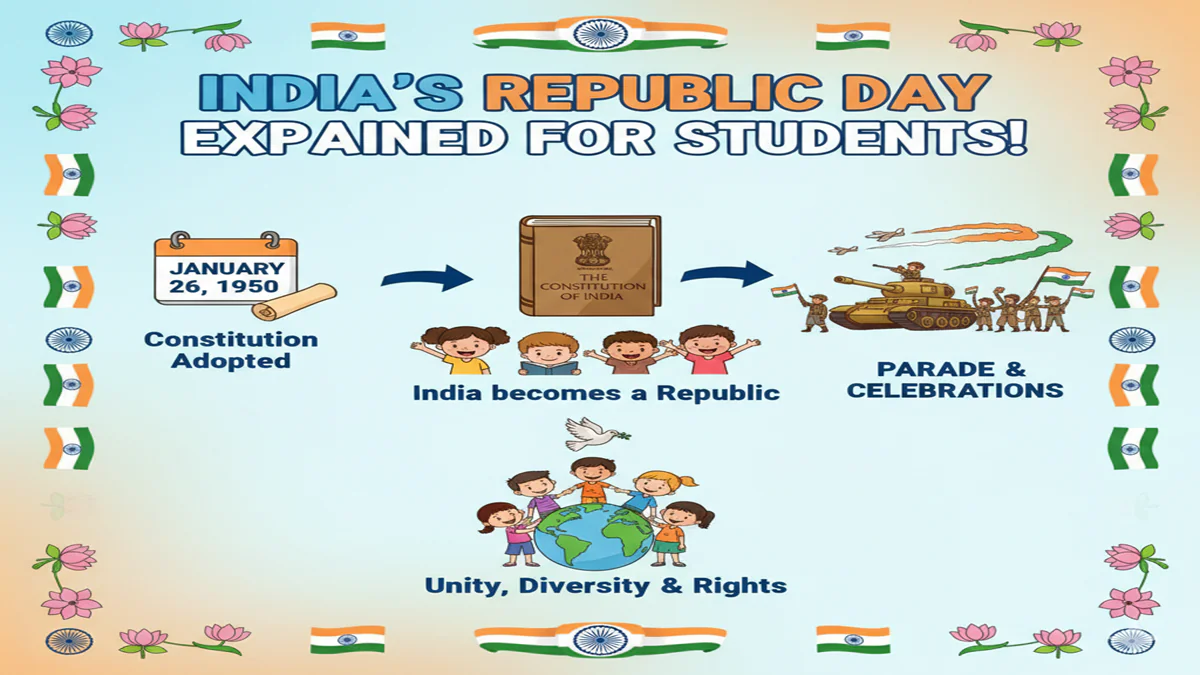
India’s Republic Day 2026: भारत का 77वां गणतंत्र दिवस! जानिए इतिहास, महत्व और इस साल के भव्य आयोजन की पूरी जानकारी।
IndiaS Republic Day: Introduction: dDosto, हर साल 26 जनवरी को पूरा भारत बड़े ही गर्व और उत्साह के साथ अपना गणतंत्र दिवस (Republic Day) मनाता है। यह वह दिन है जब 1950 में भारत का संविधान (Constitution of India) लागू हुआ था और हमारा देश एक ‘संप्रभु लोकतांत्रिक गणराज्य’ (Sovereign Democratic Republic) बना था।
2026 में भारत अपना 77वां गणतंत्र दिवस मनाने जा रहे है। दिल्ली के ‘कर्तव्यपथ’ (पुराना नाम राजपथ) पर होने वाली भव्य परेड से लेकर स्कूलों के सांस्कृतिक कार्यक्रमों तक, यह दिन देशप्रेम की भावना से भरा होता है। आज के इस आर्टिकल में हम India’s Republic Day 2026 के इतिहास, इस साल के चीफ गेस्ट और परेड की खासियतों के बारे में विस्तार से जानेंगे।
1. गणतंत्र दिवस का इतिहास (History of Republic Day)
IndiaS Republic Day: भारत को आजादी 15 अगस्त 1947 को मिली थी, लेकिन तब हमारे पास अपना कोई स्थाई संविधान नहीं था।
- डॉ. बी.आर. अंबेडकर की अध्यक्षता में ड्राफ्टिंग कमेटी ने संविधान तैयार किया।
- 26 नवंबर 1949 को संविधान को अपनाया गया, लेकिन इसे लागू करने के लिए 26 जनवरी 1950 का दिन चुना गया।
- 26 जनवरी ही क्यों?
2. Republic Day 2026 की थीम और मुख्य अतिथि (Chief Guest)
हर साल भारत किसी दूसरे देश के राष्ट्रप्रमुख को मुख्य अतिथि (Chief Guest) के रूप में आमंत्रित करता है, जो हमारे राजनयिक संबंधों (Diplomatic Relations) को दर्शाता है।
- 2026 Chief Guest: इस साल सरकार ने [अतिथि का नाम – उदा. फ्रांस के राष्ट्रपति या ASEAN नेता] को आमंत्रित किया है (आधिकारिक घोषणा के अनुसार)।
- Theme: इस साल की थीम ‘विकसित भारत’ और ‘भारत: लोकतंत्र की जननी’ पर आधारित रखी गई है, जो आत्मनिर्भर भारत के बढ़ते कदमों को दर्शाती है।
3. कर्तव्यपथ पर भव्य परेड (Republic Day Parade Highlights)
IndiaS Republic Day: गणतंत्र दिवस का सबसे मुख्य आकर्षण दिल्ली में होने वाली परेड होती है:
- ध्वजारोहण (Flag Hoisting): भारत के राष्ट्रपति तिरंगा फहराते हैं, जिसके बाद 21 तोपों की सलामी दी जाती है।
- सैन्य शक्ति का प्रदर्शन: भारतीय सेना, नौसेना और वायु सेना के जवान अपनी ताकत का प्रदर्शन करते हैं। साथ ही लेटेस्ट मिसाइलें और टैंक दिखाए जाते हैं।
- झांकियां (Tableaux): देश के विभिन्न राज्यों की संस्कृति और विकास को दर्शाने वाली झांकियां निकाली जाती हैं।
- Flypast: वायुसेना के लड़ाकू विमानों (जैसे राफेल, सुखोई) का हैरतअंगेज प्रदर्शन आसमान में तिरंगा बनाता है।
4. परेड के लिए ऑनलाइन टिकट कैसे बुक करें? (Online Ticket Booking)
IndiaS Republic Day: अगर आप दिल्ली में लाइव परेड देखना चाहते हैं, तो आप घर बैठे टिकट बुक कर सकते हैं:
- आधिकारिक पोर्टल aamantran.mod.gov.in पर जाएं।
- अपना मोबाइल नंबर डालें और OTP से रजिस्टर करें।
- अपनी पसंद का टिकट (General/Reserved) चुनें।
- फोटो आईडी (आधार कार्ड) अपलोड करें और ऑनलाइन पेमेंट करें।
- अपना ई-टिकट डाउनलोड करें और उसका प्रिंट ले लें।
5. गणतंत्र दिवस का महत्व (Significance)
यह दिन हमें याद दिलाता है कि भारत की शक्ति उसके संविधान में है। यह हमें मौलिक अधिकारों (Fundamental Rights) और कर्तव्यों (Duties) के प्रति जागरूक करता है। यह दिन उन वीर शहीदों को श्रद्धांजलि देने का भी है जिन्होंने देश की अखंडता के लिए अपने प्राण न्यौछावर कर दिए।
Conclusion: गर्व से मनाएं राष्ट्र का उत्सव!
IndiaS Republic Day: केवल एक छुट्टी का दिन नहीं है, बल्कि यह हमारे लोकतंत्र का जश्न है। आइए, 2026 के इस गणतंत्र दिवस पर हम संकल्प लें कि हम अपने
जय हिन्द! जय भारत!
India’s Republic Day Explained For Students: Celebrating the Spirit of Democracy
Introduction: More Than Just a Parade
IndiaS Republic Day: Every year on January 26th, India transforms into a canvas of vibrant colors, proud displays, and patriotic fervor. Schools close, families gather around televisions, and the nation’s attention turns to New Delhi’s Rajpath, where an incredible parade showcases India’s military might, cultural diversity, and technological achievements.
But Republic Day is far more than spectacular performances and impressive tank displays. It represents the very soul of modern India—the day when “We, the People” gave ourselves a remarkable framework for governance. For students across India and around the world, understanding Republic Day means understanding how India became the world’s largest democracy and what makes this celebration profoundly significant.
India’S Republic Day Explained For Students
Part 1: The Historical Journey to Republic
Colonial Rule and the Struggle for Self-Governance
IndiaS Republic Day: To appreciate Republic Day, we must first travel back to India before independence. For nearly 200 years, the British East India Company and later the British Crown ruled the Indian subcontinent. During this period, Indians had limited say in their own governance. Laws were made in London, resources flowed outward, and the aspirations of millions remained unaddressed. The freedom struggle, led by figures like Mahatma Gandhi, Jawaharlal Nehru, Sardar Patel, and countless others, wasn’t just about removing British rule—it was about the right to self-determination.
Independence: The First Step, Not the Destination
IndiaS Republic Day: When India finally gained independence at midnight on August 15, 1947, the nation rejoiced. However, independence alone didn’t complete the journey. The country was governed by the Government of India Act 1935 (modified), essentially a colonial-era law. India was a constitutional monarchy, with King George VI as head of state, represented by Governor-General Lord Mountbatten. The crucial task of creating India’s own governing document—one that reflected its unique civilization, diverse population, and democratic aspirations—still lay ahead.
The Constitutional Assembly: An Extraordinary Gathering
IndiaS Republic Day: On December 9, 1946, before independence was even officially achieved, the Constituent Assembly began its historic work. This wasn’t a typical political body; it included 299 members from diverse backgrounds—lawyers, farmers, social reformers, and educators. Notably, it included 15 women, remarkable for the time. Dr. Rajendra Prasad served as President, but the intellectual and philosophical leadership came from Dr. B.R. Ambedkar, who chaired the Drafting Committee.
IndiaS Republic Day: For nearly three years, these representatives debated, discussed, and deliberated. They studied constitutions from around the world—the United States, Britain, Ireland, Canada, Australia—but sought to create something uniquely Indian. They met for 166 days over 2 years, 11 months, and 18 days. The debates fill 12 bulky volumes, totaling over 2,000 pages. Every word, every comma, was weighed for its implications for future generations.
Why January 26th? The Purna Swaraj Connection
IndiaS Republic Day: The choice of January 26th is deeply symbolic. On this date in 1930, the Indian National Congress issued the Declaration of Purna Swaraj (Complete Self-Rule), declaring independence from British rule. By adopting the Constitution on this date, independent India honored that earlier pledge, linking the struggle for freedom with the establishment of self-governance.
Part 2: The Constitution: India’s Governing Blueprint
What is a Constitution?
IndiaS Republic Day: Imagine building a magnificent, complex structure—a nation with over a billion people, dozens of languages, multiple religions, and varied geography. You wouldn’t begin without an architectural plan. A constitution is precisely that—a master blueprint for governance. It defines:
- The Structure of Government: How power is divided between central and state governments (federal structure)
- Citizens’ Rights and Duties: What the government cannot take away from you (Fundamental Rights) and what you owe to the nation (Fundamental Duties)
- The Rules of Politics: How laws are made, implemented, and interpreted
- Guiding Principles: The values and aspirations that should guide governance (Directive Principles)
Extraordinary Features of the Indian Constitution
IndiaS Republic Day: 1. Length and Detail: At its adoption, it was the world’s longest written constitution for any sovereign nation, with 395 articles and 8 schedules (now 470 articles and 12 schedules after amendments). This detail was necessary to address India’s immense diversity and complex social realities.
2. A Living Document: The Constitution included Article 368, providing for its own amendment. This foresight has allowed it to evolve through 105 amendments (as of 2023) to address changing times, from abolishing privy purses to establishing the Right to Education.
IndiaS Republic Day: 3. The Preamble: The Soul of the Document: Perhaps the most famous part begins with “WE, THE PEOPLE OF INDIA,” establishing that all authority flows from citizens. It declares India as a “SOVEREIGN SOCIALIST SECULAR DEMOCRATIC REPUBLIC” and secures for all citizens “JUSTICE, LIBERTY, EQUALITY, and FRATERNITY.”
4. Balancing Rigidity and Flexibility: Some provisions are easy to amend (simple majority), while others protecting federal structure or fundamental rights require special majorities, creating stability while allowing evolution.
5. Single Citizenship: Unlike some federal nations, Indians have single citizenship, reinforcing national unity alongside diverse identities.
Fundamental Rights and Duties: The Citizen-State Compact
IndiaS Republic Day: Six Fundamental Rights guarantee:
- Right to Equality (Articles 14-18)
- Right to Freedom (Articles 19-22)
- Right against Exploitation (Articles 23-24)
- Right to Freedom of Religion (Articles 25-28)
- Cultural and Educational Rights (Articles 29-30)
- Right to Constitutional Remedies (Article 32)
IndiaS Republic Day: Eleven Fundamental Duties (added in 1976) remind citizens of their responsibilities, including respecting the Constitution, national flag, and anthem; upholding unity; and protecting public property.
Part 3: Republic Day Celebrations: Symbols and Significance
The Grand Parade: A National Showcase
IndiaS Republic Day: Parade along Rajpath (now Kartavya Path) is the celebration’s centerpiece, watched by millions worldwide. Each element carries symbolic meaning:
1. The Presidential Arrival: As the Constitutional head, the President’s arrival in a cavalry escort represents the transfer of military authority to civilian leadership.
2. The Wreath-Laying at Amar Jawan Jyoti: The Prime Minister honoring the unknown soldier at India Gate places the nation’s gratitude for sacrifice above all ceremony.
3. The Gallantry Awards: Children and adults receiving awards for bravery from the President highlight that courage isn’t limited to battlefields but exists in everyday life.
4. The March Past: The synchronised marches by the Army, Navy, Air Force, and paramilitary forces demonstrate discipline and dedication to protecting the Republic.
5. The Tableaux: States and ministries present their cultural heritage, development projects, and themes through moving exhibits, showcasing India’s “Unity in Diversity.”
6. The Flypast: The Indian Air Force’s aerial display concludes the parade, a breathtaking reminder of technological prowess and national security.
Beyond Delhi: Celebrations Across India
IndiaS Republic Day: While Delhi hosts the main event, Republic Day is celebrated nationwide:
- State Capitals: Governors take the salute at parades showcasing local culture
- Schools and Colleges: Flag hoisting, cultural programs, and patriotic song competitions
- Government Offices: Simple ceremonies reaffirming commitment to constitutional values
- Villages: Community gatherings that connect local governance (Panchayats) to the constitutional framework
The Beating Retreat: A Musical Farewell
IndiaS Republic Day: On January 29th, the Beating Retreat ceremony at Vijay Chowk formally concludes Republic Day celebrations. Military bands, pipes and drums, and traditional instruments like the shehnai perform together, symbolizing the harmonious coordination between different forces. The playing of “Abide With Me” (a favorite of Mahatma Gandhi) and the final bugle call of “Sare Jahan Se Achha” create a poignant moment of reflection.
Part 4: Republic vs. Independence Day: Understanding the Difference
IndiaS Republic Day: Students often confuse Republic Day with Independence Day (August 15). While both are national celebrations, they mark different milestones:
Independence Day (August 15):
- Marks liberation from British rule in 1947
- Celebrates freedom FROM foreign domination
- Prime Minister addresses the nation from Red Fort
- Symbol: Raising the national flag
Republic Day (January 26):
- Marks the adoption of the Constitution in 1950
- Celebrates freedom TO govern ourselves
- President takes salute; guest of honor often a foreign leader
- Symbol: Display of constitutional governance and national capabilities
Think of it this way: Independence Day was India’s birth as a free nation; Republic Day was India coming of age with its own rulebook for democracy.
Part 5: Why Republic Day Matters for Students
Understanding Your Rights and Responsibilities
IndiaS Republic Day: As students, you are both beneficiaries and future guardians of the Constitution. Knowing your Fundamental Rights helps you recognize when they’re protected or violated. Understanding your Fundamental Duties reminds you that citizenship involves active participation, not just passive benefits.
Appreciating India’s Democratic Framework
IndiaS Republic Day: The Constitution created institutions that protect democracy: an independent judiciary, election commission, comptroller and auditor general, and union public service commission. These institutions, when functioning properly, ensure that no single person or group can easily undermine democratic principles.
Recognizing the Ongoing Journey
IndiaS Republic Day: The Constitution’s preamble begins with “WE, THE PEOPLE” – present tense, implying an ongoing project. India’s republic isn’t a finished achievement but a continuous effort to achieve justice, liberty, equality, and fraternity for all citizens. As students, you will soon join this effort to address contemporary challenges: environmental protection, digital privacy, gender equality, and social justice.
Global Significance
IndiaS Republic Day: India’s successful democratic experiment has global importance. In a world where many predicted that a poor, diverse, and newly independent nation couldn’t sustain democracy, India has proven otherwise. Republic Day celebrates not just India’s democracy, but democracy’s potential everywhere.
Conclusion: Your Role in the Republic
IndiaS Republic Day: As you watch the parade this Republic Day, look beyond the spectacular visuals. See the constitutional principles in action: the civilian control of the military, the celebration of diversity, the recognition of bravery, and the display of unity.
The Constitution begins with “We, the People” – not “We, the Government” or “We, the Leaders.” This places ultimate responsibility on citizens. As students, you can honor Republic Day by:
- Reading the Preamble and understanding its values
- Learning about your rights and duties
- Participating respectfully in democratic processes, starting with school elections
- Appreciating India’s diversity while strengthening its unity
- Thinking critically about how to make constitutional values real in everyday life
IndiaS Republic Day: India’s Republic Day isn’t just about commemorating the past; it’s about recommitting to the constitutional vision for India’s future—a future that you will help build.
Frequently Asked Questions (FAQs)
1. Why does India have both Republic Day and Independence Day?
India celebrates Independence Day on August 15 to mark freedom from British rule in 1947. Republic Day on January 26 celebrates the adoption of the Constitution in 1950, which made India a sovereign democratic reIndiaS Republic Day: public. Independence Day is about liberation from foreign rule, while Republic Day is about establishing our own system of self-governance.
2. Who was the chief architect of the Indian Constitution?
As Chairman of the Drafting Committee, he played the most significant role in shaping the document. However, he emphasized that the Constitution incorporated inputs from many members of the Constituent Assembly and drew upon various global constitutional traditions.
3. How is Republic Day different from national celebrations in other countries?
Many countries have national days celebrating independence or revolution. India’s Republic Day is unique because it specifically celebrates the adoption of a comprehensive constitutional framework that created the world’s largest democracy. The scale and symbolism of the parade—which showcases both military strength and cultural diversity within a democratic framework—is particularly distinctive.
4. Why is there always a chief guest from another country at the Republic Day parade?
Inviting a foreign leader as chief guest serves multiple purposes: it strengthens diplomatic relations, showcases India’s democratic traditions to the world, and reflects India’s engagement with the international community. The choice of chief guest often indicates current foreign policy priorities and relationships.
5. Can the Indian Constitution be changed? How does this process work?
Yes, the Indian Constitution can be amended, making it a “living document.” The amendment process is outlined in Article 368. Amendments require:
A majority of total membership and at least 2/3 of members present and voting in both Houses of Parliament
For some articles affecting federal structure, also ratification by at least half of state legislatures
This balanced process allows the Constitution to evolve while protecting its basic structure from easy alteration. There have been 105 amendments as of 2023.