


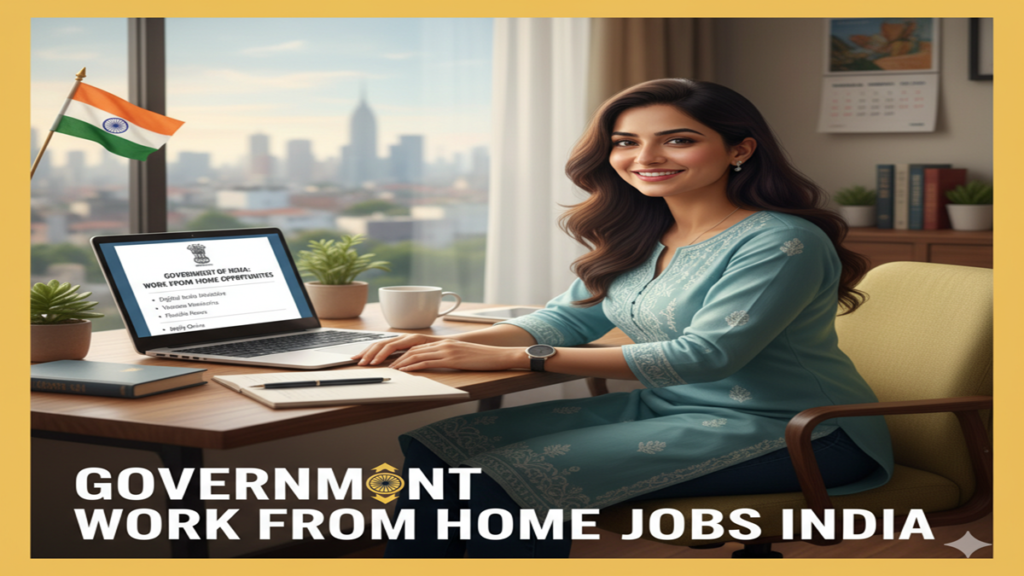
Government Work From Home Jobs India: भारत सरकार के साथ घर बैठे काम करने के बेहतरीन अवसर; 2026 की विस्तृत गाइड!
Government Work From Home Jobs India: Introduction: आज 3 मई 2026 है और डिजिटल क्रांति ने सरकारी कामकाज के तरीके को पूरी तरह बदल दिया है। अब सरकारी विभागों में केवल दफ्तर जाकर ही काम नहीं होता, बल्कि कई ऐसे प्रोजेक्ट्स और विभाग हैं जहाँ से आप घर बैठे अपना योगदान दे सकते हैं। “Government Work From Home Jobs India” की तलाश करने वाले युवाओं, महिलाओं और फ्रीलांसरों के लिए आज के दौर में अवसरों की कोई कमी नहीं है।
भारत सरकार के ‘डिजिटल इंडिया’ मिशन के तहत कई ऐसे पोर्टल और इंटर्नशिप प्रोग्राम शुरू किए गए हैं, जो नागरिकों को रिमोट वर्किंग (Remote Working) की सुविधा प्रदान करते हैं। इस लेख में हम उन विश्वसनीय प्लेटफॉर्म्स और जॉब्स के बारे में जानेंगे जहाँ आप सुरक्षित तरीके से आवेदन कर सकते हैं।
1. प्रमुख सरकारी वर्क फ्रॉम होम अवसर (Top Opportunities)
- MyGov.in (Citizen Engagement Platform): यह पोर्टल कंटेंट राइटिंग, ग्राफिक डिजाइनिंग और सोशल मीडिया मैनेजमेंट जैसे कार्यों के लिए समय-समय पर टास्क और प्रतियोगिताएं आयोजित करता है, जिसके लिए आकर्षक पुरस्कार और पारिश्रमिक दिया जाता है।
- Digital India Internship Scheme: कई मंत्रालय, विशेष रूप से इलेक्ट्रॉनिक्स और सूचना प्रौद्योगिकी मंत्रालय (MeitY), छात्रों के लिए रिमोट इंटर्नशिप प्रोग्राम चलाते हैं। इसमें आपको वजीफा (Stipend) भी मिलता है।
- NITI Aayog Internship: नीति आयोग स्नातक और स्नातकोत्तर छात्रों को घर से शोध (Research) और डेटा विश्लेषण करने के अवसर प्रदान करता है।
- National Career Service (NCS): श्रम और रोजगार मंत्रालय का यह पोर्टल ‘Work From Home’ श्रेणी में निजी और अर्ध-सरकारी क्षेत्रों की नौकरियों का सबसे बड़ा डेटाबेस है।
2. 2026 में डिजिटल जॉब मार्केट और टेक्नोलॉजी
Government Work From Home Jobs India: 2026 के इस दौर में जॉब सर्च और रिक्रूटमेंट काफी स्मार्ट हो गया है। Solaris Digital जैसे तकनीकी समाधानों के माध्यम से अब सरकारी और प्राइवेट सेक्टर में ‘रिमोट एक्सेस टूल्स’ का उपयोग किया जा रहा है, जिससे कर्मचारी घर बैठे सुरक्षित सर्वर पर काम कर सकते हैं।
रोजगार के नए अवसरों को ढूंढने और प्रोफेशनल स्किल्स सीखने के लिए Badaudyog.com जैसे पोर्टल्स युवाओं का मार्गदर्शन कर रहे हैं। यहाँ आप ‘डिजिटल मार्केटिंग’ और ‘डेटा मैनेजमेंट’ जैसे कोर्स कर सकते हैं जो सरकारी प्रोजेक्ट्स में काम पाने के लिए अनिवार्य होते जा रहे हैं। इसके अलावा, पर्यावरण के प्रति जागरूकता बढ़ने के कारण अब कई लॉजिस्टिक्स कंपनियां जैसे Prajwal Auto EV अपने बैक-एंड ऑपरेशंस और कस्टमर सपोर्ट के लिए वर्क फ्रॉम होम प्रोफेशनल्स को नियुक्त कर रही हैं, जिससे ऑफिस का कार्बन फुटप्रिंट कम होता है।
3. आवेदन कैसे करें और धोखाधड़ी से कैसे बचें? (How to Apply & Avoid Scams)
Government Work From Home Jobs India: सरकारी नौकरियों के नाम पर बहुत सी फर्जी वेबसाइट्स इंटरनेट पर मौजूद हैं। सुरक्षित रहने के लिए इन बातों का ध्यान रखें:
- आधिकारिक डोमेन: हमेशा सुनिश्चित करें कि वेबसाइट के अंत में .gov.in या .nic.in लगा हो।
- कोई शुल्क नहीं: वास्तविक सरकारी इंटर्नशिप या नौकरियों के आवेदन के लिए कोई पैसा नहीं मांगा जाता है।
- पंजीकरण: NCS Portal या MyGov पर अपना रजिस्ट्रेशन करें ताकि आपको सीधे अपडेट मिल सकें।
4. आवश्यक कौशल (Required Skills)
Government Work From Home Jobs India: सरकारी रिमोट जॉब्स के लिए आपके पास ये बुनियादी कौशल होने चाहिए:
- कंप्यूटर साक्षरता: MS Office (Excel, Word) और गूगल टूल्स की अच्छी जानकारी।
- भाषा ज्ञान: हिंदी और अंग्रेजी में अच्छी पकड़, खासकर ड्राफ्टिंग के लिए।
- इंटरनेट कनेक्टिविटी: घर पर तेज इंटरनेट और एक अच्छा लैपटॉप/कंप्यूटर।
4. अक्सर पूछे जाने वाले प्रश्न (FAQs)
Q1: क्या घर से काम करने वाली सरकारी नौकरियों के लिए सैलरी अच्छी मिलती है?
Ans: सैलरी पद और प्रोजेक्ट पर निर्भर करती है। इंटर्नशिप के लिए ₹10,000-₹20,000 और स्पेशलिस्ट रोल के लिए ₹50,000 से अधिक मिल सकते हैं।
Q2: क्या 12वीं पास छात्र सरकारी वर्क फ्रॉम होम जॉब कर सकते हैं?
Ans: हाँ, डेटा एंट्री और सर्वे जैसे कार्यों के लिए 12वीं पास छात्र NCS Portal के माध्यम से आवेदन कर सकते हैं।
Q3: क्या इन नौकरियों के लिए कोई सर्टिफिकेट मिलता है?
Ans: जी हाँ, सरकारी प्रोजेक्ट्स के पूरा होने पर आपको आधिकारिक सर्टिफिकेट मिलता है, जो आपके भविष्य के करियर के लिए बहुत मूल्यवान होता है।
Conclusion: सुरक्षित भविष्य और लचीलापन
Government Work From Home Jobs India न केवल आय का स्रोत हैं, बल्कि ये आपको देश के विकास में योगदान देने का मौका भी देती हैं। 2026 की आधुनिक तकनीक, जैसे Solaris Digital के क्लाउड टूल्स और Badaudyog.com की व्यावसायिक सलाह, आपके लिए इन अवसरों को पाना आसान बना रही हैं। Prajwal Auto EV जैसे उभरते ब्रांड्स भी अब रिमोट वर्क कल्चर को बढ़ावा दे रहे हैं। सही जानकारी और सतर्कता के साथ आप घर बैठे एक सफल सरकारी करियर की शुरुआत कर सकते हैं।
The Ultimate Guide to Government Work From Home Jobs in India: Opportunities, Process & Insights (2025-2026)
Government Work From Home Jobs India The landscape of employment in India is undergoing a profound transformation, accelerated by the digital revolution and the lessons of the pandemic. Within this transformation, a particularly intriguing development is the gradual but definite emergence of Government Work From Home (WFH) Jobs. Once synonymous with rigid office hours and physical file movements, the Indian government sector is now exploring flexible, remote work models, opening a new frontier for job seekers who value both stability and flexibility.
This comprehensive guide delves deep into the world of remote government jobs in India, exploring the available opportunities, the application process, the advantages and challenges, and the future outlook.
The Paradigm Shift: From Office-Centric to Digital-First Governance
Government Work From Home Jobs India: The push for digital India, spearheaded by initiatives like Digital India, e-Office, and Aadhaar-enabled services, laid the foundational infrastructure. The COVID-19 pandemic acted as a catalyst, forcing government departments to maintain continuity through remote operations. This proved that a significant portion of administrative, technical, and advisory work could be performed effectively outside traditional offices.
Government WFH jobs are not merely a convenience; they are a strategic tool for:
- Talent Diversification: Accessing skilled professionals from Tier-2 and Tier-3 cities, and even remote areas, without geographical constraints.
- Inclusive Employment: Creating opportunities for differently-abled individuals, women with caregiving responsibilities, and retirees with valuable expertise.
- Enhanced Efficiency: Reducing overhead costs related to office space and utilities.
- Business Continuity: Ensuring uninterrupted service delivery during unforeseen circumstances.
Categories of Government Work From Home Jobs
Government Work From Home Jobs India: These roles can be broadly classified into three main categories:
1. Permanent Government Positions with WFH Provisions
Government Work From Home Jobs India: This is the most evolving category. Certain ministries and departments (like IT, Finance, and some research organizations) are increasingly offering hybrid work models for their permanent employees. These are not “remote-first” but allow for a certain number of work-from-home days per week/month, governed by official circulars and guidelines. Securing such a position requires clearing the standard recruitment exams (UPSC, SSC, State PSCs) or direct recruitment for technical posts.
2. Contractual & Consultancy Remote Positions
Government Work From Home Jobs India: This is currently the most active domain for full-time WFH with the government. Various projects, missions, and digital initiatives hire experts on a contract basis.
- Examples: Consultants for NITI Aayog, project managers for Smart City missions, IT security analysts for MeitY, content developers for educational portals like SWAYAM or NCERT, researchers for ICSSR or ICMR studies.
- Where to Find: Websites of individual ministries and autonomous bodies (e.g., NIC, NIELIT, National Health Mission portals), and dedicated government consultancy portals.
3. Freelance & Task-Based Opportunities (Micro-Tasking)
Government Work From Home Jobs India: These are ideal for individuals seeking part-time, flexible engagement. The government outsources specific, time-bound tasks.
- Data Digitization Projects: Converting physical records to digital formats for archives, museums, or departments.
- Translation Work: Translating documents for multilingual portals, legal departments, or cultural organizations.
- Surveys & Field Research: Conducting sample surveys or field data collection for statistical or research bodies on a honorarium basis.
- Platforms to Watch: MyGov.in often crowdsources ideas, content, and designs. The Digital India initiative and specific ministry websites advertise such micro-tasks.
Key Government Portals & Initiatives for Remote Opportunities
- MyGov.in: The central hub for citizen engagement. It regularly hosts challenges, tasks, and discussions where contributors can win rewards and gain recognition. It’s a gateway to demonstrating skills to government entities.
- NIC (National Informatics Centre) & NIELIT: Frequently advertise contractual positions for IT professionals, including roles that may offer remote or hybrid options.
- Ministry of Electronics and Information Technology (MeitY): A source for high-level IT consultancy and project-based roles.
- SWAYAM & NCERT: For academic content creators, course coordinators, and instructional designers in the education sector.
- Government Work From Home Jobs India: ICSSR (Indian Council of Social Science Research) & ICHR (Indian Council of Historical Research): Advertise fellowships and short-term research assignments that can often be conducted remotely.
- State Government Portals: Many states, like Karnataka, Maharashtra, and Telangana, with strong IT policies, advertise similar contractual tech roles on their IT department websites.
The Application & Selection Process: A Step-by-Step Guide
Government Work From Home Jobs India: The process is distinct from private sector remote jobs and demands meticulous attention to detail.
- Identification of Opportunity: Scour the “Careers” or “Tenders/Consultancy” sections of the specific department’s website. Use keywords like “consultant,” “project analyst,” “remote,” “home-based,” “freelance,” and “contractual.”
- Understanding the Eligibility: Government advertisements have non-negotiable eligibility criteria—age, educational qualifications (often with specific percentages), and experience. Ensure you meet every single point before applying.
- Application Preparation:
- Tailored Resume/CV: Unlike a private-sector CV, emphasize relevant project experience, knowledge of government procedures (if any), and familiarity with digital governance tools.
- Covering Letter/Statement of Purpose: This is critical. It must align your skills with the specific objectives of the project or role mentioned in the advertisement. Use formal language.
- Supporting Documents: Have scanned copies of all degrees, mark sheets, experience certificates, caste/category certificates (if applicable), and a photo ID ready in specified formats (usually PDF).
- Government Work From Home Jobs India: Submission: Follow the prescribed mode—usually an online application portal or email submission. For email submissions, use a clear subject line as per the advertisement’s instruction.
- The Selection Process: This may involve:
- Written Test/Assignment: Often a take-home assignment or an online test to assess domain knowledge.
- Video Conference Interview: This is the standard for remote positions. Ensure a professional background, stable internet, and familiarity with the VC platform (often Webex or Zoom). Be prepared for questions on your technical expertise and your understanding of the government’s project.
- Document Verification: Original documents are verified eventually, often via post or in person at a designated office.
Advantages of Government WFH Jobs
- Government Work From Home Jobs India:
- Work-Life Balance: Eliminates commute, allowing for better time management.
- Inclusive Access: Democratizes opportunity regardless of location.
- Social Impact: The work often contributes directly to national development and public welfare.
- Learning Exposure: Provides insight into the mammoth machinery of public administration and large-scale project implementation.
Challenges & Realities to Consider
- Government Work From Home Jobs India: Process Can Be Slow: The recruitment and onboarding cycle in government is notoriously lengthy, requiring patience.
- Digital Divide & Bureaucracy: Some departments may still rely on physical paperwork or have hierarchical approval processes unsuited for agile remote work.
- Limited Formal Policies: Except for a few forward-looking departments, comprehensive WFH policies for permanent employees are still in infancy.
- Networking Hurdles: Building relationships and understanding office culture remotely can be challenging.
- Technology Infrastructure: You are responsible for your own high-speed internet and power backup, though some roles may provide allowances.
The Future Outlook
Government Work From Home Jobs India: The trend is cautiously optimistic. The “Work From Home” policy for Central Government employees, introduced in 2022 and periodically revised, sets a precedent. It allows for a certain number of days of WFH for eligible posts, based on functional requirements. This is likely to be adopted and adapted by state governments.
The future will see:
- A rise in hybrid roles in tech-enabled departments.
- More project-based, contractual roles advertised as remote-first.
- The development of secure digital infrastructure (VPNs, secure laptops, cloud access) to facilitate remote work.
- Specialized portals potentially aggregating government freelance and consultancy opportunities.
Tips for Success
- Upskill Digitally: Certifications in cybersecurity, data analysis, project management (like PRINCE2), and digital governance are highly valued.
- Government Work From Home Jobs India: Monitor Relentlessly: Set up Google Alerts for keywords like “government of India consultancy,” “remote consultant MoU,” etc.
- Network Virtually: Engage professionally on LinkedIn with officers and consultants working in your domain of interest in government. Participate in MyGov discussions.
- Prepare for Formality: The entire interaction, from application to interview, will be more formal than the private sector. Adhere to protocols.
- Demonstrate Public Service Motivation: In your interactions, convey a genuine understanding of and alignment with the larger public goals of the project.
Frequently Asked Questions (FAQs)
1. Are there genuine 100% work-from-home jobs with the Indian government?
Government Work From Home Jobs India: Yes, but they are predominantly contractual, consultancy, or task-based roles tied to specific projects or missions. Permanent government jobs with 100% WFH are extremely rare; however, permanent positions with a hybrid model (a mix of office and WFH days) are becoming more common in certain tech-savvy departments.
2. How can I find and apply for these remote government jobs?
Government Work From Home Jobs India: There is no single consolidated portal. You must regularly check the official websites of ministries, departments, and autonomous bodies (like NIC, NIELIT, NITI Aayog) under the “Career,” “Recruitment,” or “Tenders/Consultancy” sections. MyGov.in is a key source for micro-tasks and crowd-sourced opportunities. Relying on third-party job sites may lead to missing authentic advertisements.
3. What are the typical eligibility criteria?
Government Work From Home Jobs India: Criteria are strict and non-negotiable. They include:
- Indian Citizenship is a must for most roles.
- Age Limit: As specified in the advertisement, with relaxations for reserved categories as per government norms.
- Educational Qualifications: Specific degrees, often with minimum percentage marks.
- Experience: Relevant post-qualification experience, usually detailed precisely (e.g., “3 years in Java development for e-governance projects”).
4. What is the salary structure for such roles?
Government Work From Home Jobs India: For contractual/consultancy roles, the remuneration is usually a fixed consolidated monthly fee mentioned in the advertisement. It is not akin to the pay scale + allowances structure of permanent government jobs. For freelance micro-tasks, it is typically a one-time honorarium or prize money. Benefits like PF, medical insurance, etc., are not standard in short-term contracts.
5. Is the interview process different for a remote government job?
Government Work From Home Jobs India: The core remains focused on technical expertise and domain knowledge. The key difference is the mode—interviews are conducted via Video Conference (VC). You must be prepared for a formal setting, ensure a professional environment, test your tech setup beforehand, and be ready to discuss how you will manage communication and deliverables remotely while adhering to security protocols.
Conclusion
Government Work From Home Jobs India: Government Work From Home Jobs in India represent a promising convergence of traditional job security and modern work flexibility. While the ecosystem is still maturing, the direction is clear. For proactive, skilled, and patient professionals, this space offers a unique chance to contribute to nation-building while crafting a balanced career. Success lies in targeted searching, understanding the formal processes, and demonstrating how your skills can serve the public good in a digital, dispersed work environment. The future of public service is not just in office buildings; it is increasingly happening in the digital realm, from homes across the country.