


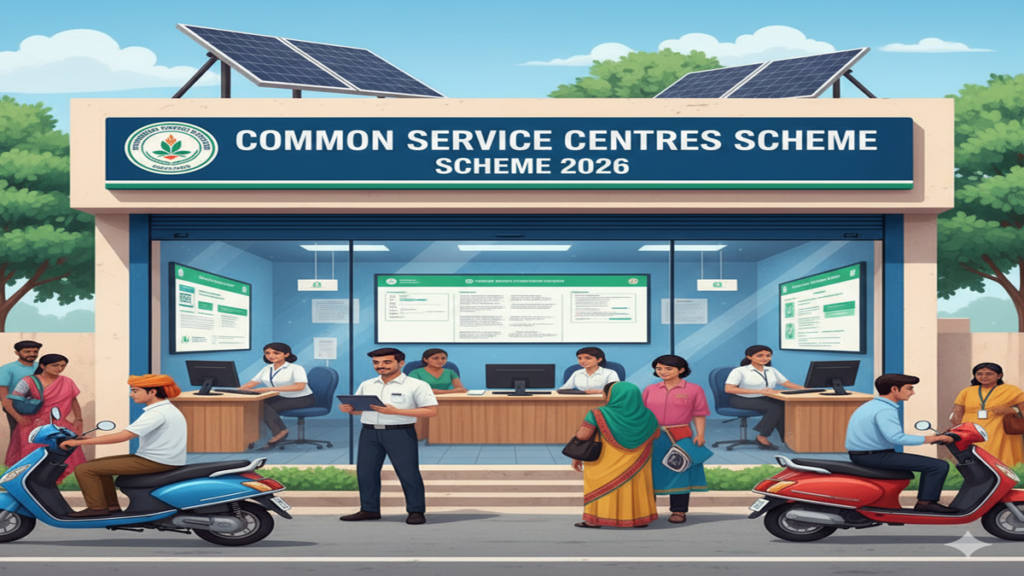
The Common Service Centres Scheme 2026: Bridging the Last Mile in India’s Digital Amrit Kaal
Common Service Centres Scheme 2026 As India strides into its ‘Amrit Kaal’—the 25-year journey towards becoming a Viksit Bharat (Developed India) by 2047—the digital empowerment of every citizen remains the cornerstone of this transformative vision. At the heart of this ambitious endeavour lies a revamped and future-ready Common Service Centres (CSC) Scheme 2026. More than just a government initiative, the CSC Scheme has evolved into a vital digital ecosystem, a grassroots movement of rural entrepreneurship, and the primary interface between the Indian state and its citizens, especially in the remotest corners of the country.
The CSC Scheme 2026 is not a standalone new policy but a strategic evolution of the program launched in 2006. It represents a maturation from providing basic G2C (Government-to-Citizen) services to becoming a multifunctional, service-agnostic digital platform that drives financial inclusion, digital literacy, skill development, healthcare, and rural e-commerce. By 2026, the scheme aims to consolidate its network of over 5 lakh CSCs into a robust, technology-first infrastructure that is pivotal to India’s digital economy.
The Evolutionary Journey: From Kiosks to Digital Hubs
The original CSC scheme was conceived as a part of the National e-Governance Plan (NeGP) to create front-end service delivery points. Over the years, it has undergone a paradigm shift:
- Phase 1 (2006-2015): Service Delivery. Focused on establishing the physical network and offering a limited set of essential services like birth/death certificates, bill payments, and form submissions.
- Phase 2 (2015-2022): Expansion & Inclusion. Under the Digital India mission, CSCs exploded in number. They became the enrolment points for Aadhaar, PMJDY bank accounts, and insurance schemes (PMSBY, PMJJBY). Services expanded to include telemedicine, soil testing, and training programs.
- Phase 3 (2023 Onwards): The 2026 Vision – Ecosystem Orchestrator. The CSC is transitioning from a service point to a “Digital Village Entrepreneur (DVE)”-led holistic hub. The focus is on creating a sustainable, revenue-generating model for Village Level Entrepreneurs (VLEs) by enabling them to offer a vast array of services that meet the evolving needs of rural India.
Core Pillars of the CSC Scheme 2026
The 2026 vision is built on several interconnected pillars:
1. Deepening Digital & Financial Inclusion:
While basic inclusion metrics have improved, the 2026 scheme aims for depth. This includes:
- Promoting Unified Payments Interface (UPI) adoption at the last mile, with VLEs acting as facilitators and educators.
- Expanding insurance and pension penetration (PM-SYM, APY) through assisted models.
- Enabling doorstep banking services in partnership with banks, making CSCs the de facto banking correspondents for many.
2. Catalyzing Rural E-Commerce (CSC ONDC):
One of the most significant thrusts is transforming CSCs into nodes for hyperlocal e-commerce through integration with the Open Network for Digital Commerce (ONDC). The CSC SPV (Special Purpose Vehicle) has become a key participant on ONDC.
- CSC Gramin eStore: Allows VLEs to source products directly from manufacturers and sell locally, eliminating middlemen and ensuring better prices for both producers and consumers.
- Market Access for Artisans: Local handicrafts and products can be listed and sold nationally through the ONDC network, with the VLE managing logistics and digital management.
- This turns the VLE from a service agent into a true local entrepreneur, driving economic activity within the village.
3. Building a Skilled India (CSC Academy & PMGDISHA):
The CSC Academy is the skilling arm of the ecosystem.
- It continues to drive the Pradhan Mantri Gramin Digital Saksharta Abhiyan (PMGDISHA), aiming to make one individual in every household digitally literate.
- Beyond basics, it offers advanced courses in digital marketing, IT literacy, financial accounting, and entrepreneurship, directly enhancing the VLE’s own capabilities and enabling them to train others.
- Partnerships with tech giants for cloud computing, AI basics, and cybersecurity awareness modules are on the horizon for 2026.
4. Transforming Healthcare (Telemedicine & Ayushman Bharat):
CSCs are becoming the first point of contact for rural healthcare.
- e-Sanjeevani Telemedicine: CSCs host teleconsultation booths where citizens can connect with doctors from premier institutions.
- Ayushman Bharat PM-JAY: CSCs assist in golden card creation, eligibility checks, and claim guidance.
- Diagnostic Services: Plans are underway to equip advanced CSCs with basic diagnostic tools for tests like ECG, blood sugar, and blood pressure, with reports digitally transmitted to doctors.
5. Promoting Governance & Ease of Living:
The scheme remains the backbone of service delivery for dozens of government departments (Central, State, and Local). The 2026 goal is seamless integration:
- Single Interface: Moving towards a unified citizen-facing platform where any certificate, application, or status check can be done from any CSC.
- Leveraging India Stack: Deeper integration with DigiLocker for document storage and retrieval, and Aadhaar-based authentication for all services.
The Digital Village Entrepreneur (DVE): The Heart of the Scheme
The success of the CSC Scheme 2026 hinges entirely on its 5+ lakh VLEs (now increasingly termed DVEs). The strategy is to increase their profitability and social standing:
- Diversified Revenue Streams: A VLE’s income is no longer dependent on a few government transactions. It now comes from e-commerce commissions, banking services, insurance, training fees, and telemedicine.
- Community Leadership: Successful VLEs are becoming local leaders and change-makers, trusted with digital solutions for farmers, students, and women.
Technology Backbone for 2026: Cloud, IoT, and AI
To support this expansive vision, the underlying technology is being upgraded:
- CSC Cloud: A centralized, secure cloud infrastructure to host all applications, ensuring scalability and reliability.
- IoT Integration: For services like smart agriculture (sensor-based advisories) and health (remote patient monitoring kits).
- AI-Powered Analytics: To help VLEs understand local demand patterns for e-commerce, personalize service offerings, and for the SPV to monitor network health and performance.
Challenges on the Path to 2026
Despite the successes, challenges persist:
- VLE Sustainability: Ensuring all centres, especially in low-population areas, are economically viable.
- Digital Divide 2.0: Bridging the gap not just in access, but in the ability to use advanced digital services.
- Infrastructure Dependence: Reliable power and high-speed internet remain inconsistent in many regions.
- Service Standardization: Maintaining uniform service quality across a vast, fragmented network.
Conclusion: The Nerve Centre of Digital Bharat
The Common Service Centres Scheme 2026 represents the maturation of a truly Indian innovation in digital governance. It is a public-private-community partnership model that is unique in its scale and ambition. By empowering local entrepreneurs to become providers of digital services, it creates a self-sustaining and scalable model for inclusion.
As we approach 2026, the CSC is poised to be far more than a “centre”—it is becoming the digital nerve centre of rural India, a one-stop-shop for services, commerce, skills, and healthcare. Its success is inextricably linked to the success of Digital India, contributing directly to the goals of financial inclusion, ease of living, and unlocking the economic potential of every village. In the journey towards a Viksit Bharat, the CSC VLE is not just a service delivery agent, but a Digital Yodha (Digital Warrior) championing the cause of equitable growth at the very last mile.
Frequently Asked Questions (FAQs) – CSC Scheme 2026
1. I want to become a CSC Village Level Entrepreneur (VLE). What are the eligibility criteria and process for 2026?
The core eligibility remains focused on local residency and entrepreneurial drive.
- Eligibility: You should be a resident of the locality where you wish to open the CSC, be at least 18 years old, have a minimum educational qualification (usually 10th pass, but higher for some services), and possess basic computer literacy. A dedicated space (even a small room) is required.
- Process:
- Register: Express interest on the official CSC SPV website (www.csc.gov.in).
- Training: Undergo mandatory training from the CSC Academy, which can be online or at a nearby centre.
- Infrastructure: Set up the required infrastructure—a computer, printer, webcam, biometric device, and reliable internet connection.
- Onboarding & Agreement: Sign an agreement with a State Designated Agency (SDA) or a Service Centre Agency (SCA) that operates the network in your district.
- Go Live: Upon verification, you will be given login credentials to the digital Seva portal to start delivering services.
2. How does the CSC ONDC (Gramin eStore) benefit a local farmer or artisan?
The CSC ONDC integration is a game-changer for local producers.
- For Farmers/Artisans: They can now sell their produce (e.g., organic vegetables, grains) or products (handicrafts, textiles) directly on a digital national network without relying on exploitative middlemen. The local VLE helps them list products, set prices, and manage orders. Payments are digital and secure.
- For Consumers: They get access to fresh, local, and often unique products at competitive prices, ordered through their trusted VLE.
- For the VLE: They earn a commission on every sale, creating a powerful new revenue stream and strengthening their role as a market-linkage facilitator.
3. With the push for digital payments and UPI, is the cash-based model at CSCs being phased out?
No, CSCs are not phasing out cash; they are adding digital as an option and promoting it actively. A key role of the VLE in 2026 is to be a “digital financial guide.”
- Assisted Digital Transactions: For citizens unfamiliar with UPI apps, the VLE can facilitate the transaction on their behalf using the CSC’s own merchant QR code, ensuring the payment is completed digitally.
- Education: VLEs are trained to educate customers on the benefits and safety of UPI, helping them set up and use their own apps.
- Cash-to-Digital Gateway: Citizens can still pay cash to the VLE for services like bill payments, and the VLE completes the transaction digitally on the backend. The goal is gradual adoption, not forced exclusion.
4. What are the major new services expected under the CSC scheme by 2026?
The service portfolio is constantly expanding. Key new focus areas include:
- Agriculture 2.0: Drone services for pesticide spraying, AI-based crop health analysis via smartphone images, and advanced soil health card-linked micronutrient recommendations.
- Education & EdTech: Subscription-based access to premium online tutoring content, competitive exam preparation, and digital classroom facilities for local schools.
- Green Energy Services: Facilitating applications and information for PM Surya Ghar Muft Bijli Yojana (solar rooftop), and acting as agents for LED bulb distribution or EV charging point information.
- Legal & Consultancy Services: Tele-law services for basic legal advice, and assistance in filing RTIs, or accessing various government schemes.
5. How does the CSC Scheme ensure the quality and reliability of services across such a vast network?
Maintaining quality is an ongoing challenge addressed through multiple mechanisms:
- Digital Governance: All transactions are logged on the centralized Digital Seva Portal, ensuring transparency and trackability.
- Training & Certification: Mandatory and recurring training programs through the CSC Academy keep VLEs updated.
- Grievance Redressal: A multi-layer system exists where citizens can lodge complaints via the portal or call centre, which are escalated to district, state, and national levels for resolution.
- Performance-Based Incentives: VLEs earn more for delivering more services and maintaining high customer satisfaction, creating a direct incentive for quality.
- Community Feedback: The social capital of the VLE, as a local resident, acts as a natural check-and-balance, as their reputation depends on reliable service.