


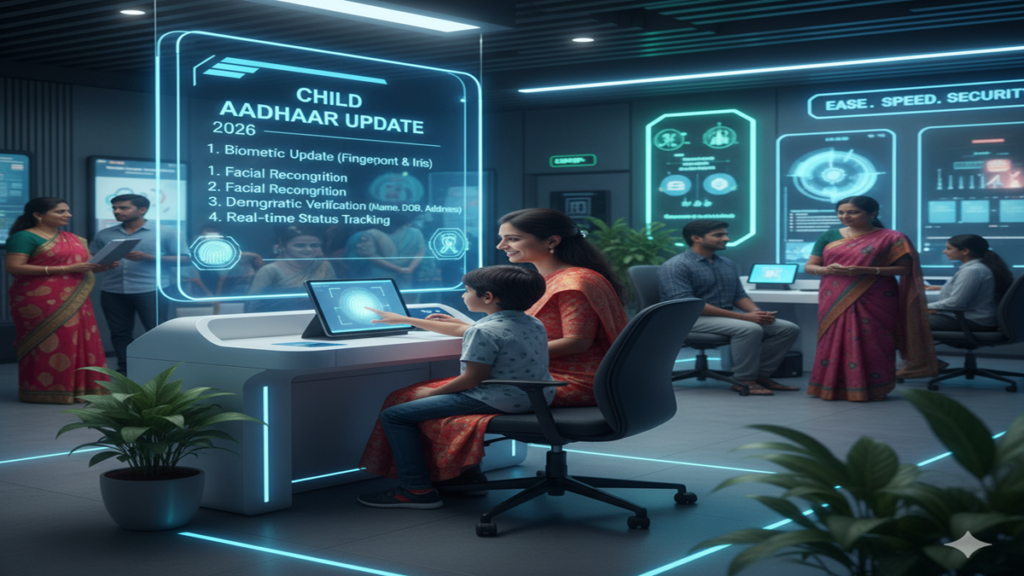
The Complete Guide to the Child Aadhaar Update Process 2026: Ensuring Your Child’s Digital Identity Grows With Them
Introduction
In the ever-evolving digital landscape of India, the Aadhaar card has cemented itself as the cornerstone of identity verification, service delivery, and welfare distribution. For children born in the last decade, the Baal Aadhaar (the blue-colored Aadhaar for minors) is often their first official identity document. However, a child’s Aadhaar is not a static document. As mandated by the Unique Identification Authority of India (UIDAI), it requires crucial updates at specific milestones to remain valid and functional. The Child Aadhaar Update Process for 2026 is a critical procedure that parents and guardians must understand and undertake to ensure their child’s digital identity seamlessly transitions into adulthood.
This comprehensive guide delves into the nuances of the process, outlining the “why,” “when,” and “how” with updated information relevant for 2026. We will navigate the mandatory biometric updates, document requirements, online and offline procedures, and address common concerns to empower you with clarity and confidence.
Part 1: Understanding Baal Aadhaar and the Need for Updates
A Baal Aadhaar is issued to children below the age of 5. Its most distinguishing feature is that it is issued without biometric authentication (fingerprints and iris scan). Instead, it is linked to the UIDAI database solely through the demographic information and photograph of the child, and more importantly, it is linked to the Aadhaar of one of the parents or guardians.
This linkage is the reason updates are mandatory. A child’s physical appearance changes rapidly, and by age 5, their biometrics are considered stable enough for capture. The 2026 update cycle will see a significant number of children born in 2021 (who received Baal Aadhaar) becoming eligible for their first major update.
The Two Mandatory Update Milestones:
- Biometric Update at Age 5: This is the most crucial update. Before the child turns 5, the Baal Aadhaar is valid. Once the child crosses the age of 5, the document must be updated with the child’s own biometrics (photograph, all ten fingerprints, and iris scan). This process transforms the Baal Aadhaar into a standard Aadhaar, de-linking it from the parent’s biometrics for future authentication.
- Biometric Re-validation at Age 15: At this age, a final biometric update is required. This is because biometrics can change during the growth spurt in adolescence. This update ensures the biometric data in the UIDAI database is current and accurate for the individual’s lifetime.
Consequences of Not Updating:
Failure to update the child’s Aadhaar at age 5 does not lead to immediate cancellation. However, the Aadhaar number remains valid but with limited functionality. It may cause authentication failures when used for services like school admissions, scholarship disbursements, health schemes, or later for passport applications. Proactively updating ensures uninterrupted access to benefits and a robust, future-proof identity.
Part 2: The Child Aadhaar Update Process 2026 – A Step-by-Step Walkthrough
The UIDAI offers multiple channels for updates, catering to varying levels of digital access and comfort.
A. Online Update Process (For Address and Other Demographic Updates)
For updates where biometrics are NOT required—such as a change of address, correction of name spelling, or updating parents’ details—the online portal is the fastest method.
- Visit the Official Portal: Go to the myAadhaar portal (myaadhaar.uidai.gov.in), the official online platform for all Aadhaar services.
- Login: Use the child’s Aadhaar Number to log in. An OTP will be sent to the mobile number linked to the child’s Aadhaar (which is invariably the parent’s number provided during enrollment).
- Select Update Request: Under the “Update Aadhaar” section, choose “Update Demographic Details.”
- Enter Details and Upload Proofs: Make the necessary changes in the form. You will be required to upload scanned copies of valid supporting documents (e.g., school certificate for name, passport for date of birth, utility bill for address).
- Review and Submit: Carefully review the updated information. Submit the request by paying a nominal fee of ₹50 (subject to change, confirm on portal for 2026).
- Track Request: You will receive an Update Request Number (URN) to track the status online. The updated Aadhaar letter will be dispatched to your registered address.
Important Note for 2026: *The online process for updating photograph, biometrics (fingerprints/iris), or date of birth still requires a physical visit to an Aadhaar Seva Kendra. UIDAI is continually enhancing its ecosystem, so check if mobile update vans or scheduled home-visit services are available in your district for 2026.*
B. Offline Update Process (Mandatory for Biometric Update at Age 5 & 15)
This is the primary method for the compulsory biometric updates.
- Locate an Aadhaar Seva Kendra (ASK): Use the ‘Locate an Aadhaar Centre’ feature on the UIDAI website or myAadhaar app to find the nearest permanent or enrolment center. For 2026, expect a wider network, including many post offices and bank branches acting as service points.
- Book an Appointment (Highly Recommended): While walk-ins are accepted, booking an online appointment via the myAadhaar portal saves significant waiting time. Slots are opened in advance, and this system is expected to be more streamlined by 2026.
- Carry Required Documents: This is critical. You must bring:
- Child’s Baal Aadhaar Card (or Aadhaar number).
- Original and Photocopy of Proof of Identity (POI) for the Child: This could be a Birth Certificate, School ID card (if applicable), or Passport.
- Original and Photocopy of Proof of Address (POA): Any document where the child’s name appears with the address, or a parent’s POA linked to the Aadhaar.
- Original and Photocopy of Proof of Relationship: Birth Certificate showing parents’ names.
- Aadhaar Card of the Parent/Gaurdian accompanying the child.
- Mandatory: Mobile Number Linked to Child’s Aadhaar. The OTP for authentication will be sent here.
- Visit the Centre: The accompanying parent/guardian must be present with the child. The executive will verify the documents, capture the child’s updated photograph, ten fingerprints, and iris scan.
- Review and Acknowledge: A form will be generated with the updated details. Verify everything meticulously before providing biometric authentication (thumb impression) to submit.
- Receive Acknowledgement Slip: You will get an acknowledgement slip containing the Update Request Number (URN). This URN can be used to track the status online or via the mAadhaar app.
- Receive Updated Aadhaar: The process takes a few weeks. The updated physical Aadhaar letter will be sent to your registered address. You can also download the updated e-Aadhaar from the myAadhaar portal using the URN.
Part 3: Special Scenarios and Troubleshooting for 2026
- Updating Date of Birth (DoB): This is a sensitive update and requires strong supporting documents like a Birth Certificate issued by a municipal authority or a passport. It can be initiated online but will likely require a visit to an ASK for verification in 2026 as well. DoB can be updated only once.
- Lost URN or No Update Received: Use the ‘Check Aadhaar Update Status’ service on the myAadhaar portal. If the URN is lost, you can retrieve status using the Aadhaar number. If the update is delayed beyond the promised timeline (usually 90 days), you can raise a grievance on the portal or contact the UIDAI helpline.
- Mobile Number Not Linked/Changed: This is a common hurdle. You cannot update a child’s Aadhaar if the mobile number is not linked or accessible. First, visit an ASK to update the mobile number in the child’s Aadhaar record. Carry the parent’s Aadhaar and original documents for the child. Once the mobile number is updated and active, proceed with other updates.
- Child with Special Needs: UIDAI provisions for biometric exceptions for children with certain disabilities. Inform the operator at the ASK. Alternative methods of validation will be used, and the process remains equally respectful and accessible.
Part 4: The mAadhaar App – Your Digital Companion
For the tech-savvy parent of 2026, the mAadhaar app will be an indispensable tool.
- Digital Aadhaar: Carry your child’s and your own Aadhaar on your phone in a password-protected, UIDAI-approved format.
- Update Status Tracking: Easily track update requests using URN.
- Locate Centre & Book Appointment: Find the nearest ASK and book slots on the go.
- Lock/Unlock Biometrics: A vital security feature to prevent unauthorized biometric authentication. You can temporarily lock your child’s biometrics and unlock only when needed for an official update or verification.
Part 5: Security, Privacy, and Best Practices for 2026
- Beware of Phishing: UIDAI will never call, email, or SMS you asking for your Aadhaar number, OTP, or biometrics. All official communication originates from UIDAI or gov.in domains. Report any suspicious activity immediately.
- Use Official Channels Only: Conduct all updates via the myAadhaar portal, mAadhaar app, or at official Aadhaar Seva Kendras.
- Document Readiness: Before visiting a centre, double-check the UIDAI website for the 2026 list of valid documents. Ensure names across documents have consistent spelling.
- Update Proactively: Don’t wait for the last minute. Plan the biometric update around your child’s 5th birthday to avoid any last-minute rush or service delays.
Frequently Asked Questions (FAQs) – Child Aadhaar Update 2026
1. My child turned 5 in 2025, but I haven’t updated the biometrics yet. Is the Aadhaar cancelled? What should I do?
No, the Aadhaar number is not cancelled. However, it may not work for biometric-based authentication. You should complete the biometric update at an Aadhaar Seva Kendra at the earliest. The process remains the same as for a child who has just turned 5.
2. Can I update my child’s photograph and address online without visiting a centre in 2026?
As of the current framework, updating the photograph requires a visit to an ASK as it is part of the biometric data. Address updates can be done entirely online by uploading valid address proof and paying the fee. Always check the myAadhaar portal for the most current 2026 guidelines.
3. What if the mobile number linked to my child’s Aadhaar is no longer in use?
This must be resolved first. Visit an ASK with your Aadhaar, the child’s original documents (Birth Certificate, old Aadhaar), and the new mobile number you wish to link. Complete the mobile number update request. Once the new number is active and linked, you can proceed with other updates.
4. Is there any penalty for late update after the child turns 5?
There is no financial penalty imposed by UIDAI. The “penalty” is functional – the Aadhaar may fail biometric authentication, potentially causing inconvenience or delay in availing services that require it.
5. After the biometric update at age 5, will my child get a new Aadhaar number? Will the card color change?
No, the Aadhaar number remains permanent and unchanged for life. The 12-digit number issued at birth will stay with your child forever. The physical card, however, will no longer be the blue Baal Aadhaar. The updated card sent after biometric enrollment will be the standard white Aadhaar letter with the child’s updated photo and biometrics linked.
Conclusion
The Child Aadhaar Update Process for 2026 is more than an administrative formality; it is an essential step in nurturing and securing your child’s digital identity as they grow. By understanding the milestones, preparing the correct documents, and utilizing the official online and offline channels, parents can ensure this transition is smooth and hassle-free. In a digitally empowered India, an updated and active Aadhaar is the key that unlocks a world of opportunities, services, and security for the next generation. Start the process today, and give your child the gift of a verified, lifelong identity.