


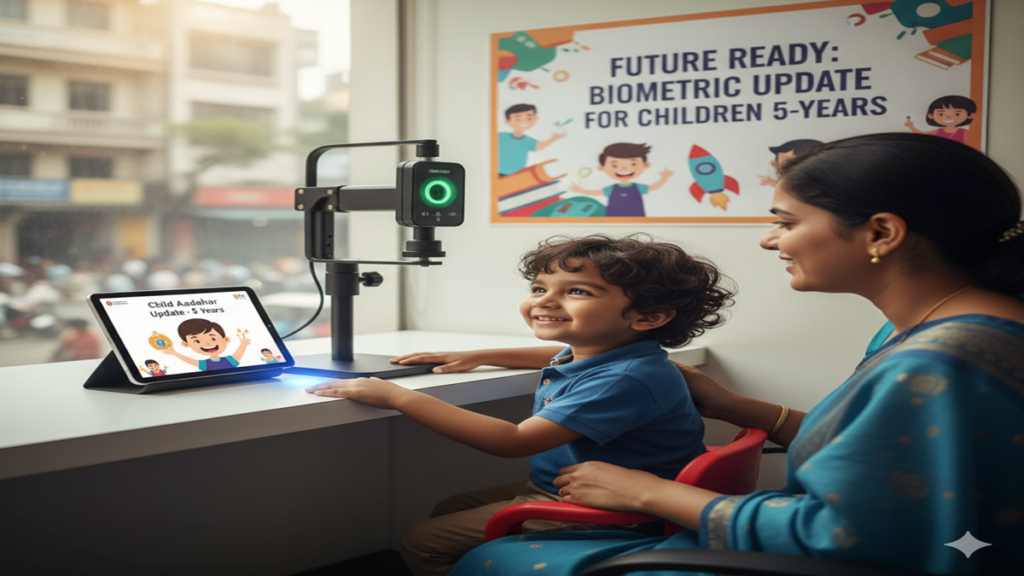
The Essential Guide to Child Aadhaar Biometric Update at Age 5: Securing Your Child’s Digital Identity
Child Aadhaar Biometric Update 5 Years In the digital landscape of modern India, an Aadhaar card has evolved from a mere identity document to a crucial key for accessing essential services—from school admissions and government scholarships to healthcare schemes and bank accounts. For children, this 12-digit unique identity number, issued by the Unique Identification Authority of India (UIDAI), is foundational. However, unlike adults, a child’s Aadhaar has a unique characteristic: it requires a mandatory biometric update upon turning 5 and again at 15. This process, often surrounded by confusion and last-minute rushes, is vital for keeping the document valid and functional.
This comprehensive guide delves into everything you need to know about the Child Aadhaar Biometric Update at 5 years, ensuring your child’s digital identity remains secure, updated, and ready for the future.
Understanding the “Baal Aadhaar” and Why Updates Are Mandatory
When a child is enrolled for Aadhaar before the age of 5, they are issued a “Baal Aadhaar.” This card is distinctly recognizable by its blue color, as opposed to the standard white adult card. At this initial stage, the child’s biometric data—specifically fingerprints and iris scans—are not captured. This is because these physiological traits are still in development and are not stable enough for reliable authentication. The Baal Aadhaar is linked biometrically to the parent or guardian (usually the mother or father) whose details and biometrics are recorded during enrolment. The child’s identity is thus validated through the guardian.
The mandatory Biometric Update at 5 years serves two critical purposes:
- Biometric Seeding: Once a child crosses the age of 5, their fingerprints and iris patterns have stabilized. The update process captures this mature biometric data and seeds it into the child’s own Aadhaar record. This severs the biometric dependency on the parent and establishes the child as a unique, independently identifiable holder of the Aadhaar number.
- Preservation of Validity: Failure to update biometrics can lead to the Aadhaar becoming “inactive” or facing authentication failures. While the UIDAI currently does not deactivate Aadhaar for non-update at 5, an outdated biometric record can cause issues when the child needs to use Aadhaar for exams, bank account openings, or other services that require authentication.
In essence, the update transforms the child’s Aadhaar from a parent-dependent document to a self-sufficient proof of identity.
Step-by-Step Process for the Biometric Update
The process is straightforward, but requires preparation and the correct documentation.
Before You Visit an Aadhaar Centre:
- Check Eligibility: The child must have turned 5 years old. You can proceed a few months before or after the 5th birthday, but it’s advisable to complete it within the year.
- Locate a Centre: Find your nearest Aadhaar Seva Kendra (ASK) or authorized Permanent Enrolment Centre. Use the UIDAI website’s Locate an Enrolment Centre feature. Booking an appointment online is highly recommended to avoid long queues.
- Gather Required Documents: You will need:
- Child’s Existing Baal Aadhaar Card: The original blue card (if issued).
- Proof of Identity (PoI) for Child: This can be a Birth Certificate, School ID card (if it has the child’s photo), or Passport.
- Proof of Address (PoA) for Child: This can be linked to the parent’s address. Documents like a Passport, Bank Statement, or Ration Card where the child’s name is included.
- Proof of Relationship Document: Mandatory. This establishes the link between the child and the accompanying guardian. Use Birth Certificate (which shows parents’ names) or a passport.
- Aadhaar Card of the Accompanying Parent/Guardian: The parent whose biometrics were linked during the initial enrolment should ideally accompany the child. Their original Aadhaar card is required.
- Recent Passport-sized Photograph of the Child: While a new photo will be captured at the centre, carrying a recent photo is sometimes helpful.
At the Aadhaar Seva Kendra:
- Fill the Update/Correction Form: Obtain the form at the centre. Select “Biometric Update” as the service type. Fill in the child’s Aadhaar number and required details accurately.
- Document Submission: Submit the original documents along with the form. The executive will verify them and may take photocopies or scan them.
- Biometric Capture:
- Photograph: A fresh photograph of the child will be taken.
- Fingerprints: All ten fingerprints of the child will be scanned.
- Iris Scan: The irises of both eyes will be scanned.
- Guardian Biometric Authentication: The accompanying parent/guardian will need to verify their identity using their fingerprint or iris scan to authorize the update.
- Acknowledgement Slip: Upon successful data capture, you will receive an acknowledgement slip containing a 14-digit Update Request Number (URN). This is your tracking token. Keep it safe until you receive the updated card.
After the Update:
- Tracking Status: Use the URN on the UIDAI website’s Check Aadhaar Update Status page to monitor the progress.
- Processing Time: The update typically takes 2-4 weeks to be processed and for the new Aadhaar card to be dispatched.
- Download e-Aadhaar: Once the status shows “Update Successful,” you can instantly download the updated e-Aadhaar from the UIDAI website using the child’s Aadhaar number and the URN/OTP. This digitally signed PDF is equally valid as the physical card.
- Physical Card: A new white Aadhaar card (not blue) with updated biometric details will be mailed to the registered address.
Common Challenges and Solutions
- Child’s Cooperation: Getting a 5-year-old to sit still for fingerprints and iris scans can be challenging. Solution: Prepare them in advance. Explain the process in a fun way. Practice at home by gently touching their fingers to a smooth surface. Ensure they are well-rested and not irritable during the visit.
- Document Mismatch: Minor discrepancies in the child’s name (e.g., initials vs. full name on different documents) can cause hiccups. Solution: Carry multiple supporting documents. The Birth Certificate is the most authoritative. If there’s a major mismatch, you may need to carry a gazette notification or affidavit.
- Absence of Original Linked Parent: If the parent whose biometrics are linked cannot accompany, the other parent or a legal guardian can go. They must carry their own Aadhaar, the child’s documents, and proof of relationship/guardianship. The process might involve additional verification.
- Lost Baal Aadhaar Card: Not a problem. As long as you know the child’s Aadhaar number, you can proceed with the update. Carry all other original documents.
Beyond 5 Years: The Next Update at 15
It’s important to note that the biometric update is a two-step process in childhood. The second mandatory update happens when the child turns 15 years old. At this age, adolescent growth has caused significant changes in biometrics. This update refreshes the record with the near-adult biometrics, ensuring lifelong authentication accuracy. The process is identical to the 5-year update.
The Importance of Keeping Child Aadhaar Updated
- Smooth Access to Services: An updated Aadhaar is seamlessly used for mid-day meal schemes, school enrolment under the RTE, Avsar scholarships, and opening junior bank accounts.
- Prevents Future Hurdles: Many national competitive exams, college admissions, and passport applications require Aadhaar authentication. An outdated record can cause last-minute rejections or delays.
- Security & Prevention of Fraud: Linking the child’s own biometrics to their identity secures their Aadhaar from potential misuse and establishes a robust, lifelong digital identity.
- Digital India Integration: An active Aadhaar is the cornerstone for future-facing digital initiatives, from health records (Ayushman Bharat) to digital lockers and learning platforms.
Frequently Asked Questions (FAQs)
Q1: Is it compulsory to update my child’s Aadhaar biometrics at 5? What happens if I don’t?
A: Yes, it is a mandatory rule set by UIDAI. While immediate deactivation may not occur, the Aadhaar may become “inactive” for authentication purposes. This can lead to rejection when using it for services that require biometric verification, causing significant inconvenience. It is strongly advised to complete the update on time.
Q2: Can I update my child’s Aadhaar biometrics online from home?
A: No, the biometric update cannot be done online. It requires the physical presence of the child at an Aadhaar Seva Kendra for the capture of fingerprints, iris scan, and photograph. However, you can book an appointment online and download the updated e-Aadhaar online post-completion.
Q3: What is the fee for the Biometric Update at age 5?
A: The biometric update service at Aadhaar Seva Kendras is completely free of charge. Be wary of any centre or agent demanding payment for this service.
Q4: My child’s Aadhaar is linked to my (mother’s) biometrics. Can the father take the child for the update?
A: Yes. While it is preferable for the linked parent to accompany, the father can take the child. He must carry his own Aadhaar, the child’s documents (Birth Certificate as proof of relationship), and a signed declaration if required. The process will involve his biometric authentication as the accompanying guardian.
Q5: After the update, will my child receive a new Aadhaar number?
A: No. The child’s 12-digit Aadhaar number remains permanent and unchanged for life. Only the biometric data and photograph in the database are updated. The physical card issued after the update will be white, not blue, but will bear the same Aadhaar number.
Conclusion
The Child Aadhaar Biometric Update at 5 is a simple yet profoundly important administrative step. It is an investment in your child’s seamless future in a digitally-enabled nation. By understanding the process, preparing the right documents, and completing the update proactively, parents can ensure their child’s identity is secure, authentic, and ready to unlock the benefits and opportunities of tomorrow. Mark the calendar as your child approaches their fifth birthday, and transform their Baal Aadhaar into a robust, lifelong digital identity.