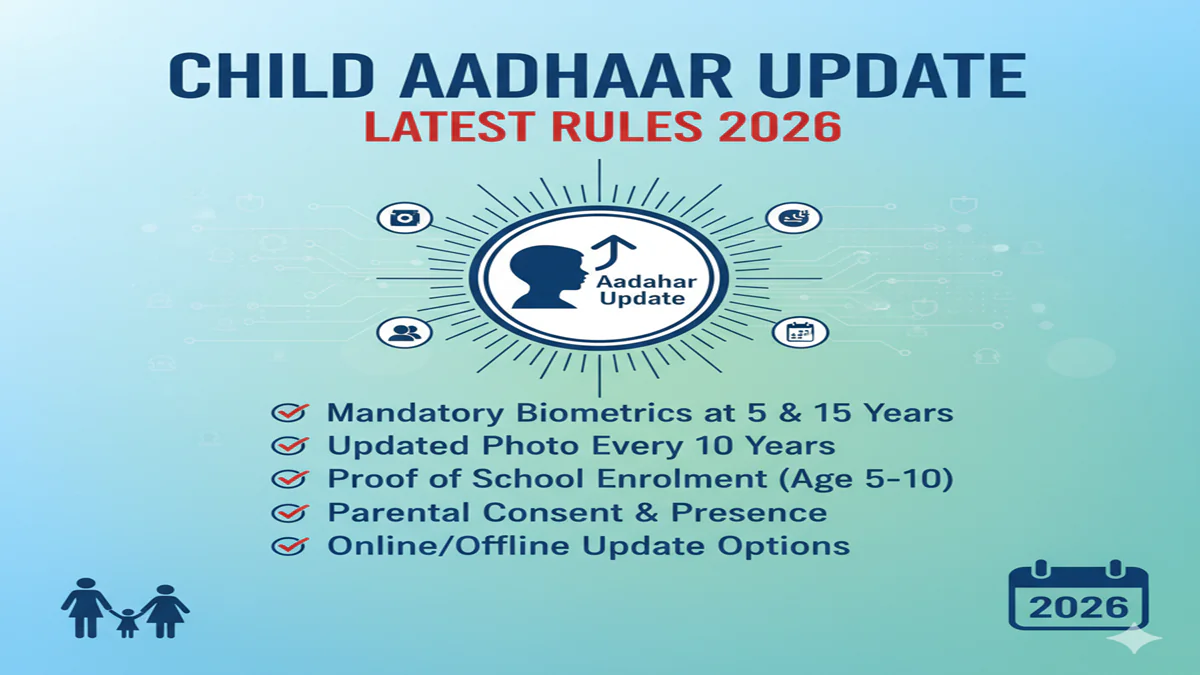
Child Aadhaar Update Rules 2026: ५ आणि १५ वर्षे पूर्ण झालेल्या मुलांसाठी आधार अपडेट अनिवार्य! जाणून घ्या नवीन नियम आणि संपूर्ण प्रक्रिया
Child Aadhaar Update Latest Rules 2026: भारतात आधार कार्ड हे केवळ ओळखीचा पुरावा नसून सरकारी योजना, शालेय प्रवेश आणि शिष्यवृत्तीसाठी अनिवार्य दस्तऐवज बनले आहे. विशेषतः लहान मुलांच्या आधार कार्डाबाबत (Baal Aadhaar) केंद्र सरकारने आणि UIDAI ने २०२६ साठी काही कडक नियम लागू केले आहेत. जर तुमच्या पाल्याचे वय ५ किंवा १५ वर्षे पूर्ण झाले असेल, तर त्याचे आधार कार्ड अपडेट करणे आता कायदेशीररित्या बंधनकारक आहे.
या लेखात आपण Child Aadhaar Update Latest Rules 2026 बद्दलची सर्व महत्त्वाची माहिती सविस्तर पाहणार आहोत.
१. बाल आधार (Baal Aadhaar) म्हणजे काय?
Child Aadhaar Update Latest Rules 2026: ५ वर्षांखालील मुलांसाठी निळ्या रंगाचे ‘बाल आधार’ कार्ड दिले जाते. यामध्ये मुलांच्या हाताचे ठसे (Fingerprints) किंवा डोळ्यांचे स्कॅन (Iris) घेतले जात नाही. हे कार्ड पालकांच्या आधार कार्डाशी लिंक असते.
२. २०२६ मधील अनिवार्य बायोमेट्रिक अपडेट (Mandatory Biometric Update – MBU)
Child Aadhaar Update Latest Rules 2026: UIDAI च्या नवीन नियमांनुसार, मुलांच्या आयुष्यात दोन वेळा बायोमेट्रिक अपडेट करणे अनिवार्य आहे:
- पहिले अपडेट (वयोगट ५ ते ७ वर्षे): जेव्हा मुल ५ वर्षांचे होते, तेव्हा त्याचे पहिले बायोमेट्रिक अपडेट करणे आवश्यक आहे. यावेळी प्रथमच त्याचे १० बोटांचे ठसे, डोळ्यांचे स्कॅन आणि नवीन फोटो घेतला जातो.
- दुसरे अपडेट (वयोगट १५ ते १७ वर्षे): मुलाचे वय १५ पूर्ण झाल्यावर पुन्हा एकदा बायोमेट्रिक्स अपडेट करावे लागतात. हे अपडेट आयुष्यभरासाठी अंतिम असते.
महत्त्वाची टीप: जर तुम्ही हे अपडेट वेळेवर केले नाही, तर मुलाचे आधार कार्ड Deactivate केले जाते, ज्यामुळे शाळा प्रवेश किंवा बँक कामात अडचणी येऊ शकतात.
३. २०२६ साठी नवीन शुल्काचे नियम (Fee Waiver Rules)
Child Aadhaar Update Latest Rules 2026: पालकांसाठी एक मोठी आनंदाची बातमी म्हणजे, UIDAI ने ३० सप्टेंबर २०२६ पर्यंत मुलांचे अनिवार्य बायोमेट्रिक अपडेट (MBU) पूर्णपणे मोफत केले आहे.
- ५ ते ७ वर्षे: मोफत (निर्धारित वेळेत केल्यास).
- १५ ते १७ वर्षे: मोफत (निर्धारित वेळेत केल्यास).
- जर तुम्ही या वयोगटाच्या मर्यादेनंतर अपडेट केले, तर तुम्हाला ₹१०० ते ₹१२५ शुल्क द्यावे लागू शकते.
४. आवश्यक कागदपत्रे (Documents Required)
Child Aadhaar Update Latest Rules 2026: मुलांचे आधार अपडेट करण्यासाठी खालील कागदपत्रे सोबत ठेवा:
१. मुलाचे सध्याचे आधार कार्ड.
२. जन्म दाखला (Birth Certificate) – १ ऑक्टोबर २०२३ नंतर जन्मलेल्या मुलांसाठी हा अनिवार्य आहे.
३. पालकांपैकी एकाचे आधार कार्ड.
४. शाळेचे ओळखपत्र (उपलब्ध असल्यास).
५. अपडेट करण्याची प्रक्रिया (How to Update)
Child Aadhaar Update Latest Rules 2026: बायोमेट्रिक माहिती असल्याने हे काम ऑनलाईन पूर्ण होऊ शकत नाही, तुम्हाला आधार सेवा केंद्रावर (Aadhaar Seva Kendra) जाणे आवश्यक आहे.
स्टेप १: ऑनलाईन अपॉइंटमेंट घ्या
वेळ वाचवण्यासाठी uidai.gov.in किंवा mAadhaar App वरून जवळच्या केंद्राची ऑनलाईन अपॉइंटमेंट बुक करा.
स्टेप २: केंद्राला भेट द्या
ठरलेल्या वेळी मुलाला आणि आवश्यक कागदपत्रांसह केंद्रावर घेऊन जा.
स्टेप ३: बायोमेट्रिक डेटा द्या
तिथे ऑपरेटर मुलाचे फोटो, हाताचे ठसे आणि डोळ्यांचे स्कॅन घेईल.
स्टेप ४: पावती मिळवा
प्रक्रिया पूर्ण झाल्यावर तुम्हाला एक Enrolment Slip मिळेल. त्यावरील ‘Update Request Number (URN)’ द्वारे तुम्ही स्टेटस चेक करू शकता.
निष्कर्ष (Conclusion)
Child Aadhaar Update 2026 कडे दुर्लक्ष करणे महागात पडू शकते. विशेषतः शाळांमध्ये आता आधार व्हॅलिडेशन (UDISE+) अनिवार्य केल्यामुळे वेळेवर बायोमेट्रिक अपडेट करणेच हिताचे आहे. ३० सप्टेंबर २०२६ पूर्वी हे अपडेट करून घ्या जेणेकरून तुम्हाला कोणतेही शुल्क भरावे लागणार नाही.
Quick Info Table
| अपडेट प्रकार | वय मर्यादा | शुल्क (३० सप्टें २०२६ पर्यंत) |
| पहिले MBU | ५ ते ७ वर्षे | मोफत |
| दुसरे MBU | १५ ते १७ वर्षे | मोफत |
| पत्ता/नाव बदल | कधीही | ₹५० |
| विलंबित अपडेट | वयोमर्यादेनंतर | ₹१०० + |
The Complete 2026 Guide to Child Aadhaar: From Baal Aadhaar to Adult Update – Latest Rules and Procedures
Child Aadhaar Update Latest Rules 2026 In the digital ecosystem of India, Aadhaar has become the cornerstone of identity and access to services. For children, it’s more than just a number; it’s a key that unlocks school admissions, healthcare benefits, passport applications, and government welfare schemes. However, a child’s Aadhaar is a dynamic document that must evolve as they grow. With updated regulations from the Unique Identification Authority of India (UIDAI) in 2026, parents and guardians need to be aware of the critical milestones and procedures. This guide demystifies the latest rules for Child Aadhaar enrolment and mandatory updates in 2026.
Understanding the Two Key Stages: Baal Aadhaar and Mandatory Re-verification
Child Aadhaar Update Latest Rules 2026: The UIDAI framework for children is designed in two clear phases, recognizing the significant biometric changes that occur from infancy to adulthood.
1. Baal Aadhaar (For Children Below 5 Years)
Child Aadhaar Update Latest Rules 2026: This is the initial Aadhaar issued to a newborn or a young child. The defining feature of a Baal Aadhaar is that it isissued without biometrics (fingerprints and iris scan)of the child. Only a photograph is captured.
- Documentary Basis: It is issued based on the biometric authentication of the parent/guardian and is linked to their Aadhaar number.
- Blue Colour: To distinguish it easily, the Baal Aadhaar card is printed on a blue-colored background.
- Validity: This card is valid only until the child attains the age of 5 years.
2. Mandatory Biometric Update (At Age 5 and 15)
Child Aadhaar Update Latest Rules 2026: This is the most crucial rule that parents must remember. To keep the Aadhaar record relevant and secure, the UIDAI mandates biometric updates at two specific ages:
- First Update at 5 Years: At this age, the child’s first set of biometrics (all ten fingerprints and iris scans) are captured and updated in the Aadhaar database. This replaces the earlier biometric linkage with the parent/guardian.
- Second Update at 15 Years: Upon reaching 15, a fresh round of biometric updates is required. This captures the stabilized biometrics of the adolescent, essentially transitioning the record to an adult status. After this update, the blue Baal Aadhaar is no longer valid, and the child receives a standard white Aadhaar card.
Latest Rules and Procedural Updates for 2026
Child Aadhaar Update Latest Rules 2026: The UIDAI continuously streamlines processes. Here are the latest features and rules as of 2026:
1. Streamlined Online Appointment System
Child Aadhaar Update Latest Rules 2026: While walk-ins are still accepted at many Aadhaar Seva Kendras (ASKs), the 2026 system heavily encouragesonline appointmentsvia themyAadhaarportal (previouslyuidai.gov.in). This minimizes wait times and ensures service. Slots are released weekly, and you can select your preferred ASK.
2. ThemyAadhaarPortal & App as the Central Hub
Child Aadhaar Update Latest Rules 2026: All child Aadhaar-related services are now integrated into themyAadhaarplatform.
- Book Appointments: For enrolment and updates.
- Check Update History: View when the last biometric update was performed.
- Download Aadhaar: Instantly download a digital, password-protected copy of the updated Aadhaar.
- Request PVC Card: Order a durable, pocket-sized PVC Aadhaar card after updates.
3. Expanded Document List for Proof of Relationship
Child Aadhaar Update Latest Rules 2026: Along with the standard Birth Certificate, UIDAI in 2026 explicitly accepts more documents for establishing the relationship between the child and the parent/guardian:
- Birth Certificate (Issued by Registrar of Births and Deaths) – Mandatory preferred document.
- Legal Guardian Documents: For orphans or children under care, court orders and appointment letters from competent authority are accepted.
- Hospital Discharge Slip: For newborns, this is often used alongside the birth certificate application.
4. Mandatory Photograph Update at Each Stage
A clear, recent photograph of the child is captured not just at enrolment, but also during the 5-year and 15-year updates. This ensures the photograph in the database reflects the child’s current appearance.
5. No Fee for First Biometric Update at Age 5
The mandatory biometric update at 5 years of age is free of cost at all UIDAI-run Aadhaar Seva Kendras. However, private enrolment centers authorized by UIDAI may charge a nominal fee as per UIDAI guidelines (typically ₹50). The update at 15 is also free at government centers.
6. SMS & In-App Alert System
UIDAI has enhanced its notification system. Registered mobile numbers now receive proactive SMS alerts when the child is nearing the age of 5 and 15, reminding parents/guardians of the mandatory update requirement.
7. Simplified Process for Name Changes/Corrections
If you need to update the child’s name (e.g., from a nickname to a full formal name) or correct a spelling, this can now be done concurrently with the mandatory biometric updates at 5 or 15, saving time and visits. Documentary proof (like an updated birth certificate or school ID) is required.
Step-by-Step Process for Child Aadhaar Updates in 2026
A. For Baal Aadhaar Enrolment (Newborn to <5 Years)
- Visit an Aadhaar Enrolment Centre: Locate one via the
myAadhaarportal. - Fill the Enrolment Form: Provide the child’s details (name, gender, date of birth, etc.).
- Submit Documents: Provide the child’s Birth Certificate and the parent/guardian’s Aadhaar as Proof of Relationship and Identity.
- Biometric of Parent/Guardian: The accompanying parent/guardian undergoes biometric authentication.
- Child’s Photograph: A photograph of the child is taken.
- Receive Acknowledgement Slip: Contains the Enrolment ID (EID) to track status and download Aadhaar.
B. For Mandatory Biometric Update at Age 5 & 15
- Book an Appointment (Recommended): Use the
myAadhaarportal or app. - Visit an Aadhaar Seva Kendra (ASK): Carry the original documents.
- Submit Documents: The child’s existing Aadhaar number (or Baal Aadhaar), Birth Certificate, and a valid proof of identity if name has changed.
- Capture Child’s Biometrics: The child’s fingerprints, iris scan, and a fresh photograph will be taken.
Post-Update: The updated Aadhaar can be downloaded in 24-48 hours using the URN or EID. You can also order a new PVC card.
Why Are These Updates Non-Negotiable?
Failure to update the child’s biometrics at the stipulated ages leads to the Aadhaar becoming “Inactive” or “Dormant.” An inactive Aadhaar cannot be used for authentication, potentially disrupting:
- School admissions and exam registrations (especially CBSE, state boards).
- Availing nutritional or health schemes.
- Opening a bank account or investing in Sukanya Samriddhi Yojana.
- Applying for a passport.
Frequently Asked Questions (FAQ) – Child Aadhaar 2026
Q1. My child is now 6, and we missed the 5-year update. What should we do?
A:Don’t panic. The rule is to updateupon turning 5. If you’ve missed the deadline, you should complete the biometric updateas soon as possible. Visit an Aadhaar Seva Kendra with the required documents and complete the process. The Aadhaar may have been marked inactive, but the update will reactivate it. There is no penalty, but it’s crucial to do it to avoid service disruptions.
Q2. Can we update a child’s Aadhaar biometrics online from home?
A: No, biometric updates (fingerprints and iris) cannot be done online.They require specialized equipment available only at authorized Aadhaar Seva Kendras or enrolment centers. However, other demographic updates like address (if supported by proof) can be done online via themyAadhaarportal using the parent’s authenticated login.
Q3. What if only one parent has an Aadhaar? Can the child still get Baal Aadhaar?
A: Yes.The enrolment form has a section for providing one parent’s Aadhaar details. The accompanying parent (whose Aadhaar is provided) must be present for biometric authentication. The Birth Certificate serves as the primary proof of relationship and date of birth.
Q4. Is the presence of the child mandatory for the updates?
A: Absolutely Yes.For both the 5-year and 15-year updates,the physical presence of the child is compulsoryas their fresh biometrics (fingerprints, iris) and photograph need to be captured on the spot. No proxy is allowed for this process.
Q5. What documents are needed if the child is under the guardianship of grandparents or an institution?
A:For non-parental guardians, you must provide:
The child’s Birth Certificate.
A valid court order or official letter of guardianship/appointment from a competent legal authority.
The guardian’s own Aadhaar card as identity proof.
The process at the centre will involve biometric authentication of the documented guardian.
Conclusion: Proactive Management is Key
Navigating your child’s Aadhaar journey in 2026 is simpler with a clear understanding of the two milestones: age 5 and age 15. By leveraging the streamlined online systems, heeding SMS alerts, and planning ahead, parents can ensure their child’s Aadhaar remains active and functional, seamlessly integrating them into India’s digital infrastructure. Remember, an updated Aadhaar is not just a compliance formality; it’s an empowered identity for your child’s future.
Important Links for 2026:
- Official Portal: https://myaadhaar.uidai.gov.in/
- Appointment Booking: https://appointments.uidai.gov.in/
- Locate an Enrolment Centre: https://uidai.gov.in/enrolment-update-centres.html