


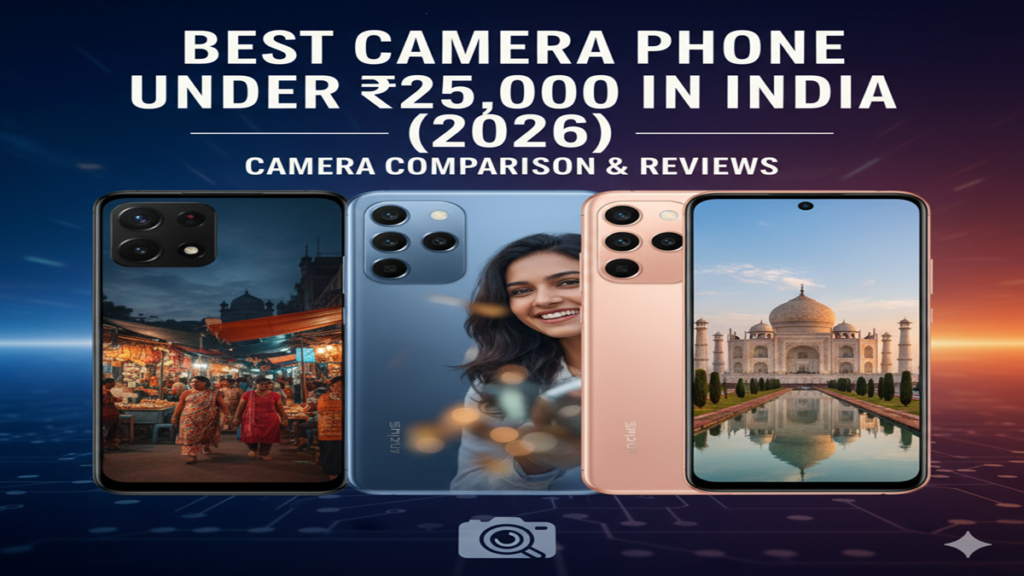
Best Camera Phone Under 25000 (फेब्रुवारी २०२६): फोटोग्राफीसाठी बजेटमधील ५ जबरदस्त स्मार्टफोन्स!
Best Camera Phone Under 25000 Introduction: आजकालच्या सोशल मीडियाच्या युगात प्रत्येकालाच प्रोफेशनल फोटो काढण्याची आवड असते. पण प्रोफेशनल फोटोग्राफीसाठी महागडा कॅमेरा हवाच असे नाही. २०२६ मध्ये कंपन्यांनी ₹२५,००० च्या रेंजमध्ये असे काही स्मार्टफोन्स लाँच केले आहेत जे Flagship Level फोटोग्राफीचा अनुभव देतात.
जर तुम्ही एक कंटेंट क्रिएटर असाल किंवा तुम्हाला ट्रॅव्हल फोटोग्राफीची आवड असेल, तर Best Camera Phone Under 25000 शोधणे आता खूप सोपे झाले आहे. या लेखात आपण फेब्रुवारी २०२६ मधील अशा ५ स्मार्टफोन्सबद्दल जाणून घेणार आहोत, ज्यांचे कॅमेरे या बजेटमध्ये सर्वोत्तम मानले जातात.
१. Motorola Edge 60 Fusion (सर्वात संतुलित कॅमेरा)
Best Camera Phone Under 25000 मोटोरोलाने या वर्षी मध्यम बजेटमध्ये सर्वांना आश्चर्यचकित केले आहे.
- कॅमेरा सेटअप: ५० MP (OIS सह मुख्य) + १३ MP (अल्ट्रावाइड).
- खास वैशिष्ट्य: याचा ‘Sony LYTIA’ सेन्सर कमी प्रकाशात (Low Light) अप्रतिम फोटो काढतो.
- किंमत: ₹२१,९९९ पासून सुरू.
२. Samsung Galaxy A56 (नेचुरल कलर्ससाठी सर्वोत्तम)
Best Camera Phone Under 25000 सॅमसंगचे कॅमेरे त्यांच्या नैसर्गिक रंगांसाठी ओळखले जातात.
- कॅमेरा सेटअप: ५० MP मेन + १२ MP अल्ट्रावाइड + ५ MP मॅक्रो.
- खास वैशिष्ट्य: याचा ५० MP सेल्फी कॅमेरा व्ह्लॉगिंगसाठी (Vlogging) या बजेटमधील सर्वोत्तम आहे. सॅमसंगचे इमेज प्रोसेसिंग सॉफ्टवेअर फोटोंना एक प्रीमियम लूक देते.
३. Poco X7 Pro 5G (परफॉरमेंस आणि कॅमेरा)
Best Camera Phone Under 25000 ज्यांना गेमिंगसोबतच चांगले फोटो हवे आहेत, त्यांच्यासाठी हा फोन आहे.
- कॅमेरा सेटअप: ५० MP (Sony LYT-600) + ८ MP अल्ट्रावाइड.
- खास वैशिष्ट्य: ५० MP ओआयएस कॅमेरा खूप स्थिर व्हिडिओ शूट करतो. दिवसाच्या प्रकाशात याचे फोटो अत्यंत डिटेल्ससह येतात.
- किंमत: ₹२१,९९९.
४. Realme 16 Pro (हाय-रेजोल्यूशन किंग)
Best Camera Phone Under 25000 रियलमी नेहमीच मेगापिक्सेलमध्ये आघाडीवर असते.
- कॅमेरा सेटअप: २०० MP (OIS) मुख्य कॅमेरा.
- खास वैशिष्ट्य: २०० मेगापिक्सेलचा सेन्सर असल्याने तुम्ही फोटो कितीही झूम केला तरी तो फाटत नाही. यात पोर्ट्रेट फोटोग्राफीसाठी विशेष एआय (AI) मोड्स दिले आहेत.
५. OnePlus Nord CE5 (ऑल-राउंडर कॅमेरा)
Best Camera Phone Under 25000 वनप्लसचे नॉर्ड सिरीजमधील हे मॉडेल सध्या मार्केटमध्ये खूप चर्चेत आहे.
- कॅमेरा सेटअप: ५० MP मेन + ८ MP अल्ट्रावाइड.
- खास वैशिष्ट्य: वनप्लसची कलर ट्यूनिंग खूपच सिनेमॅटिक आहे. स्किन टोन सुधारण्यासाठी यात नवीन एआय फिल्टर्स देण्यात आले आहेत.
- किंमत: ₹२४,४९९.
४. कॅमेरा फोन निवडताना काय तपासावे? (Buying Guide)
Best Camera Phone Under 25000 केवळ मेगापिक्सेल जास्त म्हणजे कॅमेरा चांगला असे नसते. खालील गोष्टी नक्की तपासा:
- OIS (Optical Image Stabilization): व्हिडिओ शूट करताना हात हलला तरी व्हिडिओ स्मूद येतो.
- Sensor Size: सेन्सर जितका मोठा, तितके चांगले फोटो रात्रीच्या वेळी येतात.
- Software Optimization: गुगल पिक्सल किंवा सॅमसंग सारख्या कंपन्यांचे सॉफ्टवेअर फोटोला अधिक सुंदर बनवते.
५. सतत विचारले जाणारे प्रश्न (FAQs)
Q1: ₹२५,००० मध्ये सर्वोत्तम व्हिडिओ कॅमेरा कोणता?
Ans: व्हिडिओसाठी मोटोरोला किंवा सॅमसंगचे ओआयएस (OIS) असलेले फोन उत्तम आहेत.
Q2: क्या 200MP कॅमेरा खरोखर 50MP पेक्षा चांगला असतो?
Ans: नेहमीच नाही. २०० एमपी कॅमेरा अधिक डिटेल्स देतो, पण ५० एमपीचा ‘सोनी सेन्सर’ अनेकदा नैसर्गिक रंग आणि चांगले डायनॅमिक रेंज देतो.
Q3: यामध्ये नाईट मोड कसा असतो?
Ans: २०२६ च्या बहुतांश फोन्समध्ये डेडिकेटेड ‘नाईट व्हिजन’ मोड आहे, जो काळोखातही स्पष्ट फोटो काढण्यास मदत करतो.
Conclusion: कोणता फोन निवडावा?
- प्रोफेशनल लूकसाठी: सॅमसंग गॅलेक्सी A56.
- डिटेल्स आणि झूमसाठी: रियलमी 16 प्रो.
- कमी किमतीत बेस्ट कॅमेऱ्यासाठी: पोको X7 प्रो.
The Shutterbug’s Guide: Best Camera Phone Under ₹25,000 in India (2026) – In-Depth Comparison & Reviews
Best Camera Phone Under 25000 The sub-₹25,000 segment in India has transformed from a battleground of compromises to a playground for photographic potential. In 2026, we are seeing technology that was exclusive to flagships just a few years ago trickle down decisively. Choosing the best camera phone in this range is no longer just about megapixel counts; it’s about sensor size, computational photography algorithms, lens versatility, and low-light mastery.
This guide cuts through the marketing jargon to compare the top contenders of early 2026, evaluating their cameras in real-world scenarios to help you make an informed decision.
The 2026 Landscape: What’s Changed?
Best Camera Phone Under 25000 The key trends defining this segment are:
- Larger Sensors for More Light: 1/1.5” and 1/1.7” sensors are now common, significantly improving dynamic range and low-light performance.
- Sophisticated Software: Brands are leveraging AI not just for scene detection, but for advanced multi-frame processing, superior HDR, and realistic portrait effects.
- The Rise of the 50MP Standard: High-resolution primary sensors, often using pixel-binning (combining pixels for better light capture), are the norm.
- Telephoto Makes a Comeback: A genuine 2x optical telephoto lens is becoming a key differentiator, replacing the often-gimmicky macro or depth sensors.
- Video Capabilities: 4K 30fps is standard, with OIS (Optical Image Stabilization) being critical. Some are even offering 4K 60fps from the primary sensor.
Without further ado, let’s dive into the top contenders.
Top Contenders: Head-to-Head Camera Comparison
1. The All-Round Champion: Google Pixel 7a (2026 Legacy Winner)
- Expected Price: ₹23,999 (after discounts)
- Key Camera Specs: 64MP (f/1.9, 1/1.73” Sony IMX787, OIS) + 13MP Ultrawide (f/2.2). Front: 13MP.
The Review:
The Pixel 7a, while from the 2023 lineage, remains a formidable contender in 2026 due to one unmatched factor: Google’s computational photography software. Its camera hardware is good, but the software is exceptional.
- Photo Performance:
- Daylight & HDR: Images are consistently stunning with perfect exposure, vibrant yet natural colors, and incredible dynamic range. Shadows are lifted cleanly, and highlights are preserved without looking artificial. It’s point-and-shoot magic.
- Portrait Mode: The best in the segment. Edge detection is uncannily accurate, with natural-looking background blur (bokeh) and excellent subject separation even for hair and complex objects.
- Low Light/Night Sight: Google’s Night Sight is legendary. It pulls out detail and color from near darkness with minimal noise, often outperforming phones with larger sensors.
- Ultrawide: The 13MP sensor is decent, maintaining good color consistency with the main camera, though detail drops in very low light.
- Video Performance: 4K 30fps video is stable with good dynamic range, thanks to OIS and EIS. The audio quality is also top-notch. It lacks 4K 60fps, a notable omission for some.
- Verdict: Choose the Pixel 7a if you want the most consistent, foolproof, and aesthetically pleasing point-and-shoot camera experience. Its software is years ahead. The drawbacks are the lack of a telephoto lens and an older chipset that can feel slow in processing very heavy tasks.
2. The Hardware Powerhouse: Nothing Phone (3)
- Expected Price: ₹24,999
- Key Camera Specs: 50MP Primary (f/1.9, 1/1.56” Sony IMX906, OIS) + 50MP Ultrawide (f/2.2) + 50MP 2x Optical Telephoto (f/2.0). Front: 32MP.
The Review:
Best Camera Phone Under 25000 Nothing has moved from software gimmicks to serious camera hardware. The Phone (3) boasts a triple 50MP setup, headlined by a large Sony sensor and the segment’s rare true 2x optical telephoto lens.
- Photo Performance:
- The HDR is aggressive but effective. The large sensor provides a lovely shallow depth of field in close-ups.
- Telephoto Lens: This is its killer feature. The 2x optical zoom (approx. 50mm equivalent) is perfect for portraits, street photography, and capturing details without digital zoom. Quality is excellent in good light.
- Low Light: The large sensor shines, capturing ample light. Nothing’s algorithm has improved, offering clean shots with controlled noise, though it can sometimes over-brighten a scene compared to Google’s more natural take.
- Ultrawide: The 50MP sensor ensures high detail, making it one of the best ultrawides in the price range, with minimal distortion.
- Video Performance: It supports 4K 60fps from the primary sensor with excellent stabilization. The Glyph Interface can be used as a creative video light, a unique perk.
- Verdict: The Phone (3) is for the photography enthusiast who values hardware versatility. If you need an optical telephoto for compression and detail, this is your best bet. Its raw hardware power is segment-leading.
3. The Value King & Low-Light Specialist: Samsung Galaxy A56 5G
- Expected Price: ₹24,499
- Key Camera Specs: 50MP Primary (f/1.8, OIS, Large Sensor) + 12MP Ultrawide (f/2.2) + 5MP Macro. Front: 32MP.
The Review:
Best Camera Phone Under 25000 Samsung’s A-series refines its formula yearly. The Galaxy A56 5G doesn’t have the most megapixels or lenses, but it offers a polished, reliable, and feature-rich camera experience deeply integrated into One UI.
- Photo Performance:
- Daylight & HDR: Photos are characterized by Samsung’s signature vibrant, social-media-ready pop. Colors are bright, skies are a deep blue, and greens are lush. The HDR processing is fast and reliable.
- Portrait Mode: Very competent, with a variety of fun bokeh shape options. Edge detection is good, though it can struggle with very fine details compared to the Pixel.
- Low Light: Samsung’s Night Mode is excellent. It brightens scenes significantly while preserving color accuracy and managing noise very well. It often strikes a balance between the Pixel’s natural look and Nothing’s brightness.
- Software Features: It wins on camera features—Single Take, Fun Mode, Pro Mode, and a plethora of embedded social filters.
- Video Performance: Offers Super Steady Video stabilization (1080p) which is incredibly smooth for action shots. 4K 30fps video is detailed and color-accurate.
- Verdict: Choose the Galaxy A56 5G for a balanced, feature-packed camera that excels in vibrant color reproduction and offers superb video stabilization. It’s the most well-rounded package when considering overall software, update policy (4 OS updates), and brand trust.
4. The Dark Horse: Motorola Edge 50 Neo
- Expected Price: ₹22,999
- Key Camera Specs: 50MP Primary (f/1.8, 1/1.55” sensor, OIS, Pixel-binning) + 13MP Ultrawide (f/2.2, 120° FoV). Front: 32MP with Quad Pixel technology.
The Review:
Best Camera Phone Under 25000 Motorola has made a strong comeback with its Edge series, focusing on color science and intuitive editing. The Edge 50 Neo boasts a partnership with Pantone for color calibration and clever AI tools.
- Photo Performance:
- Photos have a distinct, pleasing tonal quality—skins look accurate, and colors are rich without being cartoonish. The large sensor provides great detail.
- Creative Tools: Its unique selling point is in-camera editing like Auto Enhance and Generative AI editing (for removing objects, etc.), powered by a capable chipset.
- Low Light: Performance is solid. The OIS and large sensor combine for good handheld night shots, though the processing can be slightly slower than competitors.
- Video Performance: Can shoot 4K 30fps HDR10+ video, which is rare in this segment, offering better contrast and color in supported displays.
- Verdict: The Motorola Edge 50 Neo is for the user who values color accuracy and in-phone creative editing. It’s a minimalist’s powerhouse that focuses on getting great results from its dual-camera setup without unnecessary gimmicks.
Comparison Table at a Glance
| Feature | Google Pixel 7a | Nothing Phone (3) | Samsung Galaxy A56 5G | Motorola Edge 50 Neo |
|---|---|---|---|---|
| Primary Sensor | 64MP, 1/1.73”, OIS | 50MP, 1/1.56”, OIS | 50MP, Large, OIS | 50MP, 1/1.55”, OIS |
| Ultrawide | 13MP | 50MP | 12MP | 13MP (120°) |
| Telephoto | No | 50MP, 2x Optical | No | No |
| Low-Light King | Yes (Night Sight) | Very Good | Excellent | Good |
| Portrait King | Yes | Very Good | Good | Good |
| Video Capability | 4K@30fps, OIS | 4K@60fps, OIS | 4K@30fps, Super Steady | 4K@30fps HDR10+ |
| X-Factor | Best Computational Photography | Best Hardware/Versatility | Best Overall Ecosystem & Features | Best Color Science & Editing |
| Best For | The Purist & Point-and-Shoot User | The Photography Enthusiast | The Feature-Loving All-Rounder | The Creative Colorist |
Final Verdict & Recommendation
- For the Absolute Best Photo Quality & Consistency: Google Pixel 7a. Its software magic is timeless and delivers results that often beat newer hardware.
- For Versatility & the Telephoto Advantage: Nothing Phone (3). The triple 50MP setup with a genuine telephoto lens is a hardware coup in this segment.
- For the Balanced, Do-It-All Experience: Samsung Galaxy A56 5G. It combines a very good camera with excellent video stabilization, long software support, and a trusted ecosystem.
- For Color Accuracy & Built-in Creativity: Motorola Edge 50 Neo. It offers a unique, refined photographic style and powerful AI editing tools right in the gallery.
Pro Tip: Before buying, visit a store, if possible, and test the camera interface. The speed of launching the camera, shutter lag, and the intuitiveness of the Pro/Mode can greatly affect your real-world experience.
Frequently Asked Questions (FAQ)
Q1: I keep hearing about “sensor size.” Why is it more important than megapixels?
A: Best Camera Phone Under 25000 Think of a camera sensor as a window. A larger window (sensor) collects more light than a smaller one. More light means better image quality, especially in low-light conditions—less noise, more detail, and better colors. A high megapixel count on a tiny sensor just means you have more, but smaller, pixels crammed in, which can actually hurt low-light performance. In 2026, a large sensor (e.g., 1/1.5”) with 50MP is far superior to a small sensor with 108MP.
Q2: Is Optical Image Stabilization (OIS) necessary in a camera phone under ₹25,000?
A: Best Camera Phone Under 25000 Absolutely, yes. OIS physically stabilizes the camera sensor to counteract hand shake. This results in:
Sharper photos in low light (allowing for longer shutter speeds without blur).
Significantly smoother and more professional-looking video footage.
Better quality when using digital zoom. Consider OIS a non-negotiable feature for a serious camera phone in this budget.
Q3: How important is a telephoto lens vs. an ultrawide lens?
A: Best Camera Phone Under 25000 This depends on your shooting style:
Ultrawide (0.5x or 0.6x): Essential for landscapes, architecture, group photos in tight spaces, and creative, expansive shots.
Telephoto (2x, 3x etc.): Crucial for portraits (for flattering facial proportions), capturing distant subjects (like at a concert or wildlife), and detail shots without physically moving closer.
In 2026, a 2x telephoto is a huge value-add. If you must choose, most people use the ultrawide more often, but photography enthusiasts will adore having a true optical telephoto.
Q4: These phones have great hardware, but why does software matter so much?
A: Modern smartphone photography is 50% hardware and 50% software. The software (or computational photography) handles:
HDR Processing: Combining multiple shots for perfect exposure.
Night Mode: Stacking frames to brighten dark scenes.
Portrait Mode: Using AI to create the bokeh (blur) effect.
Color Calibration: Deciding how vibrant or natural your photos look.
This is why the Google Pixel, with older hardware, can outperform newer phones—its algorithms are simply more advanced.
Q5: I’m also interested in vlogging and video calls. What should I prioritize?
A: Best Camera Phone Under 25000 For video and vlogging, focus on these features:
Front Camera Quality: Look for a high-resolution sensor (32MP+) with pixel-binning and a wide field of view.
Stabilization: OIS on the rear camera is a must. For action vlogs, look for a dedicated “Super Steady” or “Action Stabilization” mode (usually at 1080p).
Audio: Check for features like wind noise cancellation or multiple microphones.
Frame Rate: If you want slow-motion capabilities, ensure the phone supports 1080p at 120fps or 240fps.
The Samsung Galaxy A56 5G (for Super Steady video) and Nothing Phone (3) (for 4K 60fps and Glyph light) are particularly strong here.