


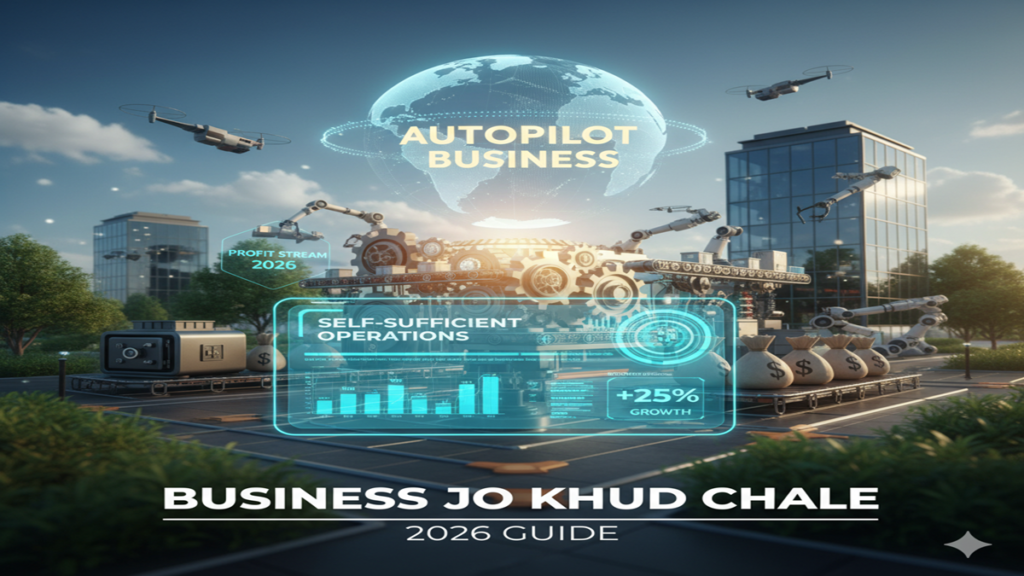
Autopilot Business Meaning: तुम्ही सुट्टीवर असतानाही तुमचा व्यवसाय नफा कमवेल! जाणून घ्या ऑटोपायलट बिझनेसची ताकद
Autopilot Business Meaning: आजच्या वेगवान जगात प्रत्येक उद्योजकाचे एक स्वप्न असते – आपला व्यवसाय असा असावा जो आपल्याशिवायही सुरळीत चालावा. याच संकल्पनेला ‘Autopilot Business’ असे म्हणतात. जर तुम्ही दिवसभर तुमच्या व्यवसायात अडकून राहत असाल आणि तुमच्याशिवाय एकही पान हलत नसेल, तर तुम्ही व्यवसायाचे मालक नसून त्याचे ‘कैदी’ आहात.
या लेखात आपण Autopilot Business Meaning आणि तुमचा व्यवसाय या मोडवर कसा न्यायचा, याची सविस्तर माहिती घेणार आहोत.
१. ऑटोपायलट बिझनेस म्हणजे काय? (What is Autopilot Business?)
Autopilot Business Meaning: ज्याप्रमाणे विमान हवेत झेपावल्यानंतर पायलट ‘ऑटोपायलट’ मोड ऑन करतो आणि विमान स्वतःहून ठरलेल्या मार्गावर चालते, त्याचप्रमाणे व्यवसायात असते. ऑटोपायलट बिझनेस म्हणजे असा व्यवसाय जिथे मालकाने सेट केलेली ‘सिस्टम’ (System) आणि ‘प्रोसेस’ (Process) काम करतात. मालकाने प्रत्यक्ष तिथे हजर राहण्याची किंवा प्रत्येक निर्णय घेण्याची गरज उरत नाही.
[Image Suggestion: A relaxed business owner on a beach checking profits on a laptop]
२. व्यवसायाला ऑटोपायलटवर नेण्याचे ५ मुख्य फायदे
- वेळेची बचत: तुम्हाला नवीन कल्पनांवर काम करण्यासाठी किंवा कुटुंबासोबत वेळ घालवण्यासाठी मोकळा वेळ मिळतो.
- स्केलेबिलिटी (Scalability): जेव्हा व्यवसाय सिस्टमवर चालतो, तेव्हा तो मोठ्या प्रमाणावर वाढवणे सोपे जाते.
- सातत्य (Consistency): मालक हजर नसला तरी ग्राहकांना मिळणारी सेवा किंवा उत्पादनाची गुणवत्ता बदलत नाही.
- विक्री मूल्य वाढते: जो व्यवसाय मालकाशिवाय चालतो, त्याला मार्केटमध्ये चांगली किंमत मिळते (Exit Strategy).
३. व्यवसायाला ‘ऑटोपायलट’ मोडवर कसे न्यावे? (Step-by-Step Guide)
अ) SOPs तयार करा (Standard Operating Procedures):
Autopilot Business Meaning: तुमच्या व्यवसायातील प्रत्येक छोट्या कामाची एक ‘लेखी पद्धत’ तयार करा. उदा. ग्राहकाचे स्वागत कसे करावे? ऑर्डर कशी घ्यावी? तक्रार कशी सोडवावी? यामुळे कर्मचाऱ्यांना काय करायचे आहे हे स्पष्ट समजते.
ब) तंत्रज्ञानाचा वापर (Automation Tools):
Autopilot Business Meaning: २०२६ च्या काळात तंत्रज्ञान खूप पुढे गेले आहे. मार्केटिंगसाठी Email Automation, हिशोबासाठी Tally/Zoho, आणि टीम मॅनेजमेंटसाठी Slack किंवा Trello सारख्या टूल्सचा वापर करा.
क) योग्य टीमची निवड (Right Delegation):
सगळी कामे स्वतः करण्याऐवजी, तुमच्यापेक्षा हुशार लोकांना कामावर ठेवा. त्यांना अधिकार द्या आणि जबाबदारी सोपवा.
ड) रिव्ह्यू सिस्टम (Monitoring):
Autopilot Business Meaning: व्यवसाय तुमच्याशिवाय चालतोय म्हणजे तुम्ही लक्षच द्यायचे नाही असे नाही. आठवड्यातून एकदा ‘KPI’ (Key Performance Indicators) चेक करा की व्यवसाय ठरवलेल्या उद्दिष्टांकडे जात आहे का.
४. ऑटोपायलट बिझनेसची काही उदाहरणे
- Franchise Models (उदा. McDonald’s): मालक कुठेही असला तरी बर्गरची चव बदलत नाही कारण तिथे सिस्टम काम करते.
- Online Courses/E-books: एकदा कोर्स बनवला की तो स्वतःहून विकला जातो आणि पैसे जमा होतात.
- Software as a Service (SaaS): सॉफ्टवेअर स्वतःच ग्राहकांना सेवा देते.
निष्कर्ष (Conclusion)
Autopilot Business Meaning फक्त ‘काम न करणे’ असे नसून ‘स्मार्टली काम करणे’ असे आहे. सुरुवातीला सिस्टम बसवण्यासाठी तुम्हाला खूप मेहनत घ्यावी लागेल, पण एकदा का चक्र फिरायला लागले की तुमचा व्यवसाय तुमच्यासाठी संपत्ती निर्माण करण्याचे मशीन बनेल.
Autopilot vs Manual Business Comparison
| वैशिष्ट्य | मॅन्युअल बिझनेस (Manual) | ऑटोपायलट बिझनेस (Autopilot) |
| मालकाची उपस्थिती | अनिवार्य (१००%) | गरजेची नाही (५-१०%) |
| निर्णय प्रक्रिया | फक्त मालक घेतो | सिस्टिम आणि टीम घेते |
| वाढ (Growth) | मर्यादित | अमर्याद |
| तणाव (Stress) | खूप जास्त | खूप कमी |
Autopilot Business Meaning: Business Jo Khud Chale (2026 Guide)
Introduction: The Dream of Self-Running Enterprise
Autopilot Business Meaning: Imagine a business that consistently generates revenue, serves customers, and grows its market presence while you sleep, travel, or focus on strategic vision. This isn’t science fiction—it’s the reality of an autopilot business, or as it’s evocatively called in Hindi, “Business Jo Khud Chale.” As we approach 2026, this concept has evolved from a motivational buzzword into a tangible operational framework powered by technological integration, systematic processes, and strategic delegation. This guide explores the complete meaning, implementation blueprint, and future trajectory of creating a self-sustaining enterprise in the modern era.
Part 1: Deconstructing the Autopilot Business Meaning
Beyond Metaphor: A Systemic Definition
Autopilot Business Meaning: An autopilot business is not an absentee-owned business requiring zero involvement. Instead, it’s a professionally managed enterprise where the owner is not the primary bottleneck for daily operations. Key revenue-generating functions—sales, delivery, customer service, and administration—are systemized, automated, or delegated to a reliable team and technology stack.
The core philosophy shifts the owner’s role from “chief doer” to “chief architect and strategist.” The system, not the individual, becomes the primary engine of execution.
The 2026 Context: Why “Khud Chale” is More Achievable Than Ever
Autopilot Business Meaning: Several converging trends make the autopilot model particularly viable as we look toward 2026:
- Maturation of SaaS Tools: Cloud-based software for every function (CRM, marketing automation, accounting, project management) is now robust, integrated, and affordable.
- Rise of AI and Hyper-Automation: Artificial Intelligence handles tasks from customer queries (chatbots) to data analysis and content generation, moving beyond simple rules to learned processes.
- Global Talent Accessibility: Remote work models and digital platforms make it easier to hire skilled specialists, virtual assistants, and fractional executives from around the world.
- Changing Consumer Expectations: Seamless, digital-first customer journeys are now the norm, which aligns perfectly with automated business processes.
Part 2: The Four-Pillar Architecture of a 2026 Autopilot Business
Autopilot Business Meaning: Building a business that runs itself requires a foundation supported by four critical pillars.
Pillar 1: Process Documentation & Systemization
Autopilot Business Meaning: The Rule: If you do it twice, document it. If you do it regularly, systemize it.
- SOPs (Standard Operating Procedures): Create clear, visual, and accessible guides for every recurring task—from onboarding a client to restocking inventory. In 2026, these are moving from text documents to interactive video guides and integrated within workflow apps.
- Decision Trees: Map out common business decisions (e.g., handling refund requests, qualifying leads) into clear “if-this-then-that” pathways that team members or even AI can follow.
- Goal: Eliminate tribal knowledge. Any trained person or system should be able to execute the process to a consistent standard.
Pillar 2: Strategic Automation & Technology Stack
Autopilot Business Meaning: This is the “digital workforce” of your autopilot business. Think in layers:
- Core Operations: Use platforms like Zapier or Make.com to connect your apps. Example: A new website lead automatically goes into your CRM, triggers a welcome email sequence, and gets tagged for follow-up.
- Marketing & Sales: Automated email marketing (Mailchimp, ActiveCampaign), social media scheduling (Buffer, Hootsuite), and ad management can run lead-nurturing campaigns 24/7.
- Customer Service: AI-powered chatbots handle FAQs, while ticketing systems (Zendesk, Freshdesk) route complex issues to the right human agent based on predefined rules.
- Financial Management: Tools like QuickBooks or Xero automate invoicing, payment reminders, and basic reconciliation, feeding data into real-time dashboards.
Pillar 3: Delegation & Team Building
Autopilot Business Meaning: Technology can’t do everything. The human element is crucial.
- The “Who Not How” Mindset: Focus on who can solve a problem or run a function, not how you will do it yourself.
- Hiring for System-Managers, Not Just Doers: Recruit or train team members who can oversee and improve systems. A VA who follows an SOP is good; a VA who suggests an improvement to the SOP is invaluable.
- Fractional Leadership: In 2026, it’s increasingly common to hire part-time CFOs, CMOs, or COOs who bring high-level oversight to systemize their domain without full-time cost.
Pillar 4: Owner Mindset & Strategic Focus
Autopilot Business Meaning: The most challenging pillar. The owner must:
- Embrace Strategic Distance: Resist the urge to jump into daily firefighting. Trust the systems and team.
- Focus on Leverage Activities: Dedicate freed-up time to high-impact work: strategy, business model innovation, key partnerships, and team culture.
- Become the “System Auditor”: Regularly review metrics, conduct system health checks, and look for upgrade opportunities.
- Protect Cash Flow: An autopilot business must have predictable, recurring revenue streams (subscriptions, retainers, evergreen products) to fuel its automated operations reliably.
Part 3: The Implementation Roadmap: From Manual to Autopilot (2026 Edition)
Autopilot Business Meaning: Phase 1: Foundation & Analysis (Months 1-3)
- Document Everything: Start by time-tracking your own work for two weeks. Identify all repetitive tasks.
- Choose One “Pilot” Process: Pick a contained, high-frequency process (e.g., client onboarding, social media posting) to systemize first.
- Audit Your Tech Stack: List current tools and identify critical gaps. Prioritize integrations.
Phase 2: Systemization & Initial Delegation (Months 4-9)
- Build SOPs for the Pilot Process: Document, then automate what you can, delegate the rest.
- Hire Your First “System-Follower”: This could be a part-time virtual assistant. Train them rigorously using your new SOPs.
- Establish Core Dashboards: Set up a single dashboard (using Google Data Studio, Power BI, or your CRM’s dashboard) to monitor the health of your pilot system and key business metrics.
Phase 3: Scaling & Integration (Months 10-18)
- Repeat Phase 2 for other core processes: Move to sales, delivery, and support.
- Build Redundancy: Ensure no one person (including yourself) is a single point of failure for any critical system.
- Deepen Integrations: Aim for a “single source of truth” (like your CRM) where all customer and operational data flows.
Phase 4: Optimization & Refinement (Ongoing from Year 2)
- Introduce AI Enhancements: Use AI tools for predictive analysis (e.g., forecasting cash flow), personalized content creation, or advanced customer segmentation.
- Iterate on Feedback: Use team and customer feedback to continuously streamline systems.
- Strategic Pivoting: With the business running smoothly, you can now explore new markets, products, or acquisition strategies.
- Over-Automating & Losing the Human Touch: Balance is key. Customers still value human connection for complex or sensitive issues.
- Underestimating Initial Time Investment: Building systems takes significant upfront time and energy—the “dentist drill” before the relief.
- Tech Stack Fragmentation: Using too many disjointed tools creates complexity. Favor integrated platforms.
- Security & Data Privacy Risks: Automated systems handling data must be secured against breaches, complying with evolving regulations.
- Complacency: An autopilot system needs a pilot (the owner) to set course and monitor instruments. Strategic neglect is dangerous.
Conclusion: Your Business, Unbound
Autopilot Business Meaning: The “Business Jo Khud Chale” of 2026 is not a fantasy of passive income with zero work. It is the pinnacle of entrepreneurial craftsmanship—the intentional design of an asset that operates with elegant efficiency. It represents freedom: the freedom to focus on what truly matters, to innovate without being mired in administration, and to build an enterprise whose value and resilience are not tied to your constant physical presence. The technology and tools are ready. The blueprint is clear. The question for the forward-thinking entrepreneur is no longer if it can be done, but when you will begin architecting your own self-running enterprise.
Frequently Asked Questions (FAQs)
1. Is an autopilot business truly “hands-off,” or is it a myth?
Autopilot Business Meaning: It’s a myth to think it’s completely hands-off. A more accurate term is “hands-light” or “owner-agnostic.” The business can run day-to-day without your direct involvement in operations. However, the owner’s role evolves to strategic oversight, system optimization, culture-setting, and high-level decision-making. Think of yourself as the captain setting the course and maintaining the ship, not rowing the oars.
2. What type of business models are best suited for the autopilot approach?
Autopilot Business Meaning: While any business can benefit from systemization, some models are inherently more amenable:
Digital Products & Online Courses: Once created, delivery and payment can be fully automated.
Subscription Services (SaaS, Membership Sites): Recurring billing and digital delivery streamline operations.
E-commerce with Dropshipping or Fulfilled-by-Amazon (FBA): Inventory and shipping are handled by third parties.
Agency/Services with Retainer Models: Standardized service packages with clear processes are easier to delegate and systemize.
Licensing and Affiliate Marketing: Revenue generation is built into the model itself.
3. Doesn’t building all these systems and hiring a team require a lot of capital? How do I start as a solopreneur?
You start small and fund growth from revenue. Begin by systemizing one process using low-cost or free tools (Google Docs for SOPs, free tiers of automation apps). Hire your first virtual assistant for just a few hours a week to handle that one systemized task. Reinvest the time and money you save back into systemizing the next process. It’s a gradual, bootstrapped evolution, not a massive upfront investment.
4. How do I ensure quality control when I’m not involved in daily operations?
Quality is baked into the system through:
Detailed SOPs and Checklists: Ensuring every task has a clear standard.
Key Performance Indicators (KPIs): Tracking output quality (e.g., client satisfaction scores, error rates, project completion time).
Automated Quality Checks: Using software to proofread, test website functionality, or monitor service response times.
Structured Feedback Loops: Regular client surveys and team reviews that feed directly into system improvements.
5. With AI advancing so quickly, will human teams still be necessary in an autopilot business by 2026?
Absolutely. AI is a powerful tool for automation and augmentation, but it does not replace the need for human judgment, creativity, empathy, and strategic thinking. The future autopilot business will have a hybrid structure: AI handles repetitive data tasks, analysis, and initial customer interactions, while a lean, skilled human team manages exceptions, builds relationships, drives innovation, and oversees the AI systems themselves. The focus shifts from hiring for execution to hiring for oversight and complex problem-solving.