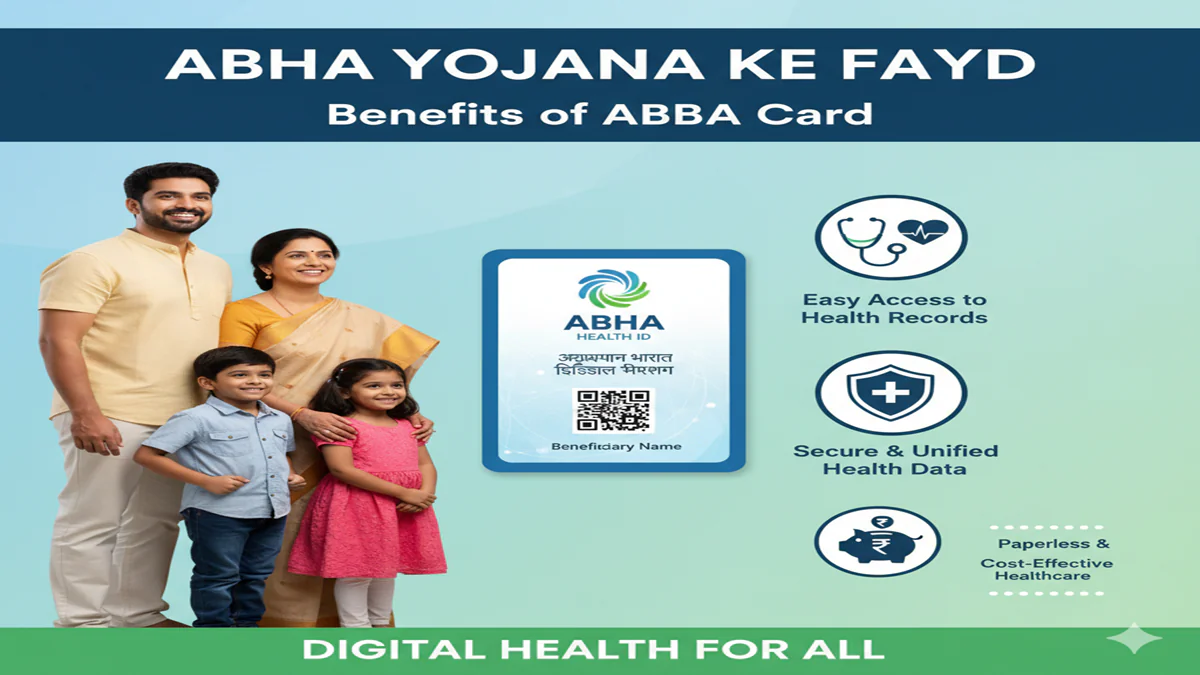
Abha Yojana Benefits: How India’s ABHA Card is Revolutionizing Healthcare Access
Introduction: India’s Digital Healthcare Revolution
Abha Yojana Benefits ABHA Card Health ID Ke Fayde In an era where technology is transforming every aspect of our lives, healthcare in India is undergoing a monumental shift with the introduction of the Ayushman Bharat Health Account (ABHA)—commonly known as the ABHA Card. This 14-digit unique health identifier represents more than just another government ID; it’s the cornerstone of India’s ambitious digital healthcare ecosystem that promises to make medical services more accessible, efficient, and patient-centric for over 1.3 billion citizens.
Launched under the National Digital Health Mission (NDHM), the ABHA initiative aims to create a unified digital health infrastructure that bridges the gap between patients, healthcare providers, insurers, and government health schemes. As we explore the multifaceted benefits of the ABHA Card, it becomes evident that this initiative isn’t merely about digitizing health records—it’s about empowering individuals with control over their health information while streamlining India’s complex healthcare landscape.
What is the ABHA Card?
The ABHA (Ayushman Bharat Health Account) is a randomly generated 14-digit number that serves as a unique health identifier for Indian citizens. Unlike Aadhaar which serves as identity proof for various services, ABHA is specifically designed for healthcare purposes. It acts as a gateway to India’s digital health ecosystem, allowing individuals to link their medical records, access telehealth services, store vaccination details, and participate in government health schemes seamlessly.
The card can be obtained through multiple channels: online via the official ABHA website or Health Records app, at government health facilities, or through participating private hospitals. Registration requires basic demographic information and either an Aadhaar card or mobile number for verification. Once created, the ABHA ID becomes a permanent health identifier that follows an individual throughout their life, across different healthcare providers and geographical locations.
Comprehensive Benefits of the ABHA Card
1. Unified Health Records at Your Fingertips
One of the most significant advantages of the ABHA Card is its ability to consolidate fragmented health information into a single, accessible digital repository. Indians typically receive healthcare from multiple providers throughout their lives—government hospitals, private clinics, diagnostic centers, and specialists—creating scattered medical histories that are difficult to track.
With ABHA:
- All medical records including prescriptions, diagnostic reports, discharge summaries, and vaccination history can be linked to your unique health ID
- Patients can access their complete health history anytime, anywhere through their smartphone
- Healthcare providers can view relevant medical history with patient consent, leading to better-informed treatment decisions
- No more carrying physical files or worrying about lost medical records during emergencies
2. Seamless Access to Telemedicine Services
The COVID-19 pandemic accelerated the adoption of telehealth in India, and ABHA integrates this convenience into the national healthcare framework. The card enables:
- Easy registration and verification on telemedicine platforms
- Secure sharing of medical history with online healthcare providers
- Prescription digitization that can be accessed by pharmacists nationwide
- Follow-up consultations without geographical constraints, especially beneficial for rural populations and those with mobility issues
3. Enhanced Emergency Medical Care
In emergency situations where patients cannot communicate their medical history, ABHA can be lifesaving. Emergency responders or hospital staff can access critical information such as:
- Known allergies and adverse drug reactions
- Chronic conditions (diabetes, hypertension, etc.)
- Current medications
- Blood type and major surgical history
- Emergency contact information
This immediate access to medical history enables faster, safer treatment decisions during critical moments when every second counts.
4. Streamlined Health Insurance Claims
The health insurance claims process in India has traditionally been paperwork-intensive and time-consuming. ABHA transforms this experience by:
- Creating verifiable digital records that reduce insurance fraud
- Enabling faster claim processing through digitized documentation
- Facilitating cashless treatment across networked hospitals
- Providing transparent records that benefit both insurers and policyholders
- Simplifying the process for government health schemes like Ayushman Bharat Pradhan Mantri Jan Arogya Yojana (AB-PMJAY)
5. Improved Continuity of Care
Healthcare is rarely a one-time event but a continuous journey. ABHA ensures consistency in treatment by:
- Allowing different specialists to access the same medical history
- Reducing repetitive diagnostic tests (and associated costs)
- Enabling smooth transitions between primary care physicians and specialists
- Creating longitudinal health records that help identify patterns and provide preventive care
6. Privacy and Control Over Personal Health Data
In an age of data breaches and privacy concerns, ABHA addresses these issues through:
- A consent-based framework where patients control who accesses their data
- Purpose-specific access—healthcare providers can only view information relevant to treatment
- Detailed access logs so patients can track who has viewed their records
- Data encryption and compliance with India’s digital data protection standards
- The option to temporarily lock health data access
7. Integration with National Health Programs
ABHA serves as the foundation for India’s various health initiatives:
- Ayushman Bharat PM-JAY: Simplified identification and verification for beneficiaries
- Immunization programs: Digital vaccination records, especially crucial for children
- National Telemedicine Service: eSanjeevani platform integration
- E-pharmacy and diagnostic registry: Streamlined service delivery
- Health research: Anonymous aggregated data for public health planning
8. Cost Efficiency for Patients and Providers
By reducing administrative overhead and minimizing duplicate testing, ABHA creates economic benefits:
- Patients save money on repeated diagnostic tests
- Healthcare providers reduce administrative costs associated with record-keeping
- Insurance companies experience lower fraud-related losses
- The overall healthcare system becomes more efficient, potentially reducing national healthcare expenditure
9. Support for Preventive Healthcare
ABHA isn’t just for sick care—it’s designed to promote wellness through:
- Digital health diaries and wellness tracking
- Integration with fitness apps and wearable devices (with user consent)
- Reminders for regular check-ups and screenings based on risk profiles
- Personalized health recommendations based on medical history
10. Standardization and Interoperability
Before ABHA, healthcare providers used incompatible systems that couldn’t communicate. ABHA establishes:
- Common standards for health data exchange
- Interoperability between different healthcare IT systems
- A foundation for innovative health-tech applications
- Consistent patient identification across the healthcare ecosystem
Real-World Applications and Success Stories
Case Study 1: Rural Healthcare Transformation
In Uttar Pradesh’s remote villages, community health workers equipped with tablets now use ABHA IDs to update maternal health records in real-time. Pregnant women no longer need to carry paper records between home visits and primary health centers. Their entire prenatal history is accessible to any authorized healthcare provider, reducing complications and improving maternal outcomes.
Case Study 2: Chronic Disease Management
Ramesh, a 58-year-old diabetic from Chennai, previously struggled to manage his condition while traveling for work. With ABHA, his glucose readings, medication history, and specialist consultations are available to any doctor he visits. When he experienced a hypoglycemic episode in Delhi, the emergency room doctor accessed his ABHA records and provided appropriate treatment within minutes.
Case Study 3: Streamlined Insurance Claims
The Sharma family faced a lengthy hospital stay when their daughter required surgery. With their ABHA-linked insurance, the cashless claim was processed in hours rather than weeks. All documentation was digital, and the family avoided the usual bureaucratic hurdles, allowing them to focus on their daughter’s recovery instead of paperwork.
Challenges and the Path Forward
While ABHA offers transformative benefits, its implementation faces challenges:
- Digital Literacy Divide: Rural populations and elderly citizens may struggle with digital adoption
- Infrastructure Gaps: Uneven internet connectivity across regions
- Healthcare Provider Adoption: Encouraging widespread participation from all healthcare facilities
- Data Security Concerns: Maintaining public trust in digital health systems
- Integration Complexities: Connecting existing hospital management systems with the ABHA framework
The government is addressing these through:
- ABHA creation assistance at common service centers and health facilities
- Offline functionality for areas with limited connectivity
- Incentives for healthcare providers to join the digital ecosystem
- Robust cybersecurity protocols and regular audits
- Phased implementation with continuous feedback mechanisms
Comparative Advantage: ABHA vs. International Models
India’s ABHA system draws lessons from global digital health initiatives while adapting to local needs:
- Unlike the UK’s NHS Number, ABHA incorporates telemedicine from inception
- Compared to the US system of disparate electronic health records, ABHA offers nationwide interoperability
- Similar to Australia’s My Health Record, but with stronger emphasis on mobile accessibility
- Unique to India: Integration with the world’s largest government health insurance scheme (AB-PMJAY)
How to Maximize Your ABHA Benefits
To fully leverage your ABHA Card:
- Complete Your Health Profile: Add existing medical records, allergies, and current medications
- Link Family Members: Register ABHA for children, elderly parents, and dependents
- Use Consciously: Grant access only to trusted healthcare providers for specific purposes
- Keep Updated: Regularly add new prescriptions, test results, and consultation summaries
- Explore Connected Services: Utilize linked telemedicine, e-pharmacy, and diagnostic services
- Secure Your Account: Use strong authentication and monitor access logs
The Future Vision: ABHA 2.0
The roadmap for ABHA includes exciting developments:
- AI-Powered Health Insights: Predictive analytics for disease prevention
- Genomic Data Integration: Personalized medicine based on genetic profiles
- International Portability: Health records accessible during overseas travel
- Blockchain Integration: Enhanced security and transparency
- Expanded Wellness Features: Mental health support, nutrition tracking, and fitness integration
Conclusion: A Healthier Digital India
The ABHA Card represents a paradigm shift in how India approaches healthcare—from a fragmented, provider-centric model to an integrated, patient-empowered ecosystem. Its benefits extend beyond individual convenience to create systemic efficiencies that could transform public health outcomes for generations.
While challenges remain in universal adoption, the foundation has been laid for a more equitable, accessible, and efficient healthcare system. As digital infrastructure expands and more citizens embrace this innovation, ABHA has the potential to bridge India’s healthcare disparities, improve treatment outcomes, reduce costs, and ultimately create a healthier nation.
The ABHA Card isn’t just another identification number—it’s a key to unlocking comprehensive, continuous, and compassionate healthcare for every Indian. By participating in this digital health revolution, citizens aren’t merely receiving a service; they’re becoming active stakeholders in shaping the future of Indian healthcare—one digital health record at a time.