Introduction: Navigating the Practical Core of Computer Science
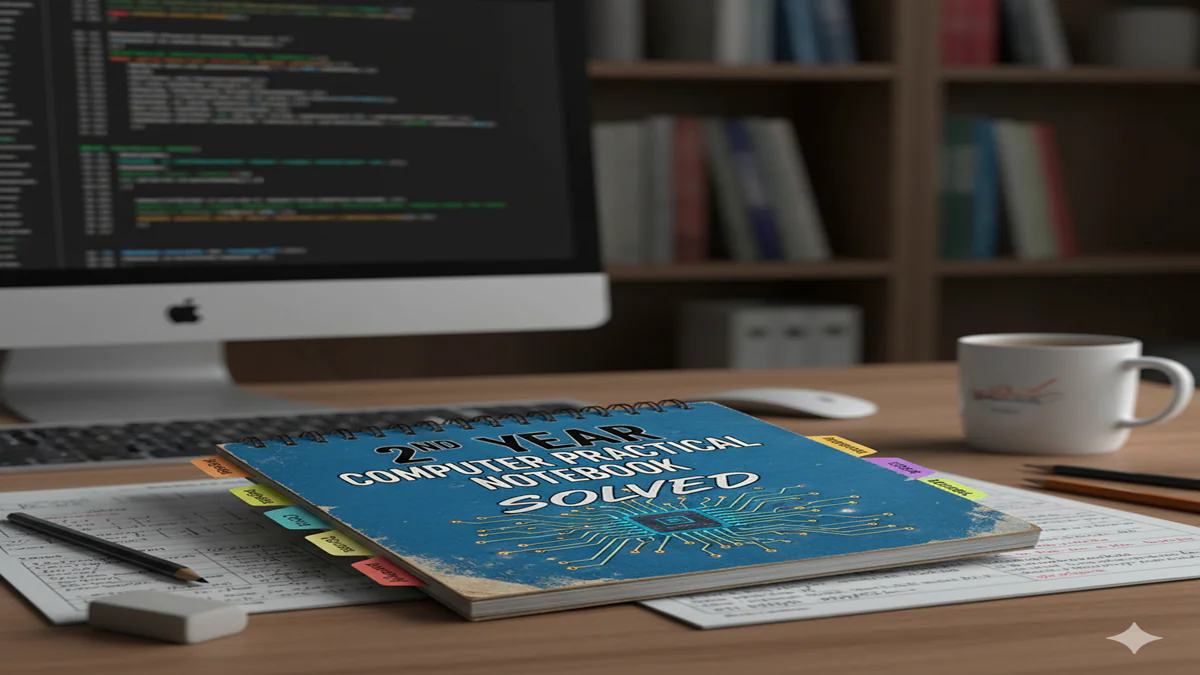
2nd Year Computer Practical Notebook Solved For students in their 2nd year of intermediate programs (often FSc/ICS, 12th Grade, or equivalent), the Computer Science practical notebook is not just a requirement—it’s the foundational playground where theoretical concepts of programming, databases, and web development come to life. This subject, rich with languages like C++, SQL, HTML, and problem-solving algorithms, demands hands-on practice. A solved practical notebook serves as an indispensable roadmap, clarifying outputs, code structure, and viva voce expectations.
As we step into 2026, the demand for updated, accurate, and freely accessible digital resources has never been higher. This comprehensive guide explores the importance of the practical notebook, provides insights into its contents, and addresses the safe, ethical acquisition of a
2nd Year Computer Practical Notebook Solved PDF Free Download | Updated 2026.
Chapter 1: The Critical Role of the Practical Notebook in Computer Science
Computer Science is inherently practical. While theory teaches you about loops, functions, and normalization, the practical notebook is where you battle syntax errors, logical bugs, and learn the true meaning of “debugging.”
- Bridge Between Theory and Application:The notebook contains prescribed experiments and programs that directly translate classroom learning into executable code. It reinforces concepts like control structures, arrays, file handling, and DBMS commands.
- Exam Preparation Blueprint:For most boards (Punjab, Federal, KPK, Sindh, AJK), the practical examination carries significant marks. The notebook’s solutions prepare students for the lab performance, output demonstration, and the ensuing viva voce.
- Building Problem-Solving Muscle:Going through solved exercises isn’t about copying; it’s about understanding methodology. A well-documented solved PDF shows the approach to tackling a problem, from algorithm to final code and output.
Chapter 2: What’s Inside the Updated 2026 Practical Notebook?
An updated notebook for 2026 will align with current syllabi, which, while consistent in core, may see shifts in emphasis or software versions. A standard solved notebook includes:
- Programming in C++:Solutions to programs covering:
- Basic I/O and control structures (if-else, loops).
- Functions (call by value, call by reference).
- Arrays (1D & 2D), sorting, and searching algorithms.
- Structures and file handling.
- Database Management Systems (SQL):Solved queries for:
- Data Definition Language (CREATE, ALTER TABLE).
- Data Manipulation Language (SELECT with WHERE, ORDER BY, GROUP BY, JOINs).
- Practical implementation of normalization.
- Web Development (HTML):Code for creating:
- Basic web pages with formatting.
- Lists, tables, and forms.
- Simple CSS integration for styling.
- Lab Experiments & Viva Questions:Often includes sample outputs and anticipated oral questions with answers.
Chapter 3: The Quest for “Free Download” – A Guide to Safe and Ethical Sourcing
Navigating this space requires caution to avoid malware, outdated material, or copyright infringement.
Recommended and Safe Sources for 2026:
- Official Educational Portals:First, check if your respective board (e.g., BISE Lahore, Federal Board) provides any digital resources or model practical sheets.
- Reputable Educational Websites:Sites likeilmkidunya.com,campus.pk, andnotespk.comhave historically curated subject resources. Look for uploads dated 2024-2026 for the most relevant content.
- Digital Libraries & Forums:Platforms likeAcademia.eduorSlideSharesometimes host educator-uploaded materials. Always check the upload date and user credibility.
- YouTube Tutorials with Links:Many computer science educators (e.g.,CS with M. Ali,Perfect Computer Engineer) create video walkthroughs of practical programs and often provide PDF links in the descriptions. This is one of the most effective ways to learn in 2026.
A Critical Word on Ethics and Use:
A “solved” PDF is a study aid, not a shortcut. Ethically, it is meant for:
- Cross-verifying your own code.
- Understanding a concept you’re stuck on.
- Preparing for exams.
Directly copying and submitting the work as your own violates academic integrity and hinders your learning, which is catastrophic in a field like computer science.
Chapter 4: Maximizing Your Learning with the Solved PDF – A 2026 Study Strategy
Simply having the PDF won’t magically grant you knowledge. Here’s how to use it effectively:
- Try First, Peek Later:Always attempt to write the code or query yourself first. Struggle with the errors. Only after a genuine effort should you consult the solution.
- Deconstruct the Solution:Don’t just read it. Break it down. Why was a
forloop used instead of awhile? Why was that specific JOIN condition applied? - Execute Independently:Type the solution from the PDF into your compiler/DBMS yourself. This builds muscle memory and helps you spot typos you might have otherwise missed.
- Experiment and Modify:Once it works, break it! Change parameters, try different inputs, or add a feature. This is where true programming confidence is built.
- Compile Your Own Notes:Use the solved PDF as a reference to create your own, simplified commentary or cheat sheet.
Chapter 5: Beyond the PDF – Supplementary Resources for 2026 Success
Complement your solved notebook with these modern resources:
- Online Compilers & IDEs:UseOnlineGDBfor C++,W3Schools’ Tryit Editorfor HTML/SQL, orSQLiteOnlinefor database practice. They are instant and require no setup.
- AI-Powered Coding Assistants:Tools likeGitHub CopilotorChatGPT (used responsibly)can explain concepts, debug errors, and generate alternative code examples.Never use them to do your work for you;use them as interactive tutors.
- Coding Challenge Platforms:Websites likeHackerRankorLeetCode (easy problems)offer fantastic practice for core programming logic beyond the syllabus.
Conclusion: The Path to Mastery in 2026
integrity, can significantly elevate your practical understanding and exam readiness. In the fast-evolving world of technology, the principles cemented during these practical sessions are perennial. Use this guide to source your materials wisely, engage with the content actively, and build not just a portfolio of solved programs, but a robust, problem-solving mindset that will define your success in computer science far beyond your final exams.
Frequently Asked Questions (FAQ)
Q1: Is it legal to download a solved practical notebook PDF?
A: Downloading for personal study and reference is generally considered fair use, similar to using a textbook solution guide. However, distributing it for profit or claiming it as your original work for submission is unethical and likely a violation of academic integrity policies. Always prioritize your own effort.
Q2: The PDF I downloaded has programs from an old syllabus (e.g., using Turbo C++). Is it still useful for 2026?
A: The core logic of C++ programs remains consistent. However, the old DOS-based Turbo C++ compiler is largely obsolete. The concepts are transferable, but you should implement them in a modern IDE like Code::Blocks, Dev-C++ (updated), or Visual Studio Code. Focus on the algorithm, not the outdated IDE-specific instructions.
Q3: I can’t find a single PDF with all solutions updated for my specific board in 2026. What should I do?
A: This is common. Your best strategy is to aggregate resources. Find a reliable base PDF, then use YouTube tutorials (filtered for 2024-2026) for specific programs you’re missing. Many educators create topic-wise videos that are more up-to-date than compiled PDFs.
Q4: How can I verify the accuracy of the solutions in a downloaded PDF?
A: The only surefire way is to run the code yourself. Type it into your compiler or DBMS. If it executes successfully and produces the correct output, it’s verified. This practice is, in itself, a crucial part of your learning.
Q5: Are there any risks associated with downloading these PDFs from free sites?
A: Yes. Risks include:
- Malware:Files disguised as PDFs can contain viruses. Use a reputable antivirus and download from well-known educational sites.
- Outdated/Incorrect Content:This can lead to confusion and learning wrong methods.
- Spam & Pop-ups:Many free download sites are filled with intrusive ads.
Mitigate these risks by using ad-blockers, verifying file sizes (extremely small files might be suspicious), and preferring sites that host content directly (like Google Drive links shared by educators) over multi-click download portals.