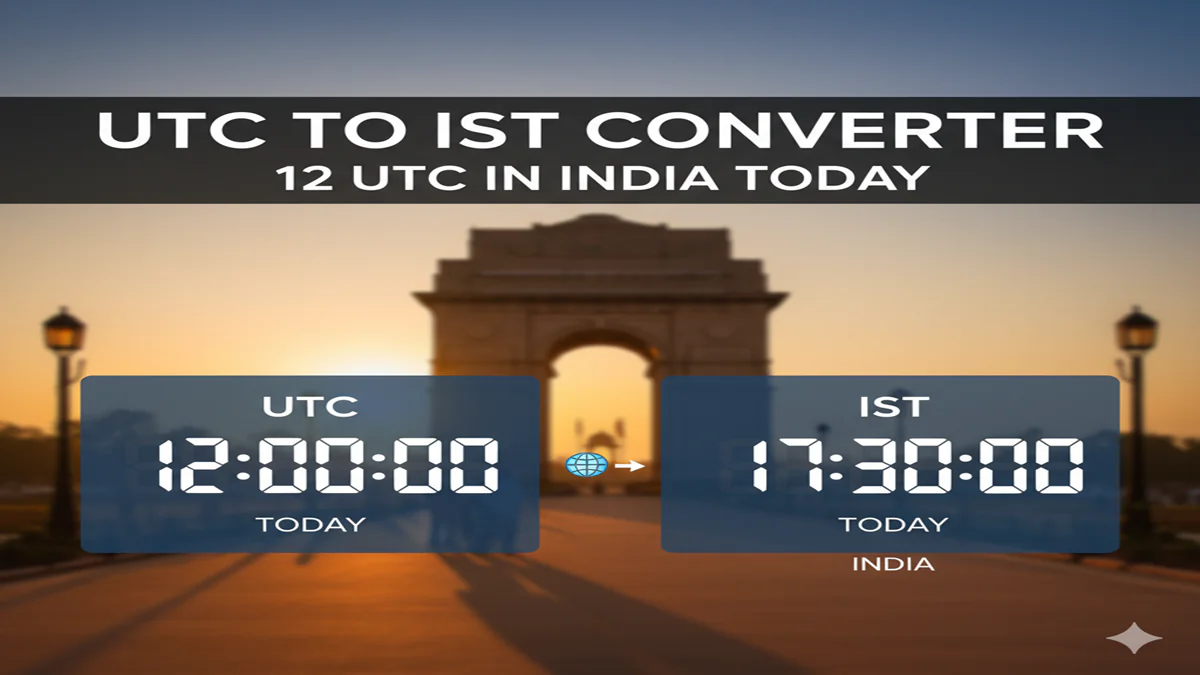
12 UTC in India: भारत में क्या समय होगा? UTC और IST के बीच के अंतर को समझने की पूरी गाइड!
Introduction:
12 UTC in India: इंटरनेट और ग्लोबलाइजेशन के इस दौर में, हम अक्सर ऐसी खबरें या इवेंट्स देखते हैं जिनका समय ‘UTC’ (Coordinated Universal Time) में दिया होता है। चाहे वो किसी नई फिल्म का ग्लोबल रिलीज हो, शेयर बाजार की खबर हो या किसी अंतरराष्ट्रीय मीटिंग का समय। सबसे आम सवाल जो भारतीयों के मन में आता है, वह है— “12 UTC in India का मतलब क्या है?” क्या यह दोपहर के 12 बजे हैं या रात के? भारत में उस समय घड़ी में क्या बज रहा होगा? इस लेख में हम इसी गुत्थी को सुलझाएंगे और आपको समय बदलने का एक ऐसा फॉर्मूला देंगे जिसे आप कभी नहीं भूलेंगे।
1. UTC और IST के बीच का बुनियादी अंतर (The Difference)
12 UTC in India: UTC (यूनिवर्सल टाइम) पूरी दुनिया का एक मानक समय है। भारत का समय जिसे हम IST (Indian Standard Time) कहते हैं, वह UTC से 5 घंटे 30 मिनट आगे रहता है।
- गणित का फॉर्मूला:$$IST = UTC + 5:30 \text{ hours}$$
2. 12 UTC का भारत में क्या समय होगा? (Calculation)
12 UTC in India: यहाँ हम दो स्थितियों की बात करेंगे— दोपहर के 12 (12 PM) और रात के 12 (12 AM)।
स्थिति A: 12 PM UTC (दोपहर के 12 बजे)
12 UTC in India: यदि लंदन या UTC ज़ोन में दोपहर के 12 बज रहे हैं, तो भारत में समय होगा:
- 12:00 PM + 5 घंटे 30 मिनट = 5:30 PM (शाम के साढ़े पांच बजे)
- यानी जब दुनिया के मानक समय के अनुसार दोपहर होती है, तब भारत में चाय का समय (शाम) हो रहा होता है।
स्थिति B: 12 AM UTC (रात के 12 बजे / 00:00 UTC)
12 UTC in India: यदि UTC में नई तारीख शुरू हो रही है और रात के 12 बज रहे हैं, तो भारत में समय होगा:
- 12:00 AM + 5 घंटे 30 मिनट = 5:30 AM (सुबह के साढ़े पांच बजे)
- यानी जब UTC में दिन बदलता है, भारत में लोग सुबह की सैर की तैयारी कर रहे होते हैं।
3. UTC का महत्व और उपयोग (Why UTC matters in 2026?)
- 12 UTC in India: फ्रीलांसिंग और मीटिंग्स: यदि आपका क्लाइंट अमेरिका या यूरोप में है, तो वे अक्सर UTC का उपयोग करते हैं ताकि समय का भ्रम न हो।
- गेमिंग और टेक इवेंट्स: PUBG, Fortnite या Apple के इवेंट्स अक्सर 12 UTC या उसके आसपास शेड्यूल किए जाते हैं।
- एविएशन और शिपिंग: पायलट और नाविक हमेशा UTC का ही उपयोग करते हैं ताकि पूरी दुनिया में एक ही समय का पालन हो सके।
- क्रिप्टो और स्टॉक मार्केट: अंतरराष्ट्रीय क्रिप्टोकरेंसी एक्सचेंज का डेटा अक्सर UTC में अपडेट होता है।
4. समय बदलने के आसान तरीके (Quick Tips)
- 12 UTC in India: गूगल सर्च: सीधे गूगल पर टाइप करें “12 UTC to IST”, आपको तुरंत जवाब मिल जाएगा।
- स्मार्टफोन वर्ल्ड क्लॉक: अपने फोन की क्लॉक ऐप में ‘UTC’ को एक शहर के रूप में जोड़ें।
- याद रखने वाली ट्रिक: बस इतना याद रखें कि हम दुनिया से साढ़े पांच घंटे आगे हैं। जब भी UTC दिखे, उसमें साढ़े पांच घंटे जोड़ दें।
4. अक्सर पूछे जाने वाले प्रश्न (FAQs)
Q1: क्या UTC और GMT एक ही हैं?
12 UTC in India: Ans: तकनीकी रूप से UTC एक अधिक सटीक मानक समय है, जबकि GMT (Greenwich Mean Time) एक टाइम ज़ोन है। हालांकि, व्यावहारिक रूप से दोनों का समय एक ही रहता है।
Q2: भारत में साढ़े पांच घंटे का ही अंतर क्यों है?
Ans: भारत की मानक देशांतर रेखा (Longitude) $82.5^\circ E$ है, जिसे $15^\circ$ प्रति घंटा के हिसाब से गणना करने पर 5.5 घंटे का अंतर आता है।
Q3: क्या गर्मी और सर्दी में यह समय बदलता है?
12 UTC in India: Ans: भारत में ‘Daylight Saving Time’ (DST) नहीं होता, इसलिए साल भर UTC और IST के बीच 5:30 घंटे का ही अंतर रहता है।
Conclusion: समय का सही प्रबंधन!
12 UTC in India का मतलब सीधा सा है— शाम के 5:30 बजे (यदि 12 PM है) या सुबह के 5:30 बजे (यदि 12 AM है)। इस छोटे से अंतर को समझकर आप अपने अंतरराष्ट्रीय काम और इवेंट्स को बिना किसी गलती के मैनेज कर सकते हैं। समय की सही जानकारी ही आपको ग्लोबल दुनिया में अपडेट रखती है।
The Intricate Dance of Time: A Deep Dive into UTC to IST Conversion and What 12:00 UTC Means in India
Utc To Ist Converter 12 Utc In India Today In our hyper-connected, globalized world, the simple question of “What time is it there?” has profound implications. For developers coordinating an international software launch, for financial traders executing time-sensitive transactions, for families connecting across continents, and for remote teams collaborating on projects, understanding time zone conversion is not just a convenience—it’s a necessity. At the heart of this temporal coordination lies the conversion between Coordinated Universal Time (UTC) and Indian Standard Time (IST). This article will explore the history, mechanics, and practical significance of this conversion, with a special focus on the pivotal moment of 12:00 UTC in India.
Part 1: The Pillars of Modern Timekeeping – Understanding UTC and IST
Coordinated Universal Time (UTC): The World’s Time Reference
12 UTC in India: It is the successor to Greenwich Mean Time (GMT) but is far more precise. While GMT was based on the mean solar time at the Royal Observatory in Greenwich, London, UTC is based on International Atomic Time (TAI) with leap seconds added at It is the bedrock of global timekeeping, the “Zulu” time in aviation and military, and the “epoch” timestamp from which computer systems measure time.
Indian Standard Time (IST): A Nation on a Single Time Zone
12 UTC in India: It is set atUTC +5:30. Unlike large countries like the USA, Canada, or Russia, which span multiple time zones, India has chosen a single time zone for the entire country, despite its longitudinal breadth of nearly 30 degrees (from about 68°E to 97°E). This decision, made in 1906 during British rule, was intended to unify administrative and railway systems.
The “+5:30” Quirk: A Historical Anomaly
12 UTC in India: The unusual half-hour offset is a legacy of India’s colonial history. While most time zones are offset by whole hours from UTC, a few regions like India, Nepal (+5:45), and parts of Australia have half-hour or even 45-minute offsets. For India, this was a compromise between the solar times of Calcutta (Kolkata) in the east and Bombay (Mumbai) in the west.
Part 2: The Conversion – How to Translate 12:00 UTC to IST
12 UTC in India: The conversion from UTC to IST is mathematically straightforward but requires careful attention.
The Formula:
Therefore, when it is 12:00 UTC (often written as 12:00 UTC or 12:00Z):
12:00 + 5:30 = 17:30 IST.
12 UTC in India: This means that12:00 noon at the Prime Meridian is 5:30 PM in India, the same calendar day. It’s the early evening in India when the sun is at its highest point over Greenwich.
Illustrative 24-Hour Clock Examples:
- 00:00 UTC (Midnight) = 05:30 IST (Early morning)
- 06:00 UTC = 11:30 IST (Late morning)
- 12:00 UTC (Noon) = 17:30 IST (Late afternoon / Early evening)
- 18:00 UTC = 23:30 IST (Late night)
- 23:00 UTC = 04:30 IST (Next day, early morning)
12 UTC in India: The Critical “Day Boundary” Consideration:
For UTC times from18:30 UTC to 23:59 UTC, the corresponding IST will be on thenext calendar day(after 00:00 IST). For example, 22:00 UTC becomes 03:30 ISTthe following day. This is a crucial point for scheduling international events, software cron jobs, or flight bookings to avoid a day-off error.
Part 3: The Significance of 12:00 UTC in the Indian Context – More Than Just a Time
12 UTC in India: So, why focus on 12:00 UTC? This specific timestamp acts as a global synchronizing pulse, and its translation to 17:30 IST places it at a unique and busy time in the Indian daily cycle.
1. The Financial Markets Intersection:
- 12 UTC in India: 12:00 UTC is 7:30 AM Eastern Standard Time (EST). For half the year (outside Daylight Saving Time), the London Stock Exchange (open ~08:00-16:30 GMT/UTC) is still in session at 12:00 UTC. Meanwhile, in India (17:30 IST), the markets have been closed for two hours (trading hours: 9:15 AM – 3:30 PM IST). However, this is a key time for Indian financial analysts and news desks. They are digesting the closing trends from Europe, analyzing the impact on global commodities and currencies, and preparing reports for the next Indian trading session. It’s a moment of analysis and reflection in the financial world.
2. The Global Technology & Remote Work Handover:
- 12 UTC in India: For global tech companies with teams in India, Europe, and North America,17:30 IST (12:00 UTC)is a critical handover window. The Indian tech workforce is typically winding down its core day (which often runs from ~10:00 AM to 7:00 PM IST). The“stand-up” or handover meetingoften happens around this time. The Indian team can pass on updates and completed work to their European colleagues (who are at 13:00 CET in winter) and their North American colleagues (who are just starting their day at 7:30 AM EST). 12:00 UTC thus becomes a synchronous moment in an asynchronous workflow.
3. Media & News Publishing Deadlines:
- 12 UTC in India: Major international news wires and publications often use UTC for timestamping stories. A news break at12:00 UTCwill hit Indian digital news desks at17:30 IST, just as the evening news cycle is ramping up. This is prime time for Indian news channels and websites to integrate global developments into their evening bulletins and home page updates.
4. Aviation and Logistics Scheduling:
- 12 UTC in India: Flight schedules and international logistics tracking are almost exclusively planned in UTC/Local time pairs. A flight departing a European hub at 12:00 UTC with a 9-hour flight time would have an arrival time in India of (12:00 + 9:00 = 21:00 UTC | 21:00 + 5:30 = 02:30 IST). Understanding this conversion is essential for accurate itinerary planning.
5. The Software Developer’s Realm – “Epoch Time” and Cron Jobs:
- In programming, times are often stored as timestamps based on “Unix Epoch” – the number of seconds since 00:00:00 UTC on 1 January 1970. A developer in Bangalore writing a cron job (a scheduled task) to run a database backup daily at “12:00” must be explicit: is it 12:00 IST on their server, or 12:00 UTC? A job set to “0 12 * * *” on a server set to UTC will trigger at 17:30 IST, which might be in the middle of peak database traffic. This specific misconfiguration is a common source of technical issues.
Part 4: Practical Tools and Best Practices for Accurate Conversion
1. Reliable Digital Tools:
- WorldTimeAPI, TimeAPI.io: Excellent for developers to integrate into applications.
- WorldTimeBuddy, EveryTimeZone: Visual, user-friendly tools for planning across time zones.
- Google Search: Simply typing “12 UTC to IST” yields an instant, accurate conversion.
2. The Mental Map & Best Practices:
- Remember the Core: IST is UTC+5:30. For a quick, rough mental calculation for afternoon UTC times, add 5.5 hours.
- Embrace 24-Hour Time: Always use the 24-hour format (17:30 instead of 5:30 PM) in written international communication to avoid AM/PM confusion.
- Always Specify the Zone: When stating a time, always append the time zone. Write “Our call is at 12:00 UTC (17:30 IST),” not just “Our call is at 12:00.”
- Double-Check Daylight Saving Time (DST): While India does not observe DST, many other countries (like the US, UK, and EU) do. Ensure your conversion tool is accounting for the correct seasonal period (e.g., British Summer Time is UTC+1).
Conclusion: Bridging Temporal Divides
Converting 12:00 UTC to 17:30 IST is more than a simple arithmetic exercise. It is a symbolic and practical bridge between the global standard and local reality. It represents the point where the sun at Greenwich commands the attention of a nation where the day is transitioning from work to evening. In a world that never sleeps, understanding this conversion fosters smoother collaboration, prevents costly errors, and reminds us that even in our digital universe, we are still governed by the ancient, rotating rhythm of our planet. By mastering this simple conversion, we take a small but significant step toward truly seamless global interaction.
Frequently Asked Questions (FAQ)
Q1: Does India observe Daylight Saving Time (DST)?
A:No. India does not observe Daylight Saving Time. Indian Standard Time (IST) remains constant at UTC +5:30 throughout the entire year. This eliminates the biannual clock-change confusion for domestic scheduling but means the time difference with countries thatdoobserve DST (like the US and UK) will change by one hour during their DST period.
Q2: I’m scheduling a meeting for 12:00 UTC. What time is that for me in Mumbai/Delhi/Bangalore/Kolkata?
A:All of India follows a single time zone (IST). Therefore,12:00 UTC is simultaneously 5:30 PM (17:30) across all of India, from Mumbai to Delhi, Bangalore to Kolkata, and everywhere in between.
Q3: Why is my “12 UTC to IST” Google result sometimes off by an hour? Could it be wrong?
A:It’s highly unlikely a major service like Google is wrong. The most common cause for confusion isDaylight Saving Time (DST) in your own location. If you are in a region observing