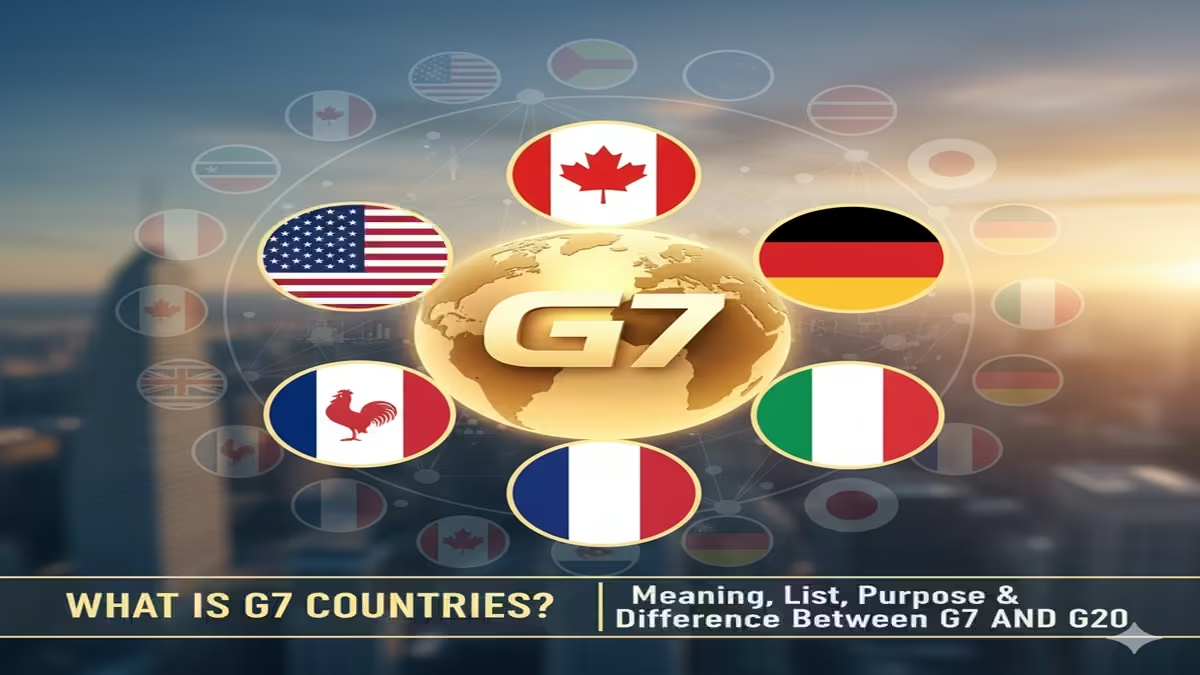
Understanding the G7: Meaning, List, Purpose, and Its Distinction from the G20
What Is G7 Countries In the complex architecture of global governance, a handful of informal, high-profile forums play a disproportionate role in shaping international economic policy and geopolitical discourse. Foremost among these is the Group of Seven, or G7. While it lacks the legal authority of a treaty-based organization like the United Nations, the G7 functions as a powerful steering committee of leading industrialized democracies. This article delves into the essence of the G7, exploring its meaning, membership, evolving purpose, and crucially, how it differs from its larger counterpart, the G20.
What is the G7? Meaning and Origins
The G7 is an informal intergovernmental organization consisting of seven of the world’s most advanced economies, all of which are democracies. Its core identity is that of acrisis committeeand alike-minded caucus. It provides a confidential, high-level setting for leaders, finance ministers, and central bank governors to coordinate on pressing global issues, from macroeconomic stability to security threats.
The group’s origins are rooted in the economic turbulence of the 1970s. In response to the 1973 oil crisis and the subsequent global recession, the French President Valéry Giscard d’Estaing invited the heads of state from West Germany, the United States, the United Kingdom, Japan, and Italy to an informal summit at the Château de Rambouillet in 1975. This gathering was designed to foster candid, off-the-record dialogue among leaders of aligned nations. The success of this meeting led to its institutionalization. Canada joined the following year, forming the G7, and the European Union (then the European Communities) was invited as a non-enumerated participant.
The group’s composition reflects the geopolitical and economic power structure of the late 20th century. It is not based on a fixed criterion like GDP; rather, it is a self-constituted club of nations that share a common commitment to liberal democracy, open markets, and a rules-based international order.
The G7 Countries: The List and Key Profiles
The seven permanent members are:
- Canada
- France
- Germany
- Italy
- Japan
- United Kingdom
- United States
The European Union is represented at all summits by the President of the European Commission and the President of the European Council. It is a full participant in discussions but does not hold the rotating presidency or host summits.
A Snapshot of the Members:
- United States:The world’s largest economy and the traditional geopolitical anchor of the group.
- Japan:Asia’s most advanced economy and a key technological powerhouse.
- Germany:The economic engine and de facto leader of the European Union.
- United Kingdom:A major financial center with global diplomatic reach.
- France:A nuclear power and a leading voice on European strategic autonomy and global culture.
- Italy:A founding EU member with significant industrial and cultural influence.
- Canada:A resource-rich nation and a stable, middle-power ally with a strong commitment to multilateralism.
The exclusivity of the G7 has been a point of contention. Russia was incorporated from 1998 to 2014, forming the G8, but was suspended following its annexation of Crimea. Its membership was never reinstated, and the group returned to the G7 format.
The Purpose and Agenda of the G7: Beyond Economics
While born from economic crisis, the G7’s purpose has dramatically expanded. Its agenda is now a barometer of the most urgent transnational challenges. The annual summit, hosted by the rotating presidency, sets the tone and produces a communiqué that, while not legally binding, carries significant political weight and can guide global policy.
1. Economic Coordination and Financial Stability: This remains its foundational role. The G7 coordinates on monetary policy, fiscal stimulus, trade practices, and global tax reform (as seen with the landmark global minimum corporate tax agreement). It works closely with institutions like the International Monetary Fund (IMF) and the World Bank.
2. Foreign Policy and Security: The G7 has become a primary platform for democracies to present a unified front on geopolitical issues. This includes coordinating sanctions (e.g., against Russia post-2022 invasion), addressing regional conflicts (Middle East, Ukraine), and developing strategies for managing relations with China, often framed as “de-risking” rather than decoupling.
3. Climate Change and Energy: Since the 1980s, environmental issues have been on the agenda. The G7 has played a key role in shaping international climate finance, promoting clean energy transitions, and setting ambitious (though not always met) emission reduction targets.
4. Global Health: The group was instrumental in creating the Global Fund to Fight AIDS, Tuberculosis and Malaria. It took a leading role in coordinating the international response to the COVID-19 pandemic, particularly in vaccine funding and distribution through the COVAX facility.
5. Technology and Digital Governance: In the 21st century, the G7 has tackled issues like cyber security, data privacy, the ethical development of artificial intelligence, and building resilient digital infrastructure. The “Hiroshima AI Process” launched in 2023 is a recent example.
6. Addressing Inequality: Development aid, support for low-income countries, and gender equality are recurring themes. The G7’s decisions on debt relief for poor nations can have substantial impact.
Criticisms and Challenges: The G7 is often criticized as an outdated “rich countries’ club” that excludes the rising economic powers of the Global South. Its declarations can be seen as aspirational but lacking in enforcement mechanisms. Internal divisions, such as those on trade or climate policy, can also undermine its cohesion and effectiveness.
G7 vs. G20: A Fundamental Difference in Scope and Identity
The emergence of the Group of Twenty (G20) in 1999 (at the finance ministers’ level) and its elevation to leaders’ summits after the 2008 financial crisis created a new, broader forum. Understanding the difference is key to grasping modern global governance.
| Feature | G7 | G20 |
|---|---|---|
| Membership | 7 industrialized democracies + EU. Homogeneous in political values. | 19 countries + the EU. Includes G7 members plus major emerging economies like China, India, Brazil, Saudi Arabia, and Russia (suspended from G8 but remains in G20). |
| Core Identity | A like-minded political caucus. A club of advanced democracies. | A critical economic steering committee. A forum for systemic economic actors. |
| Primary Focus | Broad: Geopolitics, security, democratic values, economic policy, climate, health. | Primarily macroeconomic and financial stability. Its mandate is narrower but deeper on finance. |
| Decision-Making | Can be quicker due to shared values, but can appear insular. | More representative of the global economy, but consensus is harder due to divergent political systems and interests. |
| Effectiveness | Strong on political signaling and normative leadership for the West. | Essential for managing global financial crises and coordinating economic policy where the “too-big-to-fail” economies are at the table. |
The Symbiotic Relationship: The two groups are not in direct competition but often function in tandem. The G7 can be seen as a “dress rehearsal” where aligned nations hammer out common positions before engaging with the more diverse and politically divided G20. For example, a consensus on Ukraine or China strategy is first solidified in the G7 before being presented at the G20, where direct dialogue with adversaries occurs.
In essence, the G7 is about shared values, while the G20 is about shared systemic impact. The G7 retains unique importance as the only forum where the core Western allies and Japan meet consistently at the highest level to align their strategic compass.
The Future of the G7
The G7 faces an existential question: can it remain relevant in a multipolar world where economic and political power is diffusing? Its response has been two-fold:
- Deepening Internal Coordination:Strengthening unity in the face of challenges from authoritarian states.
- Outreach and Partnership:Increasingly, the host nation invites guest countries (like India, Australia, or African Union representatives) to parts of the summit. This “G7+” model is an attempt to bridge the gap with the Global South and inject broader perspectives without formally expanding membership.
The group’s future will depend on its ability to deliver tangible results—mobilizing climate finance, ensuring global health security, upholding a rules-based order—and transitioning from being a closed directorate to an effective coordinator within a wider, more complex network of global institutions.
Frequently Asked Questions (FAQs)
1. Why is China not in the G7?
China is not a member primarily because it does not meet the G7’s fundamental political criterion: being a liberal democracy. The G7 was formed as a club of advanced industrialized democracies. While China’s economy is now larger than most G7 members’, its different political system and state-led economic model place it outside the group’s like-minded core. China is, however, a central member of the G20, which is based on economic weight rather than political values.
2. Are G7 decisions legally binding?
No. The G7 is an informal forum with no charter or permanent secretariat. Its outcomes—communiqués, statements, and action plans—are politically binding commitments. Their power lies in the collective economic and diplomatic weight of the members, which can shape norms, guide other international organizations, and influence market expectations. Implementation depends on each member nation’s domestic political processes.
3. Who holds the G7 presidency, and what does it do?
The presidency rotates annually among member countries in the following order: France, United States, United Kingdom, Germany, Japan, Italy, Canada. The presiding country is responsible for hosting and organizing the annual leaders’ summit, setting the agenda, and steering the year-long work of ministerial meetings (finance, foreign affairs, health, etc.). It plays a crucial role in shaping the group’s focus for that year.
4. How does the G7 relate to NATO and the UN?
The G7 is distinct but complementary. NATO is a formal military alliance with a collective defense treaty (Article 5). The G7 is a broader political-economic forum; its members (except Japan) are either in NATO or closely aligned. They use the G7 to coordinate the non-military aspects of security, like economic sanctions. The United Nations is a universal, treaty-based body with 193 members and legal authority. The G7, representing a concentrated bloc of economic power, often tries to build consensus among themselves to drive initiatives within the UN system.
5. What are the main criticisms of the G7?
The G7 faces three enduring criticisms:
- Legitimacy Deficit:It is seen as an unrepresentative, anachronistic club of wealthy Northern Hemisphere countries that makes decisions affecting the entire world without adequate input from the Global South.
- Accountability Gap:Its declarations are often ambitious but lack enforcement mechanisms, leading to a “promise gap” where targets (e.g., on climate finance or development aid) are not met.
- Internal Divisions:Political shifts within member states (like changes in leadership in the US or UK) can create stark policy differences on trade, climate, or foreign policy, hampering cohesive action and reducing the group’s effectiveness.