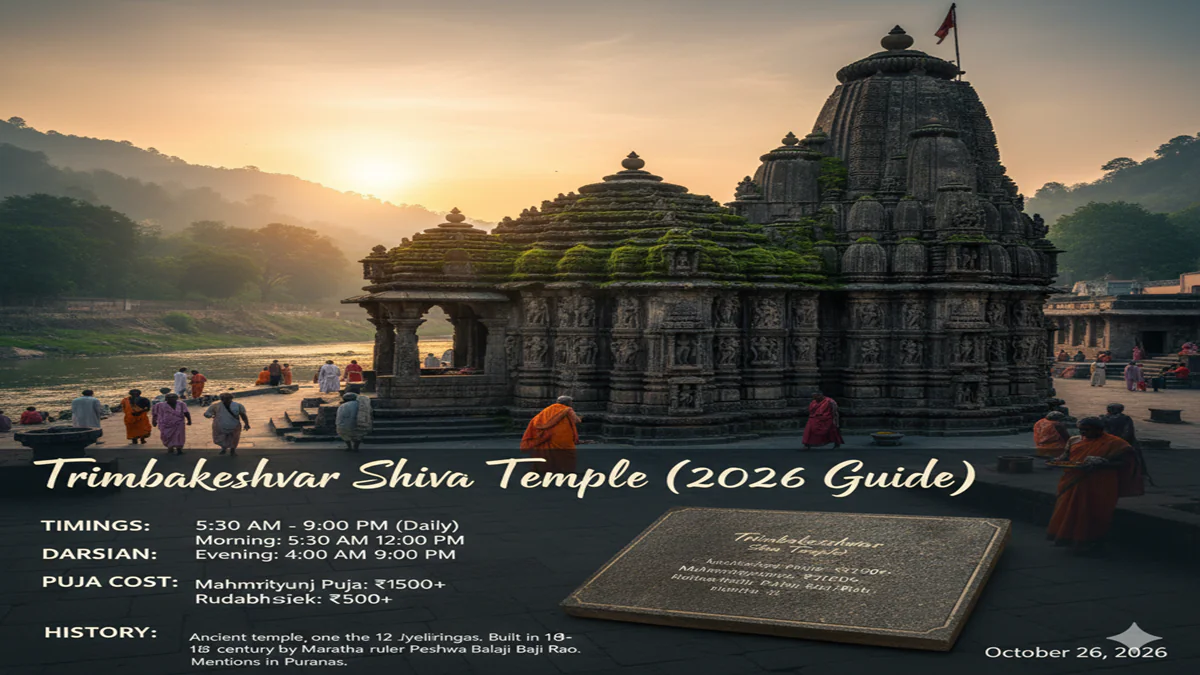
The Ultimate 2026 Guide to Trimbakeshwar Shiva Temple: Timings, Darshan, Puja Costs & Ancient History
An in-depth pilgrimage companion to Maharashtra’s Jyotirlinga where the Godavari begins
Introduction: The Sacred Nexus of Trimbak
Nestled in the Sahyadri hills of Maharashtra, just 28 kilometers from Nashik, lies Trimbakeshwar Temple—one of the twelve revered Jyotirlingas of Lord Shiva. Unlike other Shiva temples, Trimbakeshwar houses a unique, three-faced lingam representing Brahma, Vishnu, and Shiva—the Hindu trinity. This 2026 guide provides comprehensive, updated information for pilgrims and spiritual seekers planning a visit to this powerful spiritual center where the holy Godavari River originates.
Beyond its architectural grandeur, Trimbakeshwar represents a profound cosmological idea: the confluence of earthly geography and divine mythology. The temple sits at the base of Brahmagiri Hill, believed to be the place where Lord Shiva released the Ganges (in the form of Godavari) to relieve the sage Gautama of a curse. This guide navigates not only the practical aspects of your visit but the layered history and spiritual significance that make Trimbakeshwar an enduring pilgrimage destination.
The Gautama Rishi Legend
The temple’s origin story is intricately linked to sage Gautama. According to the Shiva Purana and Ramayana, a severe drought plagued the region. Gautama Rishi, through intense penance, received a blessing of unlimited grains. Other sages, envious, sent a cow to his granary, which died accidentally. To absolve himself of the sin of Go-hatya (cow slaughter), Gautama performed penance to Lord Shiva.
Pleased, Shiva descended as the river Ganga. However, to prevent the earth from flooding with Ganga’s mighty force, Shiva asked her to manifest as the Godavari. The river thus emerged from Brahmagiri Hill, and Gautama was liberated. Shiva then took eternal abode here as Trimbakeshwar—”the three-eyed lord.”
Historical Timeline & Architecture
While mythology dates the site to the Treta Yuga, historical records show temple construction around the 11th-12th century CE. The current stone structure reflects classic Hemadpanti architecture (named after Hemadri Pandit, minister of the Yadava dynasty), characterized by intricate stone carvings, black basalt construction, and no use of mortar.
Key Historical Periods:
- Medieval Era:The temple gained prominence under the Yadavas of Devagiri.
- Peshwa Era (18th century):The Peshwas, particularly Balaji Bajirao (Nanasaheb Peshwa), renovated and expanded the temple complex significantly after the 1755 floods. The Nagarkhana (drum house), courtyard, and gateways date to this period.
- Colonial Period:The British recognized its religious importance and provided protection.
- Modern Era:The temple is currently managed by the Trimbakeshwar Temple Trust under government supervision.
The temple’s architectural plan follows a panchayatana style, with the main shrine at the center. The sanctum sanctorum (garbhagriha) houses the unique lingam adorned with a jeweled crown believed to be from the Pandava era. A water stream continuously flows over the lingam, making it one of the few Swayambhu (self-manifested) lingams requiring constant moisture.
Chapter 2: 2026 Temple Timings & Best Seasons to Visit
Regular Daily Schedule (Subject to minimal seasonal changes)
The temple follows a strict ritual schedule. Note: These timings are projected for 2026 based on historical patterns. Verify with the temple trust website closer to your visit.
| Ritual/Period | Morning Timings | Evening Timings | Details |
|---|---|---|---|
| Kakad Aarti | 5:30 AM – 6:00 AM | – | The first awakening ritual with chanting of hymns. |
| Morning Darshan | 6:00 AM – 12:00 PM | – | General darshan begins after Kakad Aarti. |
| Madhyana Aarti | 12:00 PM – 12:30 PM | – | Midday offering; darshan halts briefly. |
| Darshan Resumes | 12:30 PM – 3:00 PM | – | Post-noon darshan. |
| Evening Aarti (Shej) | – | 7:30 PM – 8:00 PM (Summer) | The last ritual of the day; temple closes after. Timings shift by 30 minutes seasonally. |
| 7:00 PM – 7:30 PM (Winter) | |||
| Temple Closing | – | 8:00 PM / 7:30 PM | After Shej Aarti. |
Special Days (Pournima/Amavasya/Ekadashi): Temple opens 30 minutes earlier. Expect larger crowds.
Monthly Rituals of Significance
- Mondays:Considered especially auspicious for Shiva. Longer queues expected.
- Pradosh (13th lunar day):Special evening puja between 4-6 PM.
- Maha Shivratri (Feb-Mar 2026):Night-long vigil, special rituals. Book accommodations months in advance.
- Shravan Month (Jul-Aug 2026):Peak pilgrimage season. Thousands ofkanwarias(devotees carrying holy water) visit.
Best Time to Visit (2026 Climate Considerations)
- Ideal Months:October to February offers pleasant weather (15-28°C).
- Monsoon (June-September):Lush green scenery, but travel may be challenging. The Godavari is fullest.
- Summer (April-May):Hot (up to 38°C) but less crowded.
- Avoid:Major festival days if you seek a quieter experience.
Chapter 3: Darshan Procedure, Rituals & Essential Tips
Types of Darshan & Queues
- General Queue (Mukhya Dwar):Free entry. Can take 2-4 hours on normal days, up to 6-8 hours on festivals.
- Fast Track (Sheegra Darshan):Paid token system (₹100-₹250 per person approx.) for quicker access. Saves 50-70% waiting time.
- Special Darshan for Rituals:If you book a specific puja (like Narayan Nagbali), you get prioritized entry.
The Unique Darshan Experience
Due to constant water flow, the lingam is covered with a silver mask (mukhavata). Only the top is visible. Priests (pujaris) briefly remove the mask during abishekam for a direct glimpse. Photography is strictly prohibited inside the sanctum.
Major Rituals & Their Significance
- Rudrabhishek:Purificatory bath of the lingam with milk, water, honey, etc. Believed to remove planetary doshas.
- Laghu Rudra:A shorter version of Rudrabhishek for specific desires.
- Mahamrityunjaya Jaap:Recitation for health, longevity, and overcoming crises.
- Narayan Nagbali & Kalasarpa Shanti:Unique to Trimbakeshwar and nearby temples. These are tantric-vedic rituals performed over 3 days to appease ancestors and resolve astrological issues.Note:These require priest consultation and advance booking.
Pilgrim Etiquette & Tips
- Dress Code:Conservative clothing is recommended. Shoulders and knees should be covered.
- Footwear:Available in paid stalls outside the temple (₹10-₹20).
- Security:Bag checks and metal detectors are present. Keep luggage minimal.
- Physical Considerations:The sanctum area is small and can be crowded. Elderly and disabled pilgrims can request (not guaranteed) assistance from temple staff.
- Guides:Official guides are available near the entrance. Fix fees beforehand.
Chapter 4: 2026 Puja Cost & Booking Information
Important Disclaimer: All prices are estimates based on 2024-2025 rates and inflation projections for 2026. Exact costs will be set by the temple trust and are subject to change. Confirm directly via the official channels before planning.
Standard Puja Price List (Estimated in INR)
| Puja Name | Approximate Cost (2026) | Duration | Includes |
|---|---|---|---|
| Regular Abhishek | ₹500 – ₹1,200 | 20-30 min | Basic abhishek with milk, ghee, honey. |
| Rudrabhishek | ₹1,500 – ₹2,500 | 45-60 min | Full vedic chanting with 11 ingredients. |
| Laghu Rudra | ₹3,000 – ₹5,000 | 1.5-2 hours | More elaborate chanting for specific wishes. |
| Mahamrityunjaya Jaap | ₹2,000 – ₹4,000 | 1-1.5 hours | 125,000 recitations of the mantra (often done in groups). |
| Maha Puja | ₹1,100 – ₹2,000 | 30-40 min | Comprehensive worship with offerings. |
Special Rituals (Require Priestly Consultation & Advance Booking)
These are multi-day rituals with variable costs depending on priest fees, materials, and donations.
- Narayan Nagbali:₹25,000 – ₹75,000+ (performed only on specific days).
- Kalasarpa Shanti Puja:₹15,000 – ₹50,000+.
- Tripindi Vidhi:(Related to ancestral rites) ₹20,000 – ₹60,000+.
Booking Methods for 2026
- Official Temple Office:Located in Trimbak. Book in person upon arrival (for next-day or later rituals).
- Online Portal:The temple trust is expected to enhance its official website for 2026 bookings. Monitor:Trimbakeshwar Temple Trust Official Site(check for 2026 updates).
- Authorized Priests (Pujaris):Can facilitate booking for a service fee.
- Recommended:Contact the temple administration directly for the most accurate 2026 procedure:Phone:+91-2594-XXX-XXX (verify number closer to 2026).
What Your Puja Cost Typically Covers
- Priest honorarium
- Ritual materials (flowers, milk, honey, sandalwood, etc.)
- Temple donation
- Prasad(sacred offering)
Chapter 5: The Pilgrim’s Circuit – What Else to See in Trimbak
A visit to Trimbakeshwar is incomplete without exploring its sacred geography.
- Brahmagiri Hill & Godavari Source:A 3.5 km trek (or shorter drive) toGodavari Kund, the symbolic source. The actual origin,Kushavarta Kund, is next to the main temple—a large, stepped tank where pilgrims take a holy dip.
- Gangadwar:The spot where the Godavari emerges from the hill.
- Amruteshwar Temple:In nearby village Ratanwadi, an exquisite 11th-century Shiva temple.
- Anjaneri Fort:Birthplace of Lord Hanuman, ideal for trekking enthusiasts.
Conclusion: A Journey of Transformation
Trimbakeshwar is more than a temple; it’s a tirtha—a crossing point between the material and spiritual worlds. Its power lies in the continuity of its rituals, the ancient chants echoing off stone walls, and the unwavering faith of millions. As you plan your 2026 pilgrimage, remember that the journey is as significant as the destination. Come with patience, an open heart, and respect for the ancient traditions that breathe life into this sacred space.
By understanding its history, respecting its timings, and participating thoughtfully in its rituals, your visit to Trimbakeshwar can transform from a tourist outing into a genuine spiritual experience, connecting you to a lineage of devotion that flows as steadily as the Godavari herself.
Frequently Asked Questions (2026 FAQ)
Q1: What are the exact Trimbakeshwar Temple opening timings for Maha Shivratri 2026?
A: For Maha Shivratri (expected in late February 2026), the temple will likely remain open almost 24 hours, with special jagran (night vigil) and continuous abhishekam. General darshan will be available except during core ritual periods (4-6 AM and 8-10 PM). The temple trust will release exact schedules 1-2 months prior. Expect extremely large crowds; arrive very early or during late night hours.
Q2: Can I perform Narayan Nagbali Puja for my ancestors online?
A: No. Narayan Nagbali is an intense, tantra-vedic ritual that must be performed in person at Trimbakeshwar (or a few other specific temples) over three days. It requires physical presence, fasting, and participation in specific rites. Priests will not accept proxy performance. Consultation with a qualified temple priest is mandatory before planning.
Q3: Are there any accommodation facilities managed by the temple trust for 2026?
A: Yes, the Trimbakeshwar Temple Trust manages several dharmashalas (guest houses) like the Shri Muktidham and Godavari guest houses. These offer basic, affordable rooms (₹200-₹800 per night). Booking is on a first-come, first-served basis and cannot typically be done online. Contact the trust office directly. Numerous private hotels and lodges are also available in Trimbak and Nashik.
Q4: What is the best way to reach Trimbakeshwar in 2026?
A: The nearest airport is Nashik Airport (20 km), with increasing connectivity. Mumbai Airport (180 km) is the major international gateway. The nearest major railway station is Nashik Road (40 km), well-connected to Mumbai, Pune, and Delhi. From Nashik, taxis and state transport buses run regularly to Trimbak (approx. 1.5 hours). Road connectivity via NH60 is excellent.
Q5: Has the temple introduced any new digital services for 2026?
A: The temple trust is progressively digitizing. For 2026, expect enhancements like:
- A more robust online portal forSheegra Darshan token purchases.
- Live darshanstreams on official social media during major aartis.
- SMS-based queue status updatesfor special puja bookings.
- Digital payment integrationfor donations and puja fees at counters.
Always check the official website or contact the trust for the latest tech-enabled services to plan your visit efficiently.