


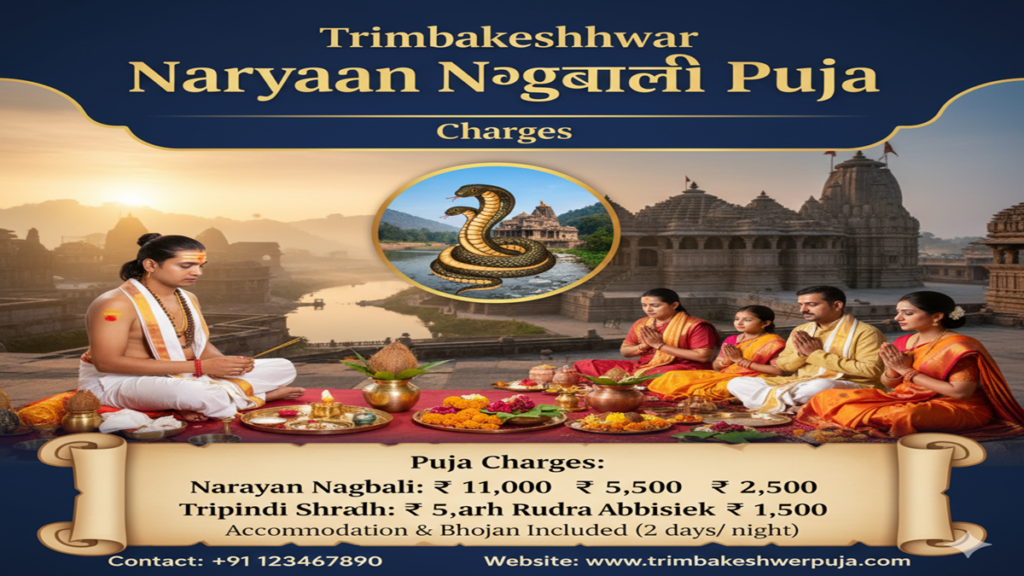
Trimbakeshwar Narayan Nagbali Puja Charges: नासिक त्र्यंबकेश्वर में नारायण नागबली पूजा का कुल खर्च, विधि और 2026 के नए नियम!
Trimbakeshwar Narayan Nagbali Puja Charges: Introduction: आज 22 अप्रैल 2026 है और त्र्यंबकेश्वर की पावन भूमि महादेव के जयकारों से गूंज रही है। नासिक से 28 किमी दूर स्थित भगवान शिव का यह ज्योतिर्लिंग केवल दर्शन के लिए ही नहीं, बल्कि पितृ दोष और कालसर्प दोष जैसी समस्याओं के निवारण के लिए भी जाना जाता है। यहाँ होने वाली नारायण नागबली पूजा का विशेष महत्व है।
यदि आप “Trimbakeshwar Narayan Nagbali Puja Charges” के बारे में सटीक जानकारी ढूंढ रहे हैं, तो यह लेख आपको पूजा की सामग्री, दक्षिणा, रहने-खाने के खर्च और 2026 की नवीनतम दरों के बारे में विस्तार से बताएगा।
1. नारायण नागबली पूजा क्या है? (Understanding the Ritual)
Trimbakeshwar Narayan Nagbali Puja Charges: यह एक विशेष 3-दिवसीय अनुष्ठान है। यह दो अलग-अलग विधियों का मेल है:
- नारायण बलि: अतृप्त पितरों की आत्मा की शांति और अकाल मृत्यु के दोष को दूर करने के लिए।
- नागबली: किसी पूर्व जन्म में सर्प हत्या के दोष से मुक्ति पाने के लिए। यह पूजा केवल त्र्यंबकेश्वर में ही पूर्ण फलदायी मानी जाती है क्योंकि यहाँ अहिल्या और गोदावरी का संगम है।
2. पूजा का कुल खर्च (Charges in 2026)
Trimbakeshwar Narayan Nagbali Puja Charges: त्र्यंबकेश्वर में पूजा का खर्च आपकी आवश्यकताओं और पूजा के प्रकार (ग्रुप या इंडिविजुअल) पर निर्भर करता है:
नोट: इसमें सामग्री, दक्षिणा, 3 दिन का सात्विक भोजन और साधारण आवास शामिल होता है।
3. पूजा की 3-दिवसीय विधि (3-Day Procedure)
- पहला दिन: कुशावर्त कुंड में पवित्र स्नान के बाद संकल्प लिया जाता है और भगवान विष्णु की पूजा के साथ ‘नारायण बलि’ की शुरुआत होती है।
- दूसरा दिन: नागबली की विधि होती है, जिसमें आटे से बने प्रतीकात्मक नाग का अंतिम संस्कार किया जाता है।
- तीसरा दिन: गणेश पूजन, पुण्यवाचन और अंत में सवा-पाच ब्राह्मणों को भोजन कराकर दक्षिणा दी जाती है।
4. अन्य आवश्यक खर्च (Additional Costs)
- आवास (Stay): त्र्यंबकेश्वर में धर्मशालाएं ₹500/दिन से शुरू होती हैं, जबकि अच्छे होटल्स ₹2,500/दिन तक जा सकते हैं।
- कपड़े: पूजा के लिए पुरुषों को नया धोती-कुर्ता और महिलाओं को नई साड़ी (काले और हरे रंग को छोड़कर) पहनना अनिवार्य है।
5. 2026 में डिजिटल बुकिंग और सुविधा
Trimbakeshwar Narayan Nagbali Puja Charges: अब त्र्यंबकेश्वर देवस्थान ट्रस्ट और स्थानीय अधिकृत पंडितों ने अपनी सेवाएं ऑनलाइन कर दी हैं। Solaris Digital जैसे प्लेटफॉर्म्स अब श्रद्धालुओं को सही मुहूर्त और अधिकृत पंडितों से जुड़ने में मदद कर रहे हैं।
इसके अलावा, नासिक जैसे बढ़ते शहर में अब आवागमन भी आसान हो गया है। कई श्रद्धालु अब Prajwal Auto EV के माध्यम से नासिक से त्र्यंबकेश्वर तक इलेक्ट्रिक वाहनों में यात्रा करना पसंद कर रहे हैं, जो न केवल सस्ता है बल्कि पर्यावरण के अनुकूल भी है।
4. अक्सर पूछे जाने वाले प्रश्न (FAQs)
Q1: क्या यह पूजा मंदिर के अंदर होती है?
Ans: नहीं, नारायण नागबली पूजा मंदिर के बाहर ‘अहिल्या गोदावरी संगम’ या पंडित जी के निजी पूजा केंद्र (आश्रम) में संपन्न होती है।
Q2: पूजा के लिए कितने दिन पहले बुकिंग करनी चाहिए?
Ans: पितृ पक्ष या विशेष मुहूर्त के समय कम से कम 1 महीना पहले बुकिंग करना बेहतर रहता है।
Q3: क्या अकेले व्यक्ति यह पूजा कर सकता है?
Ans: शास्त्रानुसार, पुरुष अकेले यह पूजा कर सकता है, लेकिन महिलाओं को परिवार या पति के साथ ही यह पूजा करने की सलाह दी जाती है।
Conclusion: श्रद्धा और शांति का मार्ग
Trimbakeshwar Narayan Nagbali Puja Charges के बारे में स्पष्ट जानकारी होने से आपकी आध्यात्मिक यात्रा बिना किसी तनाव के पूरी हो सकती है। त्र्यंबकेश्वर की ऊर्जा आपके पितरों को शांति और आपके जीवन को सुख-समृद्धि प्रदान करे, यही हमारी प्रार्थना है।
Trimbakeshwar Narayan Nagbali Puja: A Comprehensive Guide to Rituals, Significance, and Charges
Introduction: The Sacred Confluence of Trimbakeshwar
Trimbakeshwar Narayan Nagbali Puja Charges Nestled in the foothills of the Brahmagiri mountain range in Nashik, Maharashtra, the ancient Trimbakeshwar Temple stands as one of the twelve revered Jyotirlingas of Lord Shiva. This hallowed site, where the Godavari River originates, holds a unique position in Hindu spirituality for hosting three specialized and profound rituals: Narayan Nagbali, Tripindi Shraddha, and Kalasarpa Shraddha. These rituals, particularly the Narayan Nagbali Puja, attract thousands of devotees annually seeking liberation from ancestral curses, planetary afflictions, and unresolved spiritual burdens.
This comprehensive guide explores the intricate details of Narayan Nagbali Puja at Trimbakeshwar, with particular attention to understanding the charges, procedures, and spiritual significance of this transformative ritual.
Understanding Narayan Nagbali: The Ritual of Ancestral Liberation
The Dual Components: Narayana Bali and Nag Bali
Trimbakeshwar Narayan Nagbali Puja Charges: Narayan Nagbali actually comprises two distinct but interconnected rituals performed together:
Narayan Bali addresses issues arising from the untimely or unnatural death of ancestors. Hindu belief holds that when a person dies prematurely—through suicide, accident, murder, or sudden illness—their soul may not achieve proper transition to the afterlife. This unresolved state can create spiritual obstacles (Pitru Dosha) for descendants, manifesting as repeated misfortunes, health issues, financial struggles, or family discord.
Nag Bali specifically remedies curses or sins related to serpents (Nagas). According to scriptures, harming or killing snakes—intentionally or accidentally—incurs the wrath of the Nagas, leading to Kalasarpa Dosha or Sarpa Dosha. This affliction is often associated with delayed success, reproductive issues, and sudden setbacks.
Trimbakeshwar Narayan Nagbali Puja Charges: When performed together at Trimbakeshwar, these rituals are believed to appease both ancestral spirits and serpent deities, restoring spiritual equilibrium.
The Unique Significance of Trimbakeshwar
Trimbakeshwar Narayan Nagbali Puja Charges: While Narayan Nagbali can theoretically be performed elsewhere, Trimbakeshwar holds exceptional sanctity for several reasons:
- Geographical Power: Located at the origin of the Godavari River, the site embodies tremendous purifying energy
- Astrological Alignment: The temple’s position creates favorable conditions for rituals addressing ancestral karma
- Historical Continuity: The rituals have been performed here for centuries with established protocols
- Divine Connection: As a Jyotirlinga site, Lord Shiva’s presence amplifies the rituals’ effectiveness
The Ritual Process: Step-by-Step Journey
Preliminary Requirements and Preparations
Trimbakeshwar Narayan Nagbali Puja Charges: Before undertaking Narayan Nagbali, devotees must fulfill specific prerequisites:
- Eligibility Check: Consultation with learned priests to determine if the ritual is necessary based on one’s horoscope and life circumstances
- Observances (Vrat): Depending on the priest’s guidance, 3-41 days of partial fasting, abstinence, and prayer
- Sacred Items: Preparation of specific offerings including black til (sesame), rice, darbha grass, and handmade wheat flour effigies
- Mental Preparation: Cultivating the right intention—not as a mechanical transaction but as sincere spiritual atonement
The Three-Day Ritual Structure
Day 1: Initial Rituals and Sankalpa
- Early morning purification bath in the Godavari River
- Formal declaration of intention (Sankalpa) at the temple
- Preliminary offerings to Lord Ganesha and Navagraha
- Evening rituals establishing connection with ancestors
Day 2: The Core Nag Bali Ceremony
- Creation of symbolic wheat flour effigies representing the seeker and ancestors
- Special mantras and offerings to serpent deities
- Ritualistic burial of effigies in sacred ground, symbolizing burial of past karmas
- Fire ceremonies (homas) with specific herbs and offerings
Day 3: Narayan Bali and Completion
- Extensive offerings to Lord Vishnu (Narayan) in his Bali (offering) form
- Final prayers for ancestral liberation
- Ritual haircut (Mundan) for male participants (optional but common)
- Distribution of donations and food to Brahmins and the poor
Trimbakeshwar Narayan Nagbali Puja Charges: Breakdown and Considerations
Understanding the Cost Structure
Trimbakeshwar Narayan Nagbali Puja Charges: The charges for Narayan Nagbali Puja at Trimbakeshwar are not standardized prices for a service but rather contributions covering ritual components, priestly expertise, and temple requirements. Costs typically range from ₹25,000 to ₹75,000 (approximately $300-$900 USD) depending on several factors.
Primary Cost Components
- Priest Honorarium (Dakshina): 40-50% of total cost
- Main priest and assisting priests (usually 3-5)
- Based on priest’s experience, lineage, and reputation
- Includes their guidance throughout the preparation and ritual
- Ritual Materials (Samagri): 20-30% of total cost
- Specific herbs, grains, fabrics, and offerings
- Handcrafted wheat flour effigies and ceremonial items
- Sacred threads, clothes, and vessels
- Temple Fees and Donations: 15-20% of total cost
- Temple trust donations for ritual space
- Special access fees during preferred timings
- Contributions to temple maintenance
- Ancillary Expenses: 10-15% of total cost
- Accommodation and food during the ritual period
- Traditional clothing for the ceremony
- Photography/videography services (if desired)
Factors Influencing Charges
1. Priest Selection
- Trimbakeshwar Narayan Nagbali Puja Charges: Regular temple priests: ₹25,000 – ₹35,000
- Renowned specialist priests: ₹40,000 – ₹75,000+
- Important to verify priest credentials through temple administration
2. Ritual Complexity
- Basic Narayan Nagbali: ₹25,000 – ₹35,000
- With additional rituals (Tripindi Shraddha, etc.): ₹45,000 – ₹60,000
- Extended ceremonies with multiple homas: ₹60,000+
3. Number of Participants
- Trimbakeshwar Narayan Nagbali Puja Charges: Individual performer: Standard rates
- Family participation (immediate family): +20-30%
- Extended family rituals: Custom quotations
4. Seasonal and Timing Factors
- Regular days: Standard charges
- Special festivals or auspicious days: +15-25%
- Trimbakeshwar Narayan Nagbali Puja Charges: Early morning or midnight rituals: Additional fees
Payment Structure and Transparency
Trimbakeshwar Narayan Nagbali Puja Charges: Reputable priests and temple-affiliated organizers typically provide:
- Itemized breakdown of estimated costs
- Receipts for temple donations
- Clear explanation of what’s included
- No hidden costs policy
Caution: Be wary of intermediaries offering “discounted” packages or guaranteeing specific results. The temple administration can provide verified priest lists.
The Spiritual and Psychological Impact
Trimbakeshwar Narayan Nagbali Puja Charges: Beyond the ritual mechanics and charges, Narayan Nagbali offers profound transformative potential:
Psychological Liberation
Trimbakeshwar Narayan Nagbali Puja Charges: Many participants report experiencing:
- Relief from recurring anxiety or unexplained fears
- Resolution of persistent family conflicts
- Improved mental clarity and decision-making
- Sense of closure regarding ancestral trauma
Spiritual Perspectives
Trimbakeshwar Narayan Nagbali Puja Charges: From the traditional viewpoint, successful completion brings:
- Resolution of Pitru Dosha (ancestral afflictions)
- Mitigation of Kalasarpa Dosha effects
- Improved planetary influences in one’s horoscope
- Clearing of obstacles to spiritual progress
Contemporary Relevance
Trimbakeshwar Narayan Nagbali Puja Charges: Even skeptics acknowledge the ritual’s value as:
- A powerful psychodrama facilitating emotional release
- A cultural practice strengthening family and spiritual identity
- A meditative retreat opportunity with focused introspection
Practical Considerations for Devotees
Best Time for Performance
- Trimbakeshwar Narayan Nagbali Puja Charges: Preferred months: Ashwin (October-November) and Shravan (July-August)
- Avoid: Eclipse periods, inauspicious lunar phases
- Weekdays generally less crowded than weekends
Accommodation and Logistics
- Numerous dharamshalas and hotels near temple
- Booking accommodations in advance recommended
- Traditional clothing (dhoti for men, saree for women) required for temple entry
Post-Ritual Observances
- 11-41 days of simple living and charity
- Regular remembrance of ancestors
- Continued spiritual practice aligned with one’s path
Frequently Asked Questions (FAQ)
Q1: Can Narayan Nagbali be performed for any problem, or are there specific indications?
Trimbakeshwar Narayan Nagbali Puja Charges: A: Narayan Nagbali is specifically recommended for certain indications: recurring dreams of snakes or deceased ancestors, persistent misfortunes despite efforts, unexplained health issues especially related to reproduction or skin, delays in marriage or childbirth, and astrological indications of Pitru Dosha or Kalasarpa Dosha. It is not a general-purpose ritual but addresses specific ancestral and karmic issues. A qualified priest or astrologer should be consulted to determine if your situation warrants this ceremony.
Q2: How long do the effects of Narayan Nagbali last, and can it be repeated if problems persist?
Trimbakeshwar Narayan Nagbali Puja Charges: A: The effects are considered permanent for the specific karmic issues addressed. However, new karma created after the ritual isn’t covered. If problems identical to those resolved reappear, it may indicate either incomplete performance the first time or different underlying causes. Generally, Narayan Nagbali is performed once in a lifetime for specific ancestral issues. Repetition is uncommon but possible in rare circumstances under priestly guidance.
Q3: Are there any negative consequences or risks associated with Narayan Nagbali if not performed correctly?
A: Like any powerful ritual, improper performance without proper intention, preparation, or priestly expertise may yield incomplete results. There’s no “negative consequence” in the supernatural sense, but psychological disappointment may occur if expectations are unrealistic. The greatest risk is financial exploitation by unauthorized practitioners. This is why performing at Trimbakeshwar with temple-approved priests is recommended—they maintain centuries-old protocols ensuring correct performance.
Q4: Can women perform Narayan Nagbali, and are there any restrictions based on gender or age?
A: Yes, women can and do perform Narayan Nagbali, often for family well-being. There are no gender-based restrictions. However, women during menstruation cannot participate in the actual rituals (as with most Hindu temple ceremonies). Children can participate but aren’t primary performers. The ideal primary performer is the eldest male descendant, but in their absence, women or younger family members can perform the rituals. Pregnant women are generally advised to consult with priests about timing.
Q5: What is the difference between doing Narayan Nagbali at Trimbakeshwar versus other temples or at home?
A: Trimbakeshwar offers unique advantages: the temple’s specific energy is considered particularly suited for these rituals, priests have specialized lineage-based expertise, the rituals follow ancient protocols unchanged for centuries, and the geographical location (Godavari origin) adds spiritual potency. While simplified versions might be performed elsewhere, the complete traditional ceremony with all symbolic components is uniquely available at Trimbakeshwar. Home performance is not recommended for this particular ritual due to its complexity and required sacred space.
Conclusion: A Transformative Journey Beyond Monetary Considerations
The Narayan Nagbali Puja at Trimbakeshwar represents far more than a ritual transaction with fixed charges. It is a profound spiritual journey addressing the deepest layers of ancestral connection and karmic resolution. While understanding the cost structure is practical and necessary for preparation, the true value lies in the ritual’s transformative potential.
For those called to this path, thorough research, sincere intention, and engagement with authentic temple resources will ensure that the experience—regardless of the exact charges—becomes a meaningful milestone in one’s spiritual evolution. In the sacred precincts of Trimbakeshwar, where the Godavari begins her journey to the sea, devotees find the possibility to liberate not just ancestors, but themselves, from cycles of unresolved karma, opening pathways to renewed life and purpose.
*Note: Charges mentioned are estimates based on 2023-2024 information and may vary. Readers should verify current rates directly with Trimbakeshwar Temple administration or authorized priests before planning their visit. Spiritual results cannot be guaranteed by any priest or temple, as these depend on numerous factors including faith, intention, and individual karma.*