


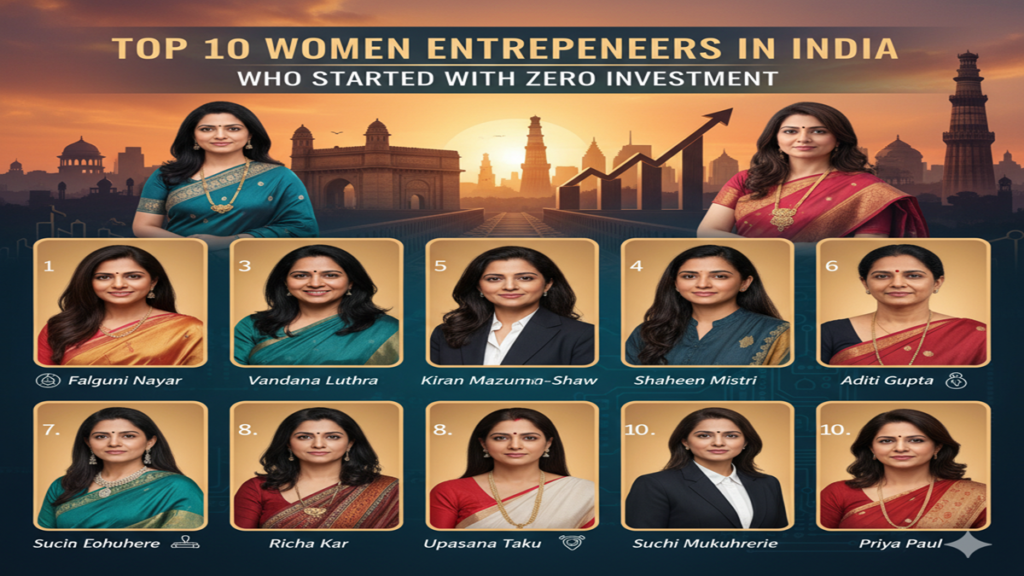
From Kitchen Tables to Boardrooms: 10 Indian Women Who Built Empires with Zero Investment
Top 10 Women Entrepreneurs In India Who Started With Zero Investment In the dynamic tapestry of India’s entrepreneurial landscape, a powerful narrative is rewriting the rules of business. It’s a story not of venture capital and inheritances, but of resilience, ingenuity, and sheer willpower. It’s the story of women who looked at their constraints—limited capital, societal expectations, and domestic spaces—and saw not walls, but launchpads. These entrepreneurs began their journeys with the most formidable asset of all: an idea, and the courage to execute it with zero financial investment.
This article celebrates ten such trailblazers who transformed passion into profession, leveraging digital platforms, community trust, and bootstrap strategies to build inspiring ventures. Their journeys are masterclasses in starting small, thinking big, and proving that the most successful businesses are often built on a foundation of grit, not gold.
Top 10 Women Entrepreneurs In India Who Started With Zero Investment
1. Vandana Ghule & Riddhi Ghule – Founders, V-Ridhi
The Venture: A home-grown brand creating eco-friendly, upcycled products like bags, accessories, and home décor from discarded materials.
The Zero-Investment Start: Sisters Vandana and Riddhi began in the confines of their Mumbai home during the 2020 lockdown. With a passion for sustainability but no capital, they started by collecting old jeans, saris, and fabric waste from friends and family. Their initial “factory” was their living room floor; their “machinery” was a single, pre-owned sewing machine. They manually created prototypes, photographed them on their smartphones, and used free social media platforms (Instagram and Facebook) to showcase their work. Orders from their personal networks provided the first revenue, which was immediately reinvested into buying basic supplies like threads and needles.
The Growth Engine: Their compelling story of upcycling and stunning designs went viral on social media. They leveraged the power of storytelling—showing before-and-after transformations of waste into beautiful products. As demand grew, they involved local women artisans, creating a community-driven supply chain. Today, V-Ridhi is a celebrated brand in the sustainable lifestyle space, supplying to larger platforms and conducting upcycling workshops, all originating from a zero-rupee investment.
2. Shraddha Khandelwal – Founder, The Health Pantry
The Venture: An online brand offering wholesome, preservative-free, and nutritious food products like granolas, nut mixes, and healthy snacks.
The Zero-Investment Start: A corporate professional with a nutritional science background, Shraddha started experimenting with healthy recipes in her Pune kitchen. To test the market, she began by making small batches of homemade granola and gifting them to friends and colleagues. The rave reviews and requests for more gave her the validation. Instead of renting a commercial space, she obtained a home-based FSSAI license (which has a lower cost for home kitchens). Her initial “investment” was the groceries already in her pantry. She used free Google Forms to take orders, and her personal bike for local deliveries. All marketing was through word-of-mouth and organic Instagram posts showcasing her cooking process.
The Growth Engine: A fanatical focus on quality and taste turned customers into brand ambassadors. She used a direct-to-consumer model, plowing back every rupee of profit into scaling batch sizes. The authenticity of a home-kitchen brand became its USP. She eventually moved to a dedicated cloud kitchen, expanded her product line, and now supplies to premium cafes and through her own website, all built from pure revenue.
3. Shuchi Pandya – Co-founder, Pipa + Bella
The Venture: A direct-to-consumer jewellery brand known for its trendy, affordable, and high-fashion designs.
The Zero-Investment Start: While Pipa + Bella is now a well-funded venture, its genesis was a classic zero-inventory, zero-investment model. Shuchi, along with her co-founder, started as curators, not manufacturers. They spent months researching and building relationships with jewellery artisans and wholesalers. They created their first digital storefront on Facebook and Instagram, posting pictures of designs sourced from these partners. Only when an order was placed would they procure the item and ship it. This drop-shipping model required no capital for inventory. Their work involved creating stunning content, managing customer relationships, and handling logistics—all from their laptops and phones.
The Growth Engine: Their sharp eye for design that resonated with young Indian women made them stand out. They mastered digital marketing on a shoestring budget, using user-generated content and influencer collaborations (often through barter). The cash flow from the drop-shipping model was used to gradually design and produce their own exclusive lines, transforming from curators to creators and building a beloved brand.
4. Shweta Paropkari – Founder, Aarunya Homes
The Venture: A premium home décor and handicrafts brand supporting rural Indian artisans.
The Zero-Investment Start: After quitting her IT job, Shweta traveled across India, connecting directly with artisan communities. With no capital to buy stock, she adopted a commission-based model. She would take high-quality photographs of artisan products (with permission), create an online catalog on a low-cost website builder, and market them through social media. Upon receiving an order and advance payment from a customer, she would then pay the artisan to make and ship the product. This ensured zero investment in inventory and built a transparent, trust-based pipeline.
The Growth Engine: Her model was fundamentally sustainable and ethical, which became its core brand message. She focused on telling the artisans’ stories, connecting urban buyers with the maker. This emotional connect fueled sales. Revenue was reinvested into designing collaborative collections with artisans, eventually allowing for small inventory batches for bestsellers. Aarunya Homes now runs successfully, bridging the gap between traditional craft and modern markets.
5. Shanti S. – Founder, Miniature Painter & Digital Creator
The Venture: A hyper-niche art business creating miniature paintings on everyday objects (pencils, pebbles, keys) and a thriving digital presence teaching the art.
The Zero-Investment Start: Shanti was a skilled miniature painter with no platform. She started by painting on discarded items and inexpensive surfaces like stones and paper. She joined free platforms like Instagram and YouTube, posting time-lapse videos of her intricate work. The initial “investment” was her existing art supplies and a cheap smartphone holder for recording. She offered to paint people’s portraits on small canvases at very low cost to build a portfolio. She used hashtags strategically to reach global art communities.
The Growth Engine: The mesmerizing quality of her work made her videos go viral. She monetized through two primary channels: 1) Commissioned Art: Orders started flowing in from across the world. 2) Digital Products: She created and sold affordable PDF guides and pre-recorded tutorials on platforms like Etsy and her own website, requiring no inventory. Her business is a perfect example of monetizing a specialized skill through digital leverage, starting with virtually nothing.
6. Aditi Gupta – Co-founder, Menstrupedia
The Venture: An educational platform and comic book that simplifies menstrual health education for children and teenagers.
The Zero-Investment Start: Aditi and her co-founder (and husband) Tuhin started Menstrupedia as a passion project to combat menstrual taboo. The first prototype of the comic was created using free design tools and their personal research. They launched a website on a budget hosting plan and started a blog to share information. Their first major break was a successful crowdfunding campaign on Wishberry (now FuelADream) in 2012. However, before that campaign, they validated the idea with zero spend: they created sample chapters, used social media to gather feedback, and partnered with NGOs for pilot workshops, covering only transport costs.
The Growth Engine: The successful crowdfunding proved demand and provided the capital for the first print run. Menstrupedia’s social impact angle garnered massive media coverage and institutional partnerships. They expanded into schools, multiple languages, and digital animations. The start was purely fueled by a desire to solve a problem, using free digital tools to build a community and validate their concept.
7. Shreya Krishnan – Founder, Loka
The Venture: A community-based platform and newsletter celebrating hyper-local discoveries, stories, and small businesses in Indian cities.
The Zero-Investment Start: Shreya began Loka as a personal passion project on Substack—a free platform for writers. With just her curiosity and writing skills, she started exploring and documenting unique neighborhoods, hole-in-the-wall eateries, and independent shops in Bangalore. Her “investment” was her time and travel expenses (which were part of her personal budget). The newsletter grew organically as people craved authentic, non-commercial city guides. She built an engaged audience without spending a penny on marketing.
The Growth Engine: The trusted community became the asset. She monetized through sponsored newsletter editions (curated and authentic, not ads), curated neighborhood walks, and partnerships with the very businesses she featured. Loka exemplifies how deep expertise, consistent content creation, and community building can create a valuable media property from a standing start.
8. Shalini Goyal Bhalla – Founder, International Council for Circular Economy & Sustainability Expert
The Venture: A pioneering consultancy and think-tank focused on the circular economy and sustainability.
The Zero-Investment Start: Shalini started as an independent consultant and writer. From her home office in Delhi, she used her deep expertise to write articles, research papers, and blogs on sustainability, publishing them on free platforms like LinkedIn Pulse and Medium. This established her as a thought leader. Her initial “clients” were pro-bono projects for NGOs or small startups, which she used to build case studies and a professional portfolio. Networking was done through free webinars and industry events.
The Growth Engine: Her authoritative content attracted speaking invitations and small consulting projects. Each project enhanced her reputation and led to bigger clients, including government bodies and large corporations. She gradually formalized her work into the International Council for Circular Economy (ICCE), onboarding other experts. This is a classic knowledge-based business built on reputation, where the only initial investment was intellectual capital.
9. Shruti Choudhary – Founder, JavaTpoint
The Venture: One of India’s largest and most visited free online tutorial websites for programming languages, computer science, and academic subjects.
The Zero-Investment Start: In 2011, Shruti, a computer science graduate, started JavaTpoint from a simple need: to provide well-structured, easy-to-understand tutorials. The start was starkly simple: she began writing and publishing tutorials on a free blogging platform (Blogger). Her investment was her time and knowledge. She focused purely on creating high-quality, comprehensive content for students and professionals. She learned basic SEO to ensure her free content ranked on Google.
The Growth Engine: Traffic grew exponentially because the content solved a real problem. She monetized the massive traffic through non-intrusive advertising networks like Google AdSense. The revenue from ads was reinvested into buying a proper domain, hosting, and eventually hiring a small team of writers and developers. JavaTpoint stands as a monumental example of the “content-first, monetize-later” model, building an asset worth millions from a zero-cash start.
10. Aqsa Mohammed – Founder, The Aqsa Way (Fitness Influencer & Coach)
The Venture: A certified personal trainer and nutrition coach with a massive online following, offering digital workout plans and wellness guidance.
The Zero-Investment Start: Aqsa began her journey as a fitness enthusiast sharing her home workouts and healthy recipes on Instagram. Her “gym” was her terrace; her equipment was her body weight and some DIY weights. She consistently posted transformation photos, workout videos (shot on a phone), and honest captions. She engaged tirelessly with her growing community, answering questions for free. She built a loyal following purely through valuable content and relatability.
The Growth Engine: After establishing credibility, she launched her first paid offering: a simple, downloadable PDF home workout plan for a nominal fee, created using free design tools. The success of this led to personalized online coaching, group challenges, and eventually, a full-fledged app. Her business was built on the foundation of authentic personal branding, leveraging free social media platforms as her sole marketing and sales channel initially.
Common Threads in Their Success: The Zero-Investment Playbook
These diverse stories reveal a shared blueprint:
- Leverage Existing Resources: They used what they had—a kitchen, a skill, a laptop, a smartphone, personal networks.
- Embrace the Digital Bazaar: Free social media platforms, blogging sites, and communication tools were their storefront, marketing agency, and distribution network.
- Adopt Frugal Models: Drop-shipping, pre-orders, commission-based sales, and service-for-equity allowed them to operate without inventory or large capital.
- Monetize Intangibles: They sold knowledge, curation, trust, community access, and digital products long before they could afford physical goods.
- Reinvest Ruthlessly: Every initial rupee earned went straight back into the business to fund the next small step.
Frequently Asked Questions (FAQs)
1. What does “zero investment” really mean in these contexts?
It means no significant financial capital was required to validate the business idea and secure the first paying customers. The entrepreneurs used non-financial resources: personal skills, time, existing household items, free digital tools, and their personal networks. There were often minimal “out-of-pocket” costs for things like internet or transport, but these were absorbed as personal expenses, not a formal business investment.
2. Is this model viable for all types of businesses?
While incredibly powerful, it is best suited for knowledge-based, digital, service-oriented, or creative businesses. It works exceptionally well for consulting, content creation, digital products, curation, and handmade goods. Manufacturing-heavy, inventory-intensive, or brick-and-mortar businesses are harder to start with absolute zero investment, though the principles of starting lean and validating demand first still apply.
3. What is the biggest challenge when starting with zero investment?
Time and Patience. Without capital to buy time (by hiring help) or accelerate growth (through ads), progress is often slow. The founder must wear all hats—creator, marketer, salesperson, accountant—which can lead to burnout. Scaling also takes longer as it is entirely dependent on organic, revenue-generated growth.
4. How important is digital literacy for this path?
In today’s world, it is non-negotiable. A fundamental understanding of how to use social media for branding, basic content creation (photos, videos, writing), and online communication tools is essential. The good news is that these skills can be learned for free through countless online tutorials (on platforms like the ones built by some of these entrepreneurs!).
5. What is the first practical step someone can take today?
Define your “MVP” (Minimum Viable Product): What is the smallest, simplest version of your product or service that someone will pay for? It could be a single blog post, one homemade jar of pickles, a 30-minute consultation call, or a PDF guide. Create it using what you have, share it with ten people in your network for feedback, and if positive, ask for a small payment. This first transaction is the most important proof of concept, moving you from “idea” to “entrepreneur.”
The journeys of these ten women are not just success stories; they are emancipatory blueprints. They demonstrate that entrepreneurship is not a privilege reserved for those with capital, but a mindset accessible to anyone with clarity, courage, and the willingness to start where they stand, with what they have. In doing so, they are not only building profitable businesses but also reshaping the narrative of Indian entrepreneurship, one zero-investment start at a time.