


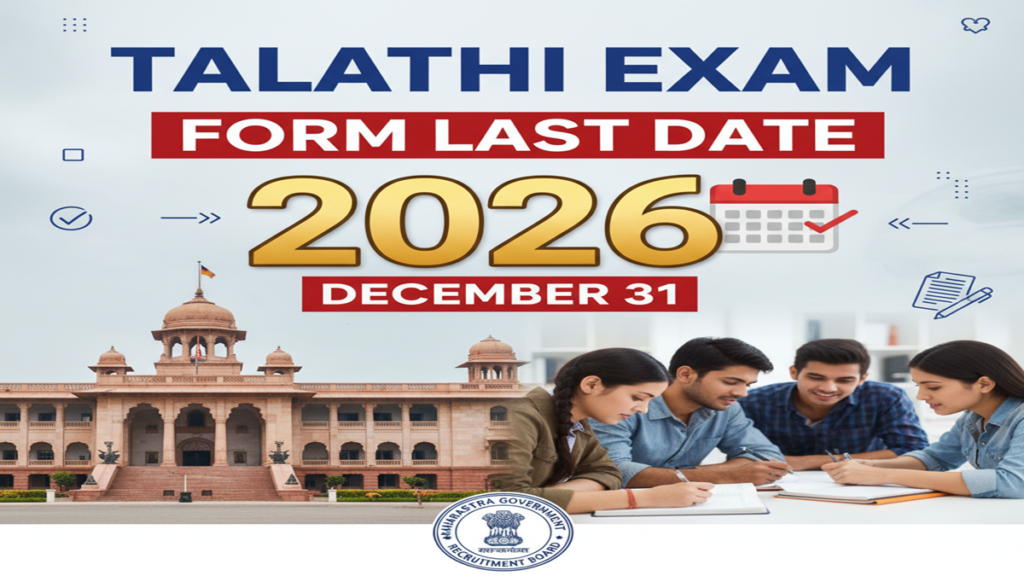
Talathi Exam Form Last Date 2026: तलाठी भरतीसाठी अर्ज करण्याची शेवटची तारीख; मुदत संपण्यापूर्वी असा करा अर्ज!
Talathi Exam Form Last Date 2026: महाराष्ट्र महसूल विभागांतर्गत होणाऱ्या तलाठी भरती २०२६ (Talathi Bharti 2026) ची प्रतीक्षा आता संपली असून, हजारो विद्यार्थ्यांनी ऑनलाइन अर्ज भरण्यास सुरुवात केली आहे. मात्र, दरवर्षीप्रमाणे शेवटच्या दिवसांत सर्व्हरवर येणारा ताण आणि तांत्रिक बिघाड टाळण्यासाठी विद्यार्थ्यांना Talathi Exam Form Last Date 2026 बद्दल माहिती असणे अत्यंत आवश्यक आहे.
या लेखात आपण अर्ज करण्याची अंतिम तारीख, फी भरण्याची पद्धत आणि शेवटच्या क्षणी होणाऱ्या चुका कशा टाळाव्यात, यावर सविस्तर चर्चा करणार आहोत.
तलाठी भरती २०२६: महत्त्वाच्या तारखा (Important Dates)
Talathi Exam Form Last Date 2026: अधिकृत अधिसूचनेनुसार, तलाठी भरती २०२६ चे वेळापत्रक खालीलप्रमाणे असू शकते:
- अर्ज सुरू होण्याची तारीख: मार्च २०२६ (अंदाजे)
- अर्ज करण्याची शेवटची तारीख (Last Date): एप्रिल २०२६ (अंदाजे)
- परीक्षा शुल्क भरण्याची अंतिम तारीख: अर्जाच्या शेवटच्या तारखेपर्यंत.
- अर्ज दुरुस्ती (Form Correction) विंडो: अर्ज प्रक्रिया संपल्यानंतर २-३ दिवस.
शेवटच्या तारखेची वाट का पाहू नये?
Talathi Exam Form Last Date 2026: अनेक विद्यार्थी शेवटच्या दोन-तीन दिवसांत फॉर्म भरण्याचे नियोजन करतात, पण यामुळे खालील समस्या उद्भवू शकतात: १. Server Down: हजारो विद्यार्थी एकाच वेळी वेबसाईटवर आल्यामुळे ‘mahabhumi.gov.in’ ही वेबसाईट संथ (Slow) होते. २. Payment Failure: ट्रॅफिकमुळे पैशांचे व्यवहार अडकतात आणि अर्ज अपूर्ण राहू शकतो. ३. Document Upload Error: घाईघाईत फोटो किंवा सही चुकीच्या फॉरमॅटमध्ये अपलोड होण्याची शक्यता असते.
ऑनलाइन अर्ज भरण्याची स्टेप-बाय-स्टेप पद्धत
Talathi Exam Form Last Date 2026: १. नोंदणी (Registration): सर्वप्रथम अधिकृत पोर्टलवर जाऊन नवीन नोंदणी करा. २. माहिती भरा: तुमची वैयक्तिक माहिती, शैक्षणिक पात्रता आणि पत्ता अचूक भरा. ३. कागदपत्रे अपलोड करा: आधार कार्ड, पदवी प्रमाणपत्र, जातीचा दाखला आणि फोटो स्कॅन करून अपलोड करा. ४. जिल्हा निवड: तुम्हाला ज्या जिल्ह्यातून परीक्षा द्यायची आहे, त्या जिल्ह्याची निवड काळजीपूर्वक करा. ५. फी भरा: क्रेडिट कार्ड, डेबिट कार्ड किंवा युपीआय (UPI) द्वारे परीक्षा शुल्क भरा. ६. प्रिंट आऊट: अर्ज यशस्वीरित्या सबमिट झाल्यावर त्याची प्रिंट किंवा पीडीएफ जपून ठेवा.
परीक्षा शुल्क (Exam Fees)
- खुला प्रवर्ग (Open): ₹१,०००
- राखीव प्रवर्ग (OBC/SC/ST): ₹९००
- माजी सैनिक: फी मधून सूट (अटी लागू).
वारंवार विचारले जाणारे प्रश्न (FAQs)
१. तलाठी भरती २०२६ ची शेवटची तारीख वाढणार का? सामान्यतः
तांत्रिक अडचणी आल्यास २-४ दिवसांची मुदतवाढ दिली जाते, परंतु विद्यार्थ्यांनी मुदतवाढीवर अवलंबून न राहता वेळेत अर्ज करावा.
२. फॉर्म भरताना चूक झाल्यास काय करावे?
अंतिम तारीख संपल्यानंतर विभाग ‘Correction Window’ सुरू करतो, जिथे तुम्ही ठराविक माहिती दुरुस्त करू शकता.
३. पेमेंट झाले पण अर्जावर ‘Pending’ दिसत आहे, काय करावे?
अशा वेळी २४ तास वाट पाहावी किंवा बँकेचे स्टेटमेंट तपासून हेल्पलाईन क्रमांकावर संपर्क साधावा.
निष्कर्ष (Conclusion)
Talathi Exam Form Last Date 2026 कडे दुर्लक्ष करणे महागात पडू शकते. तुम्ही सर्व पात्रता निकष पूर्ण करत असाल, तर शेवटच्या तारखेची वाट न पाहता आजच तुमचा अर्ज सबमिट करा. लक्षात ठेवा, एक छोटीशी चूक किंवा उशीर तुमची वर्षभराची मेहनत वाया घालवू शकतो.
Talathi Exam Form 2026: Your Complete Guide to Application Dates, Process, and Strategy
Talathi Exam Form Last Date 2026 The Talathi (or Talati) exam is one of the most sought-after entry-level government recruitment drives in states like Maharashtra, Gujarat, and others. The position of Talathi, a vital village revenue accountant, offers job security, respect, and a chance to serve at the grassroots of administration. For aspirants targeting the 2026 recruitment cycle, understanding the timeline, especially the Talathi Exam Form Last Date 2026, is the most critical first step in this competitive journey.
Talathi Exam Form Last Date 2026: Missing the application window is an irreversible misstep. This comprehensive guide of 2000+ words is designed to be your one-stop resource for everything related to the Talathi 2026 application process. We will delve into anticipated dates, a step-by-step application walkthrough, document preparation, strategic post-application steps, and crucial FAQs.
Understanding the Recruiting Body and Exam Significance
Talathi Exam Form Last Date 2026: Before diving into dates, it’s essential to know who conducts the exam. Typically, the recruitment is handled by state-level commissions or boards.
- In Maharashtra: The Maharashtra Revenue Department conducts the recruitment, with the application process managed online through its official portal (https://mahabhulekh.maharashtra.gov.in/).
- In Gujarat: The Gujarat Subordinate Service Selection Board (GSSSB) is the conducting body, and applications are submitted via https://ojas.gujarat.gov.in/.
Talathi Exam Form Last Date 2026: The Talathi exam is a gateway to a role responsible for maintaining land records (7/12 extracts), collecting land revenue, assisting in crop surveys, and implementing various government schemes at the village level. Its popularity stems from its stable pay scale, allowances, and the authority associated with the position.
Anticipated Timeline for Talathi Exam 2026
Talathi Exam Form Last Date 2026: While official notifications for 2026 are expected in late 2025 or early 2026, we can project the timeline based on previous years’ cycles (like 2023 and 2021).
| Event | Anticipated Timeline (2025-2026) | Key Notes |
|---|---|---|
| Official Notification Release | December 2025 – February 2026 | This PDF notification is the bible. It contains vacancies, eligibility, and exact dates. |
| Online Application Start Date | Within 1-2 weeks of notification | The portal opens for registration. |
| Talathi Exam Form Last Date 2026 | January – March 2026 | The Most Critical Date. Usually 4-6 weeks after the start date. |
| Last Date for Fee Payment | Often the same as form date or a day later. | Confirm in the notification. |
| Correction Window | A week after the last date. | A one-time chance to correct minor errors in the form. |
| Admit Card Release | 3-4 weeks before the exam. | Downloadable from the official portal. |
| Written Exam Date | April – June 2026 | Objective, Multiple Choice Questions (MCQs). |
Crucial Note: The Talathi Exam Form Last Date 2026 is NOT a flexible deadline. The portals close electronically at 11:59 PM on the stipulated date, and no exceptions are made for technical delays or oversight. Aim to submit at least 3-4 days prior.
A Detailed, Step-by-Step Guide to Filling the Talathi Exam Form 2026
Talathi Exam Form Last Date 2026: Filling the form correctly is as important as filling it on time. Follow this meticulous guide:
Phase 1: Pre-Application Preparation (Do this BEFORE the portal opens)
- Document Digitization: Scan and save clear, color copies in prescribed format/size (usually JPG/PDF, 50-200 KB) of:
- Recent passport-sized photograph (white background).
- Signature (on white paper with dark ink).
- Left Thumb Impression.
- Educational Certificates: Class 10th, 12th, and Graduation (if required) mark sheets and degrees.
- Caste/Category Certificate (if applicable) from competent authority.
- Domicile Certificate.
- Photo ID Proof (Aadhaar, PAN, Driver’s License).
- Eligibility Check: Re-confirm as per expected criteria:
- Educational Qualification: Minimum HSC (12th Pass) or Graduate from a recognized board/university. Some states may require graduation.
- Age Limit: Generally 18 to 38/40 years. Relaxations apply for reserved categories (SC/ST/OBC/PWD).
- Domicile Requirement: Must be a permanent resident of the respective state.
- Portal & Payment Readiness:
- Bookmark the official website.
- Have a valid, active personal email ID and mobile number for OTPs and communication.
- Ensure your preferred online payment mode (Net Banking, Credit/Debit Card, UPI) is operational.
Phase 2: The Online Application Process (A Step-by-Step Walkthrough)
- Registration: On the portal, find the “Talathi Bharti 2026” link. Click “New Registration.” Enter basic details like name, date of birth, email, and mobile number. You will receive a Registration Number/Application ID. Note it down securely.
- Logging In: Use your Registration ID and password to log into the application dashboard.
- Filling the Application Form: This multi-tab section demands utmost attention.
- Personal Details: Name (as per SSC certificate), Parents’ names, gender, category, etc.
- Educational Details: Enter qualifications, university, marks, year of passing. Have your mark sheets handy.
- Address & Contact Details: Permanent and correspondence addresses.
- Preferences: Choice of district or zone (if applicable).
- Use reliable tools to resize if needed.
- Application Preview: MOST IMPORTANT STEP. Thoroughly review every single entered detail. Check for spelling errors, digit transpositions, and category selection.
- Fee Payment: Proceed to pay the application fee. Fees vary by category (General/OBC may be ₹500-1000, while SC/ST/PWD are often exempted or charged less). Save the payment confirmation slip/screenshot.
- Final Submission & Printout: After successful payment, your form is submitted. Immediately download and print 2-3 copies of the final submitted application form. This is mandatory for future stages.
What to Do After Successfully Submitting Your Form?
Talathi Exam Form Last Date 2026: Your responsibility doesn’t end with submission. A strategic candidate uses the intervening time wisely.
- Confirmation is Key: Ensure you receive a confirmation email/SMS. If not, log back in to verify the application status is “Submitted & Paid.”
- Utilize the Correction Window: If opened, re-login and carefully correct any errors you may have spotted.
- Shift to Exam Mode: The real work begins now. The syllabus usually includes:
- General Marathi/Gujarati & English Grammar.
- Mathematics & Mental Ability.
- General Knowledge (Current Affairs, History, Geography, Polity of the state & India).
- Agriculture & Rural Development.
- Computer Knowledge.
- Create a Study Plan: Dedicate daily hours to each section, focusing on previous years’ question papers and mock tests.
- Stay Updated: Regularly check the official portal and reliable news sources for any exam updates or admit card announcements.
Common Pitfalls to Avoid During Application
- Last-Day Rush: Server crashes are common. Submit early.
- Ignoring Instructions: Each upload has size/format specs. Deviating can lead to rejection.
- Incorrect Details: Especially date of birth, category, or percentage. These are hard or impossible to change later.
- Using Incorrect Photographs: Using casual photos, selfies, or old photos leads to disqualification.
- Neglecting the Printout: The hard copy is required during document verification.
Frequently Asked Questions (FAQs) – Talathi Exam Form 2026
Q1. What is the exact expected last date for the Talathi Exam Form 2026?
Talathi Exam Form Last Date 2026: While the official date will be announced in the 2026 notification, based on historical patterns, the Talathi Exam Form Last Date 2026 is anticipated to fall between late January and late March 2026. Candidates must regularly check the official state revenue department or GSSSB websites from December 2025 onwards for the precise date.
Q2. Can I edit my application form after the final submission?
Yes, but only during a specific “Correction Window” that the authorities usually open for a limited time (about 5-7 days) after the application deadline closes. This window allows for corrections of minor typographical errors. Major changes in category, date of birth, or educational qualification are generally not permitted.
Q3. What should I do if I miss the last date for application submission?
Unfortunately, no applications are accepted after the last date and time specified in the official notification. The system is automated and will not allow submissions. There is no provision for late fees or offline submission. The only option is to wait for the next recruitment cycle.
Q4. Is the application fee refundable if I decide not to appear for the exam?
Once paid, it is processed as a cost of the application and administration, regardless of whether you attend the exam or not.
Q5. I am facing a technical error (payment failure/upload issue) just before the deadline. What can I do?
First, do not panic. Ensure the issue is not from your side (slow internet, browser cache). Try using a different browser or device. For payment failure, check your bank statement to see if the amount was debited; if debited but the portal shows failure, take a screenshot of the transaction and immediately contact the helpdesk/email provided in the notification. For upload issues, ensure the file is correctly formatted and sized. Document all communication. However, the best solution is to avoid last-minute submissions to have time to resolve such issues.
Conclusion
The journey to becoming a Talathi begins with a single, time-bound action: submitting your application before the Talathi Exam Form Last Date 2026. This date is the gatekeeper. By treating the application process with the same seriousness as exam preparation, you set a foundation of discipline and attention to detail. Start your document preparation today, vigilantly monitor the official websites from late 2025, and submit your form well in advance. Combine this punctuality with dedicated study, and you will be well on your way to securing this prestigious role in the state revenue department.
Remember: In government exams, opportunity meets preparation within a strict deadline. Don’t let the deadline be the factor that ends your journey before it even begins.