


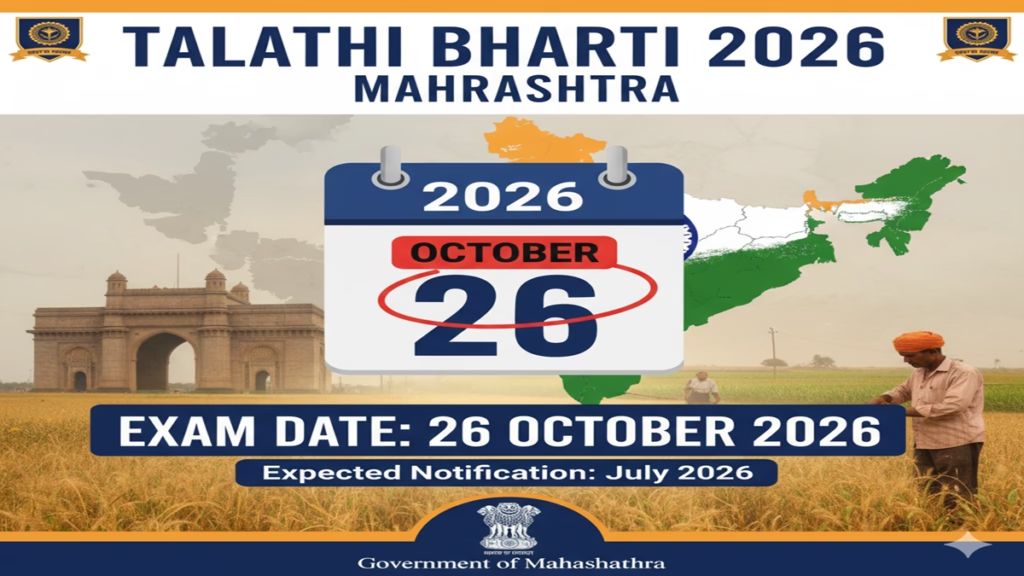
Talathi Exam Date 2026 Maharashtra: तलाठी भरती २०२६ परीक्षेचे वेळापत्रक आणि तारखा जाहीर? जाणून घ्या संपूर्ण माहिती!
Talathi Exam Date 2026 Maharashtra: महाराष्ट्र महसूल विभागातील ‘तलाठी’ (वर्ग-३) पदासाठी अर्ज केलेल्या लाखो उमेदवारांचे लक्ष आता एकाच गोष्टीकडे लागले आहे—ती म्हणजे Talathi Exam Date 2026 Maharashtra. २०२६ मधील ही सर्वात मोठी सरळसेवा भरती असून, प्रशासकीय तयारी आता अंतिम टप्प्यात आली आहे.
तुम्हीही या परीक्षेची तयारी करत असाल, तर परीक्षेच्या तारखा, हॉल तिकीट आणि TCS/IBPS पॅटर्नबद्दलची ही सविस्तर माहिती तुमच्यासाठी अत्यंत महत्त्वाची आहे.
१. तलाठी भरती २०२६: परीक्षेच्या संभाव्य तारखा (Expected Dates)
Talathi Exam Date 2026 Maharashtra: मिळालेल्या माहितीनुसार, महाराष्ट्र सरकार आणि महसूल विभाग मे ते जून २०२६ दरम्यान तलाठी भरतीची परीक्षा घेण्याचे नियोजन करत आहे.
- अधिसूचना प्रसिद्धी: मार्च २०२६
- ऑनलाईन अर्जाची मुदत: एप्रिल २०२६ पर्यंत
- परीक्षा दिनांक: जून २०२६ (संभाव्य)
- निकाल जाहीर: ऑगस्ट २०२६
(टीप: अधिकृत तारखांची घोषणा ‘mahabhumi.gov.in’ या वेबसाईटवर लवकरच केली जाईल. उमेदवारांनी नियमितपणे वेबसाईट तपासत राहावे.)
२. परीक्षेचे स्वरूप: TCS की IBPS?
Talathi Exam Date 2026 Maharashtra: २०२६ ची तलाठी भरती परीक्षा ही TCS (Tata Consultancy Services) मार्फत ऑनलाईन (Computer Based Test) पद्धतीने घेतली जाण्याची दाट शक्यता आहे.
- एकूण गुण: २००
- प्रश्न संख्या: १०० (प्रत्येक प्रश्नाला २ गुण)
- वेळ: २ तास
- नेगेटिव्ह मार्किंग: या परीक्षेत सहसा नकारात्मक गुणदान (Negative Marking) नसते, ही उमेदवारांसाठी मोठी जमेची बाजू आहे.
३. हॉल तिकीट (Hall Ticket) कधी मिळणार?
Talathi Exam Date 2026 Maharashtra: नियमानुसार, परीक्षेच्या तारखेच्या ७ ते १० दिवस आधी अधिकृत हॉल तिकीट डाऊनलोड करण्यासाठी उपलब्ध करून दिले जाते. उमेदवारांना त्यांच्या नोंदणीकृत ईमेल आणि मोबाईल नंबरवर एसएमएसद्वारे कळवले जाईल.
४. शेवटच्या दिवसांत अभ्यासाचे नियोजन (Last Minute Tips)
Talathi Exam Date 2026 Maharashtra: परीक्षेची तारीख जवळ येत असताना रिव्हिजनवर भर द्या:
- मराठी आणि इंग्रजी व्याकरण: शब्दसंग्रह (Vocabulary) आणि प्रयोगांवर जास्त लक्ष द्या.
- चालू घडामोडी (Current Affairs): २०२५ आणि २०२६ मधील महत्त्वाच्या चालू घडामोडींचा अभ्यास करा.
- गणित व बुद्धिमत्ता: TCS पॅटर्ननुसार तर्कशक्तीच्या प्रश्नांचा सराव करा.
- मॉक टेस्ट (Mock Test): वेळेचे नियोजन करण्यासाठी आठवड्यातून किमान २ ऑनलाईन सराव पेपर सोडवा.
५. तलाठी पदासाठी जिल्हावार स्पर्धा
Talathi Exam Date 2026 Maharashtra: २०२६ मध्ये पुणे, नाशिक आणि छत्रपती संभाजीनगर या जिल्ह्यांमध्ये अर्जांची संख्या सर्वाधिक राहण्याची शक्यता आहे. त्यामुळे या जिल्ह्यांतील कट-ऑफ (Cut-off) देखील जास्त राहू शकतो. विद्यार्थ्यांनी केवळ परीक्षेची तारीख शोधण्यापेक्षा आपल्या अभ्यासाची पातळी उंचावण्यावर भर देणे आवश्यक आहे.
निष्कर्ष (Conclusion)
Talathi Exam Date 2026 Maharashtra बद्दल अधिकृत अपडेट येताच आम्ही या लेखात अपडेट करू. ही परीक्षा तुमच्या करिअरसाठी एक मोठी संधी आहे, त्यामुळे वेळेचा अपव्यय न करता तयारीला लागा.
Quick Table: परीक्षेचा तपशील
| घटक (Component) | माहिती (Information) |
| पदाचे नाव | तलाठी (वर्ग ३) |
| एकूण जागा | ४,५००+ (अपेक्षित) |
| परीक्षा पद्धत | ऑनलाईन (CBT) |
| अधिकृत संकेतस्थळ | mahabhumi.gov.in |
Navigating the Path to Success: A Complete Guide to the Maharashtra Talathi Exam 2025-2026
Talathi Exam Date 2026 Maharashtra The position of Talathi (also known as Lekhpal) in Maharashtra is more than just a government job; it is the foundational pillar of rural administration and land record management. It represents a career of respect, stability, and direct impact on the agrarian backbone of the state.
With the Talathi Exam for 2026 anticipated to be announced by the Maharashtra Revenue Department, a wave of aspirants is beginning their preparation journey. This article serves as your definitive guide, covering the expected exam timeline, syllabus, strategic preparation plan, and insights to secure your name on the merit list.
Part 1: Understanding the Role and Its Significance
Talathi Exam Date 2026 Maharashtra: Before diving into exam specifics, it’s crucial to understand what a Talathi does. As the village-level revenue officer, the Talathi is responsible for maintaining and updating land records (7/12 extracts and 8-A extracts), collecting land revenue, assisting in disaster management surveys, implementing government schemes at the grassroots level, and serving as a vital link between the villagers and the revenue machinery.
This role demands integrity, attention to detail, and a good understanding of local geography and laws. The selection process is designed to identify candidates with this blend of administrative acumen and general awareness.
Part 2: Talathi Exam Date 2026: Expected Timeline and Overview
Talathi Exam Date 2026 Maharashtra: While the official notification for the 2026 recruitment cycle is expected in late 2025 or early 2026, planning must begin now. Based on previous years’ patterns (like the 2023 recruitment drive), here is a projected timeline:
- Release of Official Notification:December 2025 – February 2026
- This will be published on the official website of the Maharashtra Revenue Department and the Maharashtra Zilla Parishad.
- Online Application Period:January – March 2026
- A critical window for form filling, document upload, and fee payment.
- Admit Card Release: 4-5 weeks before the exam.
- Written Examination Date (Tentative):April – June 2026
- The exam is likely to be a Computer-Based Test (CBT) or OMR-based, depending on final notification.
- Document Verification & Final Selection: July – September 2026
Exam Pattern (Expected): The exam typically consists of a single, objective-type paper of 200 marks with a duration of 90 to 120 minutes. There is usually no negative marking, making a complete attempt crucial.
Part 3: Detailed Syllabus and Subject-Wise Breakdown
Talathi Exam Date 2026 Maharashtra: The syllabus is broad, testing both academic knowledge and awareness relevant to the role. A strategic approach to each section is key.
1. Marathi Language & Grammar (40-50 Marks):
* Focus Areas: Vyakaran (Grammar), Sandhi, Samas, Alankar, Mishra Vaaky, Prayog, Letter/Application Writing, Essay on current topics.
* Preparation Tip: Start with a standard Marathi grammar book. Practice essay writing on topics like “Role of Talathi in Digital India,” “Agriculture Challenges in Maharashtra,” etc. Regular reading of Marathi newspapers like Lokmat, Sakal, or Maharashtra Times is indispensable.
2. English Language (30-40 Marks):
* Focus Areas: Basic Grammar, Tenses, Articles, Prepositions, Spotting Errors, Fill in the Blanks, Synonyms/Antonyms, One-word substitutions.
* Preparation Tip: Use school-level English grammar books. Build vocabulary through daily word lists and practice from previous years’ papers of similar exams.
3. General Knowledge & Current Affairs (60-70 Marks):
* This is a high-scoring but vast section.
* Focus Areas:
* History: Primarily History of Maharashtra (Maratha Empire, Social Reformers like Jyotiba Phule, Dr. Ambedkar, Chhatrapati Shivaji Maharaj).
* Geography: Physical and Agricultural Geography of Maharashtra (Rivers, Soil types, Crops, Climate), National Parks.
* Polity: Indian Constitution (Basic Structure, Fundamental Rights/Duties), Panchayati Raj System (Role of Revenue Department), Important Articles.
* General Science: Basic physics, chemistry, biology relevant to daily life and agriculture.
* Preparation Tip: Make notes monthly. Focus heavily on Maharashtra-specific information. Follow a reliable GK book and a monthly current affairs magazine.
4. Mathematics & Reasoning (60-70 Marks):
* Mathematics: This is numerical ability at the 10th standard level.
* Reasoning: Verbal and Non-Verbal reasoning including Analogies, Classification, Series, Coding-Decoding, Blood Relations, Syllogism, Direction Sense.
* Preparation Tip: Speed and accuracy are born from practice. Solve at least 50 numerical problems daily. Learn shortcut formulas for quick calculations.
5. Revenue & Administration (Specialized Section) (40-50 Marks):
* This section tests domain knowledge crucial for the Talathi role.
* Focus Areas: Maharashtra Land Revenue Code, Record of Rights (7/12, 8-A), Role and Responsibilities of Talathi, Patwari, and Tehsildar. Basic knowledge of the Maharashtra Prevention of Fragmentation and Consolidation of Holdings Act, and other relevant state acts.
* Preparation Tip: This can be a differentiator. Obtain copies of simplified guides or Marathi books on the Maharashtra Land Revenue Code. Understand the processes, not just the definitions.
Part 4: A 12-Month Strategic Preparation Plan (2025-2026)
Phase 1: Foundation Building (May – August 2025)
- Understand the complete syllabus and pattern.
- Collect all necessary books and resources.
- Start with strengthening Marathi Grammar and Basic Mathematics. Begin reading the daily newspaper meticulously.
Phase 2: Intensive Subject Study (September 2025 – January 2026)
- Cover all subjects one by one. Make concise, chapter-wise notes, especially for GK and Revenue.
- Complete the entire syllabus at least once. Solve topic-wise MCQs after finishing each chapter.
- Shift focus to revision of notes and current affairs compilation.
- Start taking full-length mock tests weekly, gradually increasing to daily as the exam nears.
- Analyze each mock test: identify weak areas, manage time, and improve accuracy.
Phase 4: Final Sprint (Last 4-6 Weeks)
- Focus only on revision of formulas, important facts, and current affairs notes.
- Avoid new topics. Practice previous years’ question papers.
- Work on speed and develop a smart attempt strategy for the exam day.
Part 5: Essential Resources and Books
- Mathematics & Reasoning: R.S. Aggarwal’s “Quantitative Aptitude” and “Verbal & Non-Verbal Reasoning.”
Part 6: Beyond the Written Exam: Document Verification and Training
Talathi Exam Date 2026 Maharashtra: Clearing the written exam leads to the document verification round. Ensure all your original documents (Educational Certificates, Domicile Certificate, Caste Certificate, Validity Certificate for reserved categories, Photo ID) are in perfect order. Upon final selection, candidates undergo mandatory training at a state-run training institute before posting.
Conclusion: The Journey Begins Now
Talathi Exam Date 2026 Maharashtra: The announcement of the Talathi Exam Date 2026 is the starting gun, but the race is won by those who begin their training early. Consistent, smart, and focused preparation with an emphasis on Maharashtra-specific knowledge and current affairs is the formula for success. Remember, this exam is not just about securing a job; it’s about earning a role that sits at the heart of Maharashtra’s villages. Stay disciplined, stay updated, and let your preparation be as robust as the administrative system you aspire to join. All the best!
Frequently Asked Questions (FAQs) for Talathi Exam 2026
FAQ 1: When will the official notification for the Talathi Exam 2026 be released?
Answer: Talathi Exam Date 2026 Maharashtra: Based on previous cycles, the official notification is expected to be released by the Maharashtra Revenue Department in the period of December 2025 to February 2026. Aspirants should regularly check the official websites of the Maharashtra Revenue Department and Maharashtra Zilla Parishad for the exact announcement.
FAQ 2: What is the educational qualification required for the Talathi exam?
Answer: Talathi Exam Date 2026 Maharashtra: Candidates must possess a Bachelor’s Degree in any discipline from a recognized university. Additionally, a Government Diploma in Information Technology is often a mandatory requirement, or candidates must possess a specific computer knowledge certificate as specified in the official notification (e.g., MS-CIT, CCC, or equivalent). Some notifications may allow candidates a provisional period to obtain this certificate after selection.
FAQ 3: Is there any negative marking in the Talathi written examination?
Answer: Talathi Exam Date 2026 Maharashtra: In most previous Talathi recruitment cycles, there has been no provision for negative marking in the written objective test. However, this is subject to the rules set in the final official notification for 2026. It is always advisable to read the exam pattern section of the notification carefully once released.
FAQ 4: What is the age limit for applying to the Talathi post?
Answer: Talathi Exam Date 2026 Maharashtra: The general age limit is typically between 18 to 38 years. However, there is a provision for age relaxation as per government norms for reserved categories: 5 years for SC/ST, 3 years for OBC, and 10-15 years for PwD candidates. The exact details will be specified in the official notification.
FAQ 5: How should I prepare for the specialized “Revenue & Administration” section?
Answer: This section is unique and requires focused study. Start by obtaining a simplified guide or textbook (in Marathi) on the Maharashtra Land Revenue Code. Focus on understanding key concepts like the Record of Rights (7/12 & 8-A extracts), the hierarchy of revenue officials (Talathi, Circle Inspector, Tehsildar), and the basic procedures of land mutation, partition, and tenancy. Previous years’ questions and coaching class notes for this specific section can be highly valuable.