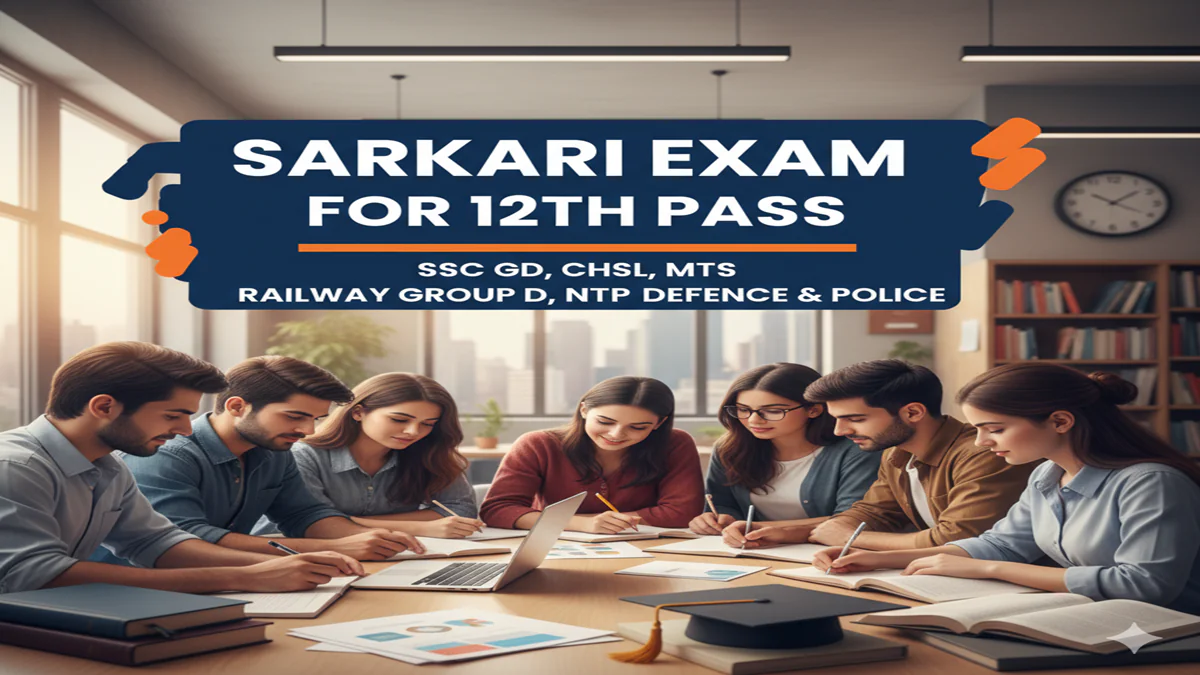
Unlocking the Gateway: A Comprehensive Guide to Sarkari Exams for 12th Pass Students
Sarkari Exam For 12th Pass For millions of students in India, completing the 12th standard is a significant milestone, marking the transition from the structured world of school to the vast, often overwhelming, landscape of higher education and career choices. In a country where job security, social respect, and financial stability are paramount,Sarkari Naukri(Government Jobs) stands out as a beacon of aspiration. For a 12th pass candidate, embarking on the journey of Sarkari exams can be both a strategic and rewarding decision. This guide serves as a comprehensive roadmap, detailing the “why,” “what,” and “how” of government exams for intermediate graduates.
Why Target Sarkari Exams After 12th?
The allure of government jobs for 12th pass students is multifaceted:
- Early Career Entry:Unlike professions requiring lengthy graduate or post-graduate degrees, many government posts for 12th pass allow you to start earning and gaining experience at the age of 18-20.
- Job Security & Stability:In an era of economic volatility, the permanence and “iron-clad” security of a government position are unparalleled. It offers immunity from sudden layoffs and market downturns.
- Attractive Compensation & Perks:Entry-level government posts come with salaries that are competitive with, and often better than, many private-sector entry-level jobs, especially when considering the benefits: Dearness Allowance (DA), House Rent Allowance (HRA), medical benefits, pensions (under the Old Pension Scheme for some), and guaranteed increments.
- Work-Life Balance:Most government jobs adhere to fixed working hours, providing a balanced lifestyle that is often hard to find in the private sector. This allows time for personal development, family, and further studies.
- Social Prestige & Respect:A government job holder enjoys considerable respect in society, which can be a significant motivator for many students and their families.
- Equal Opportunity Platform:Sarkari exams are renowned for their (largely) transparent and merit-based selection process. It provides a level playing field where your performance, not your background, is the primary determinant of success.
Major Categories of Sarkari Exams for 12th Pass
The landscape is diverse, catering to different skill sets and interests. Broadly, the opportunities can be categorized into:
1. Defence & Paramilitary Forces
These are among the most prestigious and physically demanding roles.
- Indian Army:Through entries likeSoldier General Duty (GD), Soldier Technical, Soldier Clerk/Store Keeper Technical, and Nursing Assistant.The recruitment is conducted via rallies by the respectiveArmy Recruitment Offices (AROs).
- Indian Navy:AsSailorsfor roles like Senior Secondary Recruit (SSR) and Matric Recruit (MR) for Cooks & Stewards. Notifications are released onjoinindiannavy.gov.in.
- Indian Air Force:AsAirmanin Group X (Technical) and Group Y (Non-Technical) trades. The exam is conducted by theIndian Air Force (IAF).
- Paramilitary Forces:Such as theCentral Armed Police Forces (CAPFs)– BSF, CRPF, CISF, ITBP, SSB. Recruitment for the post ofConstable (General Duty)andHead Constableis done through a common exam conducted by theStaff Selection Commission (SSC).
2. Railways – The Nation’s Lifeline
One of the largest employers in the world, Indian Railways offers a plethora of jobs.
- RRB Group D (Now Level-1 Posts):This includes positions like Track Maintainer, Helper, Porter, etc. The exam is conducted by theRailway Recruitment Boards (RRBs).
- RRB NTPC (Non-Technical Popular Categories):For posts like Clerk, Ticket Collector, Goods Guard, Time Keeper, etc. While some posts require graduation, many are open to 12th pass candidates.
3. Staff Selection Commission (SSC) – The Multi-Purpose Recruiter
The SSC is a gateway to numerous non-gazetted posts in various ministries and departments.
- SSC CHSL (Combined Higher Secondary Level):For posts likeLower Division Clerk (LDC), Junior Secretariat Assistant (JSA), Postal Assistant (PA), Sorting Assistant (SA), and Data Entry Operator (DEO). This is arguably the most popular exam for 12th pass students.
- SSC GD Constable:For recruitment of Constables in CAPFs, SSF, and Rifleman in Assam Rifles.
- SSC Stenographer (Grade C & D):For stenography roles, requiring shorthand typing skills.
4. State-Level Opportunities
Every state government releases notifications for similar roles within its jurisdiction.
- State Police Constables:Recruitment drives by State Police Departments.
- State Clerk/Secretariat Assistants:Exams conducted by StateStaff Selection BoardsorPublic Service Commissions (PSCs).
- Forest Guard, Jail Warder, Revenue Department Officials:Various departmental recruitments.
5. Other Notable Opportunities
- Banking:While most banking jobs (Clerk, PO) now require a graduation degree, someApprenticepositions or specific clerical roles in rural banks may consider 12th pass candidates.
- Postal Department:AsGramin Dak Sevaks (GDS)andPostal Assistants(via SSC CHSL).
- Government PSUs (Public Sector Undertakings):Companies likeFCI (Food Corporation of India)andNF Railwayoften recruit for Assistant Grade and Technician roles.
The Examination Pattern & Syllabus: A Common Thread
While each exam has its nuances, the pattern for most 12th-level competitive exams follows a similar structure:
- Computer Based Test (CBT) / Written Exam:
- General Intelligence & Reasoning:Analogies, Classification, Series, Coding-Decoding, Puzzles, Syllogism, etc.
- Quantitative Aptitude / Maths:Number Systems, Simplification, Algebra, Geometry, Trigonometry, Mensuration, Percentage, Average, Ratio, Time & Work, Speed & Distance, etc.
- General Awareness / General Knowledge:Current Affairs (National & International), History, Geography, Indian Polity, Economics, General Science (Physics, Chemistry, Biology), Static GK.
- Subject-Specific Knowledge:For technical posts (e.g., Soldier Technical, IAF Group X), questions from Physics, Chemistry, and Maths from the 12th syllabus are included.
- Physical Efficiency Test (PET) / Physical Standard Test (PST):Crucial for Defence and Police jobs.This includes running, long jump, high jump, shot put, etc., along with measurements of height, chest, and weight.
- Skill Tests:For certain posts likeData Entry Operator (DEO)in SSC CHSL orStenographer, a typing speed test (in English/Hindi) or stenography (shorthand) test is mandatory.
- Medical Examination:A thorough medical check-up is compulsory for all uniformed and many non-uniformed services to ensure fitness for the job.
- Document Verification (DV):The final stage where all original educational and personal documents are verified.
A Strategic Action Plan for Success
Step 1: Self-Assessment & Goal Setting
Analyse your strengths. Are you academically inclined, physically robust, or skilled in typing? Choose an exam that aligns with your profile. Aiming for the Army as a Soldier GD requires peak physical fitness, while targeting SSC CHSL demands strong academic acumen.
Step 2: Thorough Research & Notification Tracking
- Bookmark Official Websites:Make a list of all crucial sites:ssc.nic.in,indianrailways.gov.in,joinindianarmy.nic.in,indiapost.gov.in, and your state’s PSC website.
- Use Sarkari Exam Portals:Follow reputable job alert websites and channels for timely notifications.
- Understand the Eligibility:Meticulously check the age limit (usually 18-25 years, with relaxations for OBC/SC/ST), educational qualification (minimum percentage, recognized board), and nationality clauses.
Step 3: Craft a Realistic Study Plan
- Syllabus is your Bible:Break down the syllabus of your target exam into micro-topics.
- Create a Timetable:Allocate fixed hours daily, balancing between all subjects. Give more time to your weaker sections.
- Integrate Current Affairs:Dedicate 30-45 minutes daily to reading a newspaper (The Hindu, Indian Express) and a monthly current affairs magazine.
- Prioritize NCERT Books:For General Science, History, Geography, and Polity, your Class 10th and 12th NCERT textbooks are goldmines.
Step 4: The Pillars of Preparation
- Conceptual Clarity:Don’t rote-learn maths or reasoning formulas. Understand the underlying concept.
- Practice, Practice, Practice:Solve previous years’ question papers (at least last 5 years) and take regular mock tests. This builds speed, accuracy, and exam temperament.
- Revision is Non-Negotiable:Make short notes, especially for GK and current affairs. Revise them weekly.
- Physical Preparation (If Applicable):If preparing for defence/police, start a disciplined fitness regimen at least 6-8 months in advance. Focus on running, push-ups, and other exercises as per the PET standards.
- Admit Card & Exam Centre:Download your admit card well in time and visit your exam centre a day before if possible.
- Time Management in Exam:In the CBT, don’t get stuck on one question. Move on. Use intelligent guessing (elimination method) for questions you are unsure about.
- Stay Calm & Positive:Anxiety is normal. Trust your preparation.
Common Pitfalls to Avoid
- Chasing Too Many Notifications:Focus on 2-3 exams with similar syllabi to avoid burnout.
- Ignoring the Basics:Don’t jump directly to advanced books. Strengthen your foundation with NCERTs and school-level grammar/maths.
- Neglecting English/Language Section:Many students from Hindi or regional mediums underestimate this section. It is often the deciding factor.
- Underestimating Physical Tests:Failing the PET after clearing the written exam is heartbreaking. Prepare concurrently.
- Relying on Guesswork Without Practice:Mock tests teach you the art of educated guessing under time constraints.
The Path Ahead: Growth and Promotions
A government job after 12th is not a dead end. It is the first step on a ladder with ample opportunities for promotions, departmental exams, and skill-based advancements. For instance, a Constable can rise to become an Inspector, a Clerk can be promoted to Section Officer, and a Soldier can rise through the ranks. Many departments also encourage and sponsor further education.
Frequently Asked Questions (FAQs)
Q1: I have just passed 12th. Which is the easiest Sarkari exam to crack?
A: “Easiest” is subjective and depends on your strengths. However, exams like SSC GD Constable or RRB Level-1 have a relatively straightforward syllabus focused on basic aptitude and general knowledge, but they attract a massive number of applicants, making competition fierce. The key is to identify which exam’s pattern aligns with your skills rather than looking for an “easy” way out.
Q2: Is physical fitness mandatory for all 12th pass government jobs?
A: No. Physical tests are mandatory only for jobs in the Defence Forces (Army, Navy, Air Force), Paramilitary (CAPFs), State Police, and similar uniformed services. For clerical jobs like SSC CHSL, RRB NTPC, or state-level clerk posts, the selection is based purely on written exams and skill/typing tests.
Q3: Can I prepare for Sarkari exams alongside my graduation?
A: Absolutely. In fact, it is a highly recommended and strategic approach. The syllabus for many graduate-level exams (like SSC CGL, UPSC CDS) overlaps with the 12th-level exams. Preparing during graduation allows you to attempt exams at both levels, thereby increasing your chances. Time management is crucial in this dual preparation.
Q4: What is the approximate salary I can expect from a Sarkari job after 12th?
A: The salary varies by post, department, and location (city classification). As per the 7th Pay Commission, most entry-level posts (like Constable, Clerk, Railway Group D) typically fall in Pay Level 1 to 3. The approximate in-hand starting salary can range from ₹20,000 to ₹30,000 per month, including basic pay, allowances (DA, HRA), and deductions. This often increases with time and promotions.
Q5: How many attempts do I get for these exams?
A: The number of attempts is usually tied to the age limit, not a fixed number. Most exams have a minimum age of 18 and a maximum of 25 years (with relaxations for reserved categories). As long as you are within the prescribed age limit for a particular exam, you can attempt it. There is no restriction on the number of times you can appear within that age bracket.
Conclusion
The journey to secure a Sarkari Naukri after the 12th is a marathon, not a sprint. It demands discipline, perseverance, and smart work. The landscape is vast and filled with opportunities that offer not just a job, but a dignified and secure career. By choosing the right target, preparing with a structured plan, and avoiding common mistakes, you can transform this aspiration into a reality. Remember, every officer in a uniform and every official in a government office started with a single step—the decision to try. Let your first step be informed, determined, and today.