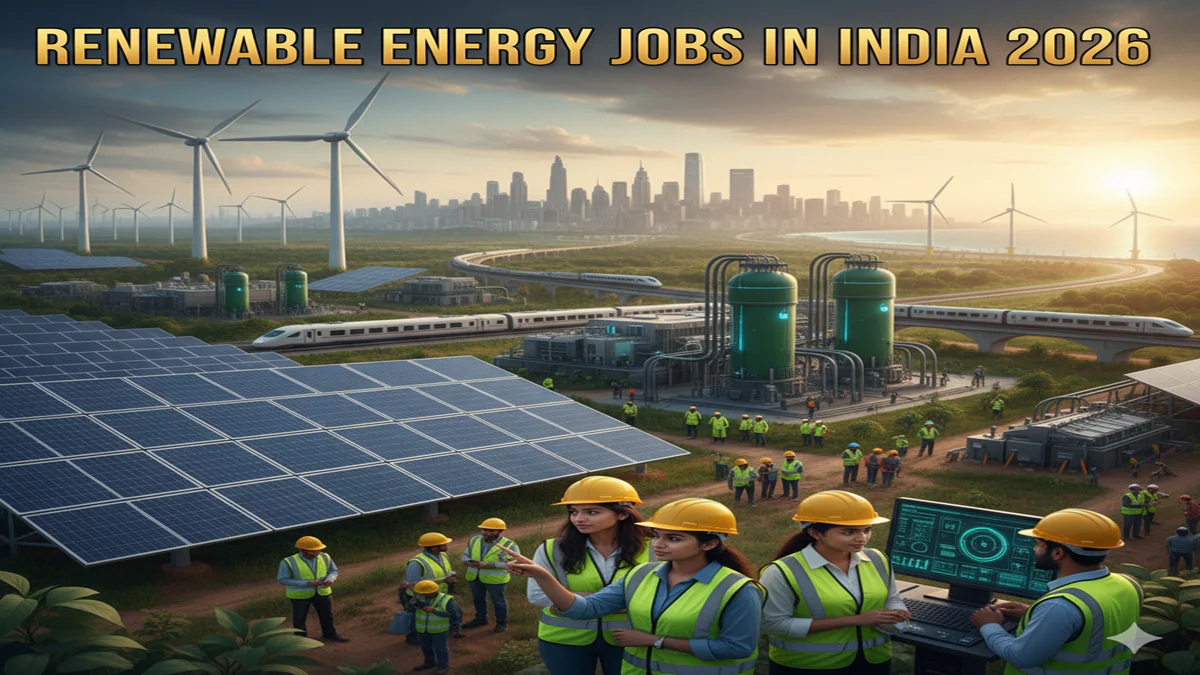
Renewable Energy Jobs In India 2026: अक्षय ऊर्जा क्षेत्र में करियर के सुनहरे अवसर; जानें कैसे पाएं ₹15-20 लाख तक की जॉब!
Renewable Energy Jobs In India 2026: Introduction: भारत ने २०२५ पर्यंत आपल्या एकूण वीज क्षमतेच्या ५०% हिस्सा बिगर-जीवाश्म इंधनांतून (Non-fossil fuel) मिळवण्याचे उद्दिष्ट साध्य केले आहे. या वेगाने होत असलेल्या बदलामुळे भारतामध्ये Renewable Energy Jobs In India या विषयावर प्रचंड चर्चा सुरू आहे. आज सौर ऊर्जा (Solar), पवन ऊर्जा (Wind), आणि आता ग्रीन हायड्रोजन (Green Hydrogen) सारख्या क्षेत्रात लाखोंच्या संख्येने रोजगाराच्या संधी निर्माण होत आहेत. जर तुम्ही एक विद्यार्थी असाल किंवा करिअर बदलू इच्छिणारे व्यावसायिक, तर हा लेख तुमच्यासाठी एक रोडमॅप ठरेल.

1. 2026 में रिन्यूएबल एनर्जी में नौकरियों की बढ़ती मांग
Renewable Energy Jobs In India 2026: २०२६ मध्ये, केवळ मोठ्या प्रकल्पांवरच नव्हे, तर ‘स्मार्ट ग्रिड्स’ (Smart Grids) आणि ‘बॅटरी स्टोरेज’ (Battery Storage) सारख्या तांत्रिक क्षेत्रांतही तज्ज्ञांची गरज आहे. सरकारी उपक्रम जसे की SECI (Solar Energy Corporation of India) आणि IREDA सतत अनुभवी प्रोफेशनल आणि इंजिनियर्सची भरती करत आहेत.
2. टॉप करियर विकल्प (Top Career Options)
- सोलर इंजिनियर (Solar Engineer): सोलर पॅनेलचे डिझाइन, इन्स्टॉलेशन आणि मेंटेनन्ससाठी यांची सर्वाधिक मागणी आहे.
- विंड टर्बाइन टेक्निशियन (Wind Turbine Technician): पवनचक्कींच्या देखभाल आणि दुरुस्तीसाठी विशेष कौशल्याची गरज असते.
- ग्रीन हायड्रोजन एक्सपर्ट: हे २०२६ मधील सर्वात ‘हॉट’ करिअर आहे. हायड्रोजन निर्मिती आणि वितरणाशी संबंधित तंत्रज्ञान यात शिकायला मिळते.
- सस्टेनेबिलिटी कंसल्टेंट (Sustainability Consultant): कंपन्यांना आपला कार्बन फूटप्रिंट कमी करण्यासाठी मदत करणारे तज्ज्ञ.
- बॅटरी स्टोरेज इंजिनियर: ईव्ही (EV) आणि अक्षय ऊर्जेच्या साठवणुकीसाठी बॅटरी तंत्रज्ञान विकसित करणारे इंजिनियर.
3. जरूरी स्किल्स (Skills You Need)
Renewable Energy Jobs In India 2026: या क्षेत्रात यशस्वी होण्यासाठी केवळ पदवी (Degree) पुरेशी नाही, तर खालील कौशल्ये मिळवणे आवश्यक आहे:
- टेक्निकल स्किल्स: इलेक्ट्रिकल आणि मेकॅनिकल इंजिनियरिंगची मूलभूत माहिती.
- डेटा ॲनालिटिक्स: सौर किंवा पवन उर्जेचे आउटपुट मोजण्यासाठी डेटा विश्लेषण आवश्यक आहे.
- प्रोजेक्ट मॅनेजमेंट: मोठ्या ग्रीन एनर्जी प्रकल्पांना वेळेत पूर्ण करण्यासाठी मॅनेजमेंटचे ज्ञान.
- पॉलिसी नॉलेज: भारतातील सरकारी नियम आणि सबसिडी स्कीमची माहिती असणे महत्त्वाचे आहे.
4. वेतन और करियर संभावनाएं (Salary and Growth)
Renewable Energy Jobs In India 2026: भारतात या क्षेत्रात सुरुवातीचा पगार (Entry level) साधारणपणे ₹४ ते ६ लाख प्रति वर्ष असतो. मात्र, ३-५ वर्षांच्या अनुभवानंतर, तुम्ही प्रति वर्ष ₹१५ ते २५ लाख किंवा त्याहून अधिक पॅकेज मिळवू शकता. विशेषतः सीनियर मॅनेजर आणि डिरेक्टर लेव्हलच्या पदांसाठी ३५-४० लाख रुपयांपर्यंत पगार दिला जात आहे.
5. जॉब्स कैसे ढूंढें? (How to Find Jobs)
- Skill Council for Green Jobs (SCGJ): अधिकृत पोर्टलला भेट देऊन स्किल डेव्हलपमेंट कोर्सेस पूर्ण करा.
- सरकारी पोर्टल: SECI, MNRE (Ministry of New and Renewable Energy) आणि NGEL च्या करियर पेजवर नियमित लक्ष ठेवा.
- लिंक्डइन (LinkedIn): या क्षेत्रातील कंपन्या (Adani Green, Tata Power, Suzlon) फॉलो करा.
4. अक्सर पूछे जाने वाले प्रश्न (FAQs)
Q1: क्या रिन्यूएबल एनर्जी में नॉन-इंजीनियर भी जॉब पा सकते हैं?
Ans: हाँ! सेल्स, बिझनेस डेव्हलपमेंट, फायनान्स, आणि पॉलिसी ॲनालिसिस या विभागांत नॉन-इंजिनिअर्ससाठी भरपूर संधी आहेत.
Q2: इस क्षेत्र में सबसे ज्यादा ग्रोथ कहां है?
Ans: सध्या ‘ग्रीन हायड्रोजन’ आणि ‘बॅटरी एनर्जी स्टोरेज सिस्टम’ (BESS) मध्ये सर्वात जास्त ग्रोथ आहे.
Q3: क्या बिना डिग्री के इसमें एंट्री मुमकिन है?
Ans: हो, ‘सूर्यमित्र’ किंवा तत्सम स्किल डेव्हलपमेंट प्रोग्राम्स करून तुम्ही टेक्निशियन म्हणून करिअर सुरू करू शकता.
Conclusion: उज्ज्वल भविष्य की राह!
Renewable Energy Jobs In India 2026 केवळ रोजगाराचा पर्याय नसून, देशाच्या विकासात योगदान देण्याची संधी आहे. जर तुम्ही तांत्रिक ज्ञान आणि शाश्वत विचारांची सांगड घातली, तर येणारी दशके तुमची आहेत. आजही योग्य कौशल्य निवडा आणि ग्रीन इकॉनॉमीचा भाग बना.
The Green Gold Rush: Renewable Energy Jobs in India 2026
Introduction: A Nation Powered by Ambition
Renewable Energy Jobs In India 2026 As India strides towards its 100th year of independence, its energy landscape is undergoing a transformation of unprecedented scale. The twin imperatives of energy security and climate
commitment have catapulted renewable energy (RE) from a peripheral alternative to the core of national strategy. With ambitious targets of 500 GW of non-fossil fuel capacity by 2030 and a net-zero pledge for 2070, India is not just building infrastructure; it is engineering a new economic ecosystem.
Renewable Energy Jobs In India 2026: The year 2026 stands as a crucial inflection point in this journey, where policy, technology, and investment converge to create what industry leaders are calling a “Green Gold Rush.” This article explores the burgeoning job market in India’s renewable sector in 2026, mapping the opportunities, skills, and challenges that define this dynamic frontier.
Part 1: The 2026 Landscape – Policy and Market Drivers
Renewable Energy Jobs In India 2026: The job market in 2026 is being shaped by powerful forces set in motion years earlier.
1. Policy Acceleration:The implementation of theNational Green Hydrogen Mission(launched in 2023) has hit its stride. With over ₹19,700 crore in incentives, gigawatt-scale green hydrogen production and electrolyzer manufacturing facilities are becoming reality,
creating a全新的价值链. Similarly, theProduction Linked Incentive (PLI) Schemefor high-efficiency solar modules has successfully reduced import dependency, fostering a robust domestic manufacturing ecosystem for solar cells, modules, and ancillary equipment.
2. Market Maturity:By 2026, solar and wind are not just clean, but often the cheapest sources of new Renewable Energy Jobs In India 2026: electricity. This economic viability, coupled withCorporate Renewable Procurementmandates and growing ESG (Environmental, Social, and Governance) investing, has unlocked massive private sector demand. Discom modernization and the green energy open access rules have made it easier for commercial and industrial consumers to go green.
3. Technological Integration: The sector has evolved beyond mere generation. The focus is now on grid integration, storage, and digitalization. Large-scale battery energy storage systems (BESS), pumped hydro projects, and advanced grid management solutions are being deployed to manage the intermittent nature of renewables. This shift from “hardware-only” to “hardware-plus-smart-software” is redefining job profiles.
4. Global Dynamics:India’s position as a reliable alternative in the global supply chain, post-global Renewable Energy Jobs In India 2026: geopolitical shifts, has attracted significant foreign investment. Additionally, the carbon border adjustment mechanisms (CBAM) of the European Union have made Indian exports with green credentials more competitive, pushing manufacturing sectors to adopt RE, indirectly fueling job growth.
Part 2: The Job Matrix – Where the Opportunities Lie
Renewable Energy Jobs In India 2026: The renewable energy job market in 2026 is highly stratified, offering roles from the factory floor to the digital cloud.
A. Core Engineering & Project Development:
- Solar & Wind Project Managers: The backbone of the industry, requiring skills in end-to-end execution, supply chain logistics, and stakeholder management in complex environments.
- Green Hydrogen Engineers: Specialists in electrolyzer technology, hydrogen storage, compression, and transportation. This includes chemical, mechanical, and safety engineers for production plants and refueling stations.
- Energy Storage Specialists: Engineers (electrical, chemical) focused on designing, installing, and maintaining BESS and exploring nascent technologies like flow batteries and compressed air storage.
- Hybrid Project Designers: Experts who design optimized solar-wind-storage hybrid parks to ensure round-the-clock renewable power supply.
B. Manufacturing & Supply Chain:
- Renewable Energy Jobs In India 2026: Advanced Manufacturing Technicians:Operating automated production lines for solar ingots, wafers, cells, modules, wind turbine components, and electrolyzers. Knowledge of robotics and quality control is key.
- Supply Chain Analysts: Managing the complex, globalized supply chain for critical minerals (like lithium, cobalt for batteries), composites for wind blades, and specialty chemicals, ensuring resilience and cost-efficiency.
C. Grid Modernization & Digitalization:
- Renewable Energy Jobs In India 2026: Smart Grid Engineers:Electrical engineers specializing in integrating high shares of variable RE into the grid, involving SCADA systems, grid stability, and power electronics.
- Renewable IT/OT Analysts: Bridging Information Technology and Operational Technology. They manage data from IoT sensors on turbines and solar panels, optimize performance using AI/ML algorithms, and protect systems from cyber threats.
- Renewable Energy Jobs In India 2026: EV-Infrastructure Integrators:With the electric vehicle revolution in full swing, professionals who can design and integrate EV charging networks with solar canopies and grid management systems are in high demand.
D. Finance, Analytics & Advisory:
- Renewable Energy Jobs In India 2026: Green Finance Experts:Professionals skilled in structuring projects for green bonds, carbon credit trading (under the new compliance market), and securing blended finance. Knowledge of international climate finance is a plus.
- Energy Data Scientists: Analysts who mine performance data to predict generation, optimize maintenance schedules (predictive maintenance), and develop digital twins of renewable plants.
- Sustainability Consultants: Helping corporations navigate RE procurement (through PPAs), achieve net-zero targets, and comply with evolving disclosure norms like BRSR (Business Responsibility and Sustainability Reporting).
E. Skilled Technicians & Blue-Collar Roles:
- Renewable Energy Jobs In India 2026: Drone Technicians for Inspection:Using drones equipped with thermal and visual cameras for automated inspection of solar farms and wind turbine blades.
- Battery Maintenance Technicians: Specialized roles for servicing and maintaining large-scale BESS installations.
- Green Hydrogen Plant Operators: Skilled technicians for the safe operation of hydrogen production and handling units.
Part 3: The Skills Imperative – Bridging the Gap
Renewable Energy Jobs In India 2026: The demand is clear, but the supply of adequately skilled professionals remains a challenge. The industry in 2026 seeks aT-shaped professional:deep expertise in one domain (the vertical bar) complemented by broad understanding of interconnected systems (the horizontal bar).
- Technical Core: Strong fundamentals in core engineering (electrical, mechanical, chemical, civil) remain essential.
- Digital Fluency: Non-negotiable skills include data literacy, understanding of AI/ML applications, and cybersecurity basics.
- Cross-Domain Knowledge: A solar engineer must understand grid constraints. A finance manager must grasp technology basics. A hydrogen specialist must know safety protocols and supply chain nuances.
- Soft Skills: Project management, adaptability in a fast-changing sector, and problem-solving for real-world challenges are highly valued.
Renewable Energy Jobs In India 2026: Initiatives in Play:The government’sSkill Council for Green Jobs (SCGJ)has expanded its curriculum. Industry-Academia partnerships are flourishing, with universities offering specialized MTech programs in Renewable Energy, Energy Systems, and Green Hydrogen. On-the-job training and global certification programs (e.g., in project finance or grid management) are becoming common career accelerators.
Part 4: Challenges on the Horizon
Renewable Energy Jobs In India 2026: The path is not without obstacles:
- Skill-Profile Mismatch: Academia’s pace often lags the industry’s innovation speed.
- Geographical Disconnect: Best jobs are often at project sites (solar parks in Rajasthan, wind farms in Tamil Nadu, hydro in the North-East), while talent pools are concentrated in metros. This demands mobility or promotes growth of new green economic zones.
- Supply Chain Vulnerabilities: Global dependencies for critical components and minerals can create boom-bust cycles impacting job stability.
- Policy Continuity: While the current trajectory is positive, long-term investor and employer confidence hinges on consistent and stable policy beyond political cycles.
Conclusion: Building a Career, Powering a Nation
Renewable Energy Jobs In India 2026: The renewable energy sector in India in 2026 is more than just an industry; it is a national project with profound economic and environmental implications. For job seekers, it offers a rare convergence of purpose and prosperity—a chance to build a meaningful career while contributing to the nation’s energy sovereignty and climate goals.
The market is dynamic, demanding continuous learning and adaptability. From the engineer optimizing a hydrogen plant in Gujarat to the data scientist forecasting wind patterns for a Tamil Nadu farm, and from the technician maintaining a grid-scale battery in Delhi to the consultant structuring a green PPA for a Mumbai conglomerate—each role is a critical cog in the vast machinery of India’s green transition. For those willing to acquire the right skills and embrace this transformation, 2026 promises not just a job, but a front-row seat to history in the making.
5 FAQs on Renewable Energy Jobs in India – 2026
1. I am a fresh engineering graduate (Electrical/Mechanical) in 2026. What are the most promising entry-level roles for me?
- Renewable Energy Jobs In India 2026: Project Engineer/Trainee:Join EPC (Engineering, Procurement, Construction) companies or utilities working on solar, wind, or hybrid projects for hands-on site and design experience.
- Graduate Engineer Trainee in Manufacturing: Work in factories producing solar modules, wind turbine components, or electrolyzers, focusing on process optimization and quality control.
- Grid Operations Trainee: With distribution companies (Discoms) or grid operators (like POSOCO) modernizing their infrastructure, roles in integrating renewable energy into the grid are growing.
- Field Performance Analyst: Use software tools to monitor and analyze the performance of operational renewable assets for companies that own large portfolios.
2. The talk is all about “Green Hydrogen” and “Storage.” Are these sectors mature enough to build a stable career in by 2026?
Renewable Energy Jobs In India 2026: Absolutely. By 2026, these sectors have moved from pilot/demonstration to early commercial scale. The National Green Hydrogen Mission targets 5 MMT annual production by 2030, meaning 2026 is a period of aggressive capacity building. Careers here are project-based now but will transition to long-term operational roles.
For storage, with mandates for BESS on new RE projects, the need for specialists in design, installation, and maintenance is concrete. Entering these fields now offers “first-mover” advantage and high growth potential, though it may require a willingness to work with emerging technologies and in newer industrial clusters.
3. How significant is the demand for non-engineering backgrounds (Commerce, Science, Humanities) in this sector?
Renewable Energy Jobs In India 2026: Very significant. The sector needs a diverse talent pool:
- Finance & Commerce: Green finance, carbon market analysts, project finance managers, and sustainability reporting experts are in desperate demand. A CA/CFA with a course in green bonds or carbon accounting is highly valuable.
- Science Graduates (Physics, Chemistry): Roles in R&D labs for new materials (e.g., for perovskite solar cells), battery chemistry, and hydrogen production processes are crucial.
- Humanities & Law: Policy researchers, community engagement specialists (for smooth land acquisition and social license to operate), and legal experts specializing in energy contracts and regulatory affairs play pivotal roles.
4. Is relocating to remote project sites mandatory for a career in renewables? What about remote/hybrid roles?
However, the digital transformation of the sector has created a parallel universe of roles that can be performed from offices or even remotely. These include:
- Design & Simulation: Using advanced software for plant design and yield assessment.
- Corporate Functions: Finance, HR, supply chain logistics, marketing, and strategy.
A hybrid model is also emerging, where professionals split time between corporate hubs and site visits.
5. What is the single most important thing I can do in 2025-26 to make myself employable in this sector?
Acquire a hybrid skill set. Complement your core degree with a targeted, industry-recognized certification or short course. For example:
- An engineer could add a certification in Energy Storage Systems or Green Hydrogen Technology.
- A finance professional could pursue a course in Sustainable Finance or Carbon Markets.
- Anyone can benefit from a foundational course in AI for Energy or Climate Science.
Additionally, gain practical exposure through internships with RE companies, startups, or research institutions. This demonstrates initiative and provides tangible experience in a fast-evolving field.