


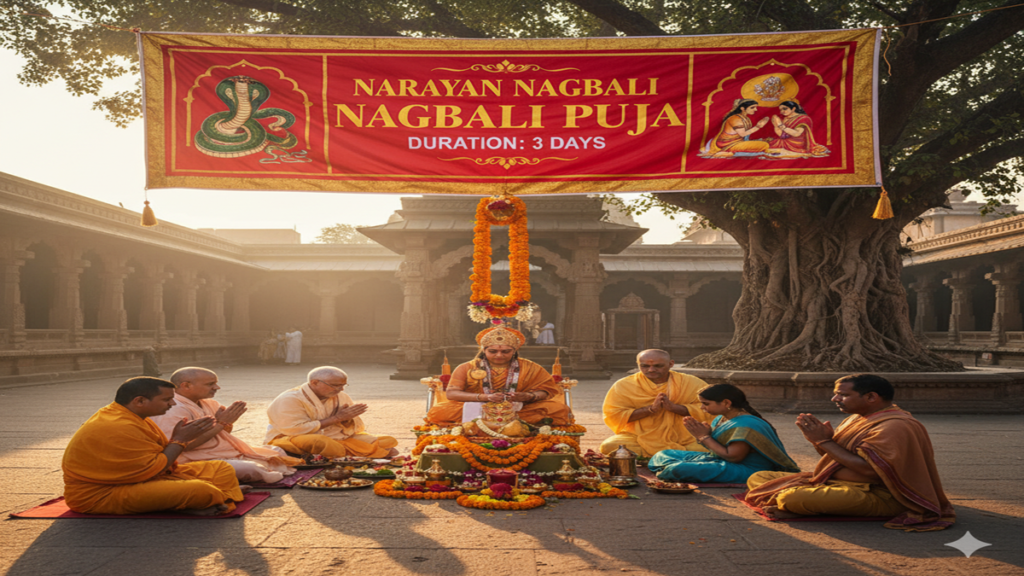
The Sacred Detox: A Complete Guide to Narayan Nagbali Puja Duration and its Profound Journey
Narayan Nagbali Puja Duration How Many Days In the vast and intricate tapestry of Hindu rituals, few ceremonies are as enigmatic, intense, and spiritually profound as the Narayan Nagbali Puja. Primarily performed in the holy town of Trimbakeshwar, near Nashik, Maharashtra, this puja is not a routine prayer for prosperity or health. It is a deep, karmic surgery—a spiritual remedy for afflictions believed to stem from unresolved ancestral curses (Pitru Dosha), sins of past lives (Mahadosha), and the unfulfilled desires of departed souls, including those who died an untimely or unnatural death (Akala Mrityu).
A central question for any devotee considering this sacred undertaking is: How long does it take? The answer is not a simple number of hours. The Narayan Nagbali Puja is a meticulously structured spiritual journey, with its duration spanning from core rituals to essential preparatory and concluding phases. At its heart, the core ritualistic performance typically lasts for 3 days. However, to understand the true commitment, one must view it as a holistic process of 5 to 7 days, encompassing pre-puja vows, the main ceremony, and a crucial period of post-puja observance.
This article delves into the significance, the daily breakdown, and the factors that influence the timeline of this powerful sacrament.
Understanding the “Why”: The Purpose Dictates the Process
Before dissecting the schedule, comprehending the puja’s dual purpose is crucial:
- Nagbali: To pacify and offer a symbolic sacrifice (bali) to the serpent gods (Nagas) for sins like killing a snake, and to appease ancestral spirits trapped in a liminal state due to unfulfilled desires or unnatural death.
- Narayan Bali: To propitiate Lord Vishnu (Narayan) and perform a symbolic rite for the deceased, allowing their restless soul to find peace and continue its cosmic journey.
The puja is a complex Vedic procedure involving homas (fire sacrifices), mantra chanting, and the creation of symbolic offerings (wheat-flour effigies) that represent the unresolved karmic burdens. The duration is designed to systematically untangle these deep-seated issues, requiring sustained focus, energy, and devotion.
The Standard Timeline: A Day-by-Day Breakdown of the 3-Day Core Ritual
The core ceremony, conducted under the strict guidance of learned Brahmins (often five in number), follows a rigorous three-day structure.
Day 1: The Foundation – Purification and Invocation (Shuddhi and Aavahan)
- Focus: Preparation of the self and the space. Invoking the divine energies and stating the intention (Sankalpa).
- Key Rituals:
- Ganapati Pujan & Kalash Sthapana: The ceremony begins by removing obstacles, invoking Lord Ganesha, and establishing the holy pot (Kalash), which represents the universe and various deities.
- Pitru Tarpan & Shraddha: Offerings of water and black sesame seeds are made to ancestors, calling upon them and acknowledging their presence.
- Homa (Fire Sacrifice): Initial fire rituals are performed to purify the atmosphere and seek blessings from Agni (the fire god), the witness and carrier of offerings.
- Sankalpa: The devotee formally declares their name, gotra (lineage), and the specific reason for performing the puja, setting a clear intention for the following days.
- Duration: This is a full-day engagement, often starting early in the morning and concluding by late afternoon or evening. It sets the sacred stage for the intense work to follow.
Day 2: The Culmination – The Symbolic Sacrifice (Bali Daan)
- Focus: The most critical and intense day. Performing the symbolic bali (offering).
- Key Rituals:
- Pinda Daan: Offering of rice balls to the ancestors, a central act in Hindu ancestor worship.
- Creation of Effigies: The priests craft three human-like effigies (Pindas) from wheat flour. These symbolically represent the seeker, the unresolved ancestral spirit, and the “sin” or karmic debt.
- Nagbali Homa: Intense fire offerings are made to appease the serpent deities.
- Narayan Bali: The climactic ritual where the effigies are offered to Lord Vishnu in a precise ceremony. This act symbolically releases the soul and absolves the karmic burden. It is often performed at a Bali Peeth (a designated sacrificial spot).
- Duration: This is the longest and most demanding day. Rituals can commence at dawn and extend well into the night, requiring immense mental and physical stamina from the performer.
Day 3: The Conclusion – Release and Peace (Visarjan and Shanti)
- Focus: Completing the offerings, releasing the invoked energies, and seeking final blessings for peace (Shanti).
- Key Rituals:
- Purnahuti: The final, comprehensive offering into the sacred fire, marking the completion of all homas.
- Kalash Visarjan: The holy water from the Kalash is poured onto a sacred tree or plant, and the pot is respectfully retired, symbolizing the dissolution of the temporary ritual universe.
- Udaka Shanti: A peace-offering ritual with water, praying for harmony and the end of all afflictions.
- Brahma Bhojan: Feeding Brahmins and the poor as a act of charity and gratitude, sealing the positive merits of the puja.
- Duration: The rituals on the final day are shorter but equally significant, typically concluding by midday. They provide closure and transition the devotee back into daily life.
The Holistic Journey: Pre and Post-Puja Phases (Total: 5-7 Days)
To perform Narayan Nagbali Puja effectively, one must account for the essential framework surrounding the core 3 days.
- Pre-Puja Preparation (1-2 Days):
- Travel & Arrival: Reaching Trimbakeshwar.
- Consultation with Priests: A detailed discussion about the specific problems, family history, and determination of the most auspicious time (Muhurta) to begin.
- Vrat (Vow) Initiation: The devotee often begins a strict vow—observing celibacy, adhering to a simple vegetarian diet (often without onion and garlic), sleeping on the floor, and maintaining intense mauna (silence) or limited speech. This mental and physical detoxification is crucial for building the necessary spiritual receptivity. This vow starts one day before Day 1.
- Post-Puja Observance (1-2 Days):
- The Vrat does not end immediately after Day 3. It is traditionally continued for one more full day and night.
- This period allows the powerful spiritual energies invoked during the puja to settle within the individual. It is a time for quiet reflection, assimilation, and maintaining purity.
- Only after this, on the following morning, is the vow formally concluded, often with a simple ritual and the first shave/haircut (Mundan) if part of the practice.
Thus, the complete spiritual journey involves:
Factors That Can Influence the Duration
While the 3-day core is standard, several factors can affect the overall timeline:
- The ceremony might need to be scheduled weeks or months in advance, and their availability can sometimes slightly compress or adjust the daily start/end times.
- Complexity of the Individual’s Case: Some specific or severe ancestral issues might require additional, smaller rituals (shanti) before or after the main puja, extending the stay.
- Devotee’s Pace and Health: The physical and mental endurance of the performer is considered. While the structure is fixed, brief breaks are accommodated.
- Auspicious Timing (Muhurta): The start time on Day 1 is chosen based on the Panchang (Hindu calendar). This could mean an early morning or a late-night start, affecting the perceived flow of the “day.”
The Significance of the Duration: Why It Cannot Be Rushed
The prescribed duration is not arbitrary. It is a carefully designed psychological and spiritual arc:
- Detoxification: The pre-puja vow breaks normal routines, forcing introspection and purification.
- Progressive Intensity: The three-day ritual builds from invocation to climactic release to peaceful conclusion, allowing the mind to gradually engage with and then release deep-seated burdens.
- Energetic Saturation: Sustained chanting, homa, and meditation over multiple days create a powerful spiritual field, believed to facilitate genuine karmic correction.
- Assimilation: The post-puja observance is as critical as the ritual itself, allowing the transformation to integrate.
Conclusion: A Transformational Investment of Time
The Narayan Nagbali Puja is a profound spiritual undertaking. Its duration of 3 days for the core ritual, embedded within a 5 to 7-day holistic process, reflects the depth of the karmic issues it seeks to address. It is not a quick fix but a sacred, immersive journey of repentance, resolution, and release. For the devotee, this investment of time is ultimately an investment in liberation—freeing oneself and one’s ancestors from cycles of suffering, thereby paving the way for peace, progress, and spiritual evolution. Anyone considering this puja must approach it with this understanding, ready to dedicate not just days, but their entire being to the process.
Frequently Asked Questions (FAQ)
Q1: Can the entire Narayan Nagbali Puja be completed in a single day?
A: No, it is traditionally and scripturally mandated as a minimum three-day ritual. The process of purification, symbolic sacrifice, and closure cannot be condensed without losing its efficacy and violating Vedic procedures. Any claim of a one-day ceremony is not the authentic Narayan Nagbali.
Q2: Is the puja performed only at Trimbakeshwar? Why?
A: While it can be performed in other sacred places (like Varanasi or Rameshwaram), Trimbakeshwar is considered the most potent and sought-after location. This is because it is one of the 12 Jyotirlingas and is uniquely associated with Lord Shiva, who is the liberator (Kaal Bhairav) and overseer of such rituals for souls caught between worlds. The temple has specialized priests trained in this complex rite.
Q3: What are the essential rules (Vrat) to follow during the puja days?
A: The strict vow includes: strict celibacy; a sattvic diet (vegetarian, often without onion/garlic); abstinence from alcohol and tobacco; sleeping on a simple mat on the floor; maintaining silence or minimal speech; and avoiding contact with strangers or impure environments. These rules maximize spiritual focus and purity.
Q4: Can women perform Narayan Nagbali Puja?
A: Yes, women can and do perform this puja, often for the peace of their parental ancestors or for their own karmic issues. The rules and duration are the same. However, it is not performed during menstruation, so women must plan their dates accordingly in consultation with the priests.
Q5: What happens after the puja? How soon can one see results or return to normal life?
A: Spiritual “results” are not always immediately tangible. Devotees often report a profound sense of peace, relief, and the gradual lifting of persistent obstacles. The post-puja observance (continuing the vow for a day) is crucial for stabilization. One can return to normal routines after concluding the vow, but it is advised to maintain a sattvic lifestyle for at least a week and to consciously observe positive changes in one’s life and mental state in the following months.