


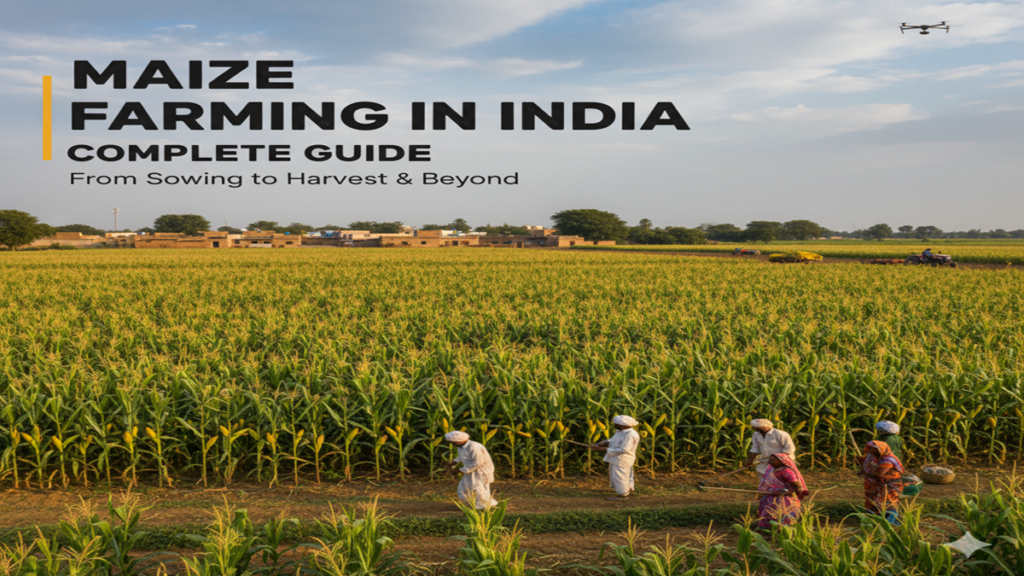
Maize Farming Guide 2026: मका लागवड करून मिळवा बंपर नफा; जाणून घ्या पेरणी ते काढणीपर्यंतची संपूर्ण माहिती
भारत हा कृषीप्रधान देश असून, येथे कापूस आणि सोयाबीननंतर मका (Maize) हे सर्वात जास्त घेतले जाणारे पीक आहे. मक्याचा वापर केवळ मानवी अन्नासाठीच नाही, तर पशुखाद्य (Poultry Feed) आणि औद्योगिक उत्पादनांसाठी (Industrial Use) मोठ्या प्रमाणात केला जातो. यामुळेच मका शेती हा शेतकऱ्यांसाठी एक फायदेशीर व्यवसाय ठरत आहे.
या लेखात आपण Maize Farming संदर्भात जमीन निवडीपासून ते खत व्यवस्थापनापर्यंतची सर्व माहिती पाहणार आहोत.
१. मका पिकासाठी हवामान आणि जमीन
मका हे पीक खरीप, रब्बी आणि उन्हाळी अशा तिन्ही हंगामात घेतले जाते.
- हवामान: मक्याला २५°C ते ३०°C तापमान पोषक ठरते.
- जमीन: मध्यम ते भारी, पाण्याचा उत्तम निचरा होणारी जमीन निवडावी. जमिनीचा सामू (pH) ६.५ ते ७.५ च्या दरम्यान असावा.
२. सुधारित वाणांची निवड (Improved Varieties)
जास्त उत्पादनासाठी हायब्रीड किंवा सुधारित वाणांची निवड करणे गरजेचे आहे. बाजारपेठेत सध्या Pioneer, Monsanto (Bayer), Syngenta आणि Kavery या कंपन्यांचे वाण लोकप्रिय आहेत. तुमच्या भागातील जमिनीनुसार कृषी सेवा केंद्राचा सल्ला घेऊन बियाणे निवडावे.
३. पेरणीची पद्धत आणि अंतर
पेरणीपूर्वी बियाण्याला बुरशीनाशकाची बीजप्रक्रिया नक्की करावी.
- वेळ: खरीप हंगामात जून-जुलै आणि रब्बीसाठी ऑक्टोबर-नोव्हेंबर ही योग्य वेळ आहे.
- अंतर: दोन ओळींतील अंतर ६० ते ७५ सेमी आणि दोन रोपांतील अंतर २० ते २५ सेमी ठेवावे.
४. खत व्यवस्थापन (Fertilizer Management)
मका हे पीक जमिनीतील अन्नद्रव्ये मोठ्या प्रमाणात शोषून घेते. त्यामुळे खतांचे नियोजन महत्त्वाचे आहे:
- पायाभूत डोस: पेरणीच्या वेळी नत्र, स्फुरद आणि पालाश यांचा संतुलित डोस द्यावा.
- दुसरा डोस: पेरणीनंतर ३० ते ४५ दिवसांनी (गुडघा उंचीवर असताना) युरियाचा हप्ता द्यावा.
५. लष्करी अळी (Fall Armyworm) नियंत्रण
मका उत्पादकांसमोर सर्वात मोठे आव्हान म्हणजे ‘लष्करी अळी’. हिचे नियंत्रण करण्यासाठी:
- कामगंध सापळे (Pheromone Traps) लावावेत.
- निंबोळी अर्काची फवारणी करावी.
- प्रादुर्भाव जास्त असल्यास तज्ज्ञांच्या सल्ल्याने इमामेक्टिन बेंझोएट (Emamectin Benzoate) सारख्या कीटकनाशकांचा वापर करावा.
६. सिंचन आणि काढणी
मक्याला पिठाच्या अवस्थेत आणि दाणे भरताना पाण्याची अत्यंत गरज असते. दाण्यांमधील ओलावा २०-२५% पर्यंत कमी झाला की मका काढणीला तयार झाला असे समजावे.
मका शेतीतील अर्थकारण (Quick Summary Table)
| घटक | अंदाजे माहिती |
| कालावधी | ११० ते १२० दिवस |
| बियाणे दर | ७ ते ८ किलो प्रति एकर |
| अपेक्षित उत्पादन | २५ ते ३५ क्विंटल प्रति एकर |
| प्रमुख उपयोग | पशुखाद्य, स्टार्च, इथेनॉल, मानवी आहार |
निष्कर्ष (Conclusion)
Maize Farming हे कमी कष्टात आणि योग्य नियोजनातून जास्त नफा मिळवून देणारे पीक आहे. जर तुम्ही योग्य वेळी पेरणी, खत व्यवस्थापन आणि अळी नियंत्रण केले, तर मका तुम्हाला आर्थिक स्थैर्य मिळवून देऊ शकतो.
The Complete Guide to Maize Farming in India: Cultivating India’s Golden Crop
Introduction
Maize Farming In India Complete Guide Maize, known as “corn” in many parts of the world and “makka” or “bhutta” in India, stands as one of the most versatile and important cereal crops in the country. As the third most cultivated food crop in India after rice and wheat, maize occupies a special place in Indian agriculture, contributing approximately 9% to the national food basket. With its remarkable adaptability to diverse agro-climatic conditions, multiple uses ranging from human consumption to industrial applications, and relatively shorter growing period, maize has become an economically viable option for millions of Indian farmers.
India’s tryst with maize dates back centuries, but its cultivation has transformed dramatically in recent decades. From traditional subsistence farming, maize cultivation has evolved into a commercially significant enterprise, driven by increasing demand from the poultry, starch, and food processing industries. This comprehensive guide explores every aspect of maize farming in India, from climate requirements to harvesting techniques, providing farmers with practical knowledge to enhance productivity and profitability.
The Significance of Maize in Indian Agriculture
Maize serves multiple purposes in the Indian context:
- Food Security: Approximately 25% of maize production is consumed directly as food, particularly in traditional dishes across various states.
- Animal Feed: Nearly 60% of India’s maize serves as critical feed for the rapidly growing poultry and livestock industries.
- Industrial Use: Around 15% is utilized by industries producing starch, corn oil, sweeteners, and ethanol.
- Economic Impact: Maize cultivation supports millions of farming families, particularly small and marginal farmers who constitute about 80% of India’s farming community.
India produced approximately 31.65 million tonnes of maize in 2022-23, with major producing states including Karnataka, Maharashtra, Madhya Pradesh, Rajasthan, and Uttar Pradesh. The country ranks among the top ten maize producers globally, though average yields (around 3.0 tonnes/hectare) remain below global averages, indicating significant potential for improvement through better agricultural practices.
Climate and Soil Requirements
Climatic Conditions
Maize is remarkably adaptable but thrives under specific conditions:
- Temperature: Optimal growth occurs between 21-27°C. Germination requires minimum temperatures of 10°C, while temperatures above 35°C during flowering can adversely affect pollination.
- Rainfall: Well-distributed rainfall of 600-800 mm during the growing season is ideal. Maize is sensitive to waterlogging and drought, especially during critical growth stages (germination, flowering, and grain filling).
- Sunlight: Being a C4 plant with high photosynthetic efficiency, maize requires plenty of sunlight throughout its growth cycle.
- Seasonality: In India, maize is cultivated in three distinct seasons:
- Kharif (June-July to September-October): Accounts for about 85% of total production, sown with monsoon onset.
- Rabi (October-November to March-April): Irrigated cultivation, mainly in peninsular India and Bihar.
- Spring (January-February to May-June): Practiced in some parts of North India.
Soil Requirements
- Soil Type: Well-drained, deep, fertile loamy soils with good water-holding capacity are ideal. Maize can also be grown in sandy loam to clay loam soils.
- Soil pH: Optimal range is 5.5 to 7.5. The crop is moderately tolerant to soil acidity but sensitive to salinity.
- Drainage: Excellent drainage is crucial as maize cannot withstand waterlogged conditions beyond 48 hours.
- Soil Preparation: Deep plowing (20-25 cm) with soil turning plough followed by 2-3 harrowing/planking operations creates a fine tilth seedbed. For conservation agriculture, zero or minimum tillage practices are gaining popularity.
Improved Varieties and Hybrids
Selecting appropriate varieties based on season, region, and purpose is critical for success:
Composite Varieties
- Developed by crossing several inbred lines, these varieties can be reused for 3-4 years.
- Examples: Vijay Composite, Amber, Kisan Composite, Jawahar, and Sona.
Hybrid Varieties
- Developed by crossing two genetically distinct inbred lines, offering higher yield but requiring fresh seed each season.
- Public Sector Hybrids: Developed by agricultural universities and ICAR institutes.
- For Kharif: DHM 117, Pusa Hybrid 5, HQPM 1, HM 4, HM 5
- For Rabi: DHM 111, HM 11, HQPM 5
- Private Sector Hybrids: Offered by companies like Pioneer, Monsanto, Syngenta, with traits like herbicide tolerance and insect resistance.
- Popular Varieties: 900M Gold, DKC 9108, Palam Sankar Makka 2, Kaveri 50
Specialty Maize
- Quality Protein Maize (QPM): Contains enhanced lysine and tryptophan (e.g., Shakti, Rattan, Protina).
- Sweet Corn: High sugar content for vegetable use (e.g., Madhuri, Sugar 75, Priya).
- Baby Corn: Harvested young for vegetable markets (e.g., HM 4, G 5414).
- Popcorn: Special varieties for popping (e.g., Amber Pop, VL Popcorn 1).
- Fodder Maize: High biomass varieties for fodder (e.g., African Tall, J 1006).
Genetically Modified (GM) Maize
While not commercially cultivated in India for food purposes due to regulatory restrictions, Bt maize hybrids with lepidopteran pest resistance are under field trials.
Land Preparation and Sowing
Field Preparation
- Initial Plowing: Deep plowing after harvest of the previous crop helps in moisture conservation and weed control.
- Harrowing: 2-3 cross harrowings create a fine tilth.
- Leveling: Proper leveling ensures uniform irrigation.
- Bed Formation: For areas with drainage issues or for precise irrigation, raised bed planting is recommended.
- Conservation Agriculture: Increasingly, zero-tillage or minimum-tillage practices are being adopted to conserve soil moisture and reduce costs.
Sowing Techniques
- Time of Sowing:
- Kharif: With monsoon onset (mid-June to early July)
- Rabi: October to November
- Spring: January to February
- Seed Rate:
- 20-25 kg/ha for composites
- 15-20 kg/ha for hybrids
- 8-10 kg/ha for baby corn
- 40-50 kg/ha for fodder maize
- Seed Treatment: Treat with fungicides like Thiram or Captan @ 2-2.5 g/kg seed to control seed-borne diseases. Biofertilizer treatment with Azospirillum and Phosphobacteria (600 g each/ha) enhances nutrient availability.
- Spacing:
- Normal maize: 60-75 cm between rows, 20-25 cm between plants
- Baby corn: 50-60 cm between rows, 15-20 cm between plants
- Fodder maize: 30 cm between rows, 10 cm between plants
- Sowing Depth: 3-5 cm in normal soils, up to 8 cm in sandy soils.
- Plant Population: Optimal is 60,000-75,000 plants/ha for grain maize, 1,00,000 plants/ha for baby corn.
Nutrient Management
Maize, being a high-yielding crop, has substantial nutrient requirements:
Macronutrients
- Nitrogen (N): 120-180 kg/ha depending on soil fertility and yield target. Apply in splits:
- 50% as basal dose
- 25% at knee-high stage (20-25 days after sowing)
- 25% at tasseling stage (45-50 days after sowing)
- Phosphorus (P₂O₅): 60-80 kg/ha, apply entirely as basal dose.
- Potassium (K₂O): 40-60 kg/ha, apply entirely as basal dose.
Micronutrients
- Zinc: 25 kg zinc sulphate/ha once every 2-3 years or foliar spray of 0.5% ZnSO₄ at knee-high and pre-tasseling stages.
- Boron: 10 kg borax/ha in deficient soils.
- Iron: Foliar spray of 1% FeSO₄ if deficiency symptoms appear.
Organic Nutrition
- Farm Yard Manure: 8-10 tonnes/ha before sowing
- Vermicompost: 2-3 tonnes/ha
- Green manuring with sunnhemp or dhaincha
- Integrated Nutrient Management (INM) combining organic and inorganic sources improves soil health and provides sustained nutrition.
Water Management
Although maize requires less water than rice or sugarcane, timely irrigation is crucial:
Critical Growth Stages for Irrigation
- Germination and seedling establishment (0-20 days)
- Knee-high stage (20-35 days)
- Tasseling and silking (45-55 days)
- Grain filling stage (55-80 days)
Irrigation Scheduling
- Kharif maize: Usually rainfed but may require 1-2 supplemental irrigations during dry spells.
- Rabi/Spring maize: Requires 6-8 irrigations at critical stages.
- Water requirement: 500-800 mm depending on season and climate.
Water-Saving Techniques
- Drip Irrigation: Saves 40-60% water with 20-30% yield increase. Particularly beneficial for hybrid seed production and sweet corn.
- Sprinkler Irrigation: Efficient for light soils and undulating terrain.
- Surge Flood Irrigation: Modified flood irrigation with intermittent water application.
- Rainwater Harvesting: Farm ponds to store rainwater for supplemental irrigation.
- Mulching: Reduces evaporation losses and controls weeds.
Weed Management
Weeds can cause 30-85% yield reduction if not controlled timely:
Cultural Methods
- Timely sowing
- Optimum plant population
- Intercropping with legumes
- Crop rotation
Mechanical Methods
- Hand weeding at 20-25 and 40-45 days after sowing
- Hoeing with blade harrow or wheel hoe
- Use of weeders like dry land weeders or conical weeders
Chemical Methods
- Pre-emergence herbicides: Atrazine 1.0-1.5 kg/ha or Pendimethalin 1.0-1.5 kg/ha immediately after sowing
- Post-emergence herbicides: 2,4-D sodium salt 0.5 kg/ha at 3-4 leaf stage
- Integrated Weed Management (IWM) combining cultural, mechanical, and chemical methods is most effective.
Pest and Disease Management
Major Insect Pests
- Stem Borer: Most destructive pest; causes dead heart in young plants and tunneling in stems.
- Management: Use resistant varieties, release Trichogramma parasitoids, apply Carbofuran 3G granules in leaf whorls, spray Chlorantraniliprole or Emamectin benzoate.
- Fall Armyworm: Invasive pest since 2018 causing severe damage.
- Management: Early sowing, deep plowing, pheromone traps, spray Spinetoram 11.7% SC or Emamectin benzoate 5% SG.
- Shoot Fly: Causes dead hearts in seedlings.
- Management: Sowing in first fortnight of June, seed treatment with Imidacloprid, foliar spray of Dimethoate.
- Pink Stem Borer: Affects Rabi maize in peninsular India.
- Aphids: Vectors for viruses; controlled by Imidacloprid seed treatment.
Major Diseases
- Turcicum Leaf Blight: Causes elongated elliptical spots on leaves.
- Management: Resistant varieties, crop rotation, spray Mancozeb or Propiconazole.
- Maydis Leaf Blight: Oval spots with grey center; severe in warm, humid conditions.
- Management: Resistant hybrids, avoid water stress, spray Carbendazim.
- Banded Leaf and Sheath Blight: Water-soaked lesions on leaf sheaths.
- Management: Avoid dense planting, spray Validamycin or Propiconazole.
- Post-Flowering Stalk Rot: Causes lodging near maturity.
- Management: Balanced nutrition, avoid waterlogging, treat seeds with Trichoderma viride.
- Downy Mildew: Systemic infection causing chlorosis and downy growth.
- Management: Resistant varieties, seed treatment with Metalaxyl, rogue infected plants.
Harvesting and Post-Harvest Management
Harvesting
- Time: Grain maize is harvested when grains develop black layer at base (30-35% moisture). For Kharif, 90-100 days; Rabi, 100-110 days.
- Indicators: Browning of husks, hard grains, moisture content 20-25%.
- Methods: Manual harvesting with sickles or mechanical harvesters for large farms.
- Baby Corn: Harvest 45-50 days after sowing when silks emerge 1-3 cm.
- Sweet Corn: Harvest at milk stage (18-22 days after silking).
- Fodder Maize: Harvest at milky stage for optimal nutrition.
Post-Harvest Handling
- Drying: Dry ears or shelled grains to 12-13% moisture for safe storage.
- Shelling: Manual beating, animal treading, or mechanical shellers.
- Storage: Clean, fumigated storage structures. Treat with Malathion 50 EC @ 10 ml/Quintal.
- Value Addition: Processing into corn flakes, popcorn, corn flour, starch, oil, or ethanol enhances profitability.
Government Schemes and Support
Several government initiatives promote maize cultivation:
- National Food Security Mission (NFSM): Provides assistance for hybrid seeds, micronutrients, plant protection, and resource conservation techniques.
- Pradhan Mantri Krishi Sinchayee Yojana (PMKSY): Subsidy for micro-irrigation systems.
- Rashtriya Krishi Vikas Yojana (RKVY): Support for infrastructure and value addition.
- State Specific Schemes: Many states offer additional subsidies and support programs.
- Minimum Support Price (MSP): Government announces MSP for maize annually (₹2,090/quintal for 2023-24 season).
Future Prospects and Challenges
Opportunities
- Increasing Demand: Growing poultry (8-10% annual growth) and starch industries driving demand.
- Export Potential: India exports maize to Bangladesh, Nepal, Vietnam, and Malaysia.
- Biofortified Varieties: Zinc and iron-enriched varieties addressing malnutrition.
- Climate Resilience: Drought-tolerant and heat-resistant hybrids under development.
- Contract Farming: Tie-ups with processing industries ensuring market and price.
Challenges
- Climate Vulnerability: Erratic rainfall patterns and rising temperatures.
- Post-Harvest Losses: Inadequate storage and processing infrastructure.
- Market Fluctuations: Price volatility affecting farmer incomes.
- Pest Outbreaks: Emerging threats like Fall Armyworm.
- Small Land Holdings: 86% of farmers have less than 2 hectares, limiting mechanization.
Conclusion
Maize farming in India stands at an interesting crossroads, balancing traditional practices with modern agricultural technologies. With its diverse uses, relatively shorter duration, and adaptability to various agro-ecologies, maize offers a viable solution to multiple challenges facing Indian agriculture—from food and nutritional security to farmer income enhancement.
Success in maize cultivation requires an integrated approach combining improved varieties, balanced nutrition, efficient water management, timely plant protection, and proper post-harvest handling. The increasing public and private sector investment in maize research and development, coupled with supportive government policies, creates an enabling environment for maize farmers.
As India moves toward a more diversified and resilient agricultural system, maize is poised to play an increasingly significant role. By adopting recommended practices and staying informed about new developments, Indian farmers can harness the full potential of this golden crop, contributing to both their prosperity and the nation’s agricultural growth.
Frequently Asked Questions (FAQs)
1. What is the best time to sow maize in different parts of India?
The optimal sowing time varies by region and season. For Kharif (monsoon) maize, sowing with monsoon onset in June-July is ideal across most regions. Rabi maize is sown from October-November in peninsular India and Bihar. Spring maize is planted in January-February in northern states. Regional agricultural universities provide specific recommendations based on local climate patterns.
2. How much profit can be expected from one acre of maize cultivation?
Profitability depends on multiple factors including season, variety, management practices, and market prices. Typically, with good management, a farmer can expect 25-35 quintals/acre yield. With production costs of ₹15,000-20,000/acre and market prices of ₹2,000-2,500/quintal, net profits of ₹25,000-40,000/acre are achievable. Baby corn and sweet corn often yield higher returns but require more intensive management and immediate market access.
3. What are the most effective methods to control Fall Armyworm in maize?
Integrated Pest Management (IPM) is most effective against Fall Armyworm: (1) Early sowing to escape peak infestation; (2) Deep summer plowing to expose pupae; (3) Pheromone traps for monitoring (15 traps/ha); (4) Biological control using Trichogramma pretiosum or Telenomus remus egg parasitoids; (5) Chemical sprays of Emamectin benzoate 5% SG or Spinetoram 11.7% SC when infestation exceeds economic threshold (10% plants with live larvae); (6) Intercropping with legumes like soybean or cowpea.
4. Can maize be grown successfully with drip irrigation?
Yes, drip irrigation is highly beneficial for maize cultivation, especially for hybrid seed production, sweet corn, and baby corn. It saves 40-60% water, increases yield by 20-30%, enables precise fertilizer application through fertigation, and reduces weed growth. The system should be designed with laterals spaced according to row spacing (usually 60-75 cm apart) with emitters every 30-40 cm delivering 2-4 liters/hour.
5. What are the emerging market opportunities for maize farmers in India?
Beyond traditional grain markets, emerging opportunities include: (1) Quality Protein Maize (QPM) for nutritional programs; (2) Specialty corn (baby corn, sweet corn, popcorn) for urban markets and export; (3) Starch industry demand for modified starches; (4) Poultry and livestock feed industry expansion; (5) Ethanol production under government blending programs; (6) Export opportunities to neighboring countries; (7) Organic maize for niche markets; (8) Value-added products like corn flakes, corn flour, and corn oil.