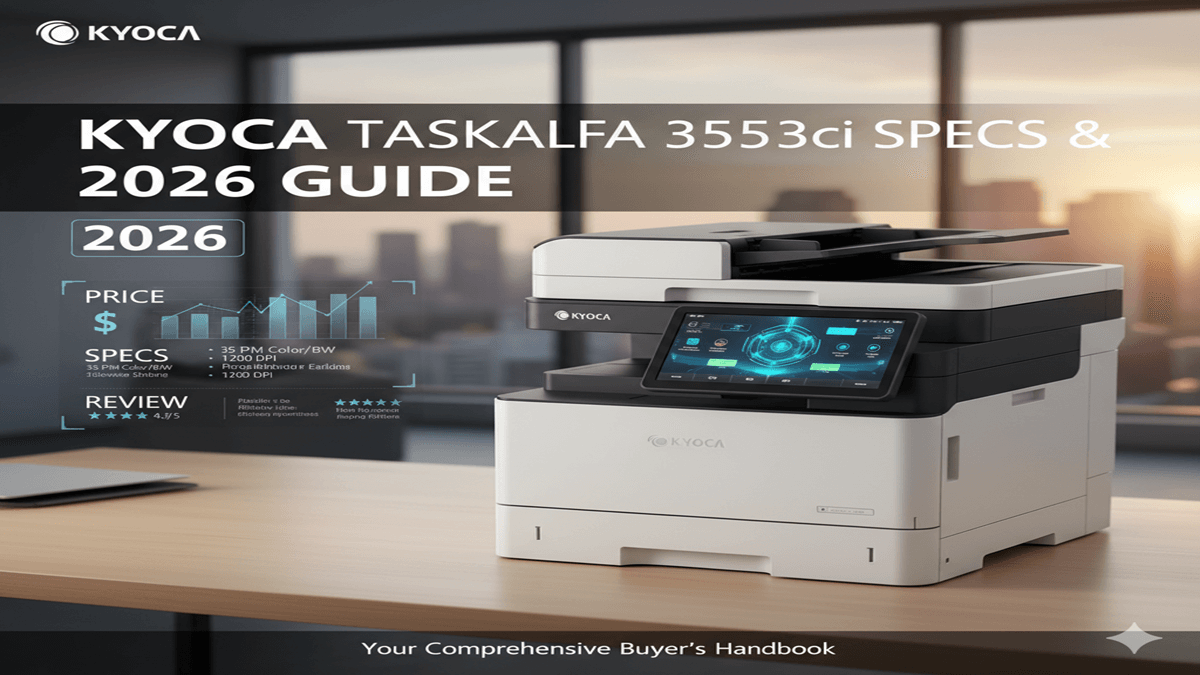
In the ever-evolving landscape of office technology, where the line between printer, productivity hub, and cloud gateway blurs yearly, the Kyocera Taskalfa 3553ci presents a fascinating case study. Launched several years prior, this monochrome multifunction printer (MFP) continues to command significant attention in the commercial market heading into 2026. This comprehensive guide delves deep into its specifications, pricing structures in the current year, and a clear-eyed review of its performance to answer a critical question: Does the Taskalfa 3553ci remain a savvy investment for businesses in 2026, or is it a capable but aging technology being overtaken by smarter, more connected alternatives?
Introduction: The Enduring Appeal of the Workhorse
The Kyocera Taskalfa 3553ci isn’t a flashy newcomer. It’s a machine built for a specific mission: relentless, high-volume document production with uncompromising reliability. In an era obsessed with “smart” features, its core value proposition is operational toughness and lower total cost of ownership (TCO). As we move through 2026, this focus makes it a primary contender for sectors like legal, manufacturing, education, government, and any high-throughput office environment where color is a luxury, not a necessity.
Part 1: In-Depth Specifications & Feature Analysis (2026 Perspective)
The Taskalfa 3553ci is a 35-page-per-minute (ppm) monochrome A3 multifunction printer. Let’s break down its specs, viewing them through a 2026 lens.
Core Print & Copy Engine:
- Print/Copy Speed: 35 ppm (A4), 18 ppm (A3). In 2026, this is solidly mid-range. It’s not the fastest, but for most document-centric workflows, it is more than sufficient.
- Resolution: 1200 x 1200 dpi. High-quality text and fine line output remains a Kyocera strength, ensuring professional-grade documents.
- First Print Out Time: As fast as 5.1 seconds. This latency-busting spec remains a key productivity advantage, minimizing user wait time.
- Duty Cycle: 150,000 pages per month. This is where the “workhorse” label is earned. A staggering monthly capacity that far exceeds its rated speed, built for heavy, sustained use.
Scanning & Digital Workflow (The 2026 Crux):
- Scanner: Standard flatbed and automatic document feeder (ADF) with a 100-sheet capacity. Scans at up to 140 images per minute (ipm).
- Scan-to-Email, Folder, Cloud: This is a critical area for evaluation in 2026. The machine natively supports scan to SMB, FTP, and email. Its cloud connectivity, while functional, may feel dated compared to 2026-native devices. Direct scanning to popular platforms like Google Drive, OneDrive, or Dropbox often requires the optional HyPAS platform.
- HyPAS Ecosystem: Kyocera’s HyPAS is a suite of downloadable applications that add functionality—like advanced document routing, OCR, and workflow solutions. In 2026, investing in a HyPAS-compatible device like the 3553ci and purchasing key apps is almost essential to modernize its workflow capabilities. Think of it as “upgrading” the machine’s intelligence.
Paper Handling & Finishing:
- Standard Paper Capacity: 1,150 sheets (2x 500-sheet drawers + 150-sheet bypass). Expandable up to 3,650 sheets.
- Output & Finishing: This is a major differentiator. The machine supports a wide array of optional finishers that are highly relevant in 2026: saddle stitch booklet makers, 3/4-hole punching, stapling (corner, saddle, multi-position), Z-folding, and even an in-line trimmer for professional booklet creation. For report-heavy or legal offices, this remains a powerful, integrated production line.
Connectivity & Security:
- Standard: Gigabit Ethernet, USB 2.0.
- Security: This is a standout feature even in 2026. Kyocera’s Data Security Controller offers advanced encryption of the hard drive, secure print release (PIN/pull-print), and comprehensive audit logging. In an age of heightened cyber threats to networked devices, its robust security architecture is a significant selling point.
Consumables & Eco-System:
- Engine: Uses Kyocera’s long-life ECOSYS drum and toner system. The drum is separate from the toner, a design that drastically reduces waste and cost-per-page over time. The standard-yield toner yields approximately 20,000 pages, with high-yield options available.
- Toner Yield & Cost: This is the heart of the TCO argument. Kyocera is famous for its low cost-per-page. In 2026, this remains a key financial advantage, especially for high-volume users.
You will not typically find this machine for a simple “sticker price” at a retail store. It is almost exclusively sold through Kyocera authorized dealers and Managed Print Service (MPS) providers.
1. Outright Purchase:
- Estimated Range: $2,500 – $4,500+.
- What it includes: The base MFP unit. All critical accessories—finishers, extra paper trays, the HyPAS controller, and even the fax module—are optional extras that can significantly increase the final price. An outright purchase is rare for this class of device.
2. Managed Print Service (MPS) / Lease Agreement (The Most Common Path in 2026):
This is the dominant and recommended model for acquiring a Taskalfa 3553ci in 2026.
- Structure: A fixed monthly fee covering the device, all maintenance, repairs, and often a predetermined volume of prints (cost-per-page).
- Monthly Cost Estimate: Expect a range of $150 – $400+ per month, heavily dependent on:
- Included Volume: The number of prints covered in the base fee.
- Overage Cost: The agreed cost-per-page for prints beyond the contract volume (typically fractions of a cent).
- Included Options: Whether the lease bundles a finisher, extra trays, or HyPAS solutions.
- 2026 Advantage: MPS perfectly aligns with the device’s workhorse nature. It transforms a large capital expense into a predictable operational one, guarantees uptime, and includes proactive supplies replenishment. It future-proofs your investment against unexpected repair costs.
Key 2026 Pricing Takeaway: Focus on the Total Cost of Ownership (TCO) over 3-5 years, not the initial price. A Kyocera 3553ci on a well-negotiated MPS contract often proves more cost-effective than a cheaper machine with volatile consumable and repair costs.
Part 3: 2026 Review – Strengths, Weaknesses & Verdict
Strengths (Why it Still Wins in 2026):
- Legendary Durability & Uptime: Its 150k monthly duty cycle and robust build quality are unmatched in its class. For environments where printer failure is not an option, it’s a fortress.
- Exceptionally Low Operational Cost: The ECOSYS drum/toner separation technology continues to deliver one of the lowest costs-per-page in the industry, a major financial benefit over time.
- Production-Grade Finishing: The availability of professional in-line finishing (booklet making, folding, trimming) in a device of this speed and price point is a killer feature for specific verticals.
- Outstanding Security: Its embedded security features are enterprise-grade and remain highly relevant, if not more so, in 2026’s threat landscape.
- HyPAS Flexibility: While an add-on, the HyPAS platform allows businesses to tailor the device’s digital workflow to their evolving needs, somewhat extending its technological shelf life.
Weaknesses & Considerations for 2026:
- Aging Core Platform & UX: The user interface, while functional, is not the sleek, tablet-like touchscreen found on newer 2026 models. It can feel slower and less intuitive.
- Cloud-Native? Not Quite. Out of the box, its cloud integration is not as seamless as modern competitors built with a “cloud-first” design. Achieving smooth, one-touch scanning to modern cloud services usually requires the HyPAS add-on, an extra step and cost.
- Monochrome-Only: This is a feature, not a bug, for its target market. However, in 2026, even monochrome-focused offices occasionally need a splash of color. Be prepared to have a separate color device.
- Physical Footprint: It’s a substantial machine. Ensure your office space can accommodate it, especially with added finishers and paper trays.
Target Audience (Who Should Buy in 2026):
- High-Volume Document Producers: Law firms, accounting departments, government offices, universities.
- In-House Print Rooms: Organizations that produce manuals, reports, or booklets in-house.
- Businesses Prioritizing Uptime & TCO: Those who value reliability and predictable printing costs above cutting-edge UI features.
- Security-Conscious Enterprises: Requiring certified, embedded data protection on their networked devices.
Verdict for 2026:
The Kyocera Taskalfa 3553ci is not for everyone. It is a specialist, not a generalist.
For businesses whose lifeblood is the rapid, reliable, and cost-effective production of black-and-white documents—especially those requiring professional finishing—the Taskalfa 3553ci remains an outstanding and strategically sound investment in 2026. Its core strengths (durability, TCO, finishing, security) are timeless and continue to provide immense value.
However, for a modern office that prioritizes a seamless, intuitive user experience, effortless cloud-mobile workflow integration, and all-in-one simplicity, the 3553ci’s age may show. These businesses might be better served by Kyocera’s own newer generation (like the 4-series platform) or competitors’ latest offerings.
Final Recommendation: If your needs align with its core competency, procure it through a Managed Print Service agreement. This mitigates any concerns about aging hardware (maintenance is covered) and allows you to bundle the necessary HyPAS apps to bring its digital functionality up to 2026 standards, resulting in a powerful, cost-controlled document production powerhouse.
Part 4: Frequently Asked Questions (FAQ) – 2026 Edition
Q1: Is the Kyocera Taskalfa 3553ci obsolete in 2026?
A: Not at all. “Obsolete” means no longer functional or supported. The 3553ci is actively sold and supported by Kyocera and its dealer network. Its technology is mature and proven. While its user interface and out-of-the-box cloud connectivity aren’t leading-edge, its core printing engine, durability, and cost-efficiency remain highly competitive and relevant for its target market.
Q2: Can it easily work with modern cloud services like Microsoft 365 or Google Workspace?
A: Yes, but often through an optional step. While it can scan-to-email to any address, native, direct “one-touch” scanning to cloud storage typically requires the installation of a HyPAS application on the device (like “Scan to Cloud”). This is a common and reliable setup but represents an additional configuration and potential cost compared to some newer “cloud-native” printers.
Q3: What’s the real cost of ownership? I keep hearing about low cost-per-page.
A: The real power is in the consumables economics. The drum is a separate, long-life component (often lasting 300k+ pages), while you only replace the toner. This design avoids the waste and expense of “all-in-one” cartridges that throw away a drum each time. On a lease/MPS contract, this translates to a very low cost-per-page (often $0.005 – $0.01), which is the most important number for high-volume users.
Q4: Is it difficult to set up the advanced finishers like the booklet maker?
A: No. The finishers are designed as modular, in-line additions. An authorized technician installs them directly onto the machine, and they are then fully integrated into the printer driver and control panel. Users can select “booklet” or “staple” from their computer or the panel just like any other print feature.
Q5: We are a hybrid office. How well does it support remote or mobile printing?
A: It supports industry-standard mobile print protocols like Kyocera Mobile Print and AirPrint/Google Cloud Print. For secure remote printing, the best practice is to use a secure pull-print solution (like Kyocera’s optional HyPAS Secure Print or a third-party solution). This allows users to send a print job from anywhere to the company network, then release it securely at the 3553ci with a PIN or card tap upon returning to the office, aligning perfectly with 2026 hybrid work models.