


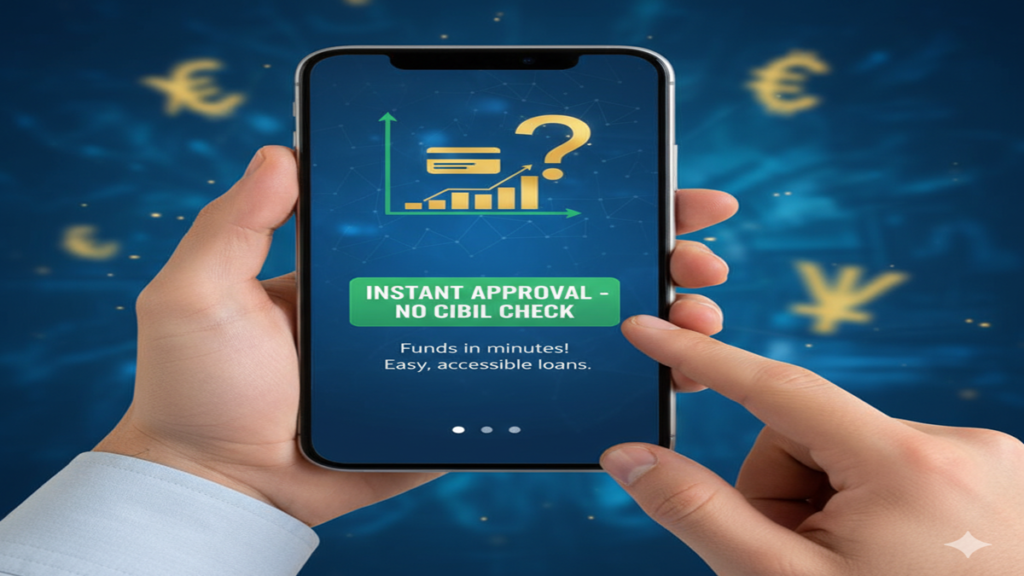
The Ultimate Guide to Instant Loans Without CIBIL Verification: A Lifeline or a Trap?
Instant Loan Without Cibil Verification In the fast-paced financial landscape of India, a sudden medical emergency, a car breakdown, or a time-bound business opportunity waits for no one. For millions, the immediate need for funds collides with a less-than-perfect credit score, often leaving them feeling financially stranded.
This is where the concept of an “Instant Loan Without CIBIL Verification“ emerges, promising a swift financial lifeline, seemingly without the daunting scrutiny of your credit history. But what exactly are these loans? How do they work, and more importantly, are they the solution you need or a debt trap in disguise? This comprehensive guide delves deep into this financial product, separating myth from reality and empowering you to make an informed decision.
Understanding the CIBIL Shadow and the “No Verification” Promise
First, it’s crucial to understand why CIBIL (TransUnion CIBIL) is a cornerstone of traditional lending. Your CIBIL score (ranging from 300 to 900) is a numerical summary of your credit history, gleaned from your past loan repayments, credit card usage, and defaults. A high score (above 750) signals reliability, unlocking lower interest rates and faster approvals. A low or non-existent score (often called a “thin file”) makes banks and major NBFCs wary.
The phrase “Instant Loan Without CIBIL Verification” is a powerful marketing hook. It targets individuals who are:
- New to credit (students, young professionals).
- Those with past financial mistakes leading to a poor score.
- Anyone needing funds faster than traditional verification allows.
In practice, “no CIBIL verification” rarely means the lender operates in a regulatory vacuum. Instead, it signifies a shift in the primary basis of lending. These lenders de-prioritize your historical credit report and prioritize other, often more immediate, data points to assess your repayment capacity and intent.
How Do These Loans Actually Work? The Alternative Underwriting Engine
If not CIBIL, what do lenders check? They employ a multi-pronged, technology-driven approach to alternative underwriting:
- Bank Statement Analysis (The Core): This is the new credit report. Lenders analyze 3-6 months of your bank statements via secure account aggregators. They scrutinize your:
- Income & Regularity: Salary credits for salaried individuals; consistent business revenue for self-employed.
- Cash Flow & Balances: Monthly inflows vs. outflows, and average minimum balance.
- Spending Patterns: Where your money goes, identifying essential vs. discretionary spending.
- Bouncing History: Any returned cheques or failed auto-debits are major red flags.
- Digital Footprint and Psychometric Profiling: Some fintech lenders use advanced algorithms to analyze your digital behavior—your mobile usage patterns, the type of smartphone you use, bill payment history via apps, and even how you fill the loan application. Psychometric tests attempt to gauge your personality traits related to financial responsibility.
- For self-employed, GST returns, ITR filings, and business vintage become key.
- Social & Professional Profile: Your qualifications, professional network on sites like LinkedIn, and sometimes even your social media stability can be factored in as soft indicators.
- Collateral-Lite Models (Secured by Asset): Some “no CIBIL” loans are actually secured against an asset you own, like:
- Gold Loans: The most common. The loan is given against the value of physical or digital gold, making your credit score irrelevant.
- Secured Credit Cards: A fixed deposit acts as collateral, offering a credit limit.
- Loan Against Securities (Shares, Mutual Funds): Your existing investments are pledged.
The Different Avatars of “No CIBIL” Loans
This category isn’t monolithic. It manifests in several forms:
- Fintech Personal Loans: Offered by digital-first NBFCs and lending apps (e.g., EarlySalary, MoneyTap, KreditBee). They heavily rely on bank statement analysis and digital underwriting. Amounts: ₹1,000 to ₹5 lakhs. Tenures: 3 to 36 months.
- Payday/Short-Term Loans: Ultra-short-tenure loans meant to tide you over until your next salary. Extremely high interest rates, often presented as a “fee.” Amounts: Usually under ₹50,000. Tenures: Few days to 3 months.
- Gold Loans: Offered by banks, NBFCs (like Muthoot, Manappuram), and fintechs. Completely score-agnostic. Interest rates are relatively lower.
- Peer-to-Peer (P2P) Lending: Platforms (like Faircent, Lendbox) connect borrowers directly with individual lenders who may have more flexible criteria, though many still check CIBIL.
- Loans from Microfinance Institutions (MFIs): Target low-income groups, often women in joint liability groups. Social collateral replaces credit score.
The Stark Reality: Advantages vs. The Hidden Costs & Risks
Perceived Advantages:
- Accessibility: The primary benefit. They provide access to credit for the credit-invisible or credit-damaged.
- Minimal Documentation: Often just Aadhaar, PAN, and bank statement.
- No Collateral (for unsecured variants): You don’t need to pledge physical assets for fintech personal loans.
The Crucial Caveats & Risks (Read This Carefully):
- Exorbitantly High Interest Rates: This is the biggest trade-off. Without a credit score to mitigate risk, lenders charge a premium. APRs (Annual Percentage Rates) can range from 18% to a staggering 48% or more for unsecured variants. A ₹50,000 loan at 36% APR for 12 months can cost over ₹9,000 in interest.
- Smaller Loan Amounts: Don’t expect lakhs. Initial offers are typically small (₹5,000-₹50,000) to limit the lender’s risk.
- Short Repayment Tenures: This increases the monthly EMI burden, straining your cash flow and increasing the risk of default.
- Aggressive Recovery Practices: Some lenders, particularly unregulated apps, may resort to harassment, calling your contacts, and using threatening language for recovery.
- Potential for Debt Traps: The combination of high cost, short tenure, and easy access can lead to a cycle of repeated borrowing (“loan stacking”) to pay off previous debts, sinking you deeper into liability.
- Data Privacy Concerns: You grant extensive permissions for these apps to access your phone, messages, and data. Ensure the lender is reputable and RBI-compliant.
- It Still Affects Your CIBIL: This is a critical myth to bust. While they may not check your CIBIL initially, most RBI-registered lenders will report your repayment behavior to credit bureaus. Timely payments can build your score, but defaults will severely damage it further.
Red Flags: How to Spot Predatory Lenders
Before you download any app or sign any agreement, watch for these warning signs:
- Unrealistic Guarantees: “100% approval” or “No check, guaranteed loan.”
- Upfront Fees: Legitimate lenders deduct fees from the disbursed amount. Any demand for money before disbursal is a SCAM.
- No Physical Address or Customer Support: Only a WhatsApp number or a generic email ID.
- Pressure Tactics: Being forced to decide immediately.
A Responsible Borrower’s Checklist: Before You Apply
- Exhaust All Alternatives: Have you asked family/friends? Can you use a credit card (costs less than these loans)? Can you avail a loan against your existing FD or insurance policy?
- Calculate the True Cost: Use an EMI calculator. Understand the total interest outflow. Can your budget withstand the high EMI?
- Verify the Lender’s Credentials: Check if they are listed on the RBI’s website under “Registered Entities” (NBFCs, Banks). Look for reviews on trusted platforms.
- Read the Fine Print: Understand all charges—processing fee, late payment penalty, GST, prepayment clause.
- Have a Clear Repayment Plan: Only borrow if you have a concrete source of funds for repayment. Do not borrow for discretionary spending.
The Better Path: Building Your CIBIL Score for the Future
Using a no-CIBIL loan should be a tactical, one-time move, not a habit. The long-term goal must be to build a healthy credit score:
- Use This Loan as a Tool: If you take one, ensure every EMI is paid on time, without fail. This positive reporting can kickstart or repair your score.
- Get a Secured Credit Card: The most effective tool for credit-newbies. Use it for small expenses and pay the full bill monthly.
- Become an Authorized User: On a family member’s old, well-maintained credit card.
- Mix of Credit: Over time, a healthy mix (card, loan) helps, but don’t take loans just for this.
Conclusion
Instant loans without CIBIL verification are a double-edged sword in India’s financial ecosystem. They democratize access to credit, fulfilling a genuine need for millions excluded by traditional metrics. They can be a legitimate emergency tool, especially in their secured forms like gold loans.
However, they come wrapped in significant risks—primarily crippling interest rates and short tenures that can exacerbate financial distress. They are not free money and are certainly not a substitute for financial planning.
The wise approach is to treat them as a last-resort financial bridge, not a first-choice solution. Use them with extreme caution, absolute clarity on terms, and a rock-solid repayment plan. Simultaneously, use the opportunity they provide to graduate towards a stronger credit profile, ultimately unlocking the vast, cheaper world of formal credit. In finance, the easiest solution today often carries the heaviest cost tomorrow. Choose with your eyes wide open.
Frequently Asked Questions (FAQs)
Q1: Is getting an instant loan without CIBIL check really possible?
Yes, it is possible, but with a key clarification. While many lenders offering these products do not perform a hard inquiry on your CIBIL report as the primary check, they are not lending blindly. They use alternative data (bank statements, employment proof, digital footprint) to assess you. Furthermore, most RBI-registered lenders will eventually report your loan and repayment behavior to CIBIL, affecting your future score.
Q2: What is the typical interest rate on these loans?
Interest rates are significantly higher than traditional bank loans due to the perceived higher risk. For unsecured instant personal loans (fintech apps), the Annual Percentage Rate (APR)—including all fees—can range from 18% to 48% per annum. For secured options like gold loans, rates are lower, typically between 12% to 24% p.a. Always look for the APR, not just the monthly reducing rate.
Q3: Can I get a large amount (like ₹5-10 lakhs) without CIBIL verification?
It is highly unlikely for unsecured loans. Initial disbursals for new customers without credit history are usually small (₹5,000 to ₹1 lakh). Over time, with consistent repayment, limits may increase. For larger amounts, secured loans (like against gold, property, or securities) are your only viable option without a CIBIL check, as the asset acts as collateral.
Q4: Are these “no CIBIL check” lending apps safe and legal?
It depends. Many are operated by RBI-registered NBFCs and are legal. However, the market is also flooded with unregulated, predatory apps. To stay safe:
- Only use apps from the official Google Play/Apple App Store.
- Verify the company’s name on the RBI’s website.
- Never pay upfront fees.
- Read reviews and check for a physical corporate address.
- Be wary of apps asking for excessive permissions (like accessing your gallery or messages unrelated to KYC).
Q5: Will taking this loan help me build a CIBIL score?
Yes, if managed correctly. Since most legitimate lenders report to credit bureaus, this loan becomes a tool to build or rebuild your score. The key is impeccable repayment. Ensure every single EMI is paid on time, in full. This positive payment history will be recorded and will gradually improve your CIBIL score, opening doors to cheaper credit in the future. Conversely, a single default will severely damage your score further.