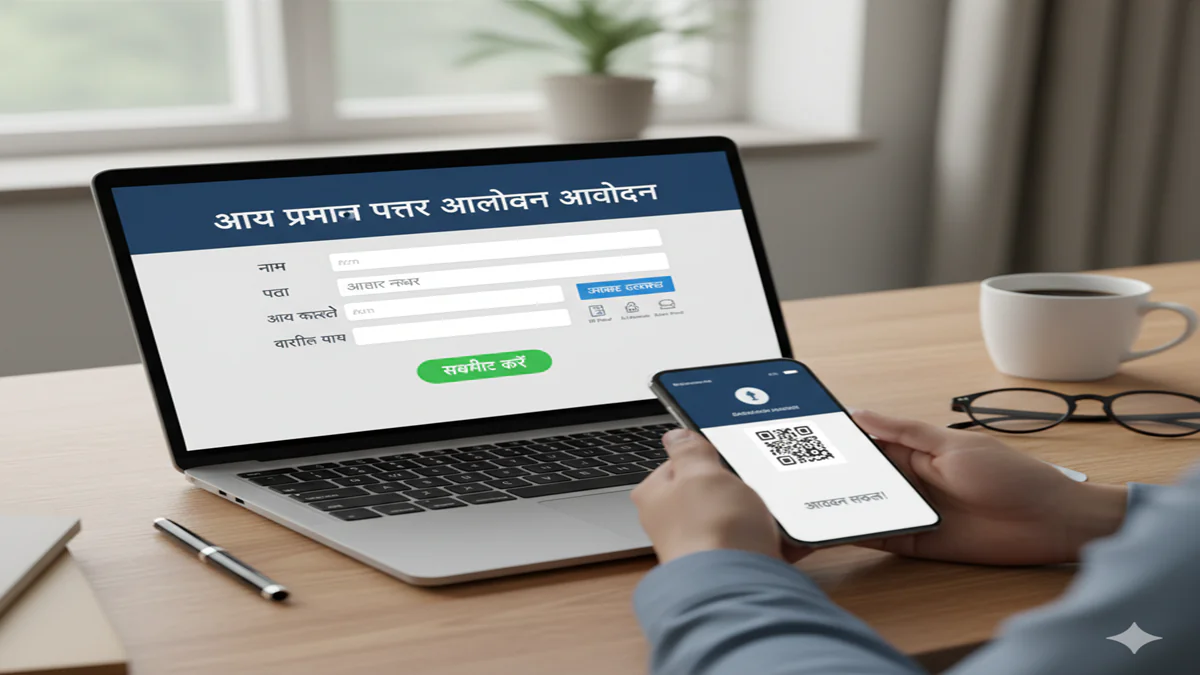
The Complete Guide to Applying for an Income Certificate Online Without Income Proof
Income Certificate Online Apply Without Income Proof In today’s digital-first India, an Income Certificate is more than just a piece of paper; it is a gateway to opportunity. It is the key that unlocks access to government scholarships, subsidized housing, educational fee waivers, healthcare benefits, and myriad welfare schemes. But what happens when you need this crucial document, yet lack the conventional proofs like salary slips or formal income records? This scenario is common among self-employed individuals, daily wage earners, farmers, artists, and those in the vast informal sector.
The good news is that the system acknowledges this reality. It is entirely possible to apply for and obtain an Income Certificate online even without traditional income proof. The process leverages self-declaration and community verification, placing trust in the applicant while ensuring accountability. This guide will walk you through every step, strategy, and legal nuance of navigating this process successfully.
Understanding the Income Certificate: Purpose and Importance
An Income Certificate is an official document issued by the state government (specifically the Revenue Department/Tahsildar’s office) that certifies the annual income of a person or a family from all sources. It typically categorizes holders as Below Poverty Line (BPL), Economically Weaker Sections (EWS), Low-Income Group (LIG), or others.
Key purposes include:
- Education:Availing state and central scholarships (like Post-Matric Scholarship, Pre-Matric Scholarship), fee concessions, and hostel benefits.
- Housing:Eligibility for PM Awas Yojana and other subsidized housing schemes.
- Healthcare:Access to subsidized treatment under various health cards and schemes.
- Civil Benefits:Applying for old-age pensions, widow pensions, and disability benefits.
- Legal & Official Use:For loan applications, court matters, or adoption processes where income verification is required.
The Legal Backbone: Self-Attestation and Affidavits
The cornerstone of applying without documented proof is the concept of aSelf-Declaration or Affidavit. Indian law, through various government circulars and the fundamental right to equality, allows for citizens to self-declare their income, especially when they are not part of the formal tax ecosystem.
- Affidavit:This is a sworn statement on a non-judicial stamp paper of a specified value (often ₹10, ₹50, or ₹100, depending on the state). In this document, you solemnly declare your name, address, family details, and total annual income from all sources. Falsifying an affidavit is a punishable offense under the Indian Penal Code, which adds a layer of deterrence against misuse.
- Self-Declaration Form:Many state portals now provide a dedicated self-declaration form that serves the same purpose, eliminating the need for a physical stamp paper. You simply fill it out, declare the information is true, and submit it digitally.
The authorities accept this declaration in lieu of salary slips or bank statements, but it triggers a more rigorous field verification process.
Step-by-Step Process: Online Application Without Income Proof
While each state’s portal (e.g., MahaOnline for Maharashtra, Seva Sindhu for Karnataka, e-District for Delhi, Punjab, etc.) has its own interface, the core process remains remarkably consistent.
Step 1: Identify the Correct Official Portal
Do not rely on third-party agents. Search for “[Your State Name] e-District portal” or “[Your State Name] Income Certificate Online Apply.” Ensure the URL is a gov.in domain. For example, Tamil Nadu uses www.tnesevai.tn.gov.in, while Uttar Pradesh uses edistrict.up.gov.in.
Step 2: Registration and Login
Create a citizen account on the portal. You will typically need your Aadhaar number, mobile number, and email ID. Verify them via OTP. If you already have an account (sometimes integrated with the state’s single sign-on), simply log in.
Step 3: Locate the Income Certificate Service
Navigate through the “Available Services” or “Apply for Certificate” sections. Find the specific service titled “Income Certificate” or “Apply for Income Certificate.” Read the instructions and eligibility criteria carefully.
Step 4: Filling the Application Form
This is the most critical stage when you lack proof. You will need to provide:
- Personal Details:Applicant name, father’s/mother’s name, date of birth, gender.
- Address Details:Permanent and present address (should match supporting address proof).
- Family Details:Names, ages, and relationship of all family members residing with you. Total family income is often calculated on afamilybasis.
- Income Details:Here, you will enter your declared annual income. Since you are not uploading a salary slip, you will see an option like:
- “Upload Self-Declaration/Affidavit”or
- “No Income Proof Available”– checking this box usually prompts the system to accept an affidavit.
- Source of Income:Even without proof, you can descriptively mention: “Agricultural Labor,” “Small Vegetable Vendor,” “Freelance Work,” “Home-based Crafts,” “Daily Wage Work,” etc. Honesty is crucial.
Step 5: Uploading Supporting Documents
While you may not have income proof, you must submit other KYC documents. These are non-negotiable:
- Identity Proof:Aadhaar Card (mandatory in most cases).
- Address Proof:Aadhaar, Ration Card, Voter ID, or a recent utility bill.
- Self-Declaration Affidavit:This is your key document.
- How to create it:Draft a statement:“I, [Your Name], son/daughter of [Father’s Name], residing at [Full Address], hereby solemnly declare that my total annual income from all sources is approximately ₹[Amount] per annum. My family includes [List Members]. I do not have formal income documentation as I am engaged in [Your Occupation]. I declare this information is true to the best of my knowledge and belief. I understand that any false statement is punishable by law.”
- Get this typed on a non-judicial stamp paper of the required value. Sign it in the presence of a Notary Public or Oath Commissioner who will stamp and sign it.
- Scan this notarized affidavit into a PDF or JPEG file.
- Photograph:A recent passport-sized photo.
- Optional but Helpful:Ration Card (supports family income claim), Bank Passbook (first page, though it shows transactions, not income source).
Step 6: Submission and Payment
Review the application thoroughly. Any discrepancy can lead to rejection. Submit the form. There is usually a nominal application fee (often between ₹20 to ₹100). Pay it online via the portal’s payment gateway (net banking, UPI, debit/credit card).
Step 7: The Crucial Field Verification
The application is forwarded to the concerned Tahsildar/Revenue Inspector office. An officer (often a Patwari or Village Administrative Officer) will be assigned to visit your residential address.
- Be Prepared:The officer will ask questions about your occupation, family, lifestyle, and assets to cross-check your declared income.
- Be Honest and Consistent:Answer precisely as per your affidavit. Neighbors might also be informally consulted. The officer will submit a verification report.
Step 8: Approval and Download
If the verification officer is satisfied, the report is recommended for approval. The Tehsildar or designated authority then approves it. You can log back into the portal, navigate to “Download Certificate” or “Application Status,” and download the digitally signede-Certificate. This is as legally valid as the physical copy. You can print it if needed.
Critical Strategies for Success
- Declare a Realistic, Justifiable Income:Do not under-declare drastically to fall into a BPL category if your lifestyle and assets do not match it. The verification officer is trained to spot inconsistencies. A realistic figure aligned with your stated profession is key.
- Leverage Community Proof:If you are part of a Self-Help Group (SHG), farmers’ cooperative, or trade union, a letter from them (even informal) supporting your income claim can be immensely persuasive during verification.
- Ensure Address Consistency:All your documents (Aadhaar, Voter ID, Affidavit) should point to the same address where verification will happen. Mismatches cause delays and rejection.
- Follow Up Politely:If your application is pending for long after verification, use your ARN to politely inquire at the Tehsil office. A physical follow-up often resolves bottlenecks.
- Understand State-Specific Variations:Some states have simpler processes. Kerala’s
www.esevanam.kerala.gov.inportal is highly streamlined. West Bengal’swww.banglarabhijan.gov.inhas specific columns for different income sources. Always read your state’s instructions.
Potential Challenges and How to Overcome Them
- Verification Officer’s Discretion:This is the biggest variable. Be courteous, cooperative, and transparent. Explain your occupation clearly.
- Application Rejection:If rejected, the portal usually states a reason (“Incorrect details,” “Verification failed”). You can rectify and reapply. There is often an appeal process.
- Technical Glitches:Save your draft frequently. Take screenshots of the final form before submission. Keep proof of payment.
Conclusion: Empowerment Through Digital Governance
The ability to apply for an Income Certificate with a self-declaration is a testament to an inclusive, trusting, and citizen-centric e-governance model. It acknowledges the economic diversity of India and ensures that the benefits of welfare schemes reach those who need them the most, regardless of their documentation status. By understanding the process, preparing a truthful affidavit, and engaging honestly with the verification system, obtaining this vital certificate without conventional income proof is not just a possibility—it is a streamlined, democratic reality.
The digital India mission is bridging the gap between the documented and the undocumented economy, one self-declared certificate at a time.
Frequently Asked Questions (FAQs)
Q1. Is a Self-Declaration Affidavit legally sufficient for an Income Certificate?
A: Yes, absolutely. A notarized self-declaration affidavit on stamp paper is a legally accepted document for income certification when traditional proofs are unavailable. It is a sworn statement, and furnishing false information in it is a punishable offense under Section 177 of the IPC (furnishing false information) and may attract charges of perjury. The authorities design the process around this very provision.
Q2. What happens during the field verification?
A:The field verification is the most important step. An officer from the revenue department will visit your given address. They will ask questions to assess the veracity of your declaration:
- Confirm your occupation and daily/monthly earning patterns.
- Ask about family members, their occupations, and educational status.
- Make a general observation of your household assets (type of house, vehicles, appliances).
- They may casually speak with neighbors to corroborate your stated livelihood.
The key is to be consistent with the information in your affidavit and application form.
Q3. My income is irregular—I’m a daily wage laborer or a freelance worker. What amount should I declare?
A: You should declare a realistic annual average. Calculate your average earnings per day/week, multiply it by the approximate number of days/weeks you work in a year, and arrive at an annual figure. For example, if you earn roughly ₹500 per day and work about 20 days a month, your monthly average is ₹10,000, and your annual income would be declared as approximately ₹1,20,000. It’s acceptable to state a range or an approximate figure in your affidavit.
Q4. Can my application be rejected if I have no income proof? What are the common reasons for rejection?
A: Yes, it can be rejected, but not solely for lacking salary slips. Common reasons include:
- Mismatch in Information:Discrepancy between your affidavit, application form, and statements during verification.
- Unrealistic Income Declaration:Declaring an improbably low income that doesn’t match your household’s observable living conditions.
- Failed Verification:You or your family members were not present at the address during multiple verification attempts.
- Document Issues:Unclear scan of the affidavit, address proof not matching, or incomplete application form.
Q5. How long does the entire process take from application to download?
A: The timeline varies by state and local administration efficiency but typically ranges from 15 to 30 working days.
- Application & Payment:1 day.
- Document Scrutiny & Assignment to Officer:3-7 days.
- Field Verification Scheduling & Execution:7-14 days.
- Report Submission & Final Approval:5-10 days.
You can track the real-time status (e.g., “Under Verification,” “Approved”) using your Application Reference Number on the portal.