


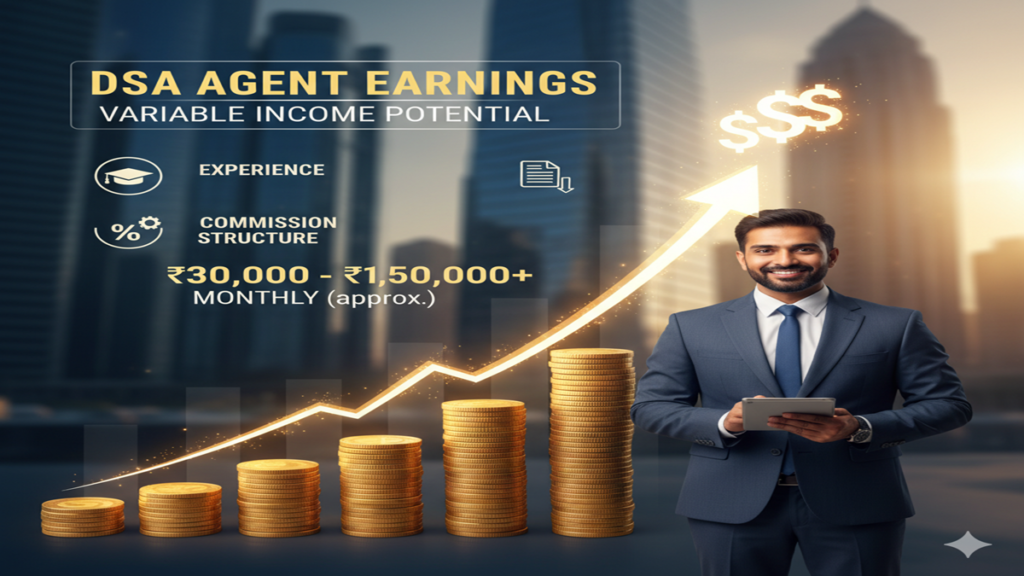
How Much Does A DSA Agent Earn? 2026 में लोन एजेंट (DSA) बनकर कितनी हो सकती है कमाई? जानें कमीशन और मुनाफा!
Introduction:
How Much Does A DSA Agent Earn आज के समय में जब बैंकों और NBFCs के बीच ग्राहकों को लोन देने की होड़ मची है, तब DSA (Direct Selling Agent) की भूमिका बहुत महत्वपूर्ण हो गई है। बहुत से लोग अपनी नौकरी के साथ या फुल-टाइम बिजनेस के रूप में “Loan Agency” शुरू करना चाहते हैं, लेकिन उनके मन में सबसे बड़ा सवाल यही होता है— “How Much Does A DSA Agent Earn?” यानी एक डीएसए एजेंट असल में कितना पैसा कमाता है?
2026 में भारत का क्रेडिट मार्केट तेजी से बढ़ रहा है। चाहे होम लोन हो या बिजनेस लोन, लोग अब बैंक जाने के बजाय किसी एजेंट के जरिए काम करवाना पसंद करते हैं। इस लेख में हम विस्तार से समझेंगे कि अलग-अलग लोन प्रोडक्ट्स पर आपको कितना कमीशन मिलता है और आप महीने के लाखों रुपये कैसे कमा सकते हैं।
1. DSA एजेंट की कमाई कैसे होती है? (Earning Model)
How Much Does A DSA Agent Earn एक DSA एजेंट की कोई फिक्स्ड सैलरी नहीं होती। उनकी पूरी कमाई कमीशन (Payout) पर आधारित होती है। जब आप किसी ग्राहक का लोन आवेदन बैंक में जमा करते हैं और वह लोन ‘Disburse’ (ग्राहक के खाते में पैसा आ जाना) हो जाता है, तब बैंक आपको उस कुल लोन राशि का एक निश्चित प्रतिशत कमीशन के रूप में देता है।
2. प्रोडक्ट-वाइज कमीशन स्ट्रक्चर 2026 (Commission Chart)
How Much Does A DSA Agent Earn बैंक और लोन के प्रकार के आधार पर कमीशन अलग-अलग होता है। यहाँ एक अनुमानित चार्ट दिया गया है:
| लोन का प्रकार (Loan Type) | कमीशन रेंज (Commission %) | ₹10 लाख के लोन पर कमाई |
| पर्सनल लोन (Personal Loan) | 1.0% – 3.0% | ₹10,000 – ₹30,000 |
| बिजनेस लोन (Business Loan) | 1.5% – 3.5% | ₹15,000 – ₹35,000 |
| होम लोन (Home Loan) | 0.25% – 1.0% | ₹2,500 – ₹10,000 |
| कार लोन (Car Loan) | 0.5% – 2.0% | ₹5,000 – ₹20,000 |
| क्रेडिट कार्ड (Credit Card) | ₹500 – ₹3,000 (Per Card) | – |
ध्यान दें: होम लोन में प्रतिशत कम दिख सकता है, लेकिन इसकी लोन राशि (Ticket Size) बहुत बड़ी होती है (जैसे ₹50 लाख या ₹1 करोड़), इसलिए इसमें कुल कमाई ज्यादा होती है।
3. वास्तविक कमाई के उदाहरण (Realistic Monthly Income)
How Much Does A DSA Agent Earn आइए समझते हैं कि एक औसत DSA एजेंट महीने में कितना कमा सकता है:
- Scenario A (शुरुआती एजेंट): यदि आप महीने में केवल 4 पर्सनल लोन (₹5 लाख ईच) क्लोज करते हैं, तो 1.5% के हिसाब से आपकी कमाई ₹30,000 होगी।
- Scenario B (प्रोफेशनल एजेंट): यदि आप महीने में 2 होम लोन (₹50 लाख ईच) और 5 बिजनेस लोन (₹10 लाख ईच) क्लोज करते हैं, तो आपकी कुल कमाई ₹1,50,000 से अधिक हो सकती है।
4. कमाई को प्रभावित करने वाले कारक (Factors Influencing Earnings)
- नेटवर्क (Network): आपके पास जितने ज्यादा लीड्स (Leads) होंगे, उतनी ज्यादा क्लोजिंग होगी।
- लोन का प्रकार: अनसिक्योर्ड लोन (Personal/Business) में ज्यादा कमीशन मिलता है।
- बैंक पार्टनरशिप: कुछ बड़े प्लेटफॉर्म (जैसे Ruloans, Wishfin) सीधे बैंकों से ज्यादा पेआउट दिलाते हैं।
- लोन राशि: बड़े अमाउंट के लोन (LAP या Corporate Loan) आपकी एक महीने की कमाई को ₹5 लाख के पार ले जा सकते हैं।
4. अक्सर पूछे जाने वाले प्रश्न (FAQs)
Q1: क्या DSA बनने के लिए कोई निवेश (Investment) चाहिए?
Ans: अधिकांश बैंक या बड़े एग्रीगेटर्स आपसे कोई पैसा नहीं लेते। यह एक Zero Investment Business है। आपको केवल अपनी मार्केटिंग और आने-जाने पर खर्च करना पड़ सकता है।
Q2: कमीशन कब मिलता है?
Ans: आमतौर पर लोन डिस्पर्स होने के अगले महीने (Billing Cycle) में बैंक आपके खाते में कमीशन ट्रांसफर कर देता है।
Q3: क्या मैं अपनी नौकरी के साथ DSA बन सकता हूँ?
Ans: हाँ, बहुत से लोग इसे पार्ट-टाइम ‘Refer and Earn’ के रूप में करते हैं और अच्छी एक्स्ट्रा इनकम कमाते हैं।
Conclusion: असीमित कमाई का अवसर!
How Much Does A DSA Agent Earn का सटीक उत्तर आपकी मेहनत में छुपा है। एक सक्रिय DSA एजेंट आसानी से महीने के ₹50,000 से ₹2,00,000 तक कमा सकता है। 2026 में डिजिटल टूल्स और ऐप्स की मदद से लीड जेनरेट करना और भी आसान हो गया है। यदि आपके पास अच्छा कम्युनिकेशन स्किल और लोगों की मदद करने का जज्बा है, तो यह फील्ड आपके लिए सोने की खान साबित हो सकती है।
Behind the Glamour: Decoding the Earnings of a DSA Agent in India
How Much Does A DSA Agent Earn The image of a Direct Selling Agent (DSA) is often painted with broad strokes of financial freedom: sleek cars, high-value client meetings, and the promise of uncapped commissions. For many in India, becoming a DSA is an attractive proposition for sideline income or a full-fledged entrepreneurial career, especially in the booming sectors of banking, insurance, and fintech.
But beneath the surface of this alluring narrative lies a more complex reality—one where earnings are a volatile cocktail of effort, skill, market dynamics, and a bit of luck. So, how much does a DSA agent actually earn? The answer is not a simple figure but a spectrum, ranging from a modest side hustle to a lucrative profession.
How Much Does A DSA Agent Earn This article delves deep into the financial anatomy of a DSA’s career, dissecting the factors that influence income, presenting realistic earning brackets, and uncovering the hidden costs and challenges that define this role.
The Role Clarified: What Exactly Does a DSA Do?
How Much Does A DSA Agent Earn A DSA acts as a freelance intermediary or channel partner for financial institutions, primarily banks, Non-Banking Financial Companies (NBFCs), insurance companies, and asset management firms. Their core function is customer acquisition. They are not employees of the company but independent agents who:
- Source and identify potential customers for products like home loans, personal loans, business loans, credit cards, insurance policies, and mutual funds.
- Assist customers with the application process, documentation, and initial verification.
- Act as a liaison between the customer and the institution until the application is submitted for processing.
For this service, they earn a commission, which is the cornerstone of their income.
The Earnings Engine: Understanding Commission Structures
How Much Does A DSA Agent Earn A DSA’s income is purely incentive-based. There is no fixed salary, no provident fund, and no medical benefits unless self-provided. Commissions are typically calculated as a percentage of the product’s value or a fixed payout per transaction. The rates vary dramatically.
1. Loan DSAs (The Most Common):
- Home Loans: Commission ranges from 0.10% to 1%+ of the loan amount. For a ₹50 lakh home loan at 0.5% commission, the payout is ₹25,000. This is often considered the “big ticket” and most sought-after product due to high absolute payout, though the sales cycle is long.
- Personal Loans/Business Loans: Commission is higher, typically between 0.50% to 2%. Since loan amounts are smaller (₹1-10 lakhs on average), the absolute payout is less, but the volume can be higher.
- Credit Cards: Usually a fixed payout per activation, ranging from ₹200 to ₹2,000 per card, depending on the card variant (standard, premium, super-premium). Higher incentives are offered for specific targets.
2. Insurance DSAs (Life & Health):
- Commissions are regulated by IRDAI but can be very lucrative, especially in the first year.
- First-Year Commission: Can be 15-40% of the first-year premium. For a policy with an annual premium of ₹50,000, a 30% commission translates to ₹15,000.
- Renewal Commissions (Trail): Smaller percentages (2-7%) on premiums for subsequent years, providing a valuable passive income stream if the policy is renewed.
3. Mutual Fund DSAs:
- Earn through Initial Trail Commission and Expense Ratio-based trail.
- Initial commission is a one-time payout (1-3% of investment). The trail commission (0.25%-1% annually of the Assets Under Management) is the key to long-term wealth building for successful agents.
The Earnings Spectrum: From Novice to Veteran
How Much Does A DSA Agent Earn Earnings are not uniform. They follow a pyramid, heavily skewed by experience, network, and work ethic.
Bracket 1: The Beginner/Part-Timer (Annual Earnings: ₹0 – ₹3 Lakhs)
- Profile: Individuals testing the waters—students, homemakers, professionals with a day job.
- Activity: Sparse, irregular sourcing; relying on immediate family and friends. May process 1-2 loans or a handful of credit cards per month.
- Income Breakdown: Highly inconsistent. Some months may see zero income. Average monthly earnings might hover between ₹5,000 to ₹25,000. Annual income often supplements primary earnings.
- Challenge: Lack of consistent lead flow and professional approach.
Bracket 2: The Active Full-Time Agent (Annual Earnings: ₹3 Lakhs – ₹12 Lakhs)
- How Much Does A DSA Agent Earn Profile: This is the core of the DSA community. Individuals treating this as a serious profession.
- Activity: Dedicated lead generation through referrals, local networking, social media, and tie-ups with real estate agents, chartered accountants, and car dealerships. Can process 3-5 loans and 10-20 credit cards monthly.
- How Much Does A DSA Agent Earn Income Breakdown: More stability. Monthly income can range from ₹25,000 to ₹1,00,000, depending on product mix and month performance. A good mix of a couple of home loans, several personal loans, and insurance policies can make this bracket achievable.
- Challenge: Managing operational costs, compliance, and competition.
Bracket 3: The Established Agency/Owner (Annual Earnings: ₹12 Lakhs – ₹50 Lakhs+)
- How Much Does A DSA Agent Earn Profile: Successful agents who have scaled into a business. They operate as a DSA firm, employing junior agents or sub-agents.
- How Much Does A DSA Agent Earn Activity: Focus is on business development, managing high-volume channels (bulk from builders, corporate partnerships), and team management. The owner earns overrides on the team’s production in addition to their own.
- Income Breakdown: Income becomes scalable and less volatile. A well-run agency with 5-10 productive agents can generate substantial revenue for the owner. Top performers in metro cities with premium product focus (large home loans, HNI insurance) can earn significantly more.
- How Much Does A DSA Agent Earn Challenge: Business operations, team retention, compliance with partner regulations, and managing larger overheads.
Bracket 4: The Elite Performer/Channel Partner (Annual Earnings: ₹50 Lakhs – Crores)
- How Much Does A DSA Agent Earn Profile: Rare, top 1-2% of the ecosystem. They often have exclusive or premier partnerships with top banks/NBFCs.
- Activity: Operate at a strategic level, handling corporate relationships, managing very high-ticket transactions (luxury home loans, SME lending), and may have multiple offices across a region or state.
- How Much Does A DSA Agent Earn Income Breakdown: Income is business revenue, with significant margins. They have mastered scalability, brand building, and niche dominance.
Key Factors That Make or Break a DSA’s Income
- How Much Does A DSA Agent Earn Product Mix: A DSA dealing only in credit cards will have high volume but lower per-unit payout. One focusing on home loans will have fewer conversions but higher payouts. The most successful agents maintain a balanced portfolio.
- More tie-ups mean more products to offer and better chances of finding the right fit for a customer, leading to higher conversion rates.
- Location & Market: A DSA in Mumbai, Delhi, or Bangalore, with higher average incomes, property prices, and financial awareness, has access to higher-ticket business than one in a tier-3 town. However, competition is also fiercer in metros.
- Network & Referrals: This is the lifeblood. A strong, trusted network of past clients, professionals (CAs, lawyers), and influencers is the most sustainable source of high-quality leads.
- Skill & Knowledge: Understanding credit underwriting, documentation, and compliance is crucial. An agent who can pre-qualify leads, guide clients accurately, and ensure clean applications enjoys higher approval rates and trust from both clients and partner banks.
- Effort & Consistency: This is a sales job. Daily prospecting, follow-ups, and relationship management are non-negotiable for steady income. Inconsistent effort leads directly to inconsistent earnings.
The Hidden Side: Costs, Risks, and Challenges
How Much Does A DSA Agent Earn The “net” earnings picture is incomplete without considering the costs:
- Operational Costs: Travel, fuel, client entertainment, phone bills, internet, and office space (if any). For full-timers, this can be ₹10,000-₹50,000+ per month.
- Technology & Marketing Costs: Investing in a website, CRM software, digital marketing, or lead buying portals to generate inquiries.
- How Much Does A DSA Agent Earn Income Volatility: The biggest risk. There are dry months with no conversions, especially during market downturns or festive seasons when banks tighten lending.
- Clawbacks: If a loan is prepaid or an insurance policy is lapsed within a short period (usually 6-12 months), the bank can “claw back” the commission paid. This directly hits past earnings.
- Zero Job Security/Benefits: No paid leaves, health insurance, or retirement plans. Everything is self-funded.
- Intense Competition: Competition comes from other DSAs, bank employees, and now, digital lending platforms.
The Verdict: Is It a Viable Career?
How Much Does A DSA Agent Earn For the right individual, being a DSA can be immensely rewarding, both financially and in terms of entrepreneurial satisfaction. It offers:
- Uncapped Earning Potential: Your income is directly proportional to your output.
- Flexibility: Be your own boss, set your own hours.
- Low Barrier to Entry: Starting requires minimal formal investment.
However, it demands a specific temperament: high resilience, self-motivation, exceptional people skills, and financial discipline to manage irregular cash flows.
How Much Does A DSA Agent Earn Final Answer to “How Much?”
For a dedicated full-timer with 2-3 years of experience and decent partnerships, an annual income of ₹6-10 lakhs is a realistic and achievable target. Top performers can scale this significantly. For part-timers, think of it as a potential ₹1-3 lakhs per year supplement.
The true earning of a DSA agent isn’t just the commission credited to their account; it’s the sum of their professional grit, the strength of their relationships, and their ability to navigate the intricate world of finance as a trusted advisor. The digits on the paycheck are simply the result.