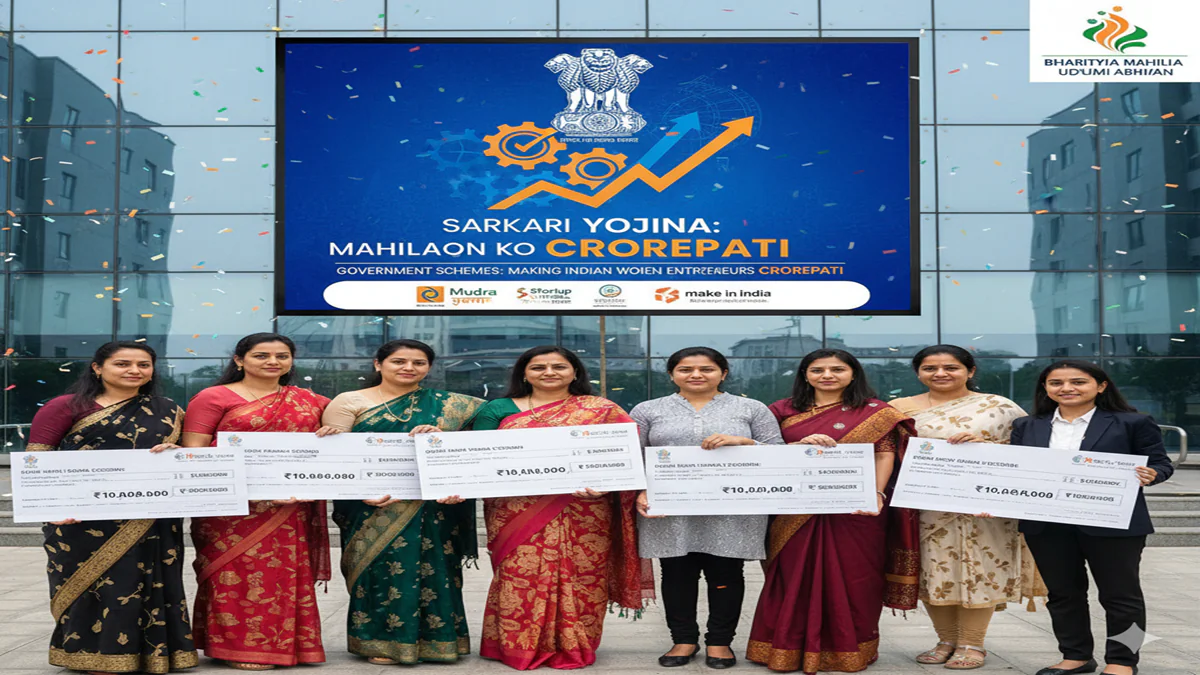
From Kitchen to Boardroom: How Government Schemes Are Crafting India’s New Generation of Women Crorepati Entrepreneurs
Government Schemes Making Indian Women Entrepreneurs Crorepati For decades, the narrative of Indian entrepreneurship was overwhelmingly male. Today, a powerful revolution is quietly rewriting this story. From a humble home kitchen in Coimbatore supplying organic pickles to national chains, to a tech-savvy start-up in Bhubaneswar developing AI solutions for farmers, women are not just participating in the economy—they are leading it, and becoming crorepatis in the process.
This transformation is not accidental. It is being strategically fueled, accelerated, and empowered by a suite of visionary government schemes that are dismantling barriers, providing capital, and building ecosystems where women’s businesses can thrive at scale. This article explores the top government initiatives that are turning ambitious Indian women into successful, self-made crorepati entrepreneurs.
The Landscape: Challenges and the Crorepati Dream
The journey for a woman entrepreneur in India has been historically steep. Beyond the universal challenges of any start-up—access to capital, market linkage, mentorship—women faced the additional burdens of societal expectations, restrictive mobility, and a deep-seated gender bias in the financial system. The “crorepati” (one who possesses assets worth ten million rupees or more) ambition seemed distant, reserved for inheritors of family businesses or a rare, celebrated exception.
Recognizing this immense untapped potential, the Indian government, across various ministries, has launched schemes that act as a comprehensive support system. These programs understand that creating a crorepati entrepreneur requires more than just a loan; it requires a holistic ecosystem that addresses training, technology, market access, and confidence-building.
The Game-Changing Schemes: A Blueprint for Success
Here are the flagship schemes that are directly contributing to the creation of women crorepatis:
1. Pradhan Mantri Mudra Yojana (PMMY): The Foundational Catalyst
Launched in 2015, theMudra Yojanais arguably the most significant catalyst for women’s micro-entrepreneurship in India. It provides loans up to ₹10 lakh to non-corporate, non-farm small/micro enterprises through three categories: Shishu (up to ₹50,000), Kishore (₹50,001 to ₹5 lakh), and Tarun (₹5,00,001 to ₹10 lakh).
- How it Creates Crorepatis:For countless women, the journey begins with aShishuloan. A tailor in Varanasi buys her first advanced sewing machine, a caterer in Pune expands her kitchen capacity. This initial, often collateral-free, credit is the critical first step. As businesses stabilize and grow, women graduate toKishoreandTarunloans, scaling operations, hiring employees, and increasing turnover exponentially.
- The scheme’s success lies in its simplicity and widespread reach through Public Sector Banks, Regional Rural Banks, and Microfinance Institutions. Many women who started with a ₹50,000 loan have, over 5-7 years, built businesses with annual turnovers crossing the crore mark, employing dozens of others.
- Crorepati Case in Point:A group of women in rural Tamil Nadu usedMudraloans to start a sanitary napkin manufacturing unit. From a small production center, they scaled up, branded their products, and secured government supply tenders. Today, their collective enterprise is valued at over ₹15 crore.
2. Stand-Up India: Forging the High-Growth Path
While Mudra supports the base, Stand-Up India (2016) specifically targets the creation of greenfield enterprises in the manufacturing, services, or trading sectors led by women or SC/ST entrepreneurs. It mandates bank branches to provide loans between ₹10 lakh and ₹1 crore for at least one such project.
- How it Creates Crorepatis:This scheme is a direct conduit to the crorepati club. By providing substantial seed capital for larger-scale ventures, it enables women to think bigger from day one. A woman can launch a boutique hotel, a medium-scale food processing plant, an IT services firm, or an eco-tourism venture.
- The loan, coupled with the handholding support from the scheme, helps overcome the biggest hurdle: high initial capital investment. The ₹1 crore loan cap is designed to create entities that have the potential for multi-crore valuations within a few years of operation.
- Crorepati Case in Point:An engineer from Maharashtra utilized a Stand-Up India loan to establish a firm specializing in solar panel installation and maintenance. Securing contracts with municipal corporations and private industries, her company’s revenue crossed ₹5 crore within four years.
Capital alone is not enough. NITI Aayog’s Women Entrepreneurship Platform (WEP) is a game-changing virtual ecosystem that addresses the other critical pillars for success. It provides:
- Communities and Networking:Connecting women with peers and mentors.
- Knowledge Hub:Resources on compliance, marketing, and technology.
- Mentorship:Access to successful entrepreneurs and industry leaders.
- Market Linkage:Opportunities to showcase products to large buyers and government e-Marketplace (GeM).
- Financial Linkage:Direct connections to schemes and investors.
- How it Creates Crorepatis:WEP acts as the force multiplier. A talented artisan with aMudraloan can use WEP to learn digital marketing, connect with an export mentor, and list her products on GeM, transforming her local business into a national or global brand with a crore-plus turnover. It provides the strategic intelligence and network that turns a good business into a great, high-value one.
Schemes like the Mahila Coir Yojana by the Coir Board are excellent examples of targeting specific sectors where women have traditional expertise. It provides training, subsidized equipment, and marketing support to women in the coir industry.
- How it Creates Crorepatis:These schemes help formalize and scale artisanal work. Women coir workers, organized into producer companies or cooperatives, can move from being piece-rate laborers to owners of branded enterprises selling high-value coir products like geo-textiles, mats, and décor to international markets. Similar schemes exist in handicrafts, handlooms (through the Ministry of Textiles), and agriculture, creating crorepatis by adding value, branding, and market access to traditional skills.
The Digital India push and the Government e-Marketplace (GeM) have been silent warriors for women entrepreneurs. Digital literacy and UPI have simplified business operations and financial management. GeM, however, is a revolutionary procurement platform.
- How it Creates Crorepatis:GeM allows women-owned enterprises (registered with the Udyam Shakti portal) to directly sell their goods and services to government departments, PSUs, and large organizations. A woman manufacturing stationery, office furniture, or IT services can secure bulk orders worth lakhs and crores of rupees, ensuring consistent, large-scale demand. This direct access to a massive, credible market is a guaranteed path to scaling turnover and profitability rapidly.
The Crorepati Mindset: How Schemes Enable the Shift
These schemes collectively do more than provide funds; they engineer a fundamental mindset shift:
- From Subsistence to Scale:They encourage women to think beyond supplemental income to sustainable, scalable business models.
- Formalization and Brand Building:Access to formal credit and platforms like GeM pushes businesses to formalize, adopt quality standards, and build brands—key steps to achieving higher valuation.
- Network Capital:Through platforms like WEP, women build networks that lead to partnerships, investments, and new opportunities, a critical component of high-growth entrepreneurship.
- Technology Adoption:Subsidies and training for adopting technology (through schemes like the Credit Linked Capital Subsidy Scheme for technology upgradation) boost productivity and competitiveness.
The Road Ahead: Consolidating the Gains
While the progress is remarkable, the journey is ongoing. The next frontiers include:
- Increasing Awareness:Ensuring every aspiring woman entrepreneur in every district knows about these schemes.
- Streamlining Processes:Further simplifying application and disbursement processes at the bank level to reduce delays.
- Focus on Advanced Skills:Introducing more modules on export procedures, intellectual property rights, and venture capital funding for women ready to go global.
- Building a Robust Investor Connect:Creating more structured platforms to connect scalable women-led start-ups with angel investors and venture capitalists.
Conclusion
The rise of the woman crorepati entrepreneur in India is a testament to a powerful combination: the indomitable spirit of women and a strategic, enabling policy framework. Government schemes are no longer just social welfare tools; they are sophisticated economic instruments crafting a new generation of business leaders. They have moved from empowering women to participate in the economy to empowering them to lead and dominate segments of it. As these stories multiply, they create powerful role models, inspiring millions more to dream not just of a livelihood, but of legacy-building, wealth-creating enterprises. The narrative has decisively shifted—from the kitchen to the boardroom, and now, to the list of India’s most respected crorepatis.
Frequently Asked Questions (FAQs)
1. I have no business experience or collateral. Which scheme is best for me to start?
The Pradhan Mantri Mudra Yojana (PMMY), specifically the Shishu category (loans up to ₹50,000), is designed for you. It is often collateral-free and offered based on your business idea. Many banks and MFIs offer it with minimal documentation. It’s the perfect first step to validate your idea and start your entrepreneurial journey.
2. My business has an annual turnover of around ₹40 lakh. I need ₹75 lakh to scale up and buy machinery. What are my options?
You are an ideal candidate for the Stand-Up India scheme. It provides loans from ₹10 lakh to ₹1 crore specifically for scaling up or starting a greenfield project in manufacturing, services, or trading. As a woman entrepreneur, you are a priority beneficiary. Approach your bank branch and inquire about their Stand-Up India loan application process.
3. I have a successful homemade food product. How can I move from local sales to supplying to large stores or online platforms?
Firstly, ensure your business is formally registered (Udyam Registration) and has FSSAI license. Then, leverage NITI Aayog’s Women Entrepreneurship Platform (WEP). Use its resources to learn about branding, packaging, and compliance. Crucially, register on the Government e-Marketplace (GeM) to supply to institutions. Additionally, explore market linkage events organized by the Ministry of Food Processing Industries (MoFPI).
4. Are these schemes only for individual businesses, or can a group of women apply?
Many schemes actively support group enterprises. Stand-Up India and Mudra Yojana can be availed by Proprietorships, Partnerships, and LLPs. For informal groups, forming a Self-Help Group (SHG) and then applying for loans under the SHG-Bank Linkage Programme is a highly effective route. Many women crorepati stories begin with collective enterprises.
5. Beyond loans, what kind of non-financial support can I get from the government?
A wealth of non-financial support exists:
- Free Training:Through WEP, MSME-DI offices, and schemes like Mahila Coir Yojana.
- Mentorship:Connect with mentors via WEP or industry associations supported by the government.
- Market Access:Use theGeM portalto get bulk orders. Participate in government-sponsored trade fairs and exhibitions.