


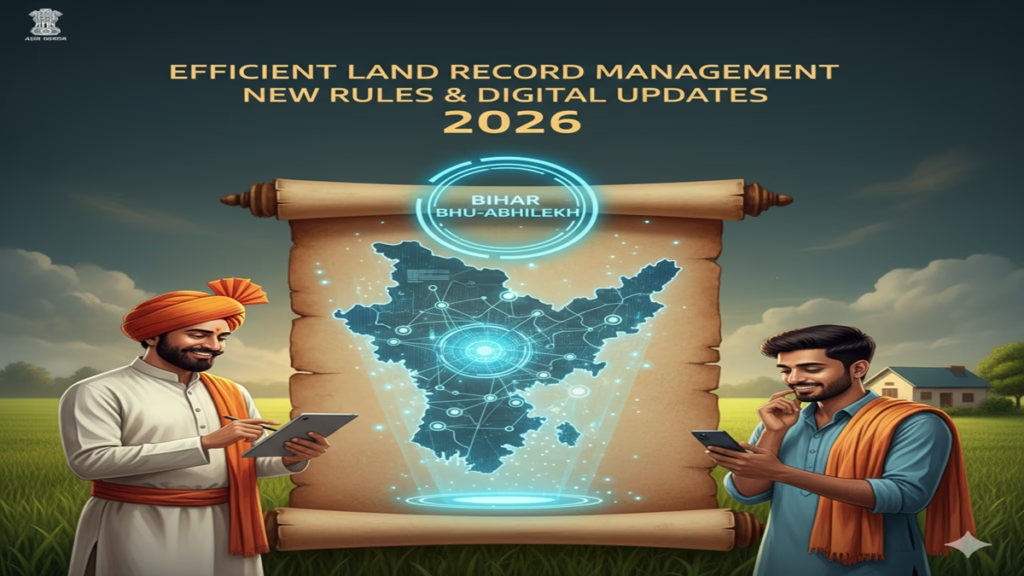
Efficient Land Record Management in Bihar:
New Rules & Digital Updates 2026
Executive Summary
Efficient Land Record Management in Bihar In 2026, Bihar is embarking on a transformative journey to overhaul its centuries-old land record management system. With a legacy of fragmented, dispute-ridden, and often inaccessible land records, the state government is implementing a comprehensive set of new rules and digital initiatives aimed at creating a transparent, efficient, and citizen-centric system. This article explores the sweeping changes under the Bihar Land Records Modernization and Governance Act, 2026, the technological backbone powering this transition, and the profound impact it promises for landowners, farmers, and the state’s economic development.
Part 1: The Imperative for Change – Legacy Challenges
For decades, land record management in Bihar has been synonymous with bureaucratic delays, opaque processes, and rampant litigation. The traditional system, primarily paper-based and housed in district record rooms (arakhas), suffered from several critical flaws:
- The Khatian Conundrum: The core record of rights, the Khatian, was often outdated, handwritten, and vulnerable to damage, forgery, and loss.
- High Litigation Rate: Disputes over ownership, boundaries, and tenancy accounted for nearly two-thirds of all civil cases in the state, stifling development and entrapping assets.
- Inaccessibility for Citizens: Obtaining a simple Record of Rights (RoR) or Nakal required multiple visits to Karmchari and Circle Offices, dealing with intermediaries, and enduring long waits, fostering corruption.
- Stalled Development Projects: Uncertainty over land titles delayed critical infrastructure, industrial, and urban development projects.
The Digital India Land Records Modernization Programme (DILRMP) provided an initial framework, but Bihar’s 2026 overhaul represents a deeper, legally-backed integration and transformation.
Part 2: The New Legal Framework: Bihar Land Records Modernization and Governance Act, 2026
The cornerstone of the reform is the new Act, which moves beyond mere digitization of old records to establishing a “Conclusive Land Titling” system. Key provisions include:
- State Land Titling Authority (SLTA): An autonomous, high-powered authority is established as the ultimate custodian of land titles. It will oversee the systematic titling process, resolve discrepancies during the transition, and maintain the Title Register.
- Conclusive and Indisputable Title: Once a title is granted and the mandated transition period ends, the title becomes conclusive evidence of ownership. This shifts the paradigm from presumptive ownership (based on current records) to conclusive ownership.
- Title Guarantee Fund: The Act establishes a fund to compensate individuals who suffer a proven loss due to an error in the conclusive title register, building trust in the new system.
- Integrated Property Registration: The Act mandates that the Registration Department seamlessly update the Land Titling Register upon registration of any sale deed, eliminating the previous lag and disconnect.
- Dispute Resolution Mechanism: Fast-track Land Tribunals are constituted at the district level to address all title-related disputes arising during the transition period within a strict 6-month timeline.
Part 3: The Digital Ecosystem – *Bhu-Abhilekh 2.0*
The legal framework is powered by a next-generation digital platform, Bhu-Abhilekh 2.0 (bhulekh.bihar.gov.in), which integrates multiple standalone systems into a unified, interoperable ecosystem.
Core Modules of Bhu-Abhilekh 2.0:
- Integrated Land Information System (ILIS): This is the single source of truth, merging data from:
- Survey & Settlement: Digitized Khatians and cadastral maps.
- Registration Department: Sale deeds from 1908 onwards.
- Revenue Department: Mutation records, rent receipts, and court decrees.
- Forest & Water Resources Departments: Layers showing forest land and water bodies.
- Blockchain-Based Title Ledger: Pilot projects in select districts are using distributed ledger technology to create an immutable, tamper-proof history of all transactions for a land parcel, enhancing security and auditability.
- Unique Land Parcel Identification Number (ULPIN) – Bhu-Aadhaar: Every plot is assigned a 14-digit Alpha-Numeric ULPIN based on its geocoordinates. This links the property’s spatial data with its textual records, eliminating ambiguity.
- Aadhaar-Enabled Services: To prevent fraudulent transactions, all dealings related to land (sale, mutation, loan) require Aadhaar-based biometric authentication of the owner(s).
- GIS-Cadastral Map Integration: High-resolution satellite imagery and drones are being used to update century-old cadastral maps. Citizens can view their plots with clear boundaries superimposed on satellite images, reducing boundary disputes.
Part 4: Key Services & Processes for Citizens
The new system simplifies several critical processes:
- Online Application for Mutation (Dakhil-Kharij): Initiated from home via the portal/app. The application triggers automatic notices to concerned parties, and the timeline is reduced from years to a mandated 30 days.
- Instant Access to RoR (Jamin Abhilekh): Digitally signed RoRs can be downloaded instantly, free of cost, in multiple languages (Hindi, English, Urdu).
- Property Certificate (Jamin Ki Nakal): A comprehensive document containing ownership, area, map, encumbrance details, and transaction history is available online for a minimal fee.
- Encumbrance Certificate: Available in real-time, showing all registered transactions on a property.
- Linkage with Court Records: Integration with the e-Courts module allows the SLTA to be notified of any pending litigation on a plot, flagging it in the registry.
Part 5: Expected Impact & Challenges
Positive Impacts:
- Reduced Litigation: Conclusive titling is expected to drastically reduce property disputes, freeing up judicial resources.
- Unlocking Capital: A clear title enables farmers and landowners to use land as collateral, facilitating easier access to formal credit and loans.
- Ease of Doing Business: Faster and transparent land transactions will attract investment for agriculture, industry, and housing.
- Women’s Empowerment: Mandatory inclusion of spouse’s name and explicit consent protocols in joint ownership transactions strengthen women’s property rights.
- Good Governance: Transparency reduces corruption, increases state revenue from stamp duty and registration, and builds public trust.
Persistent Challenges:
- Legacy Data Cleanup: The mammoth task of verifying decades-old records, especially in areas with poor survey quality, remains.
- Community Sensitization: Widespread awareness campaigns are needed, especially in rural areas, to educate citizens about the shift from possession-based to document-based rights.
- Capacity Building: Training for Karmchari, Revenue Officers, and new SLTA staff on the complex new system is critical.
- Cybersecurity: Protecting the centralized digital infrastructure from cyber-attacks is paramount.
Conclusion
Bihar’s 2026 land record reforms represent a bold leap from a colonial-era system of record-keeping to a modern, citizen-centric system of land governance. By combining a robust legal framework (Conclusive Titling) with cutting-edge technology (Blockchain, ULPIN, GIS), the state aims to convert land from a source of conflict into a catalyst for prosperity. While implementation hurdles are significant, the potential rewards—economic growth, social justice, and institutional integrity—are transformative. The success of this initiative could serve as a blueprint for land administration reform across India.
FAQs: Bihar’s New Land Record Rules (2026)
1. What is the biggest change under the new 2026 rules?
The biggest change is the move from a “Presumptive” to a “Conclusive” land title system. Once your land is surveyed and granted a title under the new State Land Titling Authority, it becomes legally indisputable proof of ownership, drastically reducing the risk of future litigation.
2. How do I check my land records online now?
You can visit the official Bhu-Abhilekh 2.0 portal (bhulekh.bihar.gov.in) or use the ‘Bihar Bhu-Abhilekh’ mobile app. You will need details like your District, Village, and Khata/Khewat Number or the new 14-digit ULPIN (Bhu-Aadhaar) number to access and download digitally signed Record of Rights (RoR).
3. Is Aadhaar mandatory for all land-related work?
Yes, under the new rules, Aadhaar-based biometric authentication is mandatory for initiating any major transaction like sale, purchase, mutation, or taking a loan against land. This is to prevent fraudulent transactions and ensure the true owner’s consent.
4. How long will the mutation process take now?
The government has mandated a maximum timeline of 30 days for the mutation (Dakhil-Kharij) process from the date of online application, provided there are no disputes. This is a significant reduction from the earlier process which could take years.
5. What if there is an error in my new conclusive title?
During the initial rollout, there will be a designated “transition period” where claims and objections can be filed. If an error is discovered later, you can approach the Fast-Track Land Tribunal. Furthermore, the Act establishes a Title Guarantee Fund to provide financial compensation for losses arising from a proven error in the conclusive title register.