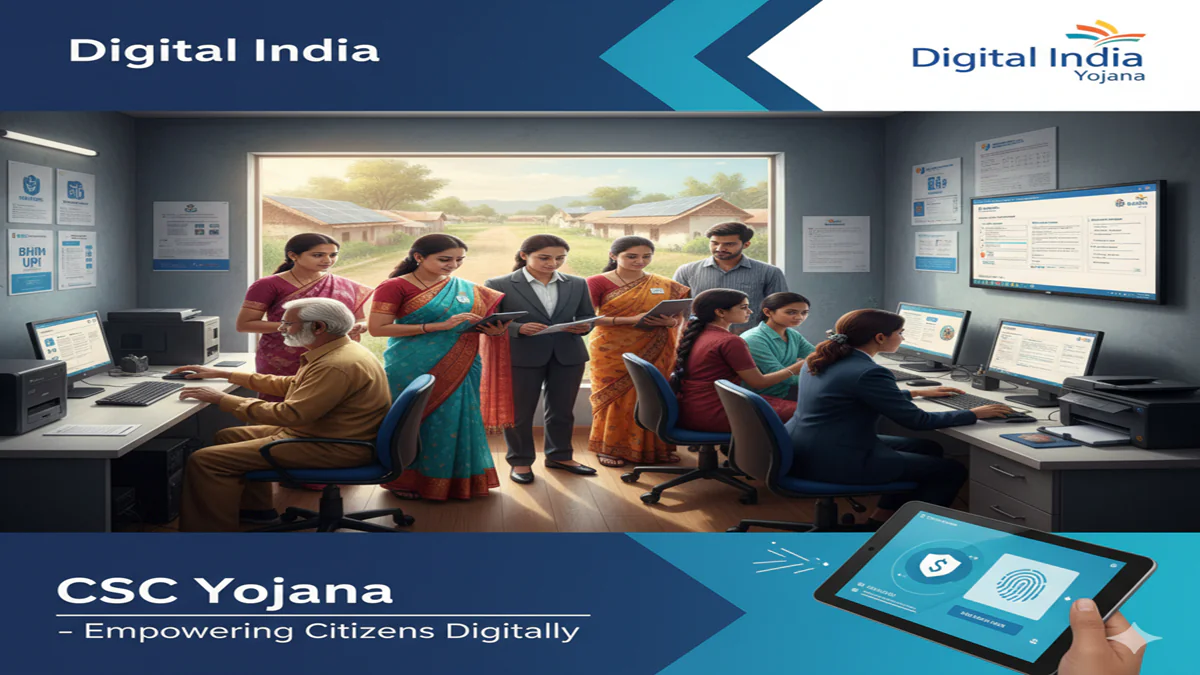
The Digital India CSC Yojana: Bridging the Digital Divide and Empowering Rural India
Introduction: The Vision of a Connected Bharat
Digital India Csc Yojana In the vast and diverse landscape of India, where bustling metropolitan cities coexist with over 600,000 villages, a profound digital divide has long been a barrier to inclusive growth. The dream of a “Digital India” – a nation where government services are accessible electronically, where digital literacy is widespread, and where economic opportunities are not limited by geography – required a radical, ground-up approach. Launched in 2015, the ambitious Digital India campaign had three core vision areas: digital infrastructure as a utility to every citizen, governance and services on demand, and digital empowerment of citizens.
At the heart of making this vision a tangible reality for rural India lies a unique and transformative initiative: the Common Service Centre (CSC) Scheme. More than just a government program, the CSC Yojana has evolved into the world’s largest digital service delivery network, a social enterprise model that is transforming rural livelihoods and democratizing access to the digital economy.
What is the Digital India CSC Yojana?
The Common Service Centre (CSC) scheme is a strategic cornerstone of the Digital India mission. It establishes a pan-India network of grassroots-level access points—the CSCs—to deliver government, financial, social, and private sector services in rural and remote areas. These centres are operated by local entrepreneurs, known as Village Level Entrepreneurs (VLEs), who are trained to become the face of digital India in their communities.
Initially launched in 2006 under the National e-Governance Plan, the scheme was revitalized and massively scaled up under the Digital India umbrella. Its primary objective is to provide a single-window, assisted-service delivery model for a myriad of services, ensuring that the benefits of technology reach the last mile.
Architecture and Governance: A Public-Private Partnership (PPP) Model
The CSC ecosystem is a brilliant example of a multi-layered PPP model:
- CSC e-Governance Services India Limited (CSC SPV):A special purpose vehicle set up by the Ministry of Electronics & Information Technology (MeitY) as the implementing agency. It acts as the nodal body for approving services, training VLEs, and managing the network.
- Service Centre Agency (SCA):At the state level, SCAs are responsible for rolling out and managing CSCs in their respective states/regions. They recruit and support the VLEs.
- Village Level Entrepreneur (VLE):The most critical layer. The VLE is a local individual who invests in and operates the CSC, often from a small kiosk or shop. He/she is the interface between technology and the citizen, providing assisted services with trust and local understanding.
- State and Central Government Departments:They onboard their services onto the CSC network for delivery.
This structure ensures accountability, scalability, and a strong entrepreneurial drive at the grassroots level.
The Expansive Universe of CSC Services: A One-Stop Digital Shop
The true power of the CSC lies in its ever-expanding service portfolio. From a few government-to-citizen (G2C) services, it has grown into a holistic service marketplace:
1. Government to Citizen (G2C) Services:
- Aadhaar Enrollment and Update:CSCs are authorized to enroll for Aadhaar, update details, and print Aadhaar cards.
- PAN Card Application:Facilitating new PAN applications and corrections.
- Pension Services:Assistance for old-age, widow, and disability pensions.
- Schemes and Certificates:Applications for PM-KISAN, PMAY-G, issuance of birth/death certificates, caste certificates, etc.
- Electoral Services:Online voter registration and corrections.
2. Financial Services (Banking Correspondent Model):
- Basic Banking:Cash deposit, withdrawal, balance enquiry, and mini statements.
- Domestic Money Transfers and Remittances.
- Micro-credit and Micro-insurance:Facilitating loans and affordable insurance products (PM Suraksha Bima Yojana, PM Jeevan Jyoti Bima Yojana).
- Atal Pension Yojana (APY) Enrollment.
3. Education and Digital Literacy:
- Pradhan Mantri Gramin Digital Saksharta Abhiyan (PMGDISHA):CSCs are the primary training grounds for this flagship scheme to make 6 crore rural adults digitally literate. The VLEs themselves often serve as trainers.
- Skill Development:Offering courses in areas like IT, retail, and entrepreneurship.
- Academic Services:Admission assistance, online form filling for competitive exams, and provision of e-learning content.
4. Telemedicine and Healthcare:
- CSC Health Services:In partnership with hospitals and doctors, CSCs offer teleconsultations, enabling villagers to consult with specialists in cities via video conferencing.
- Diagnostic Tests:Basic health check-ups like blood sugar, ECG, and pathology sample collection.
- Sale of Generic Medicines:Affordable generic medicines are made available.
5. Agriculture and Allied Services (CSC e-Governance Services):
- Soil Testing:Farmers can get their soil tested and receive recommendations.
- Information on Mandi Prices:Real-time crop prices.
- Application for Agricultural Subsidies and Schemes.
- Sale of Quality Agri-inputs:Seeds, fertilizers, pesticides.
6. Utility and Private Services:
- Bill Payments:Electricity, water, gas, mobile, DTH recharge.
- Travel Services:Booking train, bus, and flight tickets.
- Insurance:Motor, health, and crop insurance.
- Digital Photography and Printing.
- Legal Aid Services.
This “Phygital” (Physical + Digital) model ensures that even citizens with low digital literacy can access complex online services through a trusted, local intermediary.
Impact and Transformation: The Socio-Economic Ripple Effect
The CSC Yojana’s impact extends far beyond service delivery:
- Rural Empowerment and Employment Generation:It has created over 12 lakh direct employment opportunities for VLEs, many of whom are women and youth. A successful VLE becomes a respected knowledge leader in the village.
- Financial Inclusion:By bringing banking to the unbanked, CSCs have been instrumental in advancing the Jan Dhan Yojana, breaking barriers of distance and documentation.
- Digital Inclusion:PMGDISHA, delivered through CSCs, has empowered millions with basic digital skills, fostering confidence to use smartphones and access online information.
- Improved Governance:By digitizing and streamlining service delivery, it has reduced corruption, increased transparency, and cut down on the time and cost of availing services for the rural poor.
- Women Empowerment:A significant number of CSCs are run by women VLEs (Saathis), who not only achieve financial independence but also become change agents, promoting services related to women’s health and welfare.
- Rural Entrepreneurship:The CSC model is a blueprint for a sustainable rural enterprise. VLEs earn a commission on every transaction, incentivizing them to offer more services and grow their business.
Challenges and The Road Ahead
Despite its remarkable success, the CSC ecosystem faces challenges:
- Connectivity Issues:In the remotest areas, poor internet connectivity remains a bottleneck.
- VLE Profitability:Ensuring consistent and adequate income for VLEs, especially in low-population areas, is critical for sustainability.
- Awareness and Trust:In some regions, building complete trust in digital transactions and new services requires continuous effort.
- Service Integration:Streamlining and simplifying the backend integration of various government departments for smoother service delivery.
The future of CSCs is dynamic and promising. The focus is shifting towards:
- CSC 2.0:Transforming CSCs intoDigital Jan Seva Kendras, offering a more comprehensive suite of services.
- Promoting Local E-commerce:Acting as aggregation points for local artisans and farmers to sell products on e-platforms (like CSC Grameen eStore).
- Advanced Tele-law and Tele-medicine:Expanding the reach of legal and healthcare experts.
- Drone Technology:Training VLEs as drone pilots for agricultural spraying, surveying, and mapping.
- Focus on Cyber Security and Data Privacy:As digital penetration deepens, securing citizen data and building cyber awareness will be paramount.
Conclusion: More Than a Kiosk, A Catalyst for Change
The Digital India CSC Yojana is a testament to the power of a well-conceived, entrepreneurial, and citizen-centric approach to digital inclusion. It has successfully moved beyond being a mere IT infrastructure project to become a socio-economic movement. By empowering a local entrepreneur, it has created a self-sustaining ecosystem that delivers dignity, convenience, and opportunity to India’s villages.
The CSC is no longer just a service point; it is the digital nerve center of rural India, a place where a farmer can check crop prices, a student can apply for a university, a senior citizen can access her pension, and a woman can consult a doctor miles away. In bridging the last-mile gap, the CSC Yojana is not just building a Digital India, but an Equitable India, one village at a time.
Frequently Asked Questions (FAQs) about Digital India CSC Yojana
1. Who can become a CSC Village Level Entrepreneur (VLE)? What are the requirements?
Anyone who is a local resident, at least 18 years of age, with a minimum educational qualification of 10th pass (higher for some states), and basic knowledge of computers can apply to become a VLE. The individual must have a minimum space of 100-150 sq. ft. to set up the centre and the ability to invest in basic infrastructure like a computer, printer, webcam, internet connection, and furniture. The selection is done by the authorized Service Centre Agency (SCA) for the region.
2. Is using CSC services free, or are there charges?
Most government-to-citizen (G2C) services have nominal charges prescribed by the government, which are collected by the VLE as a service fee (e.g., a small fee for Aadhaar update or form filling). For private services (like insurance, recharges, travel tickets), the VLE earns a commission from the service provider. The citizen does not pay extra beyond the government fee or the product’s price. All charges are transparently displayed.
3. How does the CSC model ensure security and privacy of citizen data?
CSC SPV has implemented robust data privacy and security measures. VLEs are trained on data ethics and must adhere to a strict code of conduct. Systems are designed to ensure that VLEs cannot store or misuse citizen data. For services like Aadhaar, biometric authentication is done through registered devices, and data is encrypted and sent directly to secure UIDAI servers. Regular audits and penalties for misconduct are in place.
4. What is the difference between a CSC and a Jan Seva Kendra (or other government kiosks)?
While various government departments had their own kiosks, the CSC is a unified, multi-service platform. Think of it as a “single-window” for hundreds of services from different departments (central, state, private), unlike a kiosk that might only offer services of one department. Under the CSC 2.0 vision, all CSCs are being strengthened as Digital Jan Seva Kendras to provide this unified experience.
5. How can I find my nearest CSC and check what services it offers?
You can locate your nearest CSC through:
- The officialCSC Locatoron the CSC website (www.csc.gov.in).
- TheCSC Servicesmobile app.
- By calling the CSC helpline number.
The services offered can vary slightly from centre to centre based on the VLE’s certifications and local demand, but all core G2C services are available at all CSCs. The website and app provide a full national directory of services.