


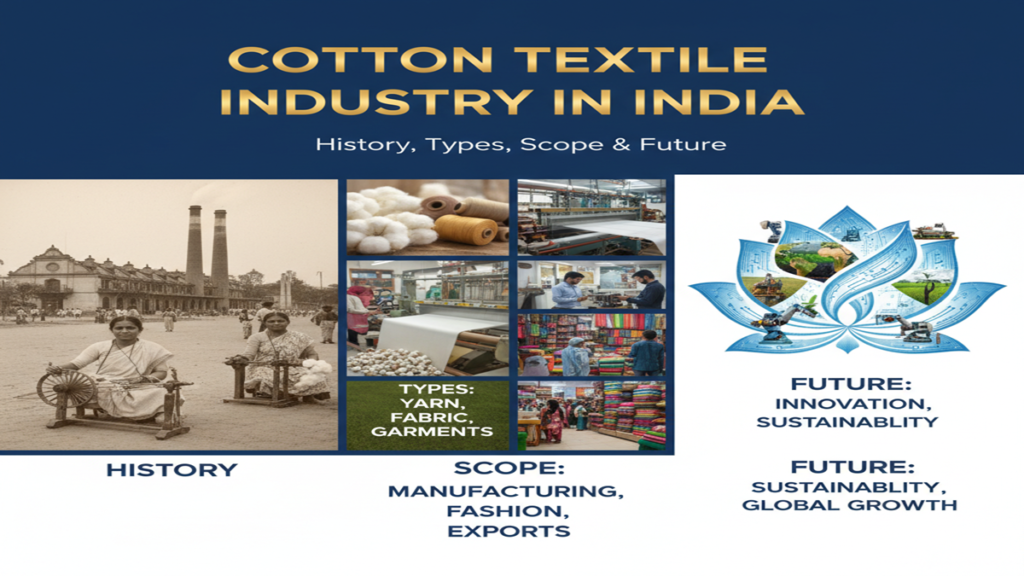
Cotton Textile Industry: भारतीय कापूस कापड उद्योगाचा सुवर्णकाळ! इतिहास, सद्यस्थिती आणि भविष्यातील संधी.
Cotton Textile Industry in India 2026: Introduction:प्राचीन काळापासून भारताचे नाव जगभरात ‘सुती कापडाचा देश’ म्हणून ओळखले जाते. आज Cotton Textile Industry ही केवळ कापड बनवणारी इंडस्ट्री राहिलेली नाही, तर ती कोट्यवधी लोकांना रोजगार देणारी आणि देशाला परकीय चलन मिळवून देणारी एक मोठी शक्ती बनली आहे.
२०२६ मध्ये या उद्योगात अनेक तांत्रिक बदल झाले आहेत. शाश्वत फॅशन (Sustainable Fashion) आणि ऑटोमेशनमुळे या क्षेत्राचे स्वरूप बदलत आहे. आजच्या या लेखात आपण भारतीय कापूस कापड उद्योगाचा इतिहास, त्याची व्याप्ती, आव्हाने आणि २०२६ मधील भविष्यातील संधी यावर सविस्तर चर्चा करणार आहोत.
१. कापूस कापड उद्योगाचा इतिहास (History)
Cotton Textile Industry in India 2026: भारतात पहिली आधुनिक कापड गिरणी १८१८ मध्ये कोलकाता येथे सुरू झाली, परंतु खऱ्या अर्थाने या उद्योगाची भरभराट १८५४ मध्ये मुंबईत ‘बॉम्बे स्पिनिंग अँड विव्हिंग कंपनी’च्या स्थापनेनंतर झाली. मुंबईला ‘कापसाचे मँचेस्टर’ (Manchester of India) म्हटले जायचे. हळूहळू हा उद्योग अहमदाबाद, कोईम्बतूर आणि कानपूर या शहरांमध्ये पसरला.
२. भारतीय अर्थव्यवस्थेत महत्त्व (Importance in Economy)
- रोजगार निर्मिती: शेतीनंतर हा उद्योग भारतात सर्वात जास्त रोजगार देणारा क्षेत्र आहे. थेट आणि अप्रत्यक्षपणे ४ कोटींहून अधिक लोक यावर अवलंबून आहेत.
- जीडीपीमध्ये वाटा: भारताच्या जीडीपीमध्ये या उद्योगाचा वाटा सुमारे २-३% आहे.
- निर्यात (Export): भारताचे सुती कापड, सुत आणि तयार कपडे अमेरिका, युरोप आणि आशियाई देशांमध्ये मोठ्या प्रमाणावर निर्यात केले जातात.
३. कापड निर्मितीची प्रक्रिया (Manufacturing Process)
Cotton Textile Industry in India 2026: कापूस कापड उद्योगाची प्रक्रिया खालील टप्प्यांतून जाते: १. जिनिंग (Gining): कापसापासून सरकी वेगळी करणे. २. स्पिनिंग (Spinning): कापसापासून सूत तयार करणे. ३. विव्हिंग (Weaving): सुतापासून कापड विणणे. ४. प्रोसेसिंग (Dyeing & Printing): कापडाला रंग देणे आणि त्यावर डिझाईन्स बनवणे. ५. गारमेंटिंग: तयार कापडापासून कपडे शिवणे.
४. २०२६ मधील आव्हाने (Challenges)
Cotton Textile Industry in India 2026: एवढी मोठी व्याप्ती असूनही या उद्योगासमोर काही आव्हाने आहेत:
- कच्च्या मालाचे दर: कापसाच्या दरातील चढ-उतार गिरणी मालकांसाठी चिंतेचा विषय ठरतात.
- जुनी मशिनरी: आजही अनेक छोट्या गिरण्या जुन्या तंत्रज्ञानावर चालतात, ज्यामुळे उत्पादकता कमी राहते.
- जागतिक स्पर्धा: बांगलादेश, व्हिएतनाम आणि चीन या देशांकडून भारताला मोठी स्पर्धा मिळत आहे.
- पर्यावरणीय नियम: पाण्याचे प्रदूषण रोखण्यासाठी आता कडक नियम लागू करण्यात आले आहेत.
५. सरकारी योजना आणि सवलती (Government Initiatives)
Cotton Textile Industry in India 2026: भारत सरकारने वस्त्रोद्योगाला चालना देण्यासाठी अनेक पावले उचलली आहेत:
- PM MITRA Scheme: सात मेगा टेक्सटाईल पार्क्सची निर्मिती केली जात आहे.
- PLI Scheme: उत्पादन आधारित प्रोत्साहन योजनेमुळे मोठ्या कंपन्यांना उत्पादनावर बोनस मिळत आहे.
- Amended Technology Upgradation Fund Scheme (ATUFS): मशिनरी आधुनिक करण्यासाठी सरकारकडून आर्थिक मदत दिली जाते.
६. भविष्यातील संधी: २०२६ चा ट्रेंड
Cotton Textile Industry in India 2026: २०२६ मध्ये ‘शाश्वतता’ (Sustainability) हा या उद्योगाचा मुख्य मंत्र आहे. ऑरगॅनिक कॉटन (Organic Cotton) आणि रिसायकल केलेले कापड यांची मागणी वाढत आहे. तसेच ‘स्मार्ट टेक्सटाईल’ सारख्या नवीन संकल्पनांमुळे तांत्रिक वस्त्रांचे (Technical Textiles) उत्पादन वाढत आहे.
Conclusion: कापूस कापड उद्योगाचे भविष्य उज्ज्वल!
Cotton Textile Industry हा भारताचा असा एक उद्योग आहे जो कधीही कालबाह्य होणार नाही. जरी कृत्रिम फायबर (Synthetic Fiber) आले असले, तरी सुती कापडाची जागा कोणीही घेऊ शकत नाही. नवीन तंत्रज्ञानाचा वापर आणि सरकारी योजनांचा लाभ घेतल्यास भारत पुन्हा एकदा ‘वस्त्रोद्योगाचा जागतिक नेता’ बनू शकतो.
The Loom of Life: An In-Depth Exploration of India’s Cotton Textile Industry
A Tapestry Woven Through Time
Cotton Textile Industry in India 2026: The cotton textile industry in India is not merely an economic sector; it is the very fabric of the nation’s identity, history, and socio-economic landscape. From the gossamer-thin Muslin of Bengal, coveted by Roman emperors, to the vibrant, block-printed fabrics of Rajasthan that tell stories of ancient craftsmanship, cotton has been intertwined with Indian civilization for over five millennia. Today, India stands as the world’s largest producer of cotton and the second-largest exporter of textiles and apparel, a testament to an enduring legacy and a dynamic, evolving force. This comprehensive article explores the rich history, diverse types, vast scope, and promising yet challenging future of this cornerstone industry.
I. History: From the Looms of Harappa to Global Dominance
Cotton Textile Industry in India 2026: The story of Indian cotton is a chronicle of innovation, colonial disruption, and resilient resurgence.
1. The Ancient and Pre-Colonial Glory (c. 2500 BCE – 18th Century CE):
- Indus Valley Civilization: Evidence from Mohenjo-Daro and Harappa reveals the use of cotton textiles as early as 2500 BCE, marking some of the world’s first cotton cultivation and weaving.
- The Golden Age of Indian Textiles: For centuries, India was the undisputed global hub for exquisite cotton textiles. Regions specialized in unique fabrics:
- Bengal: Produced the legendary Muslin, called “woven air” for its incredible fineness. Dhaka (in modern Bangladesh) was its epicenter.
- Gujarat: Famous for its Brocades, Bandhani (tie-dye), and trade with the Middle East and Africa via the port of Surat.
- South India: Renowned for its luxurious Cotton Silks and intricate Kalamkari (hand-painted) fabrics.
- Global Demand: Indian cottons were prized from Rome to China. The British East India Company initially came to trade in these textiles, which accounted for a staggering 25% of the world’s textile trade in the 17th-18th centuries.
2. Colonial Disruption and De-Industrialization (18th – Mid-20th Century):
- Systematic Destruction: Following the Battle of Plassey (1757), British colonial policy shifted from trade to conquest. Heavy duties were imposed on Indian textiles in Britain, while raw Indian cotton was forcibly exported to feed the mills of Manchester and Lancashire.
- The Birth of the Modern Mill System: The first successful modern cotton textile mill, The Bombay Spinning and Weaving Company, was established in 1854 in Mumbai by Cowasjee Nanabhoy Davar. This marked the beginning of the organized sector, primarily in western India (Mumbai, Ahmedabad) due to proximity to ports and capital availability.
- Swadeshi Movement: The industry became a symbol of national self-reliance during the Indian independence movement. Mahatma Gandhi’s promotion of the charkha (spinning wheel) and khadi (homespun cloth) was a powerful political and economic tool against British rule.
3. Post-Independence Growth and Policy Evolution (1947 – 1990):
- Key Role in Planning: The industry was a central pillar of India’s initial Five-Year Plans, focusing on import substitution, self-sufficiency, and employment generation.
- The Dominance of the Organized Sector: Mills flourished under a protected economy. However, stringent labor laws and the Textile Policy of 1985 (aimed at modernizing machinery) also led to the infamous “sick mill” phenomenon, where many large mills became unprofitable.
- Rise of the Powerloom Sector: From the 1970s onwards, the decentralized powerloom sector (small-scale units with semi-automatic looms) began to grow exponentially, driven by lower costs, flexibility, and less regulation. It eventually came to dominate cloth production in volume.
4. Liberalization and Global Integration (1991 – Present):
- The 1991 economic reforms dismantled the license raj, attracting foreign investment and technology.
- The National Textile Policy (2000) aimed to make the industry globally competitive, focusing on quality, productivity, and diversification.
- The phasing out of the Multi-Fibre Arrangement (MFA) in 2005 ended export quotas, presenting both a massive opportunity (access to global markets) and a challenge (intense competition from China, Bangladesh, Vietnam).
II. Types and Structure: A Complex Ecosystem
Cotton Textile Industry in India 2026: India’s cotton textile industry is uniquely characterized by its multi-fiber base and a dual structure of organized and decentralized sectors.
1. Based on Fiber:
- 100% Cotton: The core of the industry, used in everything from apparel to home textiles.
- Cotton Blends: Cotton blended with polyester (poly-cotton), rayon, linen, etc., to enhance durability, reduce wrinkling, or lower cost.
2. Based on Sector Structure (The “Layered” Industry):
- Cotton Textile Industry in India 2026: Organized Mill Sector: Comprises large, integrated mills (spinning, weaving, processing under one roof) and spinning mills. They use modern machinery (like ring frames, rotors, and shuttleless looms) and account for the majority of high-quality yarn production and exports.
- Decentralized Sectors: This is the heart of India’s fabric production and employment.
- Powerlooms: Millions of small units, primarily engaged in weaving. They produce over 60% of India’s total cloth and are hubs like Surat, Bhiwandi, and Ichalkaranji.
- Handlooms: The cottage industry, representing India’s cultural heritage. Employing over 4 million weavers, it produces unique, handmade fabrics like Kanjeevaram, Chanderi, Pochampally, etc. Protected under the Handloom (Reservation of Articles for Production) Act, 1985.
- Hosiery and Knitting: Concentrated in clusters like Tiruppur (Tamil Nadu) and Ludhiana (Punjab), famous for knitwear and garment production.
- Garmenting Units: Ranging from large export-oriented units (EOUs) to small subcontracting shops.
3. Key Product Categories:
- Yarn: Both coarse and fine counts, exported globally.
- Fabrics: Woven (denim, shirting, suiting, voile) and knitted (single jersey, interlock).
- Apparel: A vast range from ethnic wear (kurtas, sarees) to western wear (jeans, t-shirts, dresses).
- Home Textiles: One of India’s strongest export segments—bed linens, towels, curtains, etc.
- Technical Textiles: A high-growth sunrise segment (e.g., medical textiles, geotextiles, agrotextiles).
III. Scope and Economic Significance: The Fabric of the Nation
The scope of the Indian cotton textile industry is monumental, touching every aspect of the economy and Cotton Textile Industry in India 2026: society.
1. Economic Pillar:
- Cotton Textile Industry in India 2026: Contribution to Economy: Contributes about 2.3% to India’s GDP, 7% to industrial output (by value), and 12% to the country’s export earnings.
- Employment Generator: It is the second-largest employer after agriculture, providing direct livelihood to over 45 million people and indirect employment to around 60 million. It is a critical source of jobs for semi-skilled and rural populations, especially women.
- Value Chain Integration: Spans a long value chain from farm-to-fashion: Cotton farming → Ginning → Spinning → Weaving/Knitting → Processing/Finishing → Garmenting/Made-ups → Retail. Each stage supports ancillary industries (machinery, dyes, chemicals, logistics).
2. Global Footprint:
- Cotton Textile Industry in India 2026: Largest Producer of Cotton: Consistently the top global producer (alongside China), with a diverse range from short to extra-long staple.
- Major Exporter: A leading exporter of raw cotton, cotton yarn, fabrics, home textiles, and apparel. Key markets include the USA, EU, Bangladesh, UAE, and China.
- Competitive Advantages: Abundant raw material, low labor costs, skilled manpower, entrepreneurial spirit, and a strong domestic market that provides a buffer against global shocks.
3. Cultural and Social Scope:
- Cotton Textile Industry in India 2026: Preservation of Heritage: Sustains ancient crafts, handloom weaving traditions, and regional artistic identities.
- Women Empowerment: Employs a significant female workforce, particularly in garmenting and handloom sectors, promoting financial independence.
- Rural Development: Ginning, spinning, and handloom units are often located in semi-urban and rural areas, driving localized economic development.
Cotton Textile Industry in India 2026: The future of the Indian cotton textile industry is poised at a critical juncture, filled with immense potential but requiring strategic navigation.
1. Key Challenges:
- Fragmented Infrastructure: Poor logistics, outdated technology in powerlooms, and erratic power supply increase costs.
- Scale and Productivity: Average mill size is smaller than competitors like China and Vietnam, leading to lower productivity and economies of scale.
- Compliance and Sustainability Pressures: Increasing global demand for sustainable, ethically produced, and environmentally friendly textiles. Indian units, especially in the decentralized sector, struggle with water usage, chemical management, and labor compliance.
- Trade Agreements: Competitors like Bangladesh, Vietnam, and Pakistan enjoy preferential duty access to key markets (EU, Canada) due to Free Trade Agreements (FTAs). India’s delay in signing major FTAs has been a disadvantage.
- Fluctuating Cotton Prices: Domestic volatility in cotton prices and quality issues impact yarn and fabric cost stability.
- Skill Gap: Need for upskilling in digital manufacturing, design, and technical areas.
2. Future Opportunities and Government Initiatives:
- Cotton Textile Industry in India 2026: Production Linked Incentive (PLI) Scheme: A landmark ₹10,683 crore scheme for Man-Made Fiber (MMF) and technical textiles to boost domestic manufacturing and attract large investments.
- PM-MITRA Parks: The government plans to set up 7 Mega Integrated Textile Region and Apparel (PM-MITRA) Parks with world-class infrastructure to create scale, reduce logistics costs, and attract FDI.
- Focus on Technical Textiles: A mission-mode focus on this high-value segment, projected to grow to $40 billion by 2024-26.
- Sustainability as a Brand: Leveraging traditional sustainable practices (natural dyes, handlooms) and adopting new ones (waterless dyeing, zero-liquid discharge, recycling) to cater to the conscious consumer.
- Cotton Textile Industry in India 2026: Domestic Market Growth: A young, aspirational population and rising disposable incomes are driving robust domestic demand for branded apparel and home textiles.
- Digital Transformation: Adoption of Industry 4.0 technologies (AI for demand forecasting, IoT in manufacturing, blockchain for traceability) to enhance efficiency and transparency.
- China+1 Strategy: Global buyers looking to diversify supply chains away from China present a massive opportunity for India to capture a larger share of apparel and fabric exports.
The Road Ahead: The future belongs to integrated, scalable, sustainable, and technology-driven enterprises. Success will hinge on consolidating the fragmented sectors, embracing circular economy principles, investing in design and branding (moving from “Made in India” to “Designed in India”), and aggressively pursuing strategic trade agreements.
Conclusion
From the delicate threads of ancient Muslin to the denim of modern metropolises, India’s cotton textile industry has woven a narrative of unparalleled resilience and adaptation. It encapsulates the nation’s past glory, its complex present, and its ambitious future. By strategically addressing its challenges and capitalizing on its inherent strengths and new opportunities, India is poised to not just retain its title as the “Fabric Store of the World” but to redefine it for the 21st century—combining scale with sustainability, tradition with technology, and economic growth with inclusive employment. The loom continues to hum, now integrating smart sensors with the timeless skill of the weaver, ready to create the next chapter in its illustrious history.
Frequently Asked Questions (FAQs)
1. Why is the cotton textile industry often called the “Swadeshi Industry”?
The industry earned this title during the Indian independence struggle. Mahatma Gandhi transformed khadi (hand-spun and hand-woven cotton) into a potent symbol of self-reliance (Swadeshi) and non-violent resistance against British rule. The act of spinning the charkha became a political act, promoting economic self-sufficiency and boycotting British mill-made cloth.
2. What is the difference between the organized mill sector and the powerloom sector?
The organized mill sector consists of large, registered factories that are typically integrated (handling spinning, weaving, processing) or focused on spinning. They use advanced machinery, are subject to stricter labor laws, and produce consistent, high-quality yarn and fabric. The powerloom sector is decentralized, comprising millions of small-scale, often unregistered units that primarily focus on weaving fabric using semi-automatic power looms. They are more flexible, have lower costs, and produce the bulk of India’s cloth volume, but often face issues of quality consistency and technology obsolescence.
3. What are India’s main strengths and weaknesses in global cotton textile trade?
Strengths: Largest cotton producer, complete value chain presence, low labor cost, strong domestic market, rich heritage in design and craftsmanship, and a democratic, English-speaking business environment.
Weaknesses: Fragmented infrastructure, lower scale/productivity compared to rivals, high logistics costs, delays in signing key FTAs, compliance issues on sustainability, and volatility in domestic cotton supply and pricing.
4. How are government schemes like PLI and PM-MITRA expected to transform the industry?
The PLI Scheme specifically targets the MMF and technical textiles segments, aiming to reduce India’s import dependence and boost manufacturing of high-value products. It will attract large-scale investment and create champion companies. The PM-MITRA Parks aim to solve the core issue of fragmentation by creating integrated world-class industrial parks with ready infrastructure, plug-and-play facilities, and streamlined clearances. This will enhance scale, reduce logistics costs by 5-7%, and make Indian textiles more globally competitive.
5. Is the handloom sector dying in the age of fast fashion and automation?
No, but it is evolving. While it faces challenges from cheap powerloom imitations and changing consumer habits, the handloom sector is experiencing a renaissance driven by:
Conscious Consumerism: Growing global demand for unique, sustainable, and ethically made products.
Design Intervention: Designers and institutions are innovating with traditional weaves for contemporary markets.
E-commerce and Direct Marketing: Platforms like Google’s “Bazaar” and dedicated websites help weavers reach consumers directly.
Government Support: Schemes like the Handloom Mark, GI tags, and marketing support protect and promote authentic handlooms. It is repositioning itself from a commodity to a luxury, heritage brand.