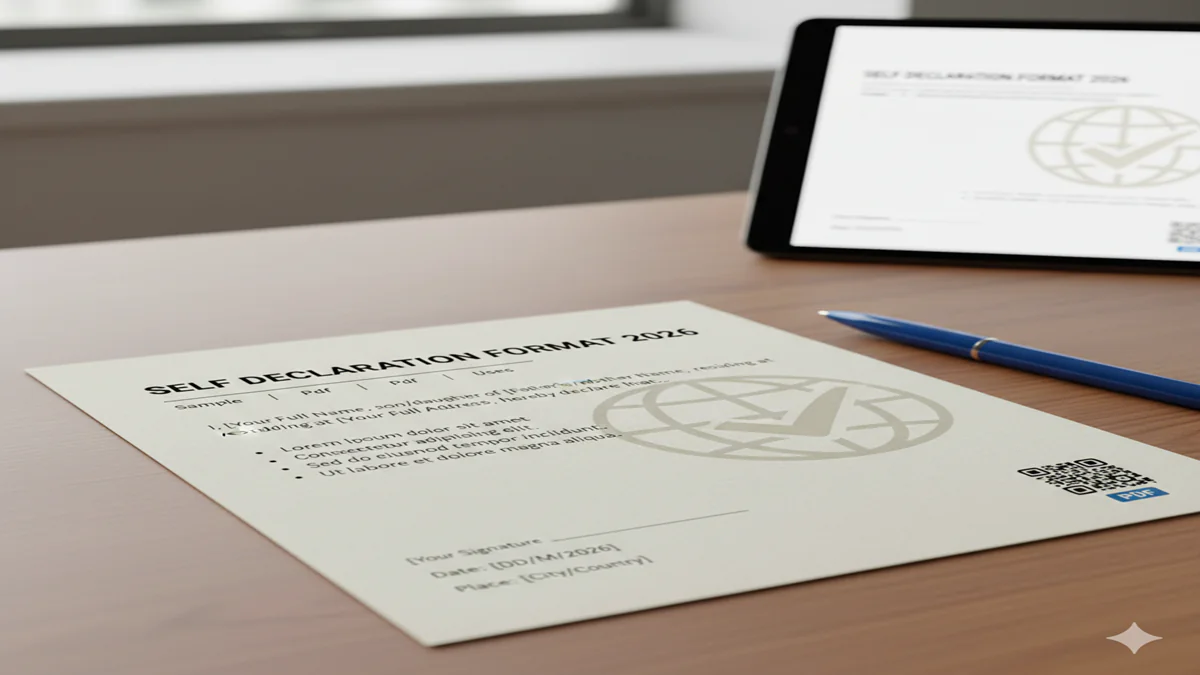
Self Declaration (स्व-घोषणा पत्र) क्या है? इसके फायदे, लिखने का तरीका और 2026 के लिए लेटेस्ट पीडीएफ फॉर्मेट!
Self Declaration Form 2026: Introduction: डिजिटल इंडिया के इस दौर में सरकार ने आम नागरिकों के लिए कई प्रक्रियाओं को सरल बना दिया है। पहले किसी भी सरकारी दस्तावेज को प्रमाणित (Attest) कराने के लिए हमें गैजेटेड ऑफिसर या नोटरी के चक्कर काटने पड़ते थे। लेकिन अब Self Declaration (स्व-घोषणा पत्र) ने इस पूरी प्रक्रिया को बदल दिया है।
चाहे आप राशन कार्ड बनवा रहे हों, स्कॉलरशिप का फॉर्म भर रहे हों या किसी सरकारी योजना (जैसे सुभद्रा योजना या लाड़ली बहिन) का लाभ लेना चाहते हों, आपसे एक स्व-घोषणा पत्र माँगा जाता है। इस लेख में हम विस्तार से जानेंगे कि “Self Declaration” क्या होता है और आप इसे खुद कैसे तैयार कर सकते हैं।
1. स्व-घोषणा पत्र (Self Declaration) क्या है?
Self Declaration Form 2026: स्व-घोषणा पत्र एक कानूनी दस्तावेज है जिसमें व्यक्ति स्वयं यह प्रमाणित करता है कि उसके द्वारा दी गई जानकारी (जैसे आय, पता, या जाति) पूरी तरह सत्य है। सरकार अब राजपत्रित अधिकारियों के हस्ताक्षर के बजाय नागरिक के खुद के भरोसे (Self-Certification) पर काम करती है।
महत्वपूर्ण नोट: यदि स्व-घोषणा पत्र में दी गई जानकारी गलत पाई जाती है, तो आपके खिलाफ भारतीय दंड संहिता (IPC) की विभिन्न धाराओं के तहत कानूनी कार्रवाई की जा सकती है।
2. Self Declaration की आवश्यकता कहाँ पड़ती है?
- आय प्रमाण पत्र (Income Certificate): अपनी वार्षिक आय की घोषणा के लिए।
- जाति प्रमाण पत्र (Caste Certificate): अपनी श्रेणी प्रमाणित करने के लिए।
- शिक्षा (Education): गैप सर्टिफिकेट या मार्कशीट के स्व-सत्यापन के लिए।
- सरकारी योजनाएं: विभिन्न डीबीटी (DBT) योजनाओं का लाभ लेने के लिए।
- नौकरी के आवेदन: दस्तावेजों की सत्यता की पुष्टि के लिए।
3. स्व-घोषणा पत्र लिखने का सही तरीका (Step-by-Step Guide)
एक प्रभावी स्व-घोषणा पत्र में निम्नलिखित जानकारी का होना अनिवार्य है:
- व्यक्तिगत विवरण: आपका नाम, पिता/पति का नाम, और पूरा पता।
- आधार नंबर: पहचान के लिए आधार कार्ड का उल्लेख।
- मुख्य घोषणा: वह बात जिसे आप प्रमाणित करना चाहते हैं (जैसे- मेरी वार्षिक आय ₹2 लाख से कम है)।
- शपथ/सत्यता की पुष्टि: यह वाक्य कि “मेरे द्वारा दी गई जानकारी सत्य है और गलत पाए जाने पर मैं दंड का पात्र हूँ।”
- दिनांक और स्थान: जिस दिन आप फॉर्म भर रहे हैं।
- हस्ताक्षर: आपका अपना हस्ताक्षर।
4. Self Declaration Form Format (Sample)
Self Declaration Form 2026: नीचे एक सामान्य स्व-घोषणा पत्र का प्रारूप दिया गया है जिसे आप कॉपी कर सकते हैं:
स्व-घोषणा पत्र
मैं ……………………………………. पुत्र/पुत्री/पत्नी श्री ……………………………………. आयु ………… वर्ष, निवासी …………………………………………………………………………………….. जिला ……………………… राज्य ……………………… एतद द्वारा यह घोषणा करता/करती हूँ कि:
- यह कि मेरे द्वारा दी गई सभी जानकारी और दस्तावेज पूरी तरह से सत्य और सटीक हैं।
- यह कि मेरे परिवार की कुल वार्षिक आय ₹ ……………………… है। (यदि आय के लिए हो)
- यह कि मैं किसी भी सरकारी पद पर कार्यरत नहीं हूँ।
- यदि मेरे द्वारा दी गई कोई भी जानकारी गलत या असत्य पाई जाती है, तो संबंधित विभाग मेरे विरुद्ध कानूनी कार्रवाई करने के लिए स्वतंत्र होगा और मेरा आवेदन रद्द किया जा सकता है।
स्थान: ……………………… दिनांक: ………………………
(आवेदक के हस्ताक्षर)
5. 2026 में Self Declaration के फायदे
- समय की बचत: अब आपको दफ्तरों के चक्कर नहीं काटने पड़ते।
- भ्रष्टाचार पर रोक: बिचौलियों की जरूरत खत्म हो गई है।
- डिजिटल स्वीकार्यता: ई-डिस्ट्रिक्ट और अन्य पोर्टल्स पर अब डिजिटल हस्ताक्षरित स्व-घोषणा पत्र मान्य हैं।
4. अक्सर पूछे जाने वाले प्रश्न (FAQs)
Q1: क्या Self Declaration के लिए स्टैम्प पेपर की जरूरत होती है?
Ans: सामान्य सरकारी योजनाओं के लिए प्लेन पेपर पर हाथ से लिखा या प्रिंट किया हुआ स्व-घोषणा पत्र मान्य होता है। स्टैम्प पेपर की जरूरत तभी होती है जब विशेष रूप से ‘Affidavit’ मांगा जाए।
Q2: क्या नाबालिग (Minor) की ओर से स्व-घोषणा पत्र दिया जा सकता है?
Ans: 18 वर्ष से कम आयु के बच्चों के मामले में, उनके माता-पिता या कानूनी अभिभावक उनकी ओर से घोषणा पत्र पर हस्ताक्षर करते हैं।
Q3: क्या स्व-घोषणा पत्र को ऑनलाइन अपलोड किया जा सकता है?
Ans: हाँ, आज के समय में लगभग सभी सरकारी पोर्टल स्कैन किए हुए स्व-घोषणा पत्र को स्वीकार करते हैं।
Conclusion: जिम्मेदारी के साथ करें उपयोग
Self Declaration सरकार द्वारा नागरिकों पर किया गया एक बड़ा भरोसा है। यह प्रक्रिया को सरल बनाता है, लेकिन साथ ही हमारी जिम्मेदारी भी बढ़ाता है। हमेशा सुनिश्चित करें कि आप जो जानकारी दे रहे हैं, वह आपके पास उपलब्ध मूल दस्तावेजों से मेल खाती हो।
The Complete Guide to Self Declaration Format 2026: Sample, PDF & Practical Uses
Introduction: Understanding Self-Declaration in the Modern Era
Self Declaration Form 2026: In an increasingly digital and bureaucratic world, the self-declaration document has emerged as a critical instrument for individuals to formally attest to facts, circumstances, or intentions. As we approach 2026, these documents have evolved beyond simple affidavits to become versatile tools used across legal, educational, professional, and governmental spheres. A self-declaration, at its core, is a written statement wherein an individual declares certain information to be true to the best of their knowledge, typically under penalty of perjury.
The significance of properly formatted self-declarations cannot be overstated. In 2026, with heightened concerns about data integrity, identity verification, and streamlined administrative processes, these documents serve as bridges between personal accountability and institutional requirements. They offer a practical solution when official documentation is unavailable, incomplete, or impractical to obtain, while simultaneously emphasizing personal responsibility within legal frameworks.
Self Declaration Form 2026: This comprehensive guide will explore the standardized Self Declaration Format for 2026, provide detailed samples, explain how to access and use PDF templates, and examine the extensive applications of these documents in contemporary society.
Part 1: Anatomy of the 2026 Self-Declaration Format
Core Components and Structure
Self Declaration Form 2026: The 2026 self-declaration format represents an evolution from previous versions, incorporating digital-friendly elements while maintaining legal robustness. A properly structured self-declaration typically includes:
Header Section:
- Title clearly stating “Self-Declaration Statement”
- Unique declaration identifier (increasingly important for digital tracking)
- Date of execution
Declarant Information:
- Full legal name (matching government-issued identification)
- Current residential address
- Contact information (phone, email)
- Government identification details (Aadhaar, PAN, Social Security Number, or equivalent national ID as applicable)
Declaration Body:
- Clear, unambiguous statements of fact
- Specific details relevant to the declaration purpose
- Timeframes and durations where applicable
- Reference to any supporting documentation
Verification and Compliance Statements:
- Affirmation of truthfulness
- Acknowledgement of legal consequences for false statements
- Reference to relevant laws or regulations (specific to declaration purpose)
Signature Block:
- Physical signature (for printed declarations)
- Digital signature field (for electronic submissions)
- Date and place of signing
- Witness signature(s) when required by specific applications
Evolution from Previous Formats
Self Declaration Form 2026: The 2026 format introduces several notable improvements:
- Standardized digital fields that align with identity verification systems
- QR code integration for quick validation and linking to supporting documents
- Multi-language support in standardized templates for diverse populations
- Accessibility features including screen-reader compatible PDF structures
- Blockchain verification options for high-stakes declarations where immutable records are valuable
Part 2: Detailed Sample Self-Declaration for 2026
Sample 1: Comprehensive General Self-Declaration
text
SELF-DECLARATION STATEMENT
Declaration ID: SD-2026-08765
Date: January 15, 2026

I, [Full Legal Name], son/daughter of [Father's/Mother's Name], residing at [Complete Address with PIN Code], hereby declare and affirm that:

1. The information provided in this declaration is true, correct, and complete to the best of my knowledge and belief.
2. I am a citizen of [Country] holding [ID Type and Number] issued on [Date] at [Place].
3. I have no criminal proceedings pending against me in any court of law as of this date.
4. I have not been convicted by any court for any criminal offense.
5. The particulars regarding my educational qualifications, professional experience, and other credentials submitted along with this declaration are authentic and verifiable.
6. I understand that any false statement in this declaration may lead to legal consequences including but not limited to penalties under the [Relevant National/State Law].

This declaration is made for the purpose of [Specific Purpose: Employment/Admission/Loan Application/etc.] and shall remain valid until [Date/Event].

Place: [City, State]
Date: [Date of Signing]

(Signature)
[Full Legal Name]
[Contact Phone Number]
[Email Address]

Witness (if required):
1. Name: _________________
   Signature: ______________
   Address: ________________

2. Name: _________________
   Signature: ______________
   Address: ________________

Verification QR Code: [Linked to digital verification portal]
Sample 2: Specific-Use Declaration (Income Self-Declaration)
text
INCOME SELF-DECLARATION FOR FINANCIAL YEAR 2025-26
Declaration ID: ISD-FY2026-04532
Date: April 5, 2026

I, [Full Legal Name], PAN: [Permanent Account Number], hereby declare that:

1. My total income from all sources for the financial year 2025-26 (April 1, 2025 to March 31, 2026) amounts to ₹/€/$ [Amount in Figures] ([Amount in Words]).
2. This income comprises:
   a) Salary income: ₹/€/$ [Amount]
   b) Business/professional income: ₹/€/$ [Amount]
   c) Capital gains: ₹/€/$ [Amount]
   d) Income from other sources: ₹/€/$ [Amount]
3. I have paid/will pay applicable taxes on the above income as per the provisions of the Income Tax Act.
4. I have no undisclosed income or assets in India or abroad.
5. The above statement is true and correct to the best of my knowledge and belief.

This declaration is submitted to [Name of Institution/Bank] for the purpose of [Specific Loan/Financial Service].

Place: [City]
Date: [Date]

(Signature)
[Full Legal Name]
[Address]
[Contact Information]

Attachments: Last 3 months bank statements, Previous year ITR (if available)
Part 3: Accessing and Using 2026 Self-Declaration PDF Templates
Official Sources for Templates
Self Declaration Form 2026: In 2026, accessing reliable self-declaration templates has become more streamlined through:
- Government Portals: Most national and state governments provide standardized templates through their official websites (e.g., India’s National e-Governance Division, USA.gov forms repository).
- Financial Institutions: Banks and lending agencies offer specific declaration forms for financial applications on their secured client portals.
- Educational Platforms: Universities and educational boards provide admission-related declaration templates through their admission portals.
- Legal Service Platforms: Bar council websites and licensed legal service providers offer legally vetted templates for various jurisdictions.
- Employment Portals: Recruitment platforms and corporate HR portals often provide standardized employment declarations.
Best Practices for PDF Usage
Self Declaration Form 2026: When working with self-declaration PDF templates in 2026:
Digital Completion:
- Use PDF editors that preserve form fields and digital signature validity
- Ensure compatibility with official verification systems
- Maintain original file structure when saving completed declarations
Print Considerations:
- Use high-quality printing on standard A4 or letter-size paper
- Ensure signature areas are clearly visible and unobstructed
- Print in black and white unless color is specifically required
Hybrid Digital-Physical Workflow:
- Complete digitally fillable sections before printing for signature
- Scan signed documents at minimum 300 DPI for clear digital copies
- Use certified PDF creation tools when submitting digitally signed declarations
Security Measures:
- Password-protect sensitive declaration PDFs when emailing
- Use secure portals for submission rather than unencrypted email
- Maintain copies in secure cloud storage with access logging
Part 4: Comprehensive Uses of Self-Declaration in 2026
Legal and Government Applications
Identity Verification: Self-declarations serve as interim identity proofs when applying for official documents, bridging gaps during document renewal or replacement processes.
Address Verification: With increasing mobility, self-declarations of residence address (often accompanied by supplementary evidence) facilitate various registrations and applications.
Marital Status Declarations: Required for visa applications, joint financial undertakings, and legal proceedings where marital status impacts rights or obligations.
Name Change Procedures: Self-declarations often initiate formal name change processes, explaining reasons and affirming no fraudulent intent.
Educational and Professional Uses
Self Declaration Form 2026: Academic Credential Verification:When original educational documents are unavailable during admissions or employment, self-declarations with backup evidence enable process continuity.
Gap Period Explanation: Self-declarations explaining employment or education gaps have become standard in recruitment and admissions processes.
Research Originality Declarations: Academic institutions increasingly require declarations affirming original work and proper attribution in publications and theses.
Self Declaration Form 2026: Professional Conduct Affidavits:Licensing bodies for various professions require declarations of ethical conduct and absence of disciplinary proceedings.
Financial and Commercial Applications
Income Self-Certification: Critical for loan applications, rental agreements, and financial product subscriptions when immediate tax documentation is unavailable.
Asset Declarations: Required for various financial transactions, visa applications, and legal proceedings involving financial status.
Self Declaration Form 2026: Business Ownership Declarations:Entrepreneurs use these to declare proprietary interests when formal registration documents are pending.
Insurance Claims: Policyholders submit self-declarations to attest to circumstances surrounding claims when immediate evidence is unavailable.
Healthcare and Special Circumstances
Self Declaration Form 2026: Medical History Declarations:Patients provide summarized medical histories when complete records are unavailable during emergencies or specialist consultations.
Vaccination Status Declarations: Continue to be relevant in 2026 for international travel, certain employment, and healthcare settings.
Disability Self-Declaration: Individuals declare disabilities to access accommodations, benefits, or services, often as preliminary steps before formal assessment.
Travel Declarations: Travelers declare health status, travel history, and purpose of visit as part of immigration procedures in many countries.
Emerging 2026 Applications
Self Declaration Form 2026: Digital Identity Linking:Self-declarations facilitate linking of disparate digital identities across platforms while maintaining privacy controls.
Remote Work Compliance: Employees declare compliance with tax, data security, and employment regulations when working across jurisdictions.
Sustainable Practice Declarations: Businesses and individuals declare environmental impact and sustainability practices for regulatory compliance and certifications.
Self Declaration Form 2026: AI-Assisted Content Declaration:Content creators declare the extent of artificial intelligence assistance in creative works for platforms implementing AI transparency requirements.
Part 5: Legal Implications and Best Practices
Understanding Legal Weight
Self Declaration Form 2026: Self-declarations occupy a unique position in legal frameworks. While not equivalent to certified documents, they carry significant weight because:
- Penalty of Perjury: Most jurisdictions treat false declarations as perjury with corresponding penalties.
- Contractual Implications: When incorporated into agreements, false declarations can void contracts and create liability.
- Administrative Consequences: False statements can lead to application rejections, revocation of privileges, and administrative penalties.
- Evidentiary Value: Courts increasingly accept self-declarations as preliminary evidence, shifting the burden of proof to challengers.
Creating Legally Sound Declarations
Self Declaration Form 2026: Precision in Language:
- Use unambiguous statements avoiding qualifiers like “maybe,” “perhaps,” or “to my limited knowledge”
- Define technical terms specific to the declaration’s purpose
- Reference specific timeframes rather than vague periods
Appropriate Scope:
- Limit declarations to matters within personal knowledge
- Avoid speculative statements about others’ actions or intentions
- Separate facts from opinions clearly
Supporting Documentation:
- Reference attached evidence without incorporating it into the declaration
- Maintain consistency between declaration statements and supporting documents
- Ensure referenced documents are properly identified and available
Jurisdictional Compliance:
- Research specific requirements of the receiving institution or jurisdiction
- Include mandatory statements required by applicable laws
- Consider notarization requirements based on declaration purpose and value
Common Pitfalls to Avoid
- Overdeclaration: Making statements beyond personal knowledge or competence.
- Ambiguity: Using vague language that enables multiple interpretations.
- Technical Inaccuracy: Misstating dates, amounts, or other measurable facts.
- Formatting Errors: Deviating from required templates in ways that invalidate acceptance.
- Improper Execution: Missing signatures, dates, or other formal requirements.
- Inconsistent Information: Contradictions between declaration and supporting documents.
Part 6: The Digital Evolution and Future Trends
Electronic Self-Declarations
The 2026 landscape features significant digital advancements:
Blockchain-Verified Declarations: Immutable timestamping and verification through distributed ledger technology for high-value declarations.
Biometrically Signed E-Declarations: Fingerprint or facial recognition signatures linked to government ID databases.
Smart Form Declarations: Interactive forms that validate information in real-time against available databases.
Automated Compliance Checking: AI systems that review declarations for inconsistencies and missing elements before submission.
Integration with Digital Identity Systems
Self-declarations increasingly interface with national digital identity frameworks:
India’s Aadhaar Integration: Declarations can be prefilled with verified identity information from Aadhaar databases with user consent.
European Digital Identity Wallet: EU’s eIDAS 2.0 framework enables verified declarations as part of digital identity portfolios.
Decentralized Identity Systems: User-controlled declarations verified through distributed identity networks without centralized authorities.
Future Projections (2027 and Beyond)
AI-Assisted Declaration Drafting: Intelligent systems that help users create accurate, complete declarations based on purpose and jurisdiction.
Predictive Verification: Systems that automatically verify declaration contents against expanding public and private databases.
Dynamic Declarations: Living documents that update automatically as circumstances change, with proper version control and audit trails.
Cross-Border Standardization: International frameworks for recognizing self-declarations across jurisdictions for common purposes like travel and business.
Conclusion: The Essential Document for Modern Life
As we navigate 2026, the self-declaration format has solidified its position as an indispensable administrative and legal instrument. Its flexibility bridges gaps in formal documentation systems while emphasizing personal responsibility in an increasingly interconnected world. The evolution toward digital integration has enhanced both accessibility and reliability, creating a more efficient ecosystem for individuals and institutions alike.
The true power of the self-declaration lies in its balanced approach: it respects institutional needs for verified information while acknowledging practical limitations in documentation availability. As digital identity systems mature and international standardization progresses, self-declarations will likely become even more seamlessly integrated into daily transactions while maintaining their core function as personal attestations of truth.
Understanding the proper format, applications, and legal implications of self-declarations in 2026 empowers individuals to navigate bureaucratic processes efficiently while minimizing risks. Whether for professional advancement, financial transactions, legal compliance, or personal matters, mastering this versatile document type remains a valuable skill in our modern administrative landscape.