Harnessing the Future: How Government Machine Subsidy Schemes are Empowering Small Business Owners
Machine Subsidy Government Scheme In the relentless engine room of a nation’s economy, small and medium enterprises (SMEs) are the pistons driving growth, innovation, and employment. Yet, these vital entities often operate on tight margins, where the capital required for transformative technological leaps remains tantalizingly out of reach.
A state-of-the-art CNC machine, a modern commercial-grade 3D printer, or an automated packaging line could double productivity and open new markets, but their upfront cost is a formidable barrier. Recognizing this critical juncture, governments worldwide have institutedMachine Subsidy Schemes—targeted financial interventions designed to bridge the technological gap. For the astute small business owner, these schemes are not merely a discount; they are a strategic catalyst for survival, competitiveness, and exponential growth.
This article delves into the top benefits of these government-backed machine subsidy schemes, moving beyond the obvious financial relief to explore their profound, multi-layered impact on a small business’s trajectory.
1. The Primary Driver: Financial De-risking and Capital Liberation
The most immediate and tangible benefit is financial.
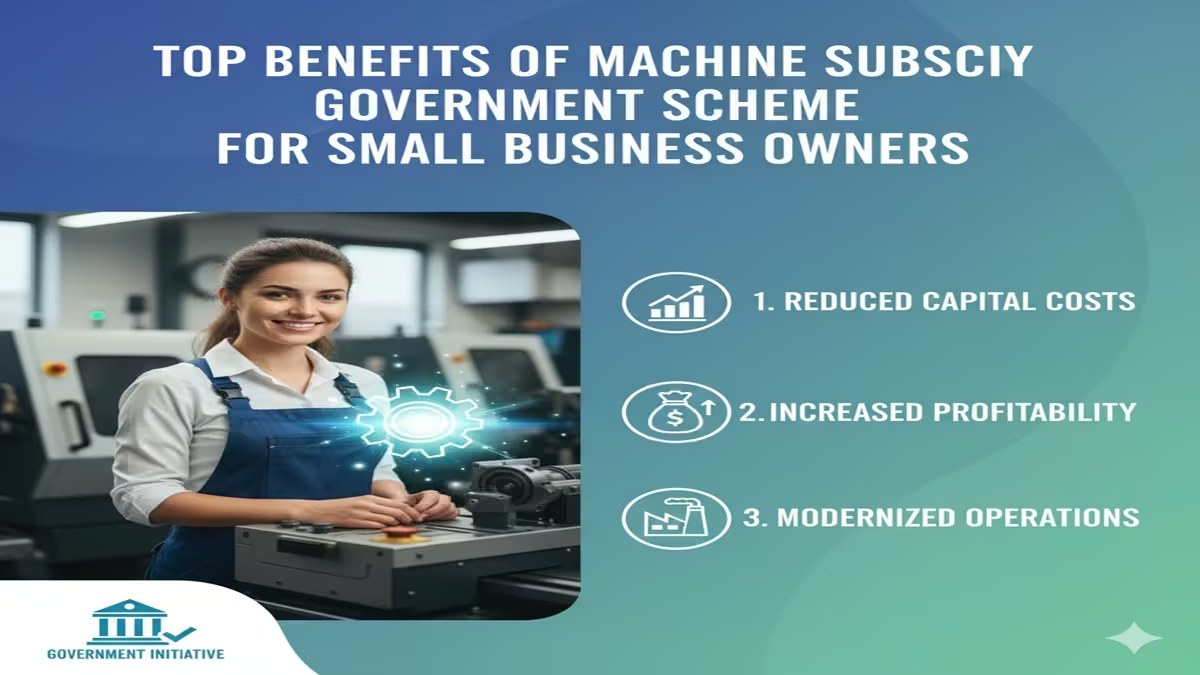
- Reducing the Capital Expenditure (CAPEX) Mountain:Subsidies, typically ranging from 15% to 50% of the machinery cost, directly lower the purchase price. This transforms a prohibitive investment into a viable one. A ₹2 million machine with a 30% subsidy effectively costs ₹1.4 million, a difference that can be the deciding factor between proceeding and abandoning an upgrade.
- Improving Cash Flow and Working Capital Health:By reducing the initial outlay or offering reimbursements, these schemes conserve precious working capital. This liberated cash can be redirected towards raw materials, marketing, skilled labor, or building a financial buffer—elements essential for day-to-day agility.
- Enhancing Borrowing Capacity and Terms:A subsidy often acts as a powerful equity injection in the eyes of lenders. Financing the subsidized portion of a machine is less risky for a bank, potentially leading to better loan terms, lower interest rates, or a higher likelihood of approval. It creates a public-private partnership in funding growth.
2. The Competitive Edge: Quantum Leap in Productivity and Quality
Technology is the great multiplier. Subsidized machinery delivers direct operational advantages that redefine a business’s market position.
- Precision and Consistency:Modern machinery minimizes human error. A subsidized laser cutter or automated sewing machine produces parts or products with flawless consistency, enhancing brand reputation and reducing waste from defects.
- Speed and Scale:Automation and computer-controlled equipment dramatically increase output rates. What took ten artisan hours can be accomplished in one, allowing a small business to take on larger orders, meet tighter deadlines, and scale operations without a linear increase in labor costs.
- Material and Energy Efficiency:Newer machines are often engineered for sustainability. They optimize material usage (e.g., nesting software in CNC cutters) and consume less energy per unit produced, leading to significant long-term cost savings and a greener operational profile—an increasingly valuable market differentiator.
3. The Innovation Imperative: Diversification and Value-Addition
Subsidized machinery unlocks new capabilities, allowing businesses to move up the value chain.
- Product Diversification:A bakery with a subsidized automated pastry line can introduce intricate, consistent new products. A metal workshop with a CNC milling machine can shift from simple fabrication to precision components for higher-tech industries. This reduces dependency on a single product and opens new revenue streams.
- Service Expansion:A print shop acquiring a high-speed, large-format printer with a subsidy can offer banner printing, photographic canvases, or custom wallpapers, attracting a new clientele.
- bring new ideas to market faster than competitors reliant on external service providers.
4. The Human Capital Dividend: Upskilling, Safety, and Job Enrichment
Contrary to the myth that automation destroys jobs, for SMEs, subsidized machinery often transforms them.
- Upskilling the Workforce:Operating advanced machinery requires trained personnel. This necessitates and incentivizes training. Employees transition from manual laborers to machine operators, programmers, and technicians—roles that command higher wages, increase job satisfaction, and reduce turnover.
- Improved Workplace Safety:Modern machines come with enhanced safety features—guards, sensors, emergency stops—replacing hazardous manual processes. This reduces the risk of workplace accidents, lowers insurance premiums, and demonstrates a commitment to employee welfare.
- Shifting Labour to Value-Added Tasks:By automating repetitive, strenuous tasks, business owners can re-deploy their human capital to areas where creativity, strategy, and customer interaction matter most: sales, design, quality control, and customer service.
5. The Strategic Foundation: Long-Term Sustainability and Market Resilience
The benefits of a subsidized machine investment compound over time, building a more resilient enterprise.
- Future-Proofing the Business:In an era of Industry 4.0, technological obsolescence is a real threat. Subsidy schemes often encourage the adoption of modern, digitally-integrated equipment. This prepares the business for integration with the Internet of Things (IoT), data analytics, and smart manufacturing trends, ensuring it remains relevant.
- Building Asset Value and Creditworthiness:The acquired machinery becomes a tangible asset on the company’s balance sheet, strengthening its net worth. This improves creditworthiness for future borrowing and increases the overall value of the enterprise.
- Formalization and Compliance:Engaging with a government scheme often requires a degree of formalization—registered business, clear accounting, tax compliance. While initially demanding, this process professionalizes the business, improves governance, and unlocks further formal-sector opportunities and financing.
- Enhanced Export Potential:With improved quality, consistency, and scale, small businesses can meet the stringent standards required for international markets. A subsidy for a food processing and packaging line, for example, can be the first step towards exporting value-added products.
Navigating the Path: How to Access These Benefits
Understanding the benefits is the first step; securing them is the next. The process typically involves:
- Identification:Find the relevant scheme through ministries of MSME, industry, agriculture, or textiles, and their associated portals (e.g., in India, the MSME Ministry’s schemes or state-level initiatives).
- Eligibility Assessment:Scrutinize criteria related to business size (investment in plant & machinery, turnover), years of operation, and sector (many schemes target specific industries).
- Application and Documentation:Prepare a robust application, often including business plans, quotations for machinery, financial statements, and proof of registration. Clarity on how the machine will impact your business is crucial.
- Post-Approval Compliance:Adhere strictly to purchase, installation, and reporting guidelines to ensure the subsidy is disbursed without hiccups.
Conclusion: A Partnership for Progress
Government machine subsidy schemes represent a powerful confluence of policy and entrepreneurship. They are a strategic handshake from the state, acknowledging that the vitality of small businesses is inextricably linked to national economic health. For the small business owner, these schemes are far more than a financial rebate. They are an instrument for competitive transformation, human capital development, and long-term resilience.
In a global marketplace defined by rapid technological change, the decision to leverage such a scheme is not just an administrative choice; it is a strategic imperative. It is the choice between struggling with the tools of the past and forging the future, one precision-cut, efficiently produced, and innovatively conceived product at a time. The machinery is the vehicle, but the subsidy is the fuel for a journey towards a more robust, scalable, and prosperous business.
Frequently Asked Questions (FAQ)
Q1: Won’t automation through subsidized machines lead to job losses in my small business?
A:Typically, no. In the SME context, automation usuallytransforms jobs rather than eliminates them. It automates repetitive tasks, allowing your existing workforce to be upskilled to operate, maintain, and manage the new technology. This leads to more skilled, higher-paying positions and frees up human talent for growth-oriented activities like sales, customer service, and innovation.
Q2: Is the application process for these subsidies notoriously complex and time-consuming?
A:While it requires diligence, the process has been streamlined in many countries with dedicated online portals and help desks. The key is thorough preparation: ensure your business is formally registered, maintain clear financial records, and carefully compile all required documents (quotations, business plan, identity proofs). Many industry associations also offer guidance. The potential return on investment makes navigating the process highly worthwhile.
Q3: My business is very small/just starting. Are we eligible for such schemes?
A:Eligibility varies by scheme, but many are specifically designed for micro, small, and start-up enterprises. There are often special provisions or separate scheme brackets for micro-enterprises and new businesses. It’s essential to check the specific criteria of the scheme in your region or sector.
Q4: Are there any hidden costs or obligations after I receive the subsidy?
A:Transparency is crucial. Read the scheme guidelines carefully. Common post-disbursement obligations may include: maintaining the machine at the registered business premises for a specified “lock-in” period (e.g., 3-5 years), submitting periodic utilization certificates, and agreeing to potential audits. There are rarely hidden “fees,” but failing to comply with terms can lead to subsidy recovery with penalties.
Q5: How do I choose the right machinery to ensure the subsidy actually benefits my business?
A:The subsidy is a tool, not a goal. Conduct a thoroughneeds analysisfirst:
What is the core bottleneck in my production?
What new products/services do I want to offer?
Get multiple technical quotations and compare specifications.
Consider total cost of ownership (maintenance, energy use, operator training), not just the purchase price.
The machine should align with a clear strategic plan for growth, not just be a “good deal.” Seek advice from industry peers or consultants if needed.