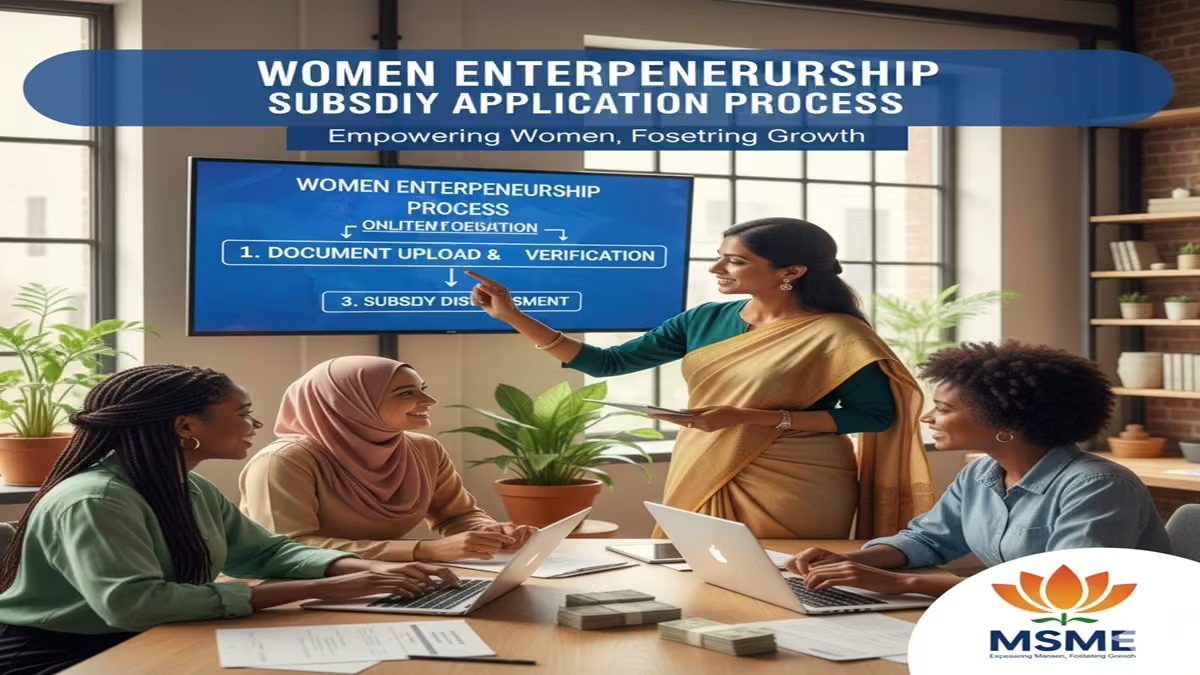
Mahila Udyam Subsidy Apply Process 2026: अपना खुद का बिजनेस शुरू करें; सरकार देगी भारी सबसिडी और लोन!
Mahila Udyam Subsidy Apply Process 2026: Dosto, आज के समय में महिलाएं हर क्षेत्र में अपनी पहचान बना रही हैं। चाहे छोटा गृह उद्योग (Home Business) हो या बड़ा स्टार्टअप, भारत सरकार महिलाओं को आगे बढ़ाने के लिए कई बेहतरीन योजनाएं चला रही है। इन्हीं में से एक है Mahila Udyam Subsidy।
अगर आप अपना ब्यूटी पार्लर, बुटीक, फूड प्रोसेसिंग यूनिट या कोई भी मैन्युफैक्चरिंग बिजनेस शुरू करना चाहती हैं, तो सरकार आपको सिर्फ कर्ज ही नहीं बल्कि उस कर्ज पर 15% से 35% तक की सबसिडी (छूट) भी दे रही है। आज के इस आर्टिकल में हम Mahila Udyam Subsidy Apply Process 2026 की पूरी जानकारी स्टेप-बाय-स्टेप देखेंगे।
1. मुख्य योजनाएं जिनसे मिलती है सबसिडी (Major Schemes)
Mahila Udyam Subsidy Apply Process 2026: महिलाओं के लिए सबसिडी वाली मुख्य रूप से तीन योजनाएं सबसे पॉपुलर हैं:
- PMEGP (Prime Minister Employment Generation Programme): इसमें महिलाओं को शहरी क्षेत्र में 25% और ग्रामीण क्षेत्र में 35% सबसिडी मिलती है।
- Udyogini Scheme: कम आय वाली महिलाओं को बिना ब्याज या बहुत कम ब्याज पर लोन मिलता है।
- Mahila Coir Yojana: नारियल से जुड़े उत्पादों के बिजनेस के लिए खास सबसिडी।
2. Eligibility: कौन आवेदन कर सकता है?
- महिला की आयु कम से कम 18 वर्ष होनी चाहिए।
- बिजनेस कम से कम नया (New Unit) होना चाहिए।
- अगर आप PMEGP के तहत ₹10 लाख से ज्यादा का लोन चाहती हैं, तो कम से कम 8वीं पास होना जरूरी है।
- स्वयं सहायता समूह (SHG) भी इसके लिए पात्र हैं।
3. जरूरी दस्तावेज (Documents Checklist)
Mahila Udyam Subsidy Apply Process 2026: आवेदन करने से पहले ये कागजात तैयार रखें:
- आधार कार्ड (Aadhaar Card) और पैन कार्ड।
- Udyam Registration Certificate: यह फ्री में ऑनलाइन बनता है।
- Project Report: आपके बिजनेस का पूरा प्लान (खर्च और कमाई का ब्यौरा)।
- Caste Certificate: अगर आप SC/ST/OBC कैटेगरी से हैं (ज्यादा सबसिडी के लिए)।
- Educational Proof: मार्कशीट या सर्टिफिकेट।
- Passport Size Photo.
4. Mahila Udyam Subsidy Apply Process (Step-by-Step)
Step 1: Udyam Registration करें सबसे पहले udyamregistration.gov.in पर जाकर अपने बिजनेस को रजिस्टर करें। यह बिल्कुल फ्री है और इससे आपको ‘MSME’ का दर्जा मिल जाएगा।
Step 2: PMEGP पोर्टल पर जाएं ज्यादातर सबसिडी वाले लोन PMEGP e-Portal के जरिए प्रोसेस होते हैं। आधिकारिक वेबसाइट खोलें और ‘Application for New Unit’ पर क्लिक करें।
Step 3: फॉर्म भरें अपनी सभी पर्सनल और बिजनेस डिटेल्स भरें। यहाँ आपको अपनी एजेंसी (KVIC/KVIB/DIC) चुननी होगी जो आपके लोन को अप्रूव करेगी।
Step 4: प्रोजेक्ट रिपोर्ट अपलोड करें अपना प्रोजेक्ट प्लान अपलोड करें। बैंक इसी रिपोर्ट के आधार पर तय करता है कि आपको कितना लोन देना है।
Step 5: बैंक का चुनाव उस बैंक को चुनें जहां आपका पहले से खाता है या जो आपके पास है। फॉर्म सबमिट करने के बाद आपको एक ‘Application ID’ मिलेगी।
Step 6: फिजिकल वेरिफिकेशन और ट्रेनिंग आवेदन मंजूर होने के बाद, अधिकारी आपकी साइट का मुआयना करेंगे। इसके बाद आपको EDP Training (Entrepreneurship Development Programme) पूरी करनी होगी, जो अब ऑनलाइन भी उपलब्ध है।
5. सबसिडी का पैसा कब और कैसे मिलता है?
Mahila Udyam Subsidy Apply Process 2026: यह सबसे जरूरी सवाल है। सबसिडी का पैसा सीधे आपके हाथ में नहीं आता। बैंक लोन की पूरी राशि जारी करता है, और सबसिडी का हिस्सा (जैसे 35%) बैंक में एक ‘Subsidy Reserve Fund Account’ में रख दिया जाता है। 3 साल तक सही तरीके से किश्तें चुकाने के बाद, वह पैसा आपके लोन अकाउंट में एडजस्ट कर दिया जाता है, जिससे आपका कर्ज कम हो जाता है।
6. Top 5 FAQs (महिला उद्यम सबसिडी)
Q1. क्या घर बैठे बिजनेस के लिए सबसिडी मिलती है?
Ans: हाँ, अगर आपका बिजनेस मैन्युफैक्चरिंग या सर्विस सेक्टर (जैसे सिलाई, कैटरिंग) में आता है, तो आप अप्लाई कर सकती हैं।
Q2. सबसिडी कितनी मिलती है?
Ans: PMEGP के तहत महिलाओं को ग्रामीण क्षेत्र में 35% और शहरी क्षेत्र में 25% तक की सबसिडी मिलती है।
Q3. प्रोजेक्ट रिपोर्ट कैसे बनाएं?
Ans: आप किसी CA की मदद ले सकते हैं या PMEGP की वेबसाइट पर दिए गए ‘Sample Project Profiles’ को देख सकते हैं।
Q4. क्या सिबिल स्कोर (CIBIL) जरूरी है?
Ans: हाँ, बैंक लोन देने से पहले आपका सिबिल स्कोर चेक करता है। यह 700 से ऊपर हो तो बेहतर है।
Q5. बिना गारंटी के कितना लोन मिल सकता है?
Ans: CGTMSE स्कीम के तहत ₹2 करोड़ तक का लोन बिना किसी कोलेटरल (बिना कुछ गिरवी रखे) मिल सकता है।
Conclusion: अपना सपना पूरा करने का सही समय!
Mahila Udyam Subsidy Apply Process अब पूरी तरह डिजिटल है, जिससे बिचौलियों का डर खत्म हो गया है। अगर आपके पास एक अच्छा बिजनेस आइडिया है, तो सरकार और बैंक आपकी मदद के लिए तैयार हैं। आज ही अपना प्रोजेक्ट रिपोर्ट तैयार करें और आवेदन करें!
Empowering Aspirations: A Comprehensive Guide to the Mahila Udyam Subsidy Application Process
Introduction: The Landscape of Women’s Entrepreneurship in India
Mahila Udyam Subsidy Apply Process In the dynamic tapestry of India’s economic growth, women entrepreneurs are emerging as powerful catalysts for change, innovation, and social development. Recognizing their unique potential and the systemic challenges they face, the Government of India, through various state and central schemes, has instituted targeted financial support mechanisms. Among these, subsidies and loans tailored for women-led enterprises, often collectively referred to in public discourse as “Mahila Udyam” (Women Enterprise) subsidies, play a pivotal role. These are primarily facilitated through flagship institutions like the Small Industries Development Bank of India (SIDBI), banks under the Pradhan Mantri Mudra Yojana (PMMY), and the Credit Guarantee Fund Trust for Micro and Small Enterprises (CGTMSE).
This article serves as a definitive, step-by-step guide to navigating the application process for these crucial subsidies and concessional loans. It aims to demystify the procedures, clarify eligibility, and equip aspiring and existing women entrepreneurs with the knowledge to secure financial backing for their ventures.
Chapter 1: Understanding the “Mahila Udyam” Subsidy Ecosystem
Mahila Udyam Subsidy Apply Process 2026: First, it’s essential to clarify that “Mahila Udyam Subsidy” is not the name of a single, monolithic scheme. It is an umbrella term used for various government initiatives that offer interest subsidies, capital subsidies, or concessional loans to enterprises owned and operated by women.
Key Schemes and Channels:
- Pradhan Mantri Mudra Yojana (PMMY): Under this, loans up to ₹10 lakh are provided by banks, NBFCs, and MFIs. While not a direct subsidy, it offers concessional loans without collateral under three categories: Shishu (up to ₹50,000), Kishore (₹50,001 to ₹5 lakh), and Tarun (₹5,00,001 to ₹10 lakh). Women entrepreneurs are a key beneficiary segment and often receive loans at preferential interest rates.
- Credit Linked Capital Subsidy Scheme (CLCSS) for Technology Upgradation: Though not exclusive to women, this scheme, now subsumed under broader MSME policies, offered capital subsidies for upgrading technology. Women-owned units were given special consideration.
- State Government Schemes: Numerous states run their own “Mahila Udyam Nidhi” or similar programs. For example, the Gujarat State Women’s Empowerment Corporation or the Uttar Pradesh Mahila Udyam Nidhi Scheme offer margin money subsidies, interest subsidies, and training support.
- Mahila Udyam Subsidy Apply Process 2026: SIDBI’s Mahila Udyam Nidhi (Historical Context):SIDBI did have a specific “Mahila Udyam Nidhi” scheme earlier, which provided soft loans. While its specific form may have evolved, SIDBI remains a central pillar in financing women-led businesses through various contemporary products and partnerships with banks.
- Stand-Up India Scheme: Facilitates bank loans between ₹10 lakh and ₹1 crore to at least one Scheduled Caste (SC) or Scheduled Tribe (ST) borrower and at least one woman borrower
- Entrepreneurship Development Programs (EDPs): Many subsidies are linked with or preceded by free training and mentorship programs for women, often sponsored by the Ministry of MSME.
Common Features of These Supports:
- Interest Subsidy: A portion of the interest on the loan is borne by the government.
- Capital/Margin Money Subsidy: A direct contribution (typically 10-30% of the project cost) to reduce the promoter’s own capital requirement.
- Concessional Interest Rates: Lower-than-market interest rates on loans.
- Collateral-Free Loans: Under schemes like Mudra and CGTMSE, loans up to certain limits require no collateral.
- Gender-Based Quotas: Many banks have internal mandates to prioritize lending to women-owned enterprises.
Chapter 2: Pre-Application Foundation – Eligibility and Documentation
Mahila Udyam Subsidy Apply Process 2026: Before embarking on the application journey, building a strong foundation is critical.
A. Who is Eligible?
Mahila Udyam Subsidy Apply Process 2026: While specifics vary, general eligibility criteria include:
- Ownership: The enterprise must be owned (minimum 51% shareholding) and controlled by one or more women. Proprietorships, partnerships, LLPs, Private Limited Companies, and One Person Companies (OPC) are eligible.
- Business Type: Manufacturing, service, or trading sectors are typically covered. Some schemes may exclude certain non-productive sectors.
- Age: The woman entrepreneur is usually required to be above 18 years of age.
- Credit History: A sound credit history with no major defaults.
- Project Viability: The business proposal must be technically feasible and financially viable.
- Legal Compliance: The enterprise should be registered as per applicable laws (MSME/Udyam Registration, Shop & Establishment Act, GST, etc.).
B. The Indispensable Documentation Dossier
Mahila Udyam Subsidy Apply Process 2026: Preparation is key. The following documents are commonly required:
- Business Proof:
- Udyam Registration Certificate (from the MSME Ministry portal) – Highly Crucial.
- Business address proof.
- Partnership Deed or Certificate of Incorporation (for companies/LLPs).
- GST Registration Certificate.
- Trade License or Shop & Establishment Certificate.
- Financial Documents:
- Detailed Project Report (DPR) – The most important document (see next section).
- Bank statements of the promoter(s) for the last 6-12 months.
- Income Tax Returns (ITR) for the last 2-3 years (if existing business).
- Audited financial statements (for existing businesses).
- Loan & Subsidy Specifics:
- Quotations for machinery/equipment (for capital subsidy schemes).
- Property documents if offering collateral (though often waived).
- Proof of ownership/lease of business premises.
- Photographs: Passport-sized photographs of the promoter(s).
Chapter 3: Crafting the Cornerstone – The Detailed Project Report (DPR)
Mahila Udyam Subsidy Apply Process 2026: The DPR is not just a formality; it’s the narrative of your business dream translated into a credible, bankable document. It convinces the lending institution of your seriousness and the project’s viability.
A comprehensive DPR should include:
- Promoter’s Profile: Your education, experience, and qualifications.
- Business Concept: A clear description of the product/service, its uniqueness, and target market.
- Technical Details: Manufacturing process, machinery list, plant layout, and raw material sourcing.
- Financial Projections:
- Cost of Project (Break-up of land, building, machinery, working capital).
- Means of Financing (Promoter’s contribution, term loan, subsidy).
- Projected Profit & Loss Statement for 5 years.
- Projected Cash Flow Statement.
- Break-Even Analysis.
- Key Ratio Analysis (ROI, Debt-Service Coverage Ratio).
- Management Structure: Organizational chart and key personnel.
- SWOT Analysis: Strengths, Weaknesses, Opportunities, Threats.
Mahila Udyam Subsidy Apply Process 2026: Seek Help:Don’t hesitate to consult a Chartered Accountant, a MSME consultant, or use templates provided by banks and government portals to prepare a robust DPR.
Chapter 4: The Step-by-Step Application Process
Step 1: Ideation and Business Registration
Mahila Udyam Subsidy Apply Process 2026: Finalize your business idea. Register your enterprise legally (as a Proprietorship, Partnership, etc.). Obtain the mandatoryUdyam Registrationonline (it’s free and based on self-declaration). This registration is your primary identity as an MSME.
Step 2: Scheme Identification and Bank Selection
- Research which specific scheme best suits your needs (e.g., Mudra for a small service unit, Stand-Up India for larger manufacturing).
- Choose your bank. It could be your home bank where you have a long-standing relationship, or a public sector bank known for aggressively supporting government schemes. Schedule a meeting with the branch manager or the MSME/loan officer.
Step 3: Preliminary Discussion and Application Form
- Mahila Udyam Subsidy Apply Process 2026: Present your business idea and DPR in a preliminary meeting.
- Obtain the specific application form for the chosen scheme (Mudra Loan Application, CGTMSE Application, etc.).
- Fill the form meticulously. Incomplete forms are the most common reason for delays.
Step 4: Submission and Acknowledgment
- Mahila Udyam Subsidy Apply Process 2026: Submit the fully filled application form along with the complete dossier of supporting documents and the DPR.
- Obtain a dated and signed acknowledgment receipt from the bank. This is your proof of submission.
Step 5: Bank’s Due Diligence and Processing
The bank will:
- Verify all documents.
- Conduct a site visit to your proposed/existing business location.
- Appraise the technical and financial viability of the project.
- Check your credit score (CIBIL).
Step 6: Sanction and Disbursement
- Mahila Udyam Subsidy Apply Process 2026: Upon satisfactory due diligence, the bank’s sanctioning committee will approve the loan amount and terms.
- Read this carefully.
- After you accept the terms and complete any final formalities (like opening a loan account, submitting collateral documents if any), the loan amount is disbursed, usually in stages tied to project milestones.
Step 7: Claiming the Subsidy Component
- Mahila Udyam Subsidy Apply Process 2026: Forinterest subsidies, the benefit is usually automatic—you pay the interest at the reduced (concessional) rate from the start, and the bank claims the subsidy from the government.
- For capital/margin money subsidies, the process may differ. Sometimes the subsidy amount is routed directly to your account by the implementing agency (like a state women’s development corporation) upon proof of loan disbursement and investment. Your bank will guide you on the specific claim process.
Chapter 5: Navigating Challenges and Pro Tips for Success
Mahila Udyam Subsidy Apply Process 2026: Common Hurdles & Solutions:
- Lack of Collateral: Opt for Mudra loans (up to ₹10L) or CGTMSE-backed loans where collateral is waived.
- Weak Credit History: Build it first with a small Shishu loan and repay it diligently.
- Incomplete DPR: Invest time and, if needed, professional help in creating a solid DPR.
- Bureaucratic Delays: Follow up politely but persistently. Maintain a file with all correspondence.
- Lack of Financial Literacy: Attend free EDPs and workshops conducted by MSME Development Institutes, NIESBUD, or WE Hubs.
Pro Tips for a Smooth Journey:
- Mahila Udyam Subsidy Apply Process 2026: Start with Udyam Registration:It’s your gateway to all benefits.
- Build a Relationship with Your Banker: Transparency and regular communication are key.
- Leverage Free Resources: Use the online portals of the Ministry of MSME, SIDBI, and your state’s industry department.
- Network: Join local women entrepreneur associations or chambers of commerce for peer learning and support.
- Be Prepared for Equity: Most schemes require a minimum promoter’s contribution (10-25%). Start saving for it.
Chapter 6: Beyond the Subsidy – Sustaining and Scaling
Mahila Udyam Subsidy Apply Process 2026: Securing the subsidy and loan is the beginning, not the end. Practice disciplined financial management, maintain separate business accounts, utilize the loan strictly for the stated business purpose, and ensure timely repayments. This builds your creditworthiness for future, larger funding needs. Explore market linkages provided by government e-marketplaces (GeM) and seek continuous skill up-gradation.
Conclusion: From Aspiration to Achievement
The journey of applying for a Mahila Udyam subsidy is a structured path of transforming an entrepreneurial vision into a tangible, funded enterprise. While the process may seem daunting, its systematization ensures transparency and fairness. By understanding the ecosystem, preparing diligently with a focus on the DPR, and navigating the steps with patience and persistence, women entrepreneurs can successfully access the capital needed to fuel their businesses.
This financial empowerment is more than just monetary gain; it is a profound step towards economic independence, societal transformation, and contributing to the nation’s progress, one enterprise at a time. The schemes are tools; your passion, planning, and perseverance are the true engines of success.
Frequently Asked Questions (FAQs)
Q1: I have a small home-based tailoring unit. Which scheme is best for me, and do I need a detailed project report?
For a small, existing home-based business like tailoring, thePradhan Mantri Mudra Yojana (PMMY)under theShishu category(loan up to ₹50,000) is often the most suitable and easiest to access. You can apply for it to buy a new sewing machine, inventory of fabric, or for working capital. While a full-fledged DPR might not be insisted upon for very small loans, you should still prepare a simple business plan stating your current operations, how the loan will be used, and how it will increase your income. A basic cost estimate and projected earnings statement will strengthen your application.
Q2: What is the difference between an interest subsidy and a capital subsidy? Which is better?
Interest Subsidy:The government pays a part of the interest on your loan. You repay the bank the principal amount plus a reduced interest rate. This lowers your regular EMI burden.
Capital (or Margin Money) Subsidy:This is a direct cash grant that contributes to your own investment in the project. It reduces the total loan amount you need to take. For example, if your project cost is ₹10 lakh and the scheme offers a 20% capital subsidy, you get ₹2 lakh as a grant, and you only need to take a loan for the remaining ₹8 lakh (plus your own contribution).
There’s no universal “better” option. An interest subsidy is beneficial for long-term cash flow management. A capital subsidy is excellent for reducing the overall debt burden upfront. The best choice depends on your specific financial situation and the schemes available for your sector.
Q3: My loan application was rejected by a bank. What are my options now?
First,ask for the specific reason for rejectionin writing. Common reasons include a low credit score, an unconvincing project report, insufficient income proof, or technical issues with the application. You can:
Address the Gap:If it’s a weak DPR, strengthen it. If it’s a low credit score, work on improving it over 6-12 months.
Apply to Another Bank/Lender:Different banks have different risk appetites and appraisal methods. Consider applying to a Regional Rural Bank, a cooperative bank, or a Small Finance Bank known for micro-lending.
Explore Non-Banking Financial Companies (NBFCs):They are also partners in schemes like Mudra and may have more flexible criteria, though interest rates might be slightly higher.
Approach a State-Level Corporation:Your state’s women’s development or industry department might have alternative funding channels.
Q4: Is Udyam Registration mandatory for applying for these subsidies and loans?
Yes, in almost all cases for MSME-related schemes, Udyam Registration is now the primary and mandatory identification.It has replaced the older EM-I/II and Udyog Aadhaar systems. It is free, online, and provides immediate registration. Banks will require your Udyam Registration Number to process your application under priority sector lending and subsidy schemes. It is the first formal step you should take after deciding to start your business.
Q5: After getting the loan and subsidy, what are the key compliance points I must remember?
End-Use of Funds:Use the loan strictly for the purposes mentioned in the sanction letter (e.g., only for buying machinery, not for personal expenses). Banks can ask for proof of purchase.
Timely Repayment:This is the most critical. Set up auto-debit for EMIs. Consistent, timely repayment builds an excellent credit history for your business.
Submission of Statements:For existing businesses, you may need to submit annual financial statements to the bank.
Inform the Bank of Major Changes:If you plan to change your business location, ownership structure, or core activity, inform your bank.
Participate in Follow-ups:Cooperate if the bank or implementing agency conducts a post-disbursement monitoring visit to check on the business progress.